What's the difference?
The world is full of shock brand announcements.
Remember the time Coke suddenly changed its cola recipe? Or when Apple decided to take on Nokia with iPhone? Nobody saw those coming.
We all know how the latter turned out and even the former eventually became a marketing masterstroke.
Now here's another super-surprise – a German electric luxury SUV that’s actually comparatively inexpensive. And not stingily equipped. Yep, we’re talking about the iX1.
Based on the really rather impressive third-generation X1, it decisively undercuts similarly-specified rivals from Mercedes-Benz (EQA, EQB) and Genesis (GV60).
But is the Bavarian EV SUV worth paying that little bit extra for against (only very slightly) cheaper alternatives like the Hyundai Ioniq 5, Kia EV6, Tesla Model Y, Polestar 2 and Volvo XC40 Recharge?
Let’s see.
Mazda has a tendency to have a lot of similar looking horses in the stable; blink and you'll miss the (very) subtle differences between the CX-8 and the CX-9 but if you're not super keen on the bulk of the CX-9 and you've outgrown the space of the CX-5... this one's for you.
Especially, if you've been considering its competition - the Hyundai Santa Fe Elite CRDi AWD and Toyota Kluger GXL AWD. Both of which have become known for their features and space.
So, how does it compare? The CX-8 GT SP diesel all-wheel drive seats seven, has a decent boot space (albeit, when the third row isn't in use) and handles like a dream.
Perfect combination? Maybe. I've been driving it for the last week with my family to find out for you.
BMW is a true EV pioneer, as the 2014 i3 and subsequent models prove. There’s never been one that we didn’t like. The only problem was that all were expensive. And at times, prohibitively so.
Astoundingly, the iX1 breaks that cycle, comparatively speaking, while impressing us with its design, quality, packaging, dynamics and equipment levels.
As it stands, the xDrive30 is one of the most convincing and best-value medium-sized luxury SUV EVs on the market right now.
Who’d have thought it from a BMW?
So, what did my family think about the Mazda CX-8 GT SP diesel all-wheel drive? I love how it performs on the road - it's super easy to drive and you don't notice how large it is in a car park.
There are some great family-friendly features scattered throughout and I like how practical this is too with the extra seats and top-tether points. The multimedia system isn’t my favourite and I would have preferred to have seen a few extra airbags and a 360-degree view camera, but overall, it’s a good family car and gets an 8.0/10 from me.
My son loved the sun blinds and the cool colour of the seats. He also gives it an 8.0/10.
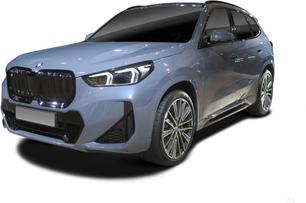
Arguably the prettiest new BMW SUV you can buy today, the well-proportioned iX1 is nearly impossible to spot over its almost-identical ICE (U11) X1 siblings.
Besides the badging, look for some blue trim bits and pieces inside and out, along with additional digital touchpoints inside.
And while both ride on the same all-new platform that’s resulted in a substantially larger body compared to previous X1 generations, the EV version seems a bit more slammed.
Dimensionally, the iX1 mirrors today’s X1 at 4500mm long and 1845mm wide, and still sits on the same 2692mm wheelbase, but is 26mm shorter at 1616mm tall and offers 35mm less ground clearance at 170mm.
Result? These plus a bunch of aero enhancements mean the slipperiest iX1 manages a Cd of just 0.26, according to BMW.
And, inevitably, the extra size equals more space inside.
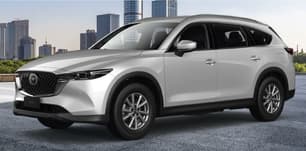
To be honest, I can't really tell the CX-8 and CX-9 apart on the road. They're both large SUVs that sport the classic Mazda bonnet - sharp and long. Up close, the CX-9 has a bulkier shape but otherwise they are remarkably similar.
The CX-8's darkened grille generates some interest with its lattice-work and there are enough shiny chrome accents scattered about the car that it looks pretty.
Yet, the sporty sharpness that Mazda is known for is still hinted at with its shaping and the 19-inch black alloy wheels.
Our model is finished in 'Platinum Quartz Metallic' and it is the highlight for the exterior styling for me. I think because it's such an interesting colour to look at - it varies a lot depending on lighting conditions. Sometimes, it almost has a sheen of pink to it and at others, it looks like pearly sand.
The interior looks polished and refined with its burgundy leather trim and soft-touchpoints. Again, there is a lot of chrome inside to make otherwise dull features, like air vents, pop out.
BMW also says the iX1’s cabin is almost as roomy in some ways as the larger X3.
Large doors allow for easy entry and egress, onto sumptuous front seats that provide exceptional comfort and support even on longer journeys.
Surrounded by an expansive feeling of space, the interior feels light and airy, as well as fresh, inviting and premium looking – something previous-gen X1s were rarely accused of being.
We’re talking on-brand stuff here, beginning with the excellent driving position, ahead of a crisp and attractive dash that’s pleasing to behold. Push-button starting and a small toggle lever operates the transmission.
An ever-so-slightly curved (towards the driver in the best-BMW old-school way) rectangular binnacle houses two digital displays – a 10.25-inch one ahead of the driver offering an array of configurable electronic dials, as well as a 10.7-inch multimedia touchscreen.
BMW pioneered the multimedia controller more than 20 years ago with iDrive, and this descendent of that system reveals all that expertise gained by being intuitive to operate and quick to respond to commands once familiarised. Which shouldn’t take too long.
It’s all very-EV centric, as the industry inexorably moves to total electrification, but there were a couple of voice-command errors in the iX1, revealing that such systems are still far from perfect. BMW does provide audio volume and climate hard buttons, thankfully, so the basics are looked after.
Speaking of which, the iX1 offers decent levels of vision out, superb ventilation and ample storage in the doors, on the dash and between the front seats. And, as we’ve noted previously in BMWs, the upright smartphone charger is a clever idea. Keeps it in position and is handy to glance at.
Out back, backrest comfort and support is A-OK, and even with the optional sunroof, our test iX1 provided sufficient space for taller bodies, while expected items like ventilation grilles, USB ports and cupholders are fitted.
Note that, though the 40/20/40-split backrests recline slightly, they do not slide as per in the ICE X1, as this is a desirable option.
Nor is the cargo capacity as good in the iX1, due to the inevitable space demanded by that rear-axle-mounted electric motor and battery pack. For the record, ranges from 490 litres to 1495L instead of 540-1527L. Plus, there’s no spare tyre, with just a tyre repair kit fitted.
These aside, the iX1’s spacious and inviting interior remains one of the compact SUV segment’s best.
The CX-8 is a very practical family hauler because there's ample room in all three rows. Yes, even adults will be able to squeeze into that third row without too many complaints!
All rows enjoy well-cushioned seats and up front they are electrically adjustable, but unfortunately, only the driver's side has lumbar support.
The middle row can slide forward manually or by using the electric button found on the side of the seats... but doing it yourself is way faster.
They do slide far enough forward that you won't embarrass yourself too much when you have to clamber into the third row. Where the seats have a 50/50 split-fold and manual adjustments (accessed via the boot).
In the first two rows there are lots of individual storage options but the front enjoys the most. The middle console is deep enough to be useful and I like the dual opening lid. Each row gets a couple of cupholders and drink bottle holders, too.
The charging options are great, with each row getting two USB-C ports and the front getting a wireless charging pad and 12-volt socket.
All of the controls and dials feel within easy reach and the 10.25-inch touchscreen multimedia system graphics are clear.
You can use it as a touchscreen or opt for the rotary dial but switching between the two was awkward for me. Especially, since the touchscreen function is disabled when you are using the wireless Apple CarPlay. This also has wired Android Auto, for those users.
The amenities are practical throughout with a dark headliner, three-zone climate control and heated outboard seats and retractable sun-blinds in the middle row.
Good news for families because there are five top-tether points across the back rows and ISOFIX child seat mounts on the outboard seats in middle row, in case you need them.
You can fit a 0-4 rearward facing child seat and it shouldn’t impact on front passenger comfort.
My six-year old found it super easy to get in and out of this car because of the 205mm ground clearance and wide door apertures. He enjoyed the high seating position, too, but was disappointed he couldn’t see out of the sunroof!
The boot space is a bit cramped with all three rows are in use at 209L but folding the third row opens up a more respectable 775L - perfect for the average family and its stuff!
The loading space is level, with the temporary spare tyre and clever storage compartments housed underneath. There is a retractable cargo blind and net, luggage anchor points and a 12-volt port, too.
And, as always, I love a powered tailgate, which this has!
For now, only a single iX1 grade is available, dubbed xDrive30, starting from $84,900 (all prices are before on-road costs).
Most buyers seem to be choosing the no-cost-extra racier 'M Sport' pack over the more-conservatively presented 'xLine'.
Both come complete with double-the-usual AC charging capability (22kW), twin-motor all-wheel drive, a 67kWh battery, variable-ratio steering and adaptive dampers as standard.
In contrast, the Mercedes EQB 350 4Matic equivalent starts from over $107,000 (though a less-expensive single-motor front-drive version comes in from nearly $89,000), and both with a slower 11kW charger. Genesis’ advanced GV60, meanwhile, kicks off from nearly $108K.
We cannot remember BMW ever going so hard on comparative value in Australia, though how it responds to the sensational (though admittedly smaller) Volvo EX30’s $59,990 ask remains to be seen.
Anyway, the iX1 is no bare-bones special.
Besides the aforementioned twin electric motors, AWD, 22kW AC charger and (non-driver-configurable) adaptive dampers, there are goodies like keyless entry/start, a digital key with ultra-wide-band tech, a 10.7-inch multimedia touchscreen, a digital instrumentation cluster, ‘Hey, BMW!’ voice control, a head-up display, sat-nav with augmented reality view, dual-zone climate control, ‘Veganza’ artificial leather, a reversing camera, digital radio, Apple CarPlay/Android Auto connectivity, wireless phone charging, a powered tailgate, roof rails and 19-inch alloy wheels.
On the safety front, you’ll find driver-assist tech like autonomous emergency braking (AEB), lane-support systems, adaptive cruise control, adaptive LED headlights and automatic parking assist. More on those in the safety section below.
Need more but want to think less? BMW’s new and simplified option packs bundles key features like a panoramic sunroof, metallic paint (normally $1500 on its own), Harman Kardon audio upgrade, lumbar massaging front seats and alternative interior trims in a reasonably-priced $4700 'Enhancement Pack'.
There are several others bundles available, too, as well as a handy 22kW BMW AC Wallbox from $1199, not including installation, that cuts down home-charging from over 33 hours using the regular mains to around 3.5 hours.
And don’t worry, BMW diehards. You can still spend tens of thousands of dollars more via the company’s endlessly extensive options list. The Germans aren’t foolish.
Unlike in the iX3’s Hyundai, Kia or Genesis rivals, which use a pure EV skateboard platform and offer no internal combustion engine (ICE) alternatives on this architecture, there is no V2L Vehicle-to-Load capability. In other words, you cannot charge appliances or power your home in an electrical blackout scenario.
The GT SP diesel AWD is one of the premium models, sitting third from the top and will cost you $65,560, before on road costs.
However, its price tag positions it as the most expensive compared to its rivals. With the closest rival being the Kluger at $65,310 and the most affordable being the Santa Fe at $60,000.
You do get a stylish-looking package with lots of features for your cash, like heated front seats, heated rear outboard seats, a tilt and slide sunroof, and premium leather interior trim.
There's some great tech scattered throughout, too, like the 10.25-inch touchscreen multimedia system, wireless charging pad, USB-A ports in the third row, Bose Premium sound system with 10 speakers, wireless Apple CarPlay and wired Android Auto.