What's the difference?
Anybody who doubts that Hyundai is gunning for the number one in the world has rocks in their head. Big heavy ones. Korean companies do not settle for anything less than number one. The second-generation Genesis (our first taste here in the Antipodes as the gen-one had its steering wheel on the wrong side) is proof.
What's different about Hyundai's unstoppable rise is the way they're going about it. They've always done their own thing in Korea, reinventing themselves time and again when they strayed off the beaten path.
The Genesis is a gamble for a Korean company in foreign markets whose default setting for luxury is marked, Britain or Germany. If Hyundai gets the Genesis wrong there will be howls of derision, or at best patronising pats on the back - "Nice try, you'll get there one day". But if they get it right...
If Holden had a dollar for every time someone had criticised the new and international flavour of Australia’s formerly home-grown hero, it would surely have more than enough spare cash to blow the dust of that vast South Australian factory and restart local Commodore production immediately.
Hell, there’d probably be enough left over to relaunch the Camira while they were at it. And maybe even knock out a new Gemini or two.
So we’re not going to do that again here. The all-new Commodore, in this case the Calais Tourer, is now here - granted having travelled further than the one it replaces - and so we’ll be playing this review with the straightest of bats.
Because the truth is, if you peel the badging - and thus the swirling emotion - off its elongated rump, then you’ll find this German-built Tourer is, really and truly, a very good thing.
The Genesis is not quite a match for cars twice its price but it makes you think what's possible. It doesn't have the dynamic brilliance of a BMW or the self-assured faultless execution of a Mercedes. Lexus ought to be worried, though - why would you have an LS when you could have this? The only answer is 'badge'.
The Genesis is an epoch-making car for the Korean manufacturer. As the company has got better, there are fewer excuses for overlooking it. While the Genesis is pitched into a shrinking market, it's not really meant for the average i30 buyer to buy, but to see.
It's bristling with tech and is not only a halo car but a shot across the bows of both Lexus and the Germans. Attached to that shot is a note: "We're coming for you." In other words, Hyundai got it right.
A best-of-both-worlds option that should have us questioning our SUV obsession, the Calais Tourer delivers plenty of practicality perks and a higher ride height in a dynamic and car-like package. The equipment levels are spot on, including the comprehensive safety package, and it you act smartly, you'll get a hugely long warranty to boot.
It sure is thirsty, though, and we can't help but think plenty of owners would be happier with a smaller, more-efficient engine.
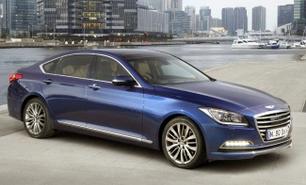
The Genesis is like no other Hyundai. For a start, it's gigantic - it looks easily as big as a BMW 7 Series (it isn't) with the road presence to match. There's a lot of BMW from most directions, but with a sharper approach to the creasing and character of the sheet metal.
Towards the rear it's more BMW 6 Series Gran Coupe and is all the better for it. The style is understated and technocratic.
Inside is also very Germanic, but with a bit more of a Lexus feel
The big wheels from the Ultimate pack help make it look lower and sleeker, too.
Inside is also very Germanic, but with a bit more of a Lexus feel. Our car had the lighter leather which meant that the wood and the metal materials didn't necessarily work well together.
The interior is expertly put together and feels like it will last forever.
The only jarring moment is the gear selector is shared with our long-term Hyundai i30 - it looked a bit cheap in what is otherwise a beautifully executed cabin - it needs more heft.
On Australian-delivered cars there is just one Hyundai badge, sitting proudly on the boot - you get the feeling this was debated long and hard and when the decision was made to go for it, a big one was chosen.
However, the winged Genesis branding takes pride of place everywhere else. When you approach the car at night and the puddle lamps come on, the Genesis logo is projected on to the ground, crisp and clear.
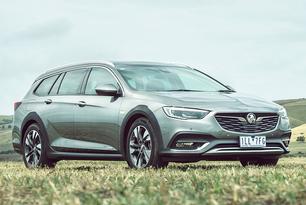
Less an SUV (happily), and more a high-riding wagon, the Calais Tourer borrows a little from the Subaru XV in its exterior design, sporting the same plastic cladding over each wheel arch. Clearly there is a whole heap of shared DNA between the Sportwagon and Tourer, and so it offers similar perks; like its SUV-shaming boot space.
Elsewhere, the Tourer shares the same soft and rounded edges as the rest of the Commodore range, and while it is genuinely quite handsome from most angles, it is at its best viewed front on, where a simple front-end is bookmarked at each corner by a narrow headlight on top, and an encased fog light below. It’s all a touch understated, sure, but it looks sharp in the metal.
Inside, it’s a clean and functional cabin design, with most of the touchscreen functions controlled by a simple row of four horizontal buttons, and with a gloss-black surround encasing the centre console. The thin leather wheel feels lovely under the touch, and the contrasting door trims and soft-touch materials find their way into the backseat, too.
The only way to describe the Genesis' pricing is aggressive - kicking off at $60,000, it's the most expensive Hyundai money can buy, but with a spec list like this, you won't feel at all short-changed.
Your sixty large buys you a huge cabin with a seventeen speaker stereo, auto headlights and wipers, LED ambient lighting inside and out, dual-zone climate control, keyless entry and start, powered front seats which are heated and cooled, satnav, front and rear parking sensors, and plenty of other bits and pieces.
Our car had the $22,000 Ultimate package, adding 19-inch alloys, blind spot sensor, front and side cameras, around-view display, real leather, more adjustments for the driver's seat, ventilated seats in the front, heated rear seats, panoramic glass sunroof, acoustic glass, heads-up display, powered bootlid and LED foglamps.
The Genesis is like no other Hyundai
You can have a lot of the more useful features in the $11,000 Sensory Pack. It's a good middle ground that, for example, features the excellent heads-up display.
The 9.2-inch screen splits the asymmetric air-conditioning vents. The software is unique to the Genesis and a huge leap forward over the rest of the Hyundai range - classy, smooth graphics, a good responsive screen.
You control the seventeen speaker stereo from here, which kicks out a rich sound and an impressive Bluetooth performance - rear seat passengers can also run the stereo from their armrest. The satnav is detailed and chatty, while the excellent heads-up display shows a configurable information set in strong, clear graphics.
The Calais has long formed the most luxurious rung of the Commodore ladder, and the wagon-ish Tourer is without doubt the most practical version. It will set you back $45,990 ($47,990 drive-away) in the guise we’ve tested here, and $53,990 In Calais V specification.
Not to be sneezed at, then. But it does arrive with plenty of stuff to help justify your investment.
Outside, you’ll find 18-inch alloys, a handsfree auto-opening boot, heated mirrors, keyless entry with push-button start, a remote start function, rain-sensing wipers and automatic headlights with LED DRLs. Inside, expect leather seats that are heated in the front, a leather-wrapped wheel, dual-zone climate control, standard satellite navigation and a wireless charging pad for compatible phones.
On the technology front, an 8.0-inch touchscreen pairs with an eight-speaker stereo, and it’s both Apple CarPlay and Android Auto equipped. There’s also a genuinely impressive standard safety package, too, but we’ll drill down on that under the Safety sub-heading.
The Genesis is powered by Hyundai's own 3.8-litre V6 developing 232kW and 397Nm, mated to Hyundai's eight-speed automatic transmission.
Despite weighing just under two tonnes, the Genesis completes the dash to 100km/h in 6.5 seconds.
It has a claimed 11.2L/100km on the combined cycle. In what must be a first, we got below that, averaging 10.8L/100km over two weeks. And that's without stop-start fuel-saving to blunt the effect of lot of city driving.
The Genesis is not going to tempt you into a track day, even with rear wheel drive
We'd still like to try the V8 - only available in left-hand drive markets - though.
A really rather good 3.6-litre V6 engine Is parked under the bonnet, feeding 235kW at 6800rpm and 381Nm at 5200rpm to all four wheels as required, thanks to an on-demand all-wheel-drive system. The suspension is tuned specifically for its high-riding antics, too.
The grunt is fed through a nine-speed automatic, and while Holden doesn’t quote a specific zero-to-100km/h time, it’s no slouch from the lights.
The 3.6-litre engine means a braked towing capacity of 2100kg, and an unbraked max of 750kg.
At five metres long, with a ride firmly pitched in the luxury camp, the Genesis is not going to tempt you into a track day, even with rear wheel drive.
Blindfold your passengers and swap them between a Lexus, a BMW and a Genesis and the overwhelming impression they'll get is one of incredible smoothness.
If you're wanting sudden movements, this isn't the car for you
Sitting in the back of the Genesis, it's easily as good as the German and luxury Japanese competition. The seats are hugely comfortable, there's ample head, leg and shoulder room and it feels lot nicer than anything within a bull's roar of its price.
No matter where you sit, it's an incredibly quiet car. The engine is a distant whoosh, the tyre noise muted and there's almost no wind or ambient noise. It's supremely comfortable and the excellent stereo will wash away what little noise does invade.
It certainly feels its weight from the driver's seat, with a competent, soft turn-in, but if you're wanting sudden movements, this isn't the car for you.
The Genesis is an epoch-making car for the Korean manufacturer
On fast flowing roads you can have some fun, but things will get floaty and that will quickly kill that fun. The ride and isolation from the rest of the world is completely worth it.
Really very good. That 3.6-litre engine (why they haven’t offered the Tourer with the smaller and smarter turbo engine is something of a mystery) might be a touch old-school and a touch thirsty, but it’s a rich and powerful thing, and it gives the Calais-stamped Tourer a perky personality that defies its dimensions.
The Calais Tourer was built in Germany, and fitted with an engine and transmission from the USA, before undergoing local tuning here in Australia (think bespoke steering and suspension tunes calibrated both at the company’s testing facility and after a 200,000km test on Aussie roads), and it’s the last of those Dr Frankenstein ingredients that have had the biggest impact here.
The Tourer’s ride is fantastic, perfectly poised between firm composure and everyday comfort, and - like most good wagons - it will honestly leave you wondering why so many people are clamouring aboard the SUV train when you can all the space with better dynamics in a humble estate.
The nine-speed ‘box is smooth and sharp in its operation, too. But the fuel use is a concern. Sure, we spent the bulk of our time in the city, where stop-start traffic naturally uses more fuel. But then, surely so would most owners?
Nine airbags, traction and stability control, lane departure warning, forward collision control, ABS, brake force assist and distribution and traction and stability control bring the ANCAP count to five stars.
The Sensory and Ultimate packs add blind spot sensors and around view cameras.
You’ve got to hand it to the Lion for the standard safety package here, which includes the Holden Eye camera system as standard, adding auto emergency braking (AEB), lane keep assist, lane departure warning and forward collision warning. You’ll also find semi-autonomous parking, a reversing camera and rear parking sensors.
The Calais Tourer adds blind-sport monitoring and rear cross-traffic alert to that pretty comprehensive package. All of which helps the Commodore range qualify for the maximum five-star ANCAP safety rating.
Finally, you can add six airbags and two ISOFIX attachment points to the mix.