What's the difference?
Anybody who doubts that Hyundai is gunning for the number one in the world has rocks in their head. Big heavy ones. Korean companies do not settle for anything less than number one. The second-generation Genesis (our first taste here in the Antipodes as the gen-one had its steering wheel on the wrong side) is proof.
What's different about Hyundai's unstoppable rise is the way they're going about it. They've always done their own thing in Korea, reinventing themselves time and again when they strayed off the beaten path.
The Genesis is a gamble for a Korean company in foreign markets whose default setting for luxury is marked, Britain or Germany. If Hyundai gets the Genesis wrong there will be howls of derision, or at best patronising pats on the back - "Nice try, you'll get there one day". But if they get it right...
A wagon and not an SUV, eh? Respect. You see, when most people now think of a new car they think of an SUV, especially when they want something with a bit of cargo space. But not you.
And for thinking outside the box you’ll be rewarded with something that’s better to drive than most SUVs – like the Hyundai i40 Tourer in the Active grade and a diesel engine we’ve road tested here.
So, what are the strengths and weaknesses of this Korean wagon, and should you wait or buy it now? Read on to find out.
The Genesis is not quite a match for cars twice its price but it makes you think what's possible. It doesn't have the dynamic brilliance of a BMW or the self-assured faultless execution of a Mercedes. Lexus ought to be worried, though - why would you have an LS when you could have this? The only answer is 'badge'.
The Genesis is an epoch-making car for the Korean manufacturer. As the company has got better, there are fewer excuses for overlooking it. While the Genesis is pitched into a shrinking market, it's not really meant for the average i30 buyer to buy, but to see.
It's bristling with tech and is not only a halo car but a shot across the bows of both Lexus and the Germans. Attached to that shot is a note: "We're coming for you." In other words, Hyundai got it right.
The i40 Tourer in the Active grade is great to drive, it’s practical, and should be low-cost to run. But you can bet the new version, due to arrive soon, will be, too. If you can wait, it's a safe bet the new i40 Tourer will have an updated look, improved safety equipment and retain all the good points of the previous model.
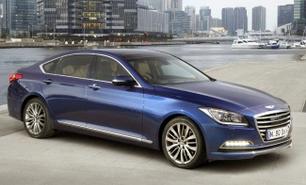
The Genesis is like no other Hyundai. For a start, it's gigantic - it looks easily as big as a BMW 7 Series (it isn't) with the road presence to match. There's a lot of BMW from most directions, but with a sharper approach to the creasing and character of the sheet metal.
Towards the rear it's more BMW 6 Series Gran Coupe and is all the better for it. The style is understated and technocratic.
Inside is also very Germanic, but with a bit more of a Lexus feel
The big wheels from the Ultimate pack help make it look lower and sleeker, too.
Inside is also very Germanic, but with a bit more of a Lexus feel. Our car had the lighter leather which meant that the wood and the metal materials didn't necessarily work well together.
The interior is expertly put together and feels like it will last forever.
The only jarring moment is the gear selector is shared with our long-term Hyundai i30 - it looked a bit cheap in what is otherwise a beautifully executed cabin - it needs more heft.
On Australian-delivered cars there is just one Hyundai badge, sitting proudly on the boot - you get the feeling this was debated long and hard and when the decision was made to go for it, a big one was chosen.
However, the winged Genesis branding takes pride of place everywhere else. When you approach the car at night and the puddle lamps come on, the Genesis logo is projected on to the ground, crisp and clear.
The i40 wagon looks good, I even caught myself doing that admiring 'look back' thing you do when you walk away from your car. Thing is, the current i40 has the ‘old’ Hyundai styling that dates it compared to the new i30, Sonata and Kona, which reflect the brand’s latest look.
This brings me to something you should really know – the newer, updated i40 will arrive in Australia soon, and it will be more in line with Hyundai’s current design approach.
The i40 is also up against some hot-looking rivals. The Mondeo is gorgeous, the Passat is stately, and the Commodore also looks stunning. To be honest the i40 is the least attractive of that lot form where I’m looking. It’s also about the same size as that trio at 4775mm long, 1815mm wide and 1470mm in height.
My mum would call the interior of the i40 Active smart looking, but she doesn’t mean tech-smart, more school dance smart, and if she ever said that before you went to a school dance you’d get changed immediately.
Yes, it looks smart in a tidy, stylish way, but that tiny screen, cloth seats and ordinary plastics lower the tone compared to the Premium's more 'premium' interior.
The only way to describe the Genesis' pricing is aggressive - kicking off at $60,000, it's the most expensive Hyundai money can buy, but with a spec list like this, you won't feel at all short-changed.
Your sixty large buys you a huge cabin with a seventeen speaker stereo, auto headlights and wipers, LED ambient lighting inside and out, dual-zone climate control, keyless entry and start, powered front seats which are heated and cooled, satnav, front and rear parking sensors, and plenty of other bits and pieces.
Our car had the $22,000 Ultimate package, adding 19-inch alloys, blind spot sensor, front and side cameras, around-view display, real leather, more adjustments for the driver's seat, ventilated seats in the front, heated rear seats, panoramic glass sunroof, acoustic glass, heads-up display, powered bootlid and LED foglamps.
The Genesis is like no other Hyundai
You can have a lot of the more useful features in the $11,000 Sensory Pack. It's a good middle ground that, for example, features the excellent heads-up display.
The 9.2-inch screen splits the asymmetric air-conditioning vents. The software is unique to the Genesis and a huge leap forward over the rest of the Hyundai range - classy, smooth graphics, a good responsive screen.
You control the seventeen speaker stereo from here, which kicks out a rich sound and an impressive Bluetooth performance - rear seat passengers can also run the stereo from their armrest. The satnav is detailed and chatty, while the excellent heads-up display shows a configurable information set in strong, clear graphics.
There are only two grades in the i40 range - 'Active' and 'Premium'. And when it comes to engines you again have two choices - petrol or diesel. The latter adding $2600 to the price.
If you’re looking for the most affordable way into an i40 wagon go for the Active. Listing at a base price of $35,690, 'our' i40 Active Tourer diesel had one option – 'Ocean View' metallic paint, adding an extra $595.
The Active grade costs $9160 less than Premium, and as much as I’d like to say that top-spec car is pretty much the same, with some shiny bits of door trim added, I’d be lying.
The Active really does miss out on some decent stuff – the screen is the smallest I’ve seen since I wore a digital watch, at 4.3-inch (the Premium has a 7.0-inch), there’s air-con but not climate control, there’s keyless entry but not a proximity key or push button start.
The Active doesn’t get a power tailgate with a handsfree function like the Premium, or tinted rear glass, or a digital speedo, or a panoramic sunroof, or a power adjustable driver’s seat, or heated seats, all of which are standard on the Premium grade.
Yup, the Active may be as base grade as you can get but it still comes with paddles shifters, LED daytime running lights, an electric handbrake with auto hold function, front and rear parking sensors, cloth seats and 16-inch alloy wheels.
A list price nudging $36K may seem high, but don’t’ forget you’re paying more for the diesel engine. There’s good reason to spend the extra on the diesel, too – which I’ll explain below.
The i40 Active Tourer diesel undercuts the $39,040 Ford Mondeo Ambiente diesel wagon, while the Volkswagen Passat 140TDI wagon only comes in the mid-spec Highline grade for $49,990 (and is a bit ‘next level’ by comparison), while the Mazda6 wagon in Touring spec with diesel engine is $41,440.
Other rivals? Yes, the new Holden Commodore Sportwagon diesel is $38,890. So, compared to its rivals the i40 Active Tourer is a bit of a bargain.
The Genesis is powered by Hyundai's own 3.8-litre V6 developing 232kW and 397Nm, mated to Hyundai's eight-speed automatic transmission.
Despite weighing just under two tonnes, the Genesis completes the dash to 100km/h in 6.5 seconds.
It has a claimed 11.2L/100km on the combined cycle. In what must be a first, we got below that, averaging 10.8L/100km over two weeks. And that's without stop-start fuel-saving to blunt the effect of lot of city driving.
The Genesis is not going to tempt you into a track day, even with rear wheel drive
We'd still like to try the V8 - only available in left-hand drive markets - though.
This is another area in which our test car impressed with its 1.7-litre four-cylinder turbo-diesel and seven-speed dual clutch auto transmission.
At 104kW, it may be less powerful than the petrol (121kW) but its 340Nm of torque gave it the shove to accelerate impressively from 1750rpm (idle is 800rpm).
The engine and dual-clutch combination performs beautifully; smooth even at low speed in traffic, and shifting down intuitively to make best use of engine braking.
At five metres long, with a ride firmly pitched in the luxury camp, the Genesis is not going to tempt you into a track day, even with rear wheel drive.
Blindfold your passengers and swap them between a Lexus, a BMW and a Genesis and the overwhelming impression they'll get is one of incredible smoothness.
If you're wanting sudden movements, this isn't the car for you
Sitting in the back of the Genesis, it's easily as good as the German and luxury Japanese competition. The seats are hugely comfortable, there's ample head, leg and shoulder room and it feels lot nicer than anything within a bull's roar of its price.
No matter where you sit, it's an incredibly quiet car. The engine is a distant whoosh, the tyre noise muted and there's almost no wind or ambient noise. It's supremely comfortable and the excellent stereo will wash away what little noise does invade.
It certainly feels its weight from the driver's seat, with a competent, soft turn-in, but if you're wanting sudden movements, this isn't the car for you.
The Genesis is an epoch-making car for the Korean manufacturer
On fast flowing roads you can have some fun, but things will get floaty and that will quickly kill that fun. The ride and isolation from the rest of the world is completely worth it.
A comfortable ride, impressive handling for the class, and a great engine and transmission mean the i40 Active Tourer diesel is engaging and enjoyable to drive.
The driving position is excellent, the seats are large but supportive, and the pedal feel is spot on. The i40 Tourer is way better to drive than it needs to be and would embarrass some cars from more prestigious brands.
It’s not all perfect: the cabin could be better insulated with wind noise obvious at 90km/h and tyre rumble intruding on course chip roads; visibility is hampered by those slanted A-pillars and the reversing camera image is next to useless thanks to the business card-sized screen in the Active.
Nine airbags, traction and stability control, lane departure warning, forward collision control, ABS, brake force assist and distribution and traction and stability control bring the ANCAP count to five stars.
The Sensory and Ultimate packs add blind spot sensors and around view cameras.
Hyundai’s website says the i40 Tourer scores the maximum five-star ANCAP rating. That’s true, but a bit sneaky because that ranking was given to the car back in 2013, and a lot has changed in terms of safety equipment in five years.
AEB, for example, is becoming common. So is rear cross traffic alert and blind spot warning, along with adaptive cruise control. You can’t get any of this advanced safety equipment on the current i40, not even the top-spec Premium.
Don’t get me wrong, the i40 is extremely safe with its suite of airbags, plus traction and stability controls - it’s just that the bar for safety has been raised higher.
The new i40 is expected to come armed with more up-to-date safety equipment.
If you’re fitting child seats you’ll find two ISOFIX mounts and three top tether anchor points across the rear row. It’s great to see a full-sized spare wheel under the boot floor, too.