What's the difference?
Anybody who doubts that Hyundai is gunning for the number one in the world has rocks in their head. Big heavy ones. Korean companies do not settle for anything less than number one. The second-generation Genesis (our first taste here in the Antipodes as the gen-one had its steering wheel on the wrong side) is proof.
What's different about Hyundai's unstoppable rise is the way they're going about it. They've always done their own thing in Korea, reinventing themselves time and again when they strayed off the beaten path.
The Genesis is a gamble for a Korean company in foreign markets whose default setting for luxury is marked, Britain or Germany. If Hyundai gets the Genesis wrong there will be howls of derision, or at best patronising pats on the back - "Nice try, you'll get there one day". But if they get it right...
Feels like lately all the Mercedes-AMG buzz has been at the smaller end of the scale.
Most recently, the screaming GLA 45 S has arrived in Australia, pumping out more kilowatts and newton-metres than any compact SUV has a right to.
But here, we're doubling the cylinder count to eight, arranging them in a vee, and lighting the wick on AMG's powerhouse mid-size sedan, the recently upgraded E 63 S.
While the ferocious twin-turbo V8 and the rest of this beast's powertrain are unchanged, the car has been brought up to speed with some aero-focused styling tweaks, Merc's latest 'Widescreen' digital cockpit, as well as the MBUX multimedia system, and a tricky new multi-function sports steering wheel.
The Genesis is not quite a match for cars twice its price but it makes you think what's possible. It doesn't have the dynamic brilliance of a BMW or the self-assured faultless execution of a Mercedes. Lexus ought to be worried, though - why would you have an LS when you could have this? The only answer is 'badge'.
The Genesis is an epoch-making car for the Korean manufacturer. As the company has got better, there are fewer excuses for overlooking it. While the Genesis is pitched into a shrinking market, it's not really meant for the average i30 buyer to buy, but to see.
It's bristling with tech and is not only a halo car but a shot across the bows of both Lexus and the Germans. Attached to that shot is a note: "We're coming for you." In other words, Hyundai got it right.
The E 63 S fills its niche in AMG's Australian line-up perfectly. More mature than the brand's four-cylinder hatches and SUVs, but not as overbearing as some of its bigger sedan, GT and SUV stablemates. And its ability to seamlessly switch between serene comfort and dynamic performance has nailed the objective for this 2021 update.
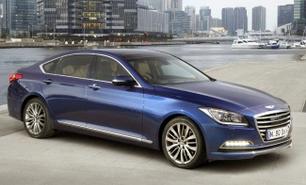
The Genesis is like no other Hyundai. For a start, it's gigantic - it looks easily as big as a BMW 7 Series (it isn't) with the road presence to match. There's a lot of BMW from most directions, but with a sharper approach to the creasing and character of the sheet metal.
Towards the rear it's more BMW 6 Series Gran Coupe and is all the better for it. The style is understated and technocratic.
Inside is also very Germanic, but with a bit more of a Lexus feel
The big wheels from the Ultimate pack help make it look lower and sleeker, too.
Inside is also very Germanic, but with a bit more of a Lexus feel. Our car had the lighter leather which meant that the wood and the metal materials didn't necessarily work well together.
The interior is expertly put together and feels like it will last forever.
The only jarring moment is the gear selector is shared with our long-term Hyundai i30 - it looked a bit cheap in what is otherwise a beautifully executed cabin - it needs more heft.
On Australian-delivered cars there is just one Hyundai badge, sitting proudly on the boot - you get the feeling this was debated long and hard and when the decision was made to go for it, a big one was chosen.
However, the winged Genesis branding takes pride of place everywhere else. When you approach the car at night and the puddle lamps come on, the Genesis logo is projected on to the ground, crisp and clear.
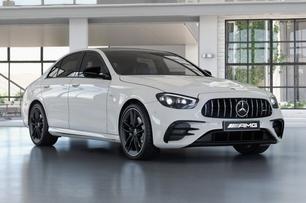
The E 63 S has been massaged for 2021 starting with flatter headlights, AMG's now signature 'Panamericana' grille, and a high gloss black flap across the top of the curved 'Jet Wing' section defining the lower part of the nose.
At the same time, the vents on either end of it are larger and feature twin transverse louvers to guide cooling air to wherever it's needed.
It's all about what AMG calls 'optimised aerobalance' but the form is just as appealing as the function. The characteristic 'Power Domes' in the bonnet dial up the muscle, as do the fat wheel arches (+27mm each side), and 20-inch rims with distinctive aero inserts.
This car's optional exterior carbon package consists of a front splitter, side sills, a flash near the fender badges, the exterior mirror covers, the boot lid lip spoiler, as well as the lower apron around the redesigned diffuser and quad tailpipes.
New, intricately styled LED tail-lights are also flatter, but there's even more going on inside.
A new AMG sports steering wheel features three rounded twin-spokes with new switches on the bottom to control the car's dynamic set-up.
It also picks up a new take on the small touch-sensitive controllers used to adjust the instrumentation and manage other functions like phone calls, audio and the cruise control.
Not sure I'm in love with them at this stage. In fact, the words fiddly, imprecise, and frustrating come to mind.
Nappa leather covering the superb AMG sports seats, upper dash, and door beltlines remains standard, but the show-stopper is the 'Widescreen Cockpit' - twin 12.25-inch digital screens for the MBUX multimedia interface on the left and instruments on the right.
The instrument cluster can be set to 'Modern Classic', 'Sport' and 'Supersport' displays, with specific AMG read-outs such as engine data, gear speed indicator, warm-up status, car set-up, as well as a G-meter and 'RaceTimer.'
To borrow an official automotive design term, it looks schmick. Overall, with touches like open-pore black ash wood trim, and brushed metal highlights, the interior looks efficient but classy, with an obvious attention to detail in the layout and its execution.
The only way to describe the Genesis' pricing is aggressive - kicking off at $60,000, it's the most expensive Hyundai money can buy, but with a spec list like this, you won't feel at all short-changed.
Your sixty large buys you a huge cabin with a seventeen speaker stereo, auto headlights and wipers, LED ambient lighting inside and out, dual-zone climate control, keyless entry and start, powered front seats which are heated and cooled, satnav, front and rear parking sensors, and plenty of other bits and pieces.
Our car had the $22,000 Ultimate package, adding 19-inch alloys, blind spot sensor, front and side cameras, around-view display, real leather, more adjustments for the driver's seat, ventilated seats in the front, heated rear seats, panoramic glass sunroof, acoustic glass, heads-up display, powered bootlid and LED foglamps.
The Genesis is like no other Hyundai
You can have a lot of the more useful features in the $11,000 Sensory Pack. It's a good middle ground that, for example, features the excellent heads-up display.
The 9.2-inch screen splits the asymmetric air-conditioning vents. The software is unique to the Genesis and a huge leap forward over the rest of the Hyundai range - classy, smooth graphics, a good responsive screen.
You control the seventeen speaker stereo from here, which kicks out a rich sound and an impressive Bluetooth performance - rear seat passengers can also run the stereo from their armrest. The satnav is detailed and chatty, while the excellent heads-up display shows a configurable information set in strong, clear graphics.
So, first of all, let's get the price out of the way. At $253,900, before on-road costs, this car's competitive set is a bruising, all-German trio comprising the Audi RS 7 Sportback ($224,000), BMW M5 Competition ($244,900), and Porsche Panamera GTS ($309,500).
And no surprise, it's loaded with all the luxury features you'd expect in this part of the market. Here are the highlights.
On top of the standard performance tech and safety equipment fitted to the E 63 S (covered later in this review), you'll also find: Nappa leather trim (seats, upper dash, upper door cards, and steering wheel), MBUX multimedia (with touchscreen, touchpad, and 'Hey Mercedes' voice control), 20-inch alloys, three-zone climate-control, interior ambient lighting, auto LED headlights (with 'Active High Beam Assist Plus'), eight “energising comfort programs” (with 'Energising Coach'), an 'Active Multicontour' front seat package, the 'Air Balance' package (including ionisation), and keyless entry and start.
Also included are the the 'Widescreen' digital cockpit (twin 12.25-inch digital screens), 13-speaker Burmester audio with digital radio, Apple CarPlay and Android Auto, a panoramic sunroof, adaptive cruise control, a head-up display, augmented reality satellite navigation, 'Parktronic' self-parking, electric front seats, seat cooling and heating front (heated rear), heated front centre armrest, a power-adjustable steering column, auto rain-sensing wipers, a wireless device charger, illuminated door sills, as well Amazon Alexa, etc, etc, etc.
And our test car also featured a couple of tasty options. An exterior carbon package ($7500), and AMG's professional grade ceramic composite brakes ($15,900), for an as-tested price of $277,300.
The Genesis is powered by Hyundai's own 3.8-litre V6 developing 232kW and 397Nm, mated to Hyundai's eight-speed automatic transmission.
Despite weighing just under two tonnes, the Genesis completes the dash to 100km/h in 6.5 seconds.
It has a claimed 11.2L/100km on the combined cycle. In what must be a first, we got below that, averaging 10.8L/100km over two weeks. And that's without stop-start fuel-saving to blunt the effect of lot of city driving.
The Genesis is not going to tempt you into a track day, even with rear wheel drive
We'd still like to try the V8 - only available in left-hand drive markets - though.
The E 63 S is powered by the M178 version of the all-alloy 4.0-litre twin-turbo V8 engine used across numerous AMG models from the C-Class up.
Thanks in no small part to direct injection and a pair of twin-scroll turbos (located in the engine's 'hot vee' to optimise throttle response), this all-alloy unit produces 450kW (that's 612hp) from 5750-6500rpm, and 850Nm from 2500-4500rpm.
And as per standard AMG practice for its Vee engines, this car's powerplant was built from scratch by a single engineer in Affalterbach. Thank you Robin Jäger.
AMG calls the nine-speed transmission used in the E 63 S an MCT, which stands for Multi-Clutch Technology. But it's not a dual-clutch, rather a normal auto transmission using a wet clutch as opposed to a conventional torque converter, to connect it to the engine on take-off.
Drive goes to all four wheels via Merc's '4Matic+' AWD system, built around an electromechanically controlled clutch connecting the permanently driven rear axle (with locking diff) variably to the front axle.
At five metres long, with a ride firmly pitched in the luxury camp, the Genesis is not going to tempt you into a track day, even with rear wheel drive.
Blindfold your passengers and swap them between a Lexus, a BMW and a Genesis and the overwhelming impression they'll get is one of incredible smoothness.
If you're wanting sudden movements, this isn't the car for you
Sitting in the back of the Genesis, it's easily as good as the German and luxury Japanese competition. The seats are hugely comfortable, there's ample head, leg and shoulder room and it feels lot nicer than anything within a bull's roar of its price.
No matter where you sit, it's an incredibly quiet car. The engine is a distant whoosh, the tyre noise muted and there's almost no wind or ambient noise. It's supremely comfortable and the excellent stereo will wash away what little noise does invade.
It certainly feels its weight from the driver's seat, with a competent, soft turn-in, but if you're wanting sudden movements, this isn't the car for you.
The Genesis is an epoch-making car for the Korean manufacturer
On fast flowing roads you can have some fun, but things will get floaty and that will quickly kill that fun. The ride and isolation from the rest of the world is completely worth it.
AMG's major goal with this upgrade of the E 63 S was to maintain its dynamic response and ferocious performance, but dial in the extra comfort customers had said they wanted.
So, the 4Matic+ AWD system has been fine-tuned for more smoothness as has the Comfort option in the dynamic set-up. But we'll investigate that shortly.
First, that 4.0-litre turbo V8 in the nose is claimed to slingshot this roughly 2.0-tonne sedan from 0-100km/h in just 3.4 seconds, and it feels every bit that fast.
With 850Nm available from 2500-4500rpm and nine gear ratios to help keep you operating in that Goldilocks band, mid-range thrust is monumental. And thanks to the bi-modal sports exhaust it sounds beautifully brutal.
The nine-speed auto's wet clutch, as opposed to a conventional torque converter, is designed to save weight and optimise response. And while some will tell you an auto with one input shaft is never going to be as fast as a dual-clutch with two, shifts are rapid and direct. The wheel-mounted shift paddles are larger and set lower, as well.
The AMG 'Ride Control+' suspension with multi-chamber air suspension and adaptive damping is amazingly good. The underlying set-up is by multi-links front and rear, and despite riding on big 20-inch rims wrapped with low-profile, high-performance Pirelli P Zero rubber (265/35 fr - 295/30 rr) the Comfort setting is incredibly... comfortable.
Slip into 'Sport' or 'Sport+' and the car immediately feels tauter but far less compliant and forgiving. An impression reinforced by the engine, transmission, and steering shifting to a more buttoned-down mode at the same time.
The standard dynamic engine mounts play a big part here. Able to make a soft connection for maximum comfort, but switch to a rigid link when required.
But no matter which mode you're in, the car is well damped and feels beautifully balanced in quick cornering. And the E 63 S's electro-mechanically-assisted variable-rate steering is progressive, feelsome, and accurate.
The 4Matic+ AWD system is built around an electromechanically controlled clutch connecting the permanently driven rear axle (with locking diff) variably to the front axle.
Torque distribution happens imperceptibly, the big V8 putting its power down emphatically, with various electronic systems tieing up the loose ends as you aim up for the next corner.
There's even a 100 per cent RWD Drift mode available in the Race setting, but without a race circuit at our disposal this time around that'll have to wait for another time.
The optional ceramic brakes feature huge rotors and six-piston front calipers, and stopping power is immense. And the good news is they operate quickly but progressively at normal pottering around town speeds. No warming up required to get them in an optimal temperature zone (as can be the case with other ceramic set-ups).
Nine airbags, traction and stability control, lane departure warning, forward collision control, ABS, brake force assist and distribution and traction and stability control bring the ANCAP count to five stars.
The Sensory and Ultimate packs add blind spot sensors and around view cameras.
The three-pointed star's white-coated boffins have gone to town on the E 63 S, and the car is as good as it currently gets in terms of active and passive safety technology.
You could argue this car's dynamic ability is its strongest contributor to crash-avoidance. But a broad suite of features, specifically designed to keep you out of trouble includes, forward and reverse AEB (with pedestrian, cyclist, and cross-traffic detection), traffic sign recognition, 'Attention Assist', 'Active Blind Spot Assist', 'Active Distance Assist', 'Active High Beam Assist Plus', 'Active Lane Change Assist', 'Active Lane Keeping Assist', and 'Evasive Steering Assist.' That's a lot of assists.
There's also a tyre pressure monitoring and pressure loss warning system, as well as a brake priming function (monitors release speed on the accelerator pedal, moving pads factionally closer to the discs when required), and brake drying (when the windscreen wipers are active the system periodically applies just enough brake pressure to wipe water off the brake rotors to optimise wet weather efficiency).
But if an impact is unavoidable the 'Pre-Safe Plus' system is able to recognise an imminent rear-end collision and fire up the rear hazard lights (at high frequency) to warn following traffic. It will also firmly apply the brakes once the vehicle is stationary to minimise the risk of whiplash injuries if the car's then hit from behind.
If the potential crash is coming from the side, 'Pre-Safe Impulse' inflates air chambers in the side bolsters of the front seat backrest (within a fraction of a second) moving the occupant to the side towards the centre of the car, away from the impact area. Amazing.
As well as that, there's an active bonnet to minimise pedestrian injuries, an auto emergency call function, 'Crash Response Emergency Lighting', even a first aid kit and hi-vis vests for all occupants.
For the record, the current E-Class received a maximum five-star ANCAP assessment in 2016.