What's the difference?
Anybody who doubts that Hyundai is gunning for the number one in the world has rocks in their head. Big heavy ones. Korean companies do not settle for anything less than number one. The second-generation Genesis (our first taste here in the Antipodes as the gen-one had its steering wheel on the wrong side) is proof.
What's different about Hyundai's unstoppable rise is the way they're going about it. They've always done their own thing in Korea, reinventing themselves time and again when they strayed off the beaten path.
The Genesis is a gamble for a Korean company in foreign markets whose default setting for luxury is marked, Britain or Germany. If Hyundai gets the Genesis wrong there will be howls of derision, or at best patronising pats on the back - "Nice try, you'll get there one day". But if they get it right...
The Hyundai Sonata N Line is a sedan. Not a hatchback, not a fastback, nor a coupe and definitely not an SUV.
And even though only a handful of people in Australia buy the Sonata N Line each year it’s been updated with a completely different look and new technology, making it an outstanding car in many ways.
The thing is, because we’re obsessed with SUVs in Australia most people will never know how good this sedan is - unlike you.
So, let me congratulate you for making it this far. There’s probably so few of you I could possibly congratulate all of you in person. In an afternoon.
The big question is, though, is the Sonata N Line fit for Aussie families? Well, it scores well, but maybe not where it counts…
Let’s see what’s new and what the Sonata N Line can do.
The Genesis is not quite a match for cars twice its price but it makes you think what's possible. It doesn't have the dynamic brilliance of a BMW or the self-assured faultless execution of a Mercedes. Lexus ought to be worried, though - why would you have an LS when you could have this? The only answer is 'badge'.
The Genesis is an epoch-making car for the Korean manufacturer. As the company has got better, there are fewer excuses for overlooking it. While the Genesis is pitched into a shrinking market, it's not really meant for the average i30 buyer to buy, but to see.
It's bristling with tech and is not only a halo car but a shot across the bows of both Lexus and the Germans. Attached to that shot is a note: "We're coming for you." In other words, Hyundai got it right.
The updated Sonata N Line looks beautifully modern from its new face to the refreshed cockpit, while remaining a ‘driver’s car’ with good dynamics, and a sporty engine.
The Sonata isn’t an ideal family car, however. This is down to a lack of practicality. Although the cabin is fairly roomy, if that roofline wasn’t so coupe-like and cabin storage was better, and the boot had a large hatch opening, and the ride height was more elevated then it would be a great family car. Oh, I’ve just described an SUV.
Note: CarsGuide attended this event as a guest of the manufacturer, with meals provided.
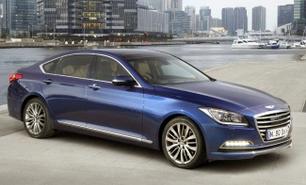
The Genesis is like no other Hyundai. For a start, it's gigantic - it looks easily as big as a BMW 7 Series (it isn't) with the road presence to match. There's a lot of BMW from most directions, but with a sharper approach to the creasing and character of the sheet metal.
Towards the rear it's more BMW 6 Series Gran Coupe and is all the better for it. The style is understated and technocratic.
Inside is also very Germanic, but with a bit more of a Lexus feel
The big wheels from the Ultimate pack help make it look lower and sleeker, too.
Inside is also very Germanic, but with a bit more of a Lexus feel. Our car had the lighter leather which meant that the wood and the metal materials didn't necessarily work well together.
The interior is expertly put together and feels like it will last forever.
The only jarring moment is the gear selector is shared with our long-term Hyundai i30 - it looked a bit cheap in what is otherwise a beautifully executed cabin - it needs more heft.
On Australian-delivered cars there is just one Hyundai badge, sitting proudly on the boot - you get the feeling this was debated long and hard and when the decision was made to go for it, a big one was chosen.
However, the winged Genesis branding takes pride of place everywhere else. When you approach the car at night and the puddle lamps come on, the Genesis logo is projected on to the ground, crisp and clear.
So, we’ve established that the Sonata N Line is a sedan and that means if you’re still reading this you are, a) A Sonata owner looking to trade the old one in for this new one, b) Driving another type of sedan such as a Toyota Camry or Volkswagen Passat and looking to update your trusty steed with one from Hyundai or c) Not in the market for an SUV.
Whatever the reason, sedans lend themselves to being sleek and sophisticated in their styling just by being lower to the ground than SUVs and generally longer than sports cars.
The Sonata N Line is long at 4.91m end-to-end. That’s only 8.0cm shorter than the gigantic Hyundai Palisade which has eight seats. I know… it bends the mind.
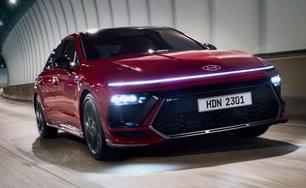
This new Sonata N Line looks even wider than the previous version, too, with that broad flat bonnet meeting the Seamless Horizon LED strip.
Fact is the Sonata N Line is 1.86m across - exactly the same as the previous version. Remind me never to wear a 'seamless horizon' T-shirt on days I’m feeling rotund.
If you look closely at the photos you can see the hidden LED headlights flanking the large, dark and low-set grille.
The rear of the new Sonata looks so different from the previous version, too, with its boot lid spoiler and LED tail-lights.
The menacing body kit comes with the N Line grade and accentuates the sporty nature of this car. It’s a good thing it has an engine to back up the looks, but more on that later.
Inside, the Sonata has been given the new 12.3-inch curved screens and a digital climate control display, while the steering wheel is new and adorned with the Hyundai 'Morse Code' badge (the letter H is four dots in Morse Code). It’s a premium and modern looking cockpit topped off with suede and leather leather N Line sports seats.
The only way to describe the Genesis' pricing is aggressive - kicking off at $60,000, it's the most expensive Hyundai money can buy, but with a spec list like this, you won't feel at all short-changed.
Your sixty large buys you a huge cabin with a seventeen speaker stereo, auto headlights and wipers, LED ambient lighting inside and out, dual-zone climate control, keyless entry and start, powered front seats which are heated and cooled, satnav, front and rear parking sensors, and plenty of other bits and pieces.
Our car had the $22,000 Ultimate package, adding 19-inch alloys, blind spot sensor, front and side cameras, around-view display, real leather, more adjustments for the driver's seat, ventilated seats in the front, heated rear seats, panoramic glass sunroof, acoustic glass, heads-up display, powered bootlid and LED foglamps.
The Genesis is like no other Hyundai
You can have a lot of the more useful features in the $11,000 Sensory Pack. It's a good middle ground that, for example, features the excellent heads-up display.
The 9.2-inch screen splits the asymmetric air-conditioning vents. The software is unique to the Genesis and a huge leap forward over the rest of the Hyundai range - classy, smooth graphics, a good responsive screen.
You control the seventeen speaker stereo from here, which kicks out a rich sound and an impressive Bluetooth performance - rear seat passengers can also run the stereo from their armrest. The satnav is detailed and chatty, while the excellent heads-up display shows a configurable information set in strong, clear graphics.
Hyundai offers one type of Sonata in Australia, so there’s not a lot of choice. Actually there’s no choice: it’s the petrol version of the Sonata in the sporty N Line grade or nothing.
But if I were to choose one Sonata this would be the one, even if at a list price of $55,500 it’s quite expensive and about $3500 more than the previous Sonata N Line.
In return for the almost $56K price you’re getting a lot of standard features, including a mountain of new equipment for this updated model.
So, new for this 2024 Sonata are dual 12.3-inch curved screens for media and driving instruments, the digital climate control display, there’s a column-mounted gear shifter, LED ambient lighting and a hands-free boot lid. That’s in addition to proximity unlocking, sat nav, Apple CarPlay and Android Auto and a 12-speaker Bose sound system.
There’s also suede and Nappa leather seats, a leather steering wheel, sunroof, dual-zone climate control, heated and ventilated front seats, a heated steering wheel, LED headlights and the LED strip which wraps around the front of the Sonata.
Hyundai calls it the 'Seamless Horizon', which sounds beautifully poetic and leads us nicely into the Design section of this review.
The Genesis is powered by Hyundai's own 3.8-litre V6 developing 232kW and 397Nm, mated to Hyundai's eight-speed automatic transmission.
Despite weighing just under two tonnes, the Genesis completes the dash to 100km/h in 6.5 seconds.
It has a claimed 11.2L/100km on the combined cycle. In what must be a first, we got below that, averaging 10.8L/100km over two weeks. And that's without stop-start fuel-saving to blunt the effect of lot of city driving.
The Genesis is not going to tempt you into a track day, even with rear wheel drive
We'd still like to try the V8 - only available in left-hand drive markets - though.
The Sonata N Line comes with a 2.5-litre turbo-petrol four-cylinder engine making 213kW and 422Nm, which is plenty of oomph, and it all goes to the front wheels through an eight-speed dual-clutch automatic transmission.
So no, there’s not a diesel version nor an all-wheel drive version, but this sporty engine suits the Sonata N Line perfectly.
That said a hybrid variant would be good seeing it’s 2023.
At five metres long, with a ride firmly pitched in the luxury camp, the Genesis is not going to tempt you into a track day, even with rear wheel drive.
Blindfold your passengers and swap them between a Lexus, a BMW and a Genesis and the overwhelming impression they'll get is one of incredible smoothness.
If you're wanting sudden movements, this isn't the car for you
Sitting in the back of the Genesis, it's easily as good as the German and luxury Japanese competition. The seats are hugely comfortable, there's ample head, leg and shoulder room and it feels lot nicer than anything within a bull's roar of its price.
No matter where you sit, it's an incredibly quiet car. The engine is a distant whoosh, the tyre noise muted and there's almost no wind or ambient noise. It's supremely comfortable and the excellent stereo will wash away what little noise does invade.
It certainly feels its weight from the driver's seat, with a competent, soft turn-in, but if you're wanting sudden movements, this isn't the car for you.
The Genesis is an epoch-making car for the Korean manufacturer
On fast flowing roads you can have some fun, but things will get floaty and that will quickly kill that fun. The ride and isolation from the rest of the world is completely worth it.
The Sonata N Line’s performance matches its sporty looks. That turbo-petrol engine is responsive and provides great acceleration, the transmission shifts fast and the steering is nicely weighted and accurate.
Add to this better rigidity in the car’s structure in this updated model and a feeling of stability thanks to this being a sedan with a low centre of mass and you have a dynamic and enjoyable vehicle in your hands.
Sure it doesn't have the sky-high visibility that comes from the pilot’s seat of an SUV, but the Sonata N Line is for those who like to drive but still want the practicality of four doors, back seats and a boot.
Nine airbags, traction and stability control, lane departure warning, forward collision control, ABS, brake force assist and distribution and traction and stability control bring the ANCAP count to five stars.
The Sensory and Ultimate packs add blind spot sensors and around view cameras.
The Sonata N Line hasn’t been tested by ANCAP, but it does have an extensive armoury of safety tech including AEB (which also works at intersections) able to detect pedestrians, cyclists, other cars and now motorbikes.
There’s blind spot warning which pulls you back into your lane and lane keeping assistance, plus rear cross-traffic alert with braking, as well.
A rear occupant alert will remind the driver there are passengers in the back seat and 'Safe Exit Assist' will protect children from opening the door into moving traffic.
Along with all this, which Hyundai bundles together in its 'Safety Sense' package as standard on the Sonata N Line, there are also side airbags protecting the rear passengers and plenty of airbags in the front for the driver and passenger.