What's the difference?
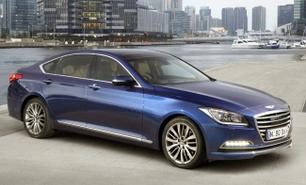
Anybody who doubts that Hyundai is gunning for the number one in the world has rocks in their head. Big heavy ones. Korean companies do not settle for anything less than number one. The second-generation Genesis (our first taste here in the Antipodes as the gen-one had its steering wheel on the wrong side) is proof.
What's different about Hyundai's unstoppable rise is the way they're going about it. They've always done their own thing in Korea, reinventing themselves time and again when they strayed off the beaten path.
The Genesis is a gamble for a Korean company in foreign markets whose default setting for luxury is marked, Britain or Germany. If Hyundai gets the Genesis wrong there will be howls of derision, or at best patronising pats on the back - "Nice try, you'll get there one day". But if they get it right...
Balancing luxury car comfort, hot hatch agility and supercar speed is no easy task, yet that is what made the six previous generations of BMW's M5 so iconic.
In seventh-generation ‘G90’ guise, the M5 has another skeleton in the cupboard: the toughest emissions regulations that Europe, and now Australia, have ever seen.
A twin-turbo V8 was untenable and going battery electric was not an option. Plug-in hybrid was the only answer. For the new M5, BMW combined a revised 4.4-litre ‘S68’ bent eight with a punchy electric motor for 535kW and 1000Nm.
Problem is, the G90 is widely acknowledged as one of the greatest BMW M cars of all time, especially in CS trim. And thanks to a circa-600kg weight hike to nearly 2500kg, the new M5's 0-100km/h claim is actually slower than the old 'F90' M5.
Doesn’t exactly sound like a big leap forward, does it?
A drive through the Central West of NSW and around the iconic Mount Panorama racing circuit gave us answers to two questions. Does the M5 work on Australia roads, and does BMW M's latest super-sedan represent progress?
The Genesis is not quite a match for cars twice its price but it makes you think what's possible. It doesn't have the dynamic brilliance of a BMW or the self-assured faultless execution of a Mercedes. Lexus ought to be worried, though - why would you have an LS when you could have this? The only answer is 'badge'.
The Genesis is an epoch-making car for the Korean manufacturer. As the company has got better, there are fewer excuses for overlooking it. While the Genesis is pitched into a shrinking market, it's not really meant for the average i30 buyer to buy, but to see.
It's bristling with tech and is not only a halo car but a shot across the bows of both Lexus and the Germans. Attached to that shot is a note: "We're coming for you." In other words, Hyundai got it right.
Let’s get one thing out of the way: the new M5 is a very good car. Considering the emissions limitations and size increase of its base model, it is an impressive bit of engineering.
What’s trickier is deciding whether the new car is really better to drive. Less edgy but supremely comfortable and quiet; BMW leaned into the daily usability of the plug-in hybrid M5 rather than amping the petrol-electric system for maximum thrills. And do you know what? That’s fine with me.
The new M5 still performs on road and track and does an incredible job of hiding its weight (most of the time). Perhaps the G90 is a little more Audi RS6 than F90 in its demeanour but some would argue that’s no bad thing.
The concept of the BMW M5 is not static, it evolves with the times, and the G90 is no exception. Expect future Competition and CS variants to unlock some extra lunacy.
Note: CarsGuide attended this event as a guest of the manufacturer, with meals provided.