What's the difference?
Anybody who doubts that Hyundai is gunning for the number one in the world has rocks in their head. Big heavy ones. Korean companies do not settle for anything less than number one. The second-generation Genesis (our first taste here in the Antipodes as the gen-one had its steering wheel on the wrong side) is proof.
What's different about Hyundai's unstoppable rise is the way they're going about it. They've always done their own thing in Korea, reinventing themselves time and again when they strayed off the beaten path.
The Genesis is a gamble for a Korean company in foreign markets whose default setting for luxury is marked, Britain or Germany. If Hyundai gets the Genesis wrong there will be howls of derision, or at best patronising pats on the back - "Nice try, you'll get there one day". But if they get it right...
There are plenty of reasons why you should still consider a mid-sized sedan like the Kia Optima. I’m sure there are… just let me think about this for a sec…
Okay, so this part of the market is dying. A decade ago, sedans like this were really popular, but now there are heaps of alternative options. Yep, people are going for mid-sized SUVs rather than mid-sized sedans like this.
But that doesn’t mean models like the just-updated 2018 Kia Optima are without their reasons for being. I’m just not sure the facelift has made it more appealing to look at…
The Genesis is not quite a match for cars twice its price but it makes you think what's possible. It doesn't have the dynamic brilliance of a BMW or the self-assured faultless execution of a Mercedes. Lexus ought to be worried, though - why would you have an LS when you could have this? The only answer is 'badge'.
The Genesis is an epoch-making car for the Korean manufacturer. As the company has got better, there are fewer excuses for overlooking it. While the Genesis is pitched into a shrinking market, it's not really meant for the average i30 buyer to buy, but to see.
It's bristling with tech and is not only a halo car but a shot across the bows of both Lexus and the Germans. Attached to that shot is a note: "We're coming for you." In other words, Hyundai got it right.
If you travel long distances, want a good amount of space and don’t want to pay big bucks for a new car, then yeah, maybe there is a reason sedans like this will hang around for a while longer.
Sure, the appeal of sedans mightn’t be as strong as it once was, but models like the Kia Optima prove they still have a reason to exist.
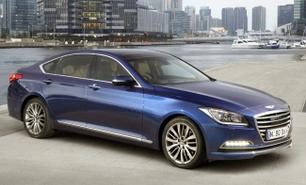
The Genesis is like no other Hyundai. For a start, it's gigantic - it looks easily as big as a BMW 7 Series (it isn't) with the road presence to match. There's a lot of BMW from most directions, but with a sharper approach to the creasing and character of the sheet metal.
Towards the rear it's more BMW 6 Series Gran Coupe and is all the better for it. The style is understated and technocratic.
Inside is also very Germanic, but with a bit more of a Lexus feel
The big wheels from the Ultimate pack help make it look lower and sleeker, too.
Inside is also very Germanic, but with a bit more of a Lexus feel. Our car had the lighter leather which meant that the wood and the metal materials didn't necessarily work well together.
The interior is expertly put together and feels like it will last forever.
The only jarring moment is the gear selector is shared with our long-term Hyundai i30 - it looked a bit cheap in what is otherwise a beautifully executed cabin - it needs more heft.
On Australian-delivered cars there is just one Hyundai badge, sitting proudly on the boot - you get the feeling this was debated long and hard and when the decision was made to go for it, a big one was chosen.
However, the winged Genesis branding takes pride of place everywhere else. When you approach the car at night and the puddle lamps come on, the Genesis logo is projected on to the ground, crisp and clear.
Cosmetic changes for the facelifted 2018 Kia Optima include new headlights and tail-lights with revised LED signatures (but still halogen lamps in the base model), and there are newly sculpted bumpers and new wheel designs across the two-model range.
We had the base model Si, which doesn’t look as good as the GT model, because it has smaller wheels, the sporty body kit and misses out on the LED headlights, but the LED daytime running lights are still present.
The GT has a more aggressive look, and the side skirts, front spoiler and rear diffuser fit it better - there are dual exhausts, but not sporty quad exhaust tips.
In fact, this model is a bit like the old-man version of the Optima. No offence intended to old men, of course. The GT is just heaps sportier, and I reckon it’s considerably more attractive as a result.
Still, the inherent sleek styling of the Optima remains - the chrome highlighting along the window line is a bit too sheeny for me, but the angles and stance of this model are quite gracious. I really dig the fact the top of the windscreen mirrors the ‘Tiger Nose’ grille shape.
I'm no exterior designer, but I liked the existing Optima more - it just looked a bit neater, even though it had a decent amount of bling with its Mercedes-like diamond-pattern grille, as opposed to the cheese grater look seen here.
There’s not quite as much bling inside the cabin of the Si, either, but it is still a well-designed space - just not as special as the premium package offering of the GT (which gets leather trim - not nappa leather, but still a quality cowhide finish, and more). Check out our interior photos to see if you agree - but size and interior dimensions of the Optima are hard to argue against.
The only way to describe the Genesis' pricing is aggressive - kicking off at $60,000, it's the most expensive Hyundai money can buy, but with a spec list like this, you won't feel at all short-changed.
Your sixty large buys you a huge cabin with a seventeen speaker stereo, auto headlights and wipers, LED ambient lighting inside and out, dual-zone climate control, keyless entry and start, powered front seats which are heated and cooled, satnav, front and rear parking sensors, and plenty of other bits and pieces.
Our car had the $22,000 Ultimate package, adding 19-inch alloys, blind spot sensor, front and side cameras, around-view display, real leather, more adjustments for the driver's seat, ventilated seats in the front, heated rear seats, panoramic glass sunroof, acoustic glass, heads-up display, powered bootlid and LED foglamps.
The Genesis is like no other Hyundai
You can have a lot of the more useful features in the $11,000 Sensory Pack. It's a good middle ground that, for example, features the excellent heads-up display.
The 9.2-inch screen splits the asymmetric air-conditioning vents. The software is unique to the Genesis and a huge leap forward over the rest of the Hyundai range - classy, smooth graphics, a good responsive screen.
You control the seventeen speaker stereo from here, which kicks out a rich sound and an impressive Bluetooth performance - rear seat passengers can also run the stereo from their armrest. The satnav is detailed and chatty, while the excellent heads-up display shows a configurable information set in strong, clear graphics.
Kia dropped prices for this updated and facelifted model range - and not by a small amount, either. So, what's the price? How much does it cost?
The Si model is the entry-grade of two models, and it comes in at the bottom of the price list at $33,290 plus on-road costs (rrp) - an $1100 drop over the previous version. The Si, then, is a value-focused sedan that you might consider if you’ve looked at a Toyota Camry Ascent, Hyundai Sonata Active, Mazda6 Sport or Subaru Liberty 2.5i.
The standard equipment list is pretty good - although there have been some deletions, because the price is down $1100. The rather good HID headlamps with washers have been dumped in favour of halogen projector lights (yeah, not even xenons), and the satellite navigation system (GPS) is gone.
But now the 7.0-inch media screen is capable of doing the Apple CarPlay iPhone connectivity and Android Auto phone mirroring thing, and that’ll serve most people’s purposes pretty well, but there is no digital DAB radio, and no CD player for the sound system. Other standard kit includes a digital driver info display with digital speedo, dual-zone climate control, cloth seat trim, auto-dimming rear-view mirror, a reversing camera, front and rear parking sensors, auto headlights and rain sensing wipers, and 17-inch alloy wheels (with a full-size spare).
New equipment for the Si includes driver-fatigue monitoring and an active lane-keeping assistance system (in place of the old lane-departure-warning buzzer).
If you want all the fruit you really need to fork out the extra cash for the GT, which lists at $43,290 plus on-roads (vs $33,290 for the Si). That is getting perilously close to Kia Stinger territory… but let's not get too far ahead of ourselves - this isn't a model comparison!
You get a fair bit more for your dough, but even the GT has seen a few deletions to help justify its $1200 price drop compared to the pre-facelift model, such as the front passenger seat being manually operated (previously electric), the cooling/ventilation of the front seats has been deleted, and the panoramic sunroof of the previous model is gone, too. And while it rides on 18-inch rims with a new design, the tyre-pressure-monitoring system has been removed.
It uses a new 8.0-inch media screen with extended smartphone connectivity and in-built sat nav (with 10 years of maps included and SUNA live traffic updates), and it also gains redesigned LED headlights but they lose the smart auto high-beam assistance of the old model. The tech doesn't go as far as to include Homelink garage door opening here in Australia, either.
Other standard kit in the GT includes leather seats, electric driver’s seat adjustment with memory settings, smart key (keyless entry) and push button start, a sports body kit, a harman/kardon audio system with 10 speakers and a subwoofer, wireless phone charging (Qi) but no Wi-Fi hotspot, rear sunshades (but no tinted windows), different interior trim finishes, a heated steering wheel, and a colour driver-information screen.
The GT also gets the new lane assist system and driver-fatigue monitor, and the entire safety approach has been improved across the range. See the safety section below for more detail.
There is no launch edition, nor is there a sports edition, but there is a decent array of colours (or colors, depending on where you're reading this) available - black, white, blue, red, grey and silver can be chosen, but not brown, purple or gold... if you wanted those.
Accessories available across both trim levels include tailored floor mats, a dash mat and weathershields, among other items.
The Genesis is powered by Hyundai's own 3.8-litre V6 developing 232kW and 397Nm, mated to Hyundai's eight-speed automatic transmission.
Despite weighing just under two tonnes, the Genesis completes the dash to 100km/h in 6.5 seconds.
It has a claimed 11.2L/100km on the combined cycle. In what must be a first, we got below that, averaging 10.8L/100km over two weeks. And that's without stop-start fuel-saving to blunt the effect of lot of city driving.
The Genesis is not going to tempt you into a track day, even with rear wheel drive
We'd still like to try the V8 - only available in left-hand drive markets - though.
The Si model is powered by a 2.4-litre four-cylinder petrol engine, which has seen no changes to its specifications for this mid-life update.
Engine specs remain at 138kW of power at 6000rpm, while torque is rated at 241Nm at 4000rpm. It makes use of a six-speed automatic transmission only - there’s no manual transmission here, but you do get paddle shifters - and it's front wheel drive (the Optima isn't available with AWD, or as a 4x4, or in rear wheel drive - the latter is left to its bigger brother, the Stinger).
The GT gets a zestier drivetrain with more horsepower - it has a 2.0-litre turbo four-cylinder engine with 180kW/350Nm, which is much more desirable, but also louder than the Si’s 2.4. It also has a six-speed auto transmission, and is FWD. If you're into ratings and statistics, that 2.0-litre with a turbocharger is one of the perkier offerings for its engine size in the class.
There is no hybrid model available, despite a plug in hybrid petrol version (allowing you to run in EV mode) being sold in European markets. No diesel here, either, while other markets get a 1.7-litre turbo diesel. No LPG model here, or anywhere else, for that matter.
Towing capacity for Optima models is 750kg unbraked and 1700kg braked for the 2.4-litre, and 700kg/1400kg for the 2.0-litre turbo. Tow bar down-weight is capped at 80kg.
If you're concerned about engine problems, suspension problems, clutch and transmission issues, be sure to check out our Kia Optima problems page.
At five metres long, with a ride firmly pitched in the luxury camp, the Genesis is not going to tempt you into a track day, even with rear wheel drive.
Blindfold your passengers and swap them between a Lexus, a BMW and a Genesis and the overwhelming impression they'll get is one of incredible smoothness.
If you're wanting sudden movements, this isn't the car for you
Sitting in the back of the Genesis, it's easily as good as the German and luxury Japanese competition. The seats are hugely comfortable, there's ample head, leg and shoulder room and it feels lot nicer than anything within a bull's roar of its price.
No matter where you sit, it's an incredibly quiet car. The engine is a distant whoosh, the tyre noise muted and there's almost no wind or ambient noise. It's supremely comfortable and the excellent stereo will wash away what little noise does invade.
It certainly feels its weight from the driver's seat, with a competent, soft turn-in, but if you're wanting sudden movements, this isn't the car for you.
The Genesis is an epoch-making car for the Korean manufacturer
On fast flowing roads you can have some fun, but things will get floaty and that will quickly kill that fun. The ride and isolation from the rest of the world is completely worth it.
The Optima has some really good elements to the way it drives, but sadly some less impressive bits as well.
Let’s start with the not-so-great stuff - the 2.4-litre engine in this Si model just isn’t as enjoyable as the turbo unit, and the fact that Kia still doesn’t offer a hybrid version here, despite doing so elsewhere, is a bit of a downer.
The drivetrain isn’t terrible - the six-speed auto is smart enough, and there’s usable power if you boot it. The two more sedate drive modes, 'Eco' and 'Comfort', mean the transmission will aim to save fuel and limit throttle response, with a bit more of a lazy feel to the drive experience. But in 'Sport' mode it is definitely more rewarding in terms of acceleration and performance, offering a bit more pep and urgency (we didn't do a 0-100 km/h speed test, but take our word for it); it undoubtedly at the cost of fuel consumption.
It’s just a bit of a shame Kia doesn’t offer the turbo in this spec, too. Fuel use for the Si model is better than the turbo, however, so it could be ideal for buyers who are more worried about the bottom line than design and a sportier drive.
The thing I like most about the Optima is its road manners - the steering and suspension have been tuned for local conditions, just like all Kia products, and it shows.
The electric power steering is really well sorted, making for easy parking moves and good assuredness at higher speeds. And the turning circle is decent, too - 10.9m (so, the turning radius is 5.45m).
Plus the ride comfort is really good. On the highway it coasts along with very little fuss, and around town it deals with lumps and bumps impressively. Sharp edges can upset things a tad, and mid-corner bumps can make it jitterbug a little bit, but not to a degree that would rule it out of contention if you want a mid-sized sedan.
It’s pretty quiet on the open road, too, and the adaptive cruise control makes long-distance driving a simple task. The GT does suffer a little bit more road noise, though.
Nine airbags, traction and stability control, lane departure warning, forward collision control, ABS, brake force assist and distribution and traction and stability control bring the ANCAP count to five stars.
The Sensory and Ultimate packs add blind spot sensors and around view cameras.
The safety rating of the Optima remains at five stars, as it was when the car was tested in this generation in 2015.
The updated Optima carries over the safety features of the previous model including autonomous emergency braking and adaptive cruise control, while the lane-departure warning system is now supplemented with lane-keeping assistance, and there’s driver-fatigue monitoring added, too. There is no park assist / self parking system.
That’s in addition to a reverse camera, front and rear parking sensors, and all the systems you’d expect, like stability control, anti-lock brakes, hill-start assist and seatbelt reminders.
Airbag coverage for Optima models is six: dual front, front side and full-length curtain. And parents will be happy to learn there are three top-tether attachment points, and two ISOFIX anchors, too.
If you've been wondering to yourself, "where is the Kia Optima built?"The answer is South Korea.