









.jpg)



The Yaris Cross is a good example of great timing.
Jacking up a small/supermini-sized wagon is hardly original, as the 2000s Peugeot 207 Outdoor proved. It bombed locally, and there were others too, probably, that never even reached our ears, let alone our shores. The point is, this seemed like a niche too far.
Not to Toyota, though. Sure, its Yaris has long included tallish wagon offshoots elsewhere, with names like Verso and Ractis. But it took a redesign that included a Subaru Outback-esque makeover, the telling 'Cross' badge and hybrid with available all-wheel drive (AWD) options to get buyers interested.


As wait times stretch to a year and beyond, now there's a "thrilling" (according to the press release) GR (for Gazoo Racing) Sport Hybrid addition, for those who seek their compact crossovers in racy eco tracksuit couture.
Can the Yaris Cross pull it off? Let's find out.
Toyota Yaris Cross 2023: Gr Sport Hybrid
| Engine Type | Inline 3, 1.5L |
|---|---|
| Fuel Type | Unleaded Petrol/Electric |
| Fuel Efficiency | 3.8L/100km (combined) |
| Seating | 5 |
| Price From | $29,590 - $35,640 |
| Safety Rating |
|
Price and features – Does it represent good value for the price? What features does it come with?
Good question. It totally depends on how 'crossover' you like your Yaris Cross to be.
Starting from $35,840, before on-road costs, the GR Sport Hybrid lives at the pointy end of the range, alongside the Urban Hybrid flagship.
And that's fine, as it does feature a few extras not found in the base GX and mid-range GXL (why does Toyota insist on '70s Datsun and Ford grade names?).
.jpg)
Whether we'd call the dynamic and visual upgrades "thrilling" is debatable.
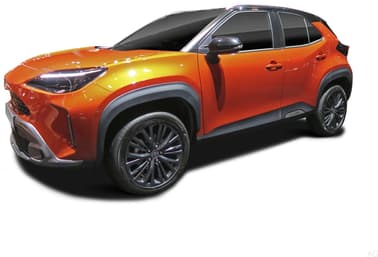
Outside, the GR Sport gains black mirror caps, mesh for the grille and bumper insert, a different rear diffuser and red brake calipers on unique 18-inch wheels. It also sits 10mm closer to the ground, thanks to lowered suspension that also boasts a revised tune.
Inside, you'll find redesigned front seats with suede-like material and vinyl bolsters, an extra USB-C port, an air-purifying filter for the climate control system, aluminium pedal covers and a smattering of GR logos, colours and trim finishes to round things out, while extra underbody bracing is there, "... to control body roll and improve ride comfort". We'll go into more detail later on.
But there are no changes to the hybrid powertrain.
As with all Yaris Crosses, the GR Sport has a long list of standard safety equipment, bringing eight airbags, Autonomous Emergency Braking (AEB), lane-keep assist and adaptive cruise control. See the Safety section for more.
.jpg)
Since it's based on the GXL hybrid 2WD (front-wheel drive) grade, you'll also find LED headlights, keyless entry/push-button start, a leather-wrapped wheel with paddle shifters, voice recognition, a 7.0-inch touchscreen, digital radio, Apple CarPlay/Android Auto connectivity, satellite navigation, 'Toyota Connected Services', auto-folding mirrors, rear privacy glass, and a temporary spare wheel.
For handy luxuries like a powered driver's seat, heated front seats, a head-up display and powered tailgate, you'll need the identically-priced Urban Hybrid 2WD. Hmm.
Or... for exactly the same money (from $35,840 plus ORC, remember), there's the GXL AWD, which drops two inches in wheel size but picks up 10mm more suspension height and an extra electric motor on the rear axle for extra traction. Gripping.
Rivals? Compared to the scores of non-hybrid small SUV alternatives, there are few that directly align with the GR Sport Hybrid.
.jpg)
The very mild-hybrid Mazda MX-30 G20 probably comes closest in price, or – from about 10 per cent more – there's the new Subaru Crosstrek AWD.
Or, in-house competitors like the ageing but still-impressive Toyota C-HR Koba Hybrid and larger Corolla Cross Hybrid. Others, like the uneven Haval Jolion Hybrid and Honda's fine HR-V e:HEV are more expensive again.
In summary, then, we reckon the GR Sport Hybrid's biggest value challengers come from within Toyota generally, and the Yaris Cross range specifically. It's hard to go past the GX or GXL Hybrid AWDs.
Related cars for sale on CarsGuide
See more Toyota Yaris Cross for sale View cars for saleDesign – Is there anything interesting about its design?
Back in October 2020 when the Yaris Cross landed in Australia, Toyota put interesting stats in the press kit showing how the original RAV4 5-door of 1995 compared with the newcomer.
Height-aside (by a substantial 70mm), the Yaris Cross is longer (by 55mm) and wider (+70mm), while its wheelbase and tracks are a whopping 150mm and 60mm more generous.
It's the last point that has us puzzled, because the Yaris Cross still seems a little tippy-toed in proportion, though the GR Sport does at least look better resolved with its larger alloys and lowered chassis.
.jpg)
And the smoked headlights and sad blacked-out grille still seem a bit dead-eyed and gormless. Not Toyota's prettiest styling effort, then.
That all said, the chunky shape and box-ticking crossover styling accoutrements seem to keep bringing people to showrooms in droves.
Finally, how Yaris is this, anyway? To refresh, compared to its supermini sibling namesake that uses the same GA-B 'Toyota New Global Architecture', the Yaris Cross sits higher off the ground and is longer and wider, as well as taller.
All in the name of a roomier body.
.jpg)
Practicality – How practical is its space and tech inside?
Very. As with all Yaris Cross models, the GR Sport Hybrid is designed to be easy to live with, with ample roof height, large doors and hip-level seating to aid entry/egress. No kneeling down to sit inside or hauling yourself up exiting this small SUV.
Comfy and embracing, the sporty front bucket seats seem to offer better support and location than the regular seats, and – as with the rest of the cabin's finish and ambience – are great to behold. It's smart and sassy in there.
Once settled in, the Japanese giant's smallest SUV continues to impress with its sense of space and pleasing all-round vision, making this seem larger than its city-slicker badge implies.
Nothing cramped or tight to report here – unless you're a basketballer perched high on the front passenger seat. Please, Toyota, provide the option of a lowering lever.
.jpg)
Aided by an amenable driving position, simplicity remains the name of the game, as demonstrated the tactile three-spoke wheel, wide adjustability of seating and steering column, unobstructed views of the attractive dash and effortless access to switchgear. If you run a driving school then here's a great lesson in elementary vehicle operation.
That said, the big digital speedo is not up high in the driver's direct sightline; you'll need to do a switcheroo with an Urban grade and its head-up display to remedy that, while the centre screen's layout can be a bit fiddly at first to figure out, though all necessary info is present.
With no shortage of storage, including 1.5-litre bottle-ready door bins and lots of areas to leave stuff in or on securely, effective ventilation and a sense of hardy quality, it's easy to imagine the Yaris Cross appealing to a broad array of buyers, whether singles, families or Empty Nesters.
It's that sort of do-it-all for less packaging that makes you question spending more for a larger SUV.
Downsides? As well as denying us front passenger seat height adjustment, Toyota seems to see no reason to provide its up-spec crossover with a front centre armrest, driver's seat lumbar support and wireless smartphone charger.
.jpg)
Maybe that's why the centre screen's graphics are so Nokia-esque. Plus, rear vision is hindered by fixed tombstone-style headrests out back. Remember when carmakers used to hollow them out to avoid such blind spots?
The Yaris Cross' rear-seat area benefits from lofty seating, a high ceiling to clear scalps, reasonable kneeroom and space beneath the front seats for big boots to tuck in under. But we'd think twice about squeezing three larger people abreast as shoulders and thighs would likely rub.
Still, outboard-sited passengers should rate the well-angled backrests and shapely cushion offering sufficient thigh support. Note that nothing slides or reclines back there.
Other observations? The 40/20/40 backrest's middle portion folds to reveal a pair of cupholders, like in a BMW. Useful, too, are more bottle-friendly door storage (up to 600ml), reading lights, a single map pocket, two coat hooks and auto up/down electric windows.
Some might miss the lack of face-level air vents, though nobody complained about it being stuffy back there.
Moving to the luggage compartment, a flimsy, fiddly, foldable fabric mesh cover is your only defence from prying eyes, and this is a poor substitute for a parcel shelf; Toyota, if you must, please check out how Honda's Civic does it.
.jpg)
.jpg)
.jpg)
.jpg)
.jpg)
.jpg)
.jpg)
.jpg)
.jpg)
.jpg)
Otherwise, the news is positive, due to a sizeable loading cavity, long flat floor and VDA-rated luggage capacity of up to 390L with rear seatbacks up in situ.
Check out the novel 60/40-split false floor, which provides some degree of extra out-of-sight security as well as loading versatility.
As with all Yaris Cross 2WDs, there's a space-saver spare below that. Going AWD means you'll have to put up with a tyre-repair kit – something we'd not inflict on anybody - as well as a substantially smaller cargo capacity (down to just 314L VDA).
Overall, with its subtle yet effective sporty accents and tasteful trim choices, the GR Sport Hybrid enhances an already generally thoughtfully presented and executed Yaris Cross interior.
Under the bonnet – What are the key stats for its engine and transmission?
Just as with the regular Yaris Cross as well as all Toyota hybrids sold in Australia since 2001, the GR Sport Hybrid is a series-parallel set-up.
It features a 1.5-litre, three-cylinder, naturally-aspirated petrol engine dubbed 'M15A-FXE', making 67kW of power at 5500rpm and 120Nm of torque between 3800rpm and 4800rpm.
That's backed up by an 85kW permanent magnet synchronous motor, producing 59kW of power and 141Nm of torque, with electricity stored in a 4.3Ah lithium-ion battery pack.
Charging is via the petrol engine and recuperated energy from braking. There's no plug-in facility, while pure-electric drive is only offered during low-speed light-throttle driving for short bursts, or during off-throttle coasting where conditions are right.
.jpg)
Drive is sent to the front wheels via an electronic continuously variable transmission (CVT) offering a 10-speed manual sequential mode as well as a mechanical first gear for a more natural torque-converter automatic gearbox experience. Less prone to engine droning that way.
Weighing in at around 1235kg (kerb), the GR Sport Hybrid has a power-to-weight ratio of 68.8kW per tonne, which is okay.
Supporting this Yaris Cross' sporty aspirations, the MacPherson-style strut-front and torsion beam rear suspension tune sees a 10mm drop, resulting in a ride height of 160mm and a lower centre of gravity.
This, along with revised suspension components and additional underfloor bracing for increased stiffness and rigidity, are claimed to benefit steering, handling, body control and ride comfort capabilities.
But we're unsure whether the benefits are felt in equal measures – or at all, in some cases.
Efficiency – What is its fuel consumption? What is its driving range?
Like all Yaris Cross hybrids, the GR Sport officially averages just 3.8 litres per 100km on the combined cycle. That translates to 86 grams per kilometre of carbon-dioxide emissions. There's another reason why this Toyota is such a smash hit.
We didn't quite manage that, predictably, but the 4.7L/100km we did achieve beat the in-car trip computer. That's a rarity. And unlike some larger Toyota hybrids, this one can run on standard 91 RON unleaded as well as 94 RON E10 ethanol-mix petrol.
Using the official fuel consumption average, expect to achieve nearly 950km of range between refills of the 36L fuel tank. Note there is practically no pure-EV range available in this system of hybrid.
Whichever way you look at it, the Yaris Cross is about as economical as petrol-powered small SUVs get.
Driving – What's it like to drive?
We've driven every version of the Yaris Cross since its late 2020 launch in Australia, and without hesitation, the GR Sport is the least impressive of an otherwise great range of small SUVs.
And nowhere is that more evident than in the way it behaves around town.
As its creators intended, the Yaris Cross was born to be an urbanite. Lofty seating, good visibility, zippy acceleration, strong brakes, a tight turning circle and – in the base GX and mid-spec GXL on 16-inch wheels and tyres – a decent level of isolation from road bumps are key and very desirable attributes for city and suburban commuting.
Tick the hybrid box and the added electrical oomph and occasional silent running that electrification brings just add to the Toyota SUV's appeal in these circumstances.
Now, what you gain in style, stance and better tyre grip in the Urban, wearing the 18-inch wheels, you lose in ride comfort over bad roads due to an underlying firmness, and increased road noise intrusion over some coarse surfaces.
However, with its 10mm lower ride height and sports-tuned suspension, the GR Sport is firmer and louder again, and that detracts from its comfort and refinement.
.jpg)
Not to the degree that it's a deal-breaker, because the basics are still there and the Yaris Cross DNA remains, but there are marked differences between the grades.
If most of your driving is urban, you might want to rethink the GR Sport as a result unless the roads you commute on are smooth, because you'll barely notice the improved handling and body control at lower speeds that this grade specialises in.
Driving away onto rural roads, however, reveals a slightly more solid and focused handling machine, with quite direct (if not very tactile) steering through fast tight turns, accompanied by a flat and neutral attitude.
In other words, you can point and shoot a GR Sport up a mountain road with the confidence that it will steer and hold the road calmly and in control, even at speed.
So composed is this version of the Yaris Cross that, on a couple of occasions, we were surprised at how high our corner exit speeds were. Dynamically this is a warm-hatch-like crossover.
Which makes the lack of any power or torque increase over regular hybrid grades all the more disappointing and a missed opportunity. The chassis is clearly up for more muscle.
Yes, as per all Yaris Cross hybrids, the GR Sport is quick off the mark, smooth in its seamless delivery of power, regardless of whether it's petrol or electricity sourced, and eager to respond to throttle inputs.
This is rapid around town and speedy on the motorway. But we'd like a bit more punch to go with the added sporty visual panache.
On our final day of testing, rain washed away weeks of dry, dust and humidity, and the roads became treacherously slick, testing the mettle of many.
Despite being front-drive, the GR Sport continued to be in total command with its grip and braking abilities, but the added surety of AWD that the identically-priced GXL would have brought cannot be denied.
In other words, the GR Sport is best where it can be enjoyed – out away from the city and on good roads. Otherwise, there are better choices within the Yaris Cross range.
Warranty & Safety Rating

Safety – What safety equipment is fitted? What is its safety rating?
Tested on release in late 2020, all bar one Yaris Cross grade sold in this country has been awarded an ANCAP crash-test rating of five stars. The outlier is, inevitably, the GR Sport, with the organisation explicitly singling it out as such.
Why? Who knows, since there are no changes in safety specification while the body and structure are actually stronger than the others. Bureaucrats...
In fact, the safety-related rollcall is impressive, starting with eight airbags, including a front centre bag to help keep occupants from colliding sideways in a lateral impact.
.jpg)
There's also driver-assist tech as part of Toyota's 'Pre-collision safety system' with AEB for pedestrian (day/night) and cyclist (day) detection and daytime intersection assistance.
The AEB functions between 10km/h and 180km/h and the lane support systems between 50km/h and 180km/h.
Additionally, 'Rear Cross Traffic Alert', parking support braking, blind-spot monitor, emergency steering assist, lane-keep assist, speed-sign recognition, auto high beam, full stop/go adaptive cruise control and front and rear parking sensors are part of the GR Sport specification.
.jpg)
You'll also find a panoramic surround-view monitor, anti-lock brakes with brake assist, traction control, stability control, active cornering assist, cross-wind assist, four-wheel disc brakes and a reverse camera, while 'Toyota Connect' brings SOS emergency call, stolen vehicle tracker and other GPS-based assistance features.
The rear seat includes three top tethers for child restraint, with ISOFIX anchors on the two outboard positions.
Ownership – What warranty is offered? What are its service intervals? What are its running costs?
Toyota offers a five-year/unlimited kilometre warranty – with the option of extending that to seven years – as well as roadside assistance.
Service intervals are at 12 months or 15,000km. The first five scheduled services are capped at $250 each, with the work carried out detailed online.
The engine and transmission are under a seven-year warranty, while the hybrid battery pack is up to 10 years as long as the owner undertakes an annual inspection "... as part of routine maintenance according to the vehicle logbook."
.jpg)
Verdict
Going from dorky to dishy thanks to some clever detail changes, the GR Sport Hybrid certainly earns its place in the high-flying Yaris Cross range. For many buyers, that it also offers enough athleticism to match its newfound style seals the deal.
But not all the changes are welcome, especially as they upset the fine balance that the GX and GXL grades in particular possess in spades. The firmer suspension and bigger wheels have a harder time soaking up the rough stuff. Yet Toyota hasn't gone far enough, by failing to provide the extra go to match the extra show.
If none of these matter, then choose the GR Sport Hybrid and enjoy its many virtues, for the Yaris Cross' time is now and you won't really lose regardless.
Pricing Guides


.jpg)
.jpg)
.jpg)
.png)
.jpg)
.png)
.jpg)
.jpg)
_0.png)


.png)

.png)
.png)


