What's the difference?
Things that have had a name change AFTER they’ve become famous…
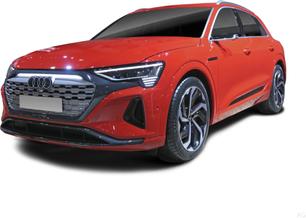
Okay… there’s Kanye West’s switch to Ye, Twitter’s rebranding to X and now this – the Audi Q8 e-tron.
As the brand’s first production EV, it used to be known simply as Audi e-tron. But that was confusing, because – Porsche Taycan-based GT and RS sports sedans aside – every electrified vehicle that the company has made before and since wears e-tron as a suffix.
Beyond new badging, the Q8 e-tron also brings a facelift and improvements underneath, to better challenge the BMW iX, Jaguar I-Pace and Mercedes EQC and EQE large electric SUVs, among others.
How does the Ingolstadt EV fare? Let’s find out.
The EQE is more than an important car for Mercedes. Not only is it the German titan’s latest electric offering, on all-new underpinnings, but it represents the very future of its passenger car range.
It adopts a completely new shape and design language, but it also puts its fastest foot forward, launching with the 53 AMG variant first in Australia, by the end of 2022.
We travelled to Europe to sample it for the first time ahead of its Australian arrival to find out what the future of Mercedes feels like, but also how its go-fast AMG division has managed to leave its mark on an electric car.
The Audi Q8 e-tron ushers in welcome improvements to an already likeable and capable large luxury SUV.
But it is also feeling dated compared to newer and fresher rivals like the BMW iX, isn’t as good to drive as the best, offers disappointing range for the size of the new battery, and prices are creeping up for what is essentially a half-decade-old EV.
The name change isn’t enough. What the Q8 e-tron really needs is a massive leap in its Vorsprung durch Technik in a rapidly evolving electrified landscape.
Very good… but far from great.
In the wild new world of fully electric cars there isn’t really an ‘average’ of what to expect. If there was, I’m sure the EQE 53 would exceed it. Its electrification brings the ambiance of a luxury car, while its performance reminds you of what AMG is capable of.
There’s a bit of the mechanical engagement of AMG missing, a relatively small boot, and some won’t be sold on the function-over-form looks, but the EQE 53 is a pleasantly surprising look at the future of fast Mercedes.
The Q8 e-tron looks smaller than it actually is, with the SUV wagon’s length/width/height/wheelbase numbers measuring in at 4915/1937/1633mm/2928mm, respectively.
The Sportback version is slightly lower at 1619mm.
You’ll need a keen eye to spot the difference between the old e-tron and new Q8 e-tron, with almost all of the visual changes reserved for the front end.
For starters, there’s a new, two-dimensional four-ring logo that looks larger and flatter than before, sitting within a sleeker and slimmer grille treatment that now takes in the restyled headlights. Along with the redesigned bumper, the effect serves to broaden the SUV’s stance.
The effect also suggests improved aerodynamics, aided by small air foils near the wheel arches and a fully-clad underbody section.
Otherwise, aside from the odd inclusion of the make-model name on the B-pillar and minor trim updates out back, the Q8 e-tron keeps the same, contemporary appearance of its predecessor. Which is no bad thing.
And there are even fewer changes inside.
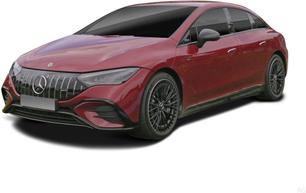
The EQE is certainly a departure from the classic lines of the current E-Class sedan. Mercedes-Benz has chosen to take a completely new approach for the electric era, embracing the need for ultra-low drag designs, and a corresponding newfound love for curvaceous surfaces.
It’s fairly imposing too with enormous wheels and an abundance of panels. Needless to say some will find this new design direction challenging. It proved quite controversial in the CarsGuide office, at any rate.
I can say it looks a bit more approachable when witnessed in the metal, and the AMG branded 53s I sampled for this review added a few more much-needed points of interest to this single curve of a design.
This is particularly notable around the rear of the EQE 53 which adds a little tail spoiler and glossy rear diffuser, which help accentuate the width and terraced design of the rear window.
Around the front is a little more featureless, with the blanked-out grille losing the intricate three-dimensional appeal of this car’s combustion equivalents. There’s just something a bit plain about the EQE’s face, although Mercedes has tried to spice it up with interesting headlight clusters.
The inside is spectacular, with a smorgasbord of screens and lights to match an abundance of glossy touch-based surfaces. Some may not be sold on the over-the-top approach, but it feels as futuristic as an EV should be.
The material choices are nice, too, with soft-touch materials atop the dash, doors, and running down the centre console. The ambient lighting is particularly flashy, and works in with the consistent single-piece sort of design which makes up the whole dash.
While the LEDs might be a little too much for some, there are some more subtle detailing points, like the way the centre air vents are delicately worked into the flow of the dash, and the rotor designs of each vent at the edges are intricate pieces.
More than merely good enough.
Entry and egress are easy thanks to a lofty ride height and wide-opening doors. Once sat, you’ll discover Audi has not changed anything much inside compared to the old e-tron. Frankly, very little needed to.
You’ll still find a strikingly stylish and upmarket cabin offering sufficient space for five people, a commanding driving position, superbly supportive front seats that are a boon when long-distance driving, plenty of storage options, ample ventilation and suitably moody lighting.
While not the most modern dash on the market when contrasted to the vast ‘hyper’ screens of some rivals, the Q8 e-tron’s remains very architectural in appearance and presentation.
Trim and material quality are certainly up to brand expectations. Practicality remains a priority, with lots of storage areas within the dash, console and door cards.
There are no fewer than three screens – a 12.3-inch digital instrument cluster Audi calls 'Virtual Cockpit', a 10.1-inch central multimedia display with haptic feedback and an 8.6-inch unit for climate control.
While they may seem daunting at first, a little familiarisation means most users will find them easy to operate.
Kudos, too, to the super-clear markings in the instrumentation, as well as the very satisfying tactile sensations of using the quality switchgear and controls. Typical Audi thoroughness here.
The same applies to the Q8 e-tron’s roomy and pleasantly-presented back seat area, with intelligently designed seating offering a nicely angled backrest as well as supportive cushion.
Three people can fit across without too much pain, though two is better, as the folding centre armrest and other amenities like air vents and climate control systems can be better-accessed and enjoyed.
You can see, smell and feel where your money’s gone inside. This is a quiet, isolated and cocooning experience, whether cruising on the motorway or stuck in heavy urban traffic. As you’d expect from a luxury SUV.
About the only real jarring aspect are the $3500 virtual exterior mirrors, created to improve aero performance. Their door-mounted screens are set low, outside the natural visual eyeline of the driver, creating confusion and adding precious extra seconds of eyes not on the road ahead. They’re irritating to the point of frustration.
Otherwise, the Q8 e-tron gets the job done inside, with cargo capacity at a reasonable 569 litres in the SUV wagon and 528L in the Sportback. And there’s even a 62L tub in the frunk up front to store the cables that also come standard with the EV.
Audi interior and packaging expertise strikes again.
The EQE is plenty practical up front, with an odd SUV-like seating position providing a commanding view of the road. This seat positioning isn’t an accident or a necessity of facilitating batteries under the floor, but a deliberate design decision by the brand to try to emulate some design choices which have made SUVs so popular.
The result is surprisingly effective, but doesn’t help the view out of the rear of the car, which is a restricted letterbox aspect courtesy of a slinky roofline and tall boot lid.
Still, peering down on the road lets you position and park this large EV more easily. Adjustability isn’t bad for the front passenger, and space is healthy both in terms of width and height. One dimension which can’t be altered is the particularly tall dash height, and while this is largely overcome by the taller-than-average seat, it could be an issue for shorter drivers.
Storage is great, with a big bottle holder and bin in the doors, a huge cutaway below the floating centre console for storage, with an elastic strap for tying down objects. There are a further two bottle holders in the centre console and a bay with a wireless charger, too, and the split-opening armrest box is deep.
One of the more divisive points of this car’s practicality offering is the screen-based functions. Everything has been moved into the massive centre screen. There are no tactile buttons or dials for this car’s functions, with it all controlled through context menus.
To be fair, with the amount of real estate on offer, the touch elements can afford to be massive, and there is a permanent set of climate controls at the base of the screen, but adjusting these functions on the fly is never as easy without physical feedback.
The same goes for the touch-centric wheel controls. Benz says the idea with the four-zoned touch panels on the wheel is to offer unrivalled ability to control the car’s functions even when the wheel is at an angle, but it is also easy to accidentally hit various touch functions, and they can require some delicate action to use properly.
The back seat is impressive. It maintains the tall seating position of the front, letting you look down on the road as though you’re in an SUV, and the comfortable seating and surfaces continue. Legroom is particularly impressive, with leagues of space behind my own driving position. Headroom is even okay considering the descending roofline. It’s quite dark in the EQE 53 we tested thanks to its black-on-black trim, giving the illusion of a space which is smaller than it actually is.
Storage is good, too, with a big bottle holder in the door cards, quad-zone climate control, complete with a separate touch panel for rear passengers, adjustable air vents, and solid clamshell pockets on the backs of the front seats.
The EQE has a boot capacity of 430 litres which doesn’t seem enormous given the footprint of this car, and no doubt has a lot to do with its slinky aerodynamic design around the rear. There’s no ‘frunk’ either so this is a car perhaps more focused on driving and being driven in than its ability to carry things.
First thing’s first. The Q8 e-tron has very little in common with the existing Q8 petrol, diesel and SQ8 high-performance models.
These, along with the larger Q7, have internal combustion engines.
However, keep in mind all leverage variations of the same 'MLB Evo' architecture that first saw the light of day all the way back in 2015. So, no spring chickens here.
But as it currently also serves Bentley, Lamborghini and Porsche SUVs, we’re talking about a classy set of components, anyway. Plus, the pre-facelift model was only rolled out on the world market in 2019.
For now, only a single variant is here, known as the Q8 e-tron 55, meaning the previous, smaller-battery 50 and flagship SQ8 aren’t here yet. That will happen sometime during 2024.
As before, there’s the choice of a traditional SUV wagon or more-popular BMW X6-style Sportback SUV coupe.
Prices start at $153,900 (all prices are before on-road costs) for the former and $165,900 for the latter, and that’s a jump of nearly $8K and $9K respectively over their old e-tron-as-a-noun-rather-than-an-adjective predecessors.
At least the Q8 e-tron is well equipped.
On the safety front, you’ll find about 40 driver assistance systems, backed up by a plethora of cameras, radar sensors and ultrasonic sensors to help keep the SUV as secure as possible.
These include a 360-degree camera system, adaptive cruise control, lane-support systems, rear cross-traffic assist and Autonomous Emergency Braking (AEB).
More on safety further down below.
All models also include adaptive air suspension with a variable ride height range of 76mm, a drive-mode selector that switches between normal and sport settings, LED headlights with auto high beams, keyless entry/start, front and rear climate control, heated and powered front seats and adjustable regenerative braking paddles on the steering wheel.
There's also a head-up display, three digital screens including electronic instrumentation and a central touchscreen with haptic feedback, satellite navigation, Android Auto, wireless Apple CarPlay, digital radio, wireless smartphone charging, four USB-C ports, an electric tailgate with gesture control, roof rails and 20-inch alloy wheels – with a space-saver spare wheel to boot.
Plus, an undisclosed number of Launch Edition SUVs from $165,900 are also available, adding Audi’s S line exterior styling touches, 21-inch wheels, sports front seats, a racier steering wheel, electric steering column adjustment and more.
Note that the base Q8 e-tron 55 does not include leather upholstery (it’s synthetic material instead) or a sunroof as standard.
Pricing and spec, then, are generally in-line with the luxury Euro EV SUV competition, which is to say, a bit on the exxy side.
Let’s check out the changes.
We don’t yet know which EQE variants will be offered in Australia. The car we drove for this review, the EQE 53 AMG is the top of the range, and will be the launch variant in Australia, but the brand is yet to settle on how it will fill the line-up underneath.
Representatives said to expect at least two more Mercedes-Benz (as opposed to AMG) branded variants, with the option of a rear-wheel drive entry model and an all-wheel drive mid-grade. Whether they adopt the same spec level as the European-market EQE 350 remains to be seen.
As for the EQE 53, CarsGuide understands a price north of $200,000 is likely when it arrives before the end of 2022.
Its rivals will include other high-end four-door models like the Porsche Taycan, Audi e-tron GT, and the updated Tesla Model S. In the coming years this segment will continue to heat up with the yet-to-launch Hyundai Ioniq 6 and Polestar 5.
The EQE is fairly large, offering dimensions comparable to that of the CLS which came before it, and is quite unconventional in a host of areas.
The standard suite of equipment we sampled is impressive, too, with performance enhancements on the 53 including four-wheel steer, adaptive dampers, a performance brake package, and torque-vectoring all-wheel drive.
Massive 21-inch alloy wheels featured on our car, and there is also the option overseas for even higher performance carbon ceramic brakes.
Outside also features LED headlights, DRLs, and tail-lights, while inside impresses with the massive dash-spanning ‘Hyperscreen’ with panels for the digital dash, centre multimedia screen, and a third panel for the front passenger.
This set-up is optional on the EQE range in Europe, but we’ll have to wait and see what becomes standard for the Australian market. The car we sampled had wireless phone mirroring tech, wireless charging pads, built-in navigation with augmented reality directions, a head-up display with configurable panels, and full USB-C connectivity throughout.
Quad-zone climate also features, as does the brand’s latest steering wheel, in our case clad in Alcantara and leather trim.
The seats, even on the EQE 53 ship standard with the ‘Artico’ synthetic leather trim, although they can also optionally be upgraded to full Nappa leather. Electrical adjustment is standard for the front seats.
It’s a flashy cabin which feels primo, and little touches like unique materials for the EQ range across the dash and ambient lighting configurable to any colour you can dream up are neat, too.
Check in closer to the EQE’s local arrival time before the end of 2022 for more accurate pricing and spec, as well as the list of option packs.
Tech-overload alert. As per its predecessor, the Q8 e-tron 55 continues with two electric motors – one on each axle – for ‘quattro’ all-wheel drive.
Upgraded internals are said to improve efficiency substantially. Both are induction/asynchronous motors, mated to a single-gear two-stage ratio planetary transmission.
In the 55 model, the dual-motor set-up delivers a combined 300kW of power and 664Nm of torque, for a healthy 0-100km/h sprint-time of 5.6 seconds, on the way to a 200km/h top speed.
That’s impressive, given the lightest Q8 e-tron 55 tips the scales from 2595kg. That said, the Audi’s power-to-weight ratio is an equally strong 116kg/tonne.
Other updates include more direct steering, stiffer front suspension and retuned chassis controls.
Suspension is a five-link arrangement all-around, with adaptive air suspension featuring an electronically controlled with continuously variable adaptive damping system.
The EQE 53 punches out huge power, with the standard car producing 460kW/950Nm from its dual electric motor set-up, or with the 'AMG Dynamic Plus Pack', producing even higher figures of 505kW/1000Nm.
Clearly, AMG’s electric vehicles will safely outrun their dramatic combustion predecessors. In fact, with the Plus Pack, the EQE 53 is capable of moving its bulk from 0-100km/h in just 3.2 seconds. Extreme for something carrying a whopping 90.6kWh of batteries under the floor.
Enhancements include torque-vectoring all-wheel drive, all-wheel steer, adaptive dampers, and the choice of standard performance brakes or a carbon ceramic package.
The good news is that the lithium-ion battery pack size rises from 95kWh to 114kWh, and is accompanied by faster DC charging capability, due to a jump from 150kW to 170kW.
While far from the class best, this cuts down charging times by a considerable margin.
The claimed driving range is 454km, while average consumption is a disappointing 25.6kWh/100km. The Q8 e-tron’s trip computer during our run in it recorded a mid-to-high 20s readout, by the way.
Electric vehicles appear to have the same issues as their combustion counterparts, in that they still drop in efficiency the more powerful you make them. In the case of the EQE 53, this means an average WLTP-rated consumption number between 20.3kWh/100km and 23.2kWh/100km.
'Thirsty' for an EV, although it is on par with the Porsche Taycan and still below Audi’s e-tron S.
When it comes to charging the EQE 53 can charge at a rate of 11kW on the AC standard, or a whopping 170kW on DC - allowing 180km of range to be added every 15 minutes. It also has the convenient option of a 22kW AC charger, a welcome inclusion if you intend to charge your car often at public outlets.
Total range for the 90.6kWh battery is 513km on the WLTP cycle.
For decades, Audi used the advertising tagline ‘Vorsprung durch Technik’ – which means Progress through Technology in its native German – to highlight how advanced its vehicles are.
So, how has the Q8 e-tron advanced over its predecessor?
Right from the get-go, there’s so much to dig about the electric Audi SUV, especially if you’re new to luxury EVs.
To start with, it’s as quiet as you’d expect, even by luxury brand standards. As the Audi accelerates, the sense of momentum is somewhat masked by how refined and civilised your progress is.
Watch that, though. You could get a speeding fine more easily than you expect!
Anyway, with 664Nm of torque coming on instantly, there’s certainly no shortage of it, backed up by enough muscle for effortless and instantaneous overtaking. This sort of motoring can become highly addictive.
Similarly, a low centre of gravity, combined with a beautifully modulated electric power steering and the quattro AWD set-up, provides pleasing agility combined with reassuring roadholding. Even when you’re pressing on, the Q8 e-tron corners and grip with confidence and control.
So far, so good. Especially considering the air suspension is further cushioning your sense of speed, with excellent bump absorption for an isolated ride.
That’s on the standard 20-inch alloys spec. Riding on the larger wheels, there is a bit more firmness, as well as some road-noise intrusion.
Plus, it doesn’t take long to realise the Q8 e-tron is a very heavy vehicle. Though undeniably quick and athletic, changing directions in a hurry means that the SUV can feel a bit unwieldy.
Throttle response at higher velocities can seem a little muted and, over certain crests and humps when travelling fast, there is a sense that the driver really needs to have their wits about them.
Best to take it a bit easier, then, and enjoy the serenity the Audi EV SUV delivers in more typical and restrained travelling scenarios.
There is so much that the Q8 e-tron brings, and driving it normally really does reveal a sophisticated, comfortable, dependable and high-quality grand-touring experience.
Push a bit harder, though, and some cracks show up.
The way the EQE 53 drives was deeply unexpected. Just looking at this massive sedan, I would have expected it to feel burdened by its batteries, and with its length and shape, cumbersome in the corners. That wasn’t the case at all.
The EQE 53 feels remarkably coherent from behind the wheel. The seating position works well to give a nice view of the road, the steering feels a tad artificial but still direct with some AMG magic having worked its way in.
What surprised me most is how agile it feels. Once you gather some speed and attack some corners, this car shrinks. Control is excellent thanks to the massive tyres, all-wheel drive system, and all-wheel steering. It sounds like a lot of complexity, but you don’t notice any of it. Each system does its part to allow you to simply point the car where you want it to go at pretty much any speed. It is very impressive.
The ride feels supple, too, thanks to adaptive dampers, but offers plenty of control. The speed is Tesla-style violent. Put your foot to the floor in Sport or Sport+ mode and you’re thrown to the back of your seat as the car enters a state of warp. AMG says there won’t be a 63 version of this car, and I can’t imagine why you could possibly need anything faster or more capable than this 53 version. 1000Nm of torque!
This overwhelming number perhaps makes it more impressive that it’s hard to extract a squeak from the tyres. Sure there’s torque-vectoring magic at play, but even at full acceleration they hold on for dear life.
It also makes a noise. AMG is very specific about what went into making the soundscape for the EQE because in the electric era its performance can be achieved silently, and the brand knows full well its badge usually comes hand-in-hand with aural drama.
I stuck it in the stock mode and varied my driving from 'Comfort' to 'Sport+.' The sound builds as the car gains speed, but it also interacts with your accelerator and brake inputs, as well as being one of few EVs with a specific noise for regenerative braking. It sounds… odd.
There’s certainly a kind of drama to it, and to me, it’s better to have it as a way of gaining some feedback from the car. But, its artificial nature and loudness became a little too much for sustained driving in Sport + mode. I found the best balance in the more regular ‘Sport’ mode, or even toned down to ‘Balanced’ which puts it in the background.
This leaves quite a void, though. While the sound is welcome, and the throttle alarming, there’s just something missing from the usually brash AMG badge promise.
As an EV, the EQE 53 has three regen modes quite distinct from one another. Mercedes says the choice to have just three modes is deliberate, as it didn’t want to dilute the personality of the car with an overwhelming choice of regen. The three modes include: basically no regen, moderate regen, and the full regen, essentially a single-pedal driving mode. I preferred the strongest setting for efficiency's sake (plus it brakes for you as you let off!).
The EQE 53 is surprising in so many areas, and much more engaging to drive than its exterior visage might suggest. I’m impressed.
Tested way back in 2019 but updated in September, 2023, the e-tron/Q8 e-tron range scored a maximum five-star ANCAP crash-test rating.
There is no shortage of safety equipment – with passive and active, driver-assist-heavy technologies designed to avoid an accident, with full surround-view cameras also providing an extra level of security.
Standard kit includes Audi’s 'Pre-Sense front' and 'Pre-Sense rear', offering AEB, cross-traffic alert and active lane-keep assistance tech, as well as adaptive cruise control with full stop/go, eight airbags (dual front as well as side and curtain airbags for all outboard occupants), hill-descent control, anti-lock brakes, electronic brake-force distribution, brake-assist, electronic stability control, traction control and tyre pressure monitors.
The AEB system can detect pedestrians and cyclists between 10km/h and 85km/h, and even at night, while for other motor vehicles that increases to 250km/h (an upper velocity more relevant for the coming SQ8 e-tron). The active lane warning operations is from 65-250km/h.
Both outboard rear seats feature ISOFIX child-seat latches, along with three top tethers for straps.
We don’t yet know what standard safety equipment will arrive on Australian-delivered EQE variants, but you can expect a high-end suite of gear including auto emergency braking to freeway speeds, lane and blind spot assistance, driver and road monitoring tech, as well as the brand’s rather good autonomous cruise suite.
The EQE pairs the expected set of airbags with an additional driver’s knee airbag and centre airbag for some markets, as well as a second set of side impact airbags for rear passengers. There are dual ISOFIX mounts on the rear outboard seats, and expect there to be the usual three top-tether mounts in Australia, too.
Stay tuned closer to the EQE’s arrival toward the end of 2022 for more accurate specification.
Audi provides a five-year/unlimited kilometre warranty as well as six-years’ worth of free roadside assistance, which is nothing unusual these days, while the battery warranty is eight years or 160,000km.
The first six years of scheduled servicing is free, too. Intervals are every two years/30,000km (whichever comes first).
Plus, owners also receive six years of complimentary access to Chargefox’s network.
Mercedes-Benz in Australia currently offers a range-wide five-year and unlimited kilometre warranty, a standard which is spreading to other premium brands.
We don’t know what the service schedule or running costs will look like for the EQE range yet, but expect it to be most affordable when chosen with a multi-year prepaid service plan at the time of purchase. Check back closer to its launch time to see the full details.