What's the difference?
Yep, it’s yet another new brand. And, yes, it’s from China.
You can be forgiven for not keeping up with the influx of new car brands in recent years, even as a professional I can find it challenging at times. But that’s why we’re here, to help you determine which brands to pay attention to and which ones you can probably ignore.
So which one is Jaecoo?
Well, the good news for the brand is that it comes from one of China’s biggest and most successful car companies, Chery, which has been a leading exporter for more than two decades, so it has a reasonable understanding of international markets.
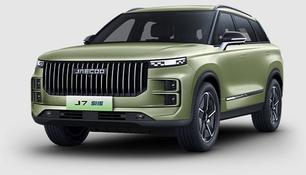
Jaecoo is designed to be a separate, stand-alone brand from Chery, and in Australia will be sold at specific Omoda-Jaecoo dealerships (as the Omoda 5 is also spun-off into yet another ‘new’ brand). The Jaecoo J7 we’re driving here is its first model, a mid-size SUV that will compete directly against the likes of the BYD Sealion 6, Toyota RAV4, Hyundai Tucson and more.
Because despite management referring to Jaecoo as a “luxury” brand and calling the J7 a “premium SUV” that’s all within the context of the Chery universe. Jaecoo is simply a more premium alternative to Chery, not a true luxury brand that will challenge the likes of Lexus, Mercedes-Benz and the rest on quality and, as you’ll soon see, price.
We’ve already sampled the entry-level J7 2WD but now we’re getting to experience the 4WD and range-topping SHS, which stands for Super Hybrid System, but is better known as a plug-in hybrid. The SHS is the model we spent the most time in and that’s what we’ll focus on in this review.
Chery/Jaecoo executives say that what it calls ‘new elites’ - people that are “moving up in the world” and are looking for a “fashionable” and “cool” car - are the target market. But as we’ll explain, the market for the J7 is likely to be much broader than just the fashionable elite and cool kids.
Launching an investigation into the Australian mid-size SUV market is like opening an automotive can of worms.
Around 20 mainstream offerings makes it one of the most popular and hotly contested segments in the local new-car market.
Think Hyundai Tucson, Kia Sportage, Mazda CX-5, Subaru Forester and the category-leading Toyota RAV4. Not to mention the subject of this review, the long-established Nissan X-Trail.
And this time around we’re looking at the X-Trail N-Trek, which sits in the middle of a five-tier X-Trail line-up, in AWD seven-seat form which increases versatility while narrowing the competitive field somewhat.
We spent a week putting it through its urban paces.
Based on our initial drive I certainly think the J7, especially the SHS Summit, does make a pretty compelling case to be on the consideration list for anyone looking to buy a mid-size hybrid SUV - plug-in or not.
It has a polished design, loads of tech and a fuel-efficient powertrain that provides adequate performance. But the real selling point is the price, which undercuts its key rivals to ensure it has your attention, especially in these days of increasingly expensive family vehicles.
And while the J7 certainly has appeal to design-oriented buyers and people that want something ‘cool’ or just different, the value it offers gives it mainstream appeal.
Note: CarsGuide attended this event as a guest of the manufacturer, with accommodation and meals provided.
Over four generations Nissan has fine-tuned the X-Trail into an impressively refined and practical option for an urban family; that practicality further extended by inclusion of two occasional seats in the third row of this N-Trek version. The value equation is also strong and safety is top-shelf.
That said, efficiency is far from class-leading and the ownership proposition is off the category pace. But this even-seater’s overall quality still shines through.
If you’re in the midst of the mid-size SUV market vortex and want seven seats rather than five make sure this car’s on your investigation list.
Design is an interesting subject to discuss with the J7, as it manages to simultaneously have a bold and distinctive look from some angles and yet has clearly been inspired by some other, more famous, premium brands from others.
To be blunt, from certain angles - namely the side profile and rear three-quarter - the J7 could be mistaken for a Range Rover Evoque at a distance. Obviously taking inspiration from rivals is nothing new in the car industry and the Jaecoo designers have also managed to give the J7 its own look when you get a bit closer and notice the details.
The most noticeable of these is the ‘waterfall-like’ grille, that the brand says symbolises “the life force of nature”, but also gives it a front profile that can’t be mistaken for anything else. Especially with the prominent ‘Jaecoo’ badge large and proudly placed in the middle of the grille - leaving you in no doubt what this is.
Overall, I’d call the exterior look of the J7 cohesive and leaving a more premium impression that what we’ve seen with Chery.
Inside, Jaecoo has followed the modern trend of going digital, with a small digital instrument display and then a larger central touchscreen. It provides a clean, modern look that leaves a good impression.
The Jaecoo designers also focused their attention on the touchpoints, elements like the door handles and arm rests, to try and give them a more premium feel. The trims used inside are also a cut above what we’ve experienced on other Chery models, and while not at a true luxury level, do stand out for what is a mainstream SUV.
One other major element of the SHS interior design worth mentioning is the central console, between the front seats. That’s because it’s unique in the SHS, offering a completely different layout to the petrol-powered models. The SHS moves the gear selector to the steering column, freeing up more small item storage space and cup holders, as well as a split-opening central storage box (instead of a rear-hinged one).
Busy but interesting is a description you might apply to a mad rocket scientist or rock ‘n’ roll roadie. But it’s also apt when looking at the Nissan X-Trail’s exterior design.
Long, angular head and front fog lights sitting either side of a large grille and above multiple air intakes set the tone at the front with a similar mix of accentuated tail-lights and jagged shapes at the rear.
There’s enough distinctive character there to identify the X-Trail as a contemporary Nissan and I for one like the look of it, especially in our test example’s ‘Ceramic Grey’ finish.
For car-spotters, the N-Trek is distinguished by specific 18-inch (mainly black) alloys, a unique front and rear bumper treatment and a blacked-out grille as well as a black finish on the door handles, mirror covers and roof rails.
This third-generation X-Trail arrived less than two years ago and the interior remains classy and restrained, Nissan so far resisting the temptation to join media and instrument displays into the increasingly common single array.
The sweeping multi-level dash is fuss-free and the muted, mainly grey and black colour palette is calming yet bright enough to avoid crossing the line into sombre.
Its layout is simple and ergonomically efficient with details like manual dials for audio and heating/ventilation control a plus.
And it’s the things you don’t regularly notice that are worth calling out. The electric handbrake is near silent on application; not always the case in recently released rivals. The rear windscreen wiper motor is also quiet; again, something you can’t take for granted these days. And the quality of the materials across the interior is a cut above those most often used by ‘challenger’ brands.
I could go on, but you get the idea. Lots of small ‘one per cent’ things that may seem minor on their own but add up to make a noticeable difference overall.
From a space perspective the J7 offers up reasonable room for an SUV of this size, but falls short of the class-leaders in a few key areas. The front seats are nice and comfortable, and while the rear seats are well-appointed (with air-con vents and USB inputs) space is adequate rather than generous.
The same can be said about the boot, at least on the SHS grade. It’s on the smaller side for an SUV of this size, measuring 500 litres, compared to 542 litres offered by the RAV4 and 574 litres in the Sealion 6. And it’s even more disappointing when you factor in the lack of a spare wheel, with only a tyre repair kit under the floor.
Thankfully the 4WD offers the same space (500L) but gets a full-size spare, while the 2WD models have a claimed 584L and a temporary spare.
As for the technology, the decision to go for the one big central screen for all infotainment provides a hi-tech, clean look but it does lead to some obvious compromises.
Namely, the lack of any physical buttons (save for the hazards, unlocking and EV function) is disappointing from a user experience perspective. As many brands have found, screens have a ‘wow factor’ and save on the cost of buttons but are more challenging to operate when you’re on the move and that’s the case with the J7.
Obviously having Apple CarPlay or Android Auto makes for a familiar experience, but if you have to dive into the extensive Jaecoo-specific menus it can become difficult and distracting.
At just under 4.7m long, a fraction over 1.8m wide and a bit more than 1.7m tall, the current Nissan X-Trail is a large mid-size SUV.
That allows for a generous amount of space up front with more than enough breathing room between the driver and co-pilot.
Storage is pretty handy, too, with a decent size lidded ‘butterfly door’ box between the seats (which doubles as a centre armrest), two cupholders in the centre console, a lower level tray underneath, door bins with space for large bottles and a decent glove box.
Move to the second row and at 183cm tall I have plenty of headroom and legroom, with the latter variable thanks to the seat’s ability to slide and open up more room for the two third-row occupants if required.
Again, there are bins in the doors with a cavity able to accommodate large-ish bottles, two cupholders in the fold-down centre armrest and map pockets on the front seat backs, while adjustable ventilation gets a big thumbs up.
Three full-size adults across the second-row seat is a recipe for discomfort but two grown-ups or a trio of up to mid-teenage kids will be fine and the rear doors deserve a big shout out.
First, they open out to 90 degrees which makes getting in and out of there s-o-o much easier and second, pull-up sunshades are always a welcome addition.
The third row is a kids-only zone, but the flexibility those two spots offer is significant and Nissan’s provision of big outer armrests with storage and drink holders built in is a thoughtful touch.
Connectivity and power options run to USB-A and -C ports (for streaming and charging) plus a 12-volt socket and wireless device charging pad in the front. There’s an identical pair of (charge only) USBs in the centre row and another 12-volt outlet in the boot.
Speaking of which, with all seats up the seven-seat X-Trail’s boot capacity shrinks to that of an oversize handbag (realistically, two or three soft bags), but with the 50/50 split third row folded down you’re provided with 465 litres of volume (to the roof) which is enough to easily swallow the three-piece CarsGuide suitcase set. And the 40/20/40 split second row’s sliding ability again allows you to play with the space available.
Worth noting a space-saver spare is provided (a much better option than a ‘roll of the dice’ repair/inflator kit) and maximum braked trailer towing capacity is a handy 2000kg (750kg unbraked).
The J7 line-up will consist of four grades initially, the 2WD Core, 2WD Track, AWD Ridge and SHS Summit, with the choice of two powertrains.
The range will begin at just $34,990 drive-away for the 2WD Core and $37,990 drive-away for the 2WD Track. These are powered by a 137kW/275Nm 1.6-litre turbocharged four-cylinder petrol engine paired to a seven-speed dual-clutch transmission and powering the front wheels.
The AWD Ridge is priced from $42,990 and has the same 1.6-litre engine, with the same performance but obviously powering all four wheels. The range is topped by the SHS Summit, priced from $47,990 drive-away.
For context, the Toyota RAV4 Hybrid (which isn’t a plug-in) is priced between $42,260 and $51,410, while the BYD Sealion 6 PHEV starts at $48,890 - so it’s clear where Jaecoo is hoping to woo buyers from.
Standard equipment on the J7 Core includes 18-inch alloy wheels, LED headlights, LED daytime running lights, a 10.2-inch digital instrument display and a 13.2-inch infotainment touchscreen, which incorporates wireless Apple CarPlay and Android Auto. The Track trim level adds a power tailgate, front parking sensors, 360-degree surround-view monitor, heated front seats, ambient lighting, dual-zone climate control, plus a wireless smartphone charger and an eight-speaker Sony sound system.
Stepping up to the AWD Ridge brings torque vectoring all-wheel drive, 19-inch alloy wheels, a full-size spare, a panoramic sunroof, heated and ventilated front seats, in-built dashcam and a 14.8-inch infotainment touchscreen.
The SHS Summit matches much of the specification of the Ridge, but gets unique 19-inch ‘aero’ alloy wheels, a head-up display and perforated synthetic leather seats.
All models are equipped with ‘Hello Jaecoo’, the brand’s voice-activated assistant.
At $50,390, before on-road costs, other similarly sized and specified three-row rivals to the X-Trail N-Trek include the recently released Tiggo 8 Pro Max Ultimate AWD ($47,990 drive-away) as well as the Mitsubishi Outlander and VW’s Tiguan Allspace.
The N-Trek’s $50K price tag neatly dissects the Outlander 7 seat AWD Aspire ($47,340) and Exceed ($52,640) grades and splits the Tiguan Allspace 132TSI Life ($47,990) and 162TSI Elegance ($57,090) models.
As well as the safety and performance tech covered later in this review, the X-Trail N-Trek’s standard equipment list features dual-zone climate-control, a 12.3-inch digital instrument cluster, 12.3-inch multimedia touchscreen display, a 10.8-inch head-up display, built-in sat nav, wireless Apple CarPlay (and wired Android Auto), keyless entry and start and six-speaker audio (with digital radio).
There’s also a ‘leather-accented’ steering wheel, a 10-way power adjustable driver seat (manual-adjust front passenger seat), heated front seats, synthetic leather trim,18-inch alloys, auto rain-sensing wipers, auto LED headlights (all other exterior lights are also LED), power-folding heated exterior mirrors, rear privacy glass and roof rails.
That’s a solid basket of fruit for the money in this part of the market.
The J7 range has a choice of two powertrains, an internal combustion engine and the plug-in hybrid.
The 2WD and AWD are powered by the same 1.6-litre turbocharged four-cylinder petrol engine that makes 137kW and 275Nm. It’s paired to a seven-speed dual-clutch transmission, with the only major difference between the two models (obviously) being the driven wheels.
The SHS combines a newly-developed 1.5-litre four-cylinder turbocharged petrol engine, which makes 105kW, with a 150kW electric motor and a single-speed transmission.
Despite the electric motor, the SHS isn’t what you’d call ‘fast’ with a 0-100km/h time of 8.5 seconds, which the 2WD can reportedly better by taking just 8.1 seconds.
The X-Trail N-Trek is powered by a 2.5-litre, naturally aspirated, four-cylinder petrol engine developing 135kW at 6000rpm and 244Nm at 3600rpm. Not a turbo in sight, which is increasingly rare as emissions standards for internal-combustion engine cars continue to tighten.
That said, the X-Trail’s hugely popular corporate sibling, the Mitsubishi Outlander (they share the same chassis platform) has the identical engine residing under its bonnet.
The all-alloy unit features direct-injection and electronically-controlled variable valve timing to produce outputs in the same ballpark as other category favourites like the Kia Sportage 1.6 turbo (132kW/265Nm) and Mazda CX-5 2.5 (140kW/252Nm). But the Toyota RAV4 Hybrid AWD steps ahead on power at 163kW.
Power is transferred to all four wheels via a CVT auto with a ‘Drive and Terrain Mode Selector’ offering ‘Auto’, ‘Eco’, ‘Sport’, ‘Snow’ and ‘Off-Road’ modes.
The AWD system is on-demand with steering angle, yaw rate and G-force sensors feeding into an electronically controlled coupling ahead of the rear differential able to adjust torque distribution between the front and rear axles from 100:0 to 50:50 on the fly.
The SHS is equipped with an 18.3kWh lithium-iron-phosphate battery that provides a claimed 90km of electric-only driving range and helps the J7 achieve a claimed fuel consumption figure of just 1.0L/100km.
Jaecoo also quotes an EV-only range of up to 106km, but that is on the NEDC cycle, which is not as relevant for real-world driving than the WLTP test cycle that returns the lower figure. Even with the lesser number, 90km of EV-only driving will be more than enough for most people to do their daily commutes.
Jaecoo claims the SHS has a theoretical driving range of 1200km, thanks to its 60-litre fuel tank. However, to achieve that economy you need to run the J7 in its hybrid state, so somewhere closer to 1000km is more realistic - if you have a really light right foot.
As for the petrol-only models, the 2WD uses a claimed 7.0L/100km and the AWD 7.8L/100km.
Nissan’s official combined cycle fuel-economy figure for the X-Trail N-Trek is 7.8L/100km, the 2.5-litre four emitting 183g/km of CO2 in the process.
That number’s in line with other non-hybrid competitors but some way off the Toyota RAV4’s 4.8L/100km.
Over a week covering mainly urban and suburban driving as well as some freeway running we recorded an average of 9.9L/100km, measured at the pump, while the on-board computer coughed up a more optimistic 9.1L/100km.
That’s starting to get up there for the class although the result’s balanced somewhat by the X-Trail’s ability to run happily on 91 RON ‘standard’ unleaded.
You’ll need 55 litres of it to fill the tank which translates to a theoretical range of around 700km and roughly 550km using our real-world number.
This is one area where the entire Chinese car industry, not just Chery/Jaecoo, have a ways to go to become not only competitive but genuinely stand out. Dynamically the J7 is average, not bad, just very ‘mid’ as the kids say. It doesn’t do anything particularly badly, but nor does it do anything particularly well.
The steering is nice and light, which will be good for navigating traffic and car parks, the ride lacks control but isn’t uncomfortable and the performance of the SHS powertrain is smooth but not spectacular, at least from a performance perspective.
This might sound like a ‘motoring journalist’ argument, but we’ve seen in the past when brands, specifically Hyundai and Kia, hired local experts to fine-tune the ride and handling of vehicles it resulted in a better experience and helped translate into sales.
With some more fine-tuning to improve the ride, and therefore the comfort, the J7 could be near the top of the class not only in terms of value but also the driving experience.
The best way to describe driving the X-Trail N-Trek is stress-free. It’s quiet, comfortable and composed with enough oomph for the cut and thrust of urban driving as well as the occasional foray onto the highway.
Maximum pulling power arrives at 3600rpm, which is higher than the small-capacity turbo SUVs the X-Trail most often competes with. But the pay off is crisp throttle response and you’re never found wanting for performance.
Drive goes to all four wheels via a ’shift-by-wire’ continuously variable transmission (CVT). By design CVTs cause the engine to hunt up and down the rev range, searching for the optimal gearing compromise between power and efficiency. But the CVT ’droning’ syndrome that characteristic can generate isn’t a noticeable factor in the X-Trail.
The strut front, multi-link rear suspension delivers smooth ride comfort helped in no small part by the standard 235/60x18 Bridgestone Potenza Sport A/S tyre’s cushy 60-series sidewall profile.
That rubber plays a part in the car’s modest road noise with wind noise on the freeway also low for a relatively upright SUV. The X-Trail also steers nicely with well-weighted assistance and good road feel.
We didn’t head off-road for this family review but the N-Trek’s variable AWD capability gives it the ability to confidently deal with loose or slippery unsealed surfaces.
An 11.1m turning circle is nice and tight, which, in concert with a reversing camera, 360-degree camera view and front and rear proximity sensors makes parking a straight-forward exercise.
Brakes are discs all around (ventilated at the front) and the pedal is agreeably progressive.
In fact, that kind of refinement is a hallmark of the way this car operates. Recently arrived competitors can be noticeably abrupt when it comes to brake, throttle and steering inputs.
Not so here. As mentioned in the Design section, these one per cent positive qualities lift the X-Trail above the norm.
Safety across the range includes autonomous emergency braking (AEB), adaptive cruise control and lane departure warning. However, notably the 2WD Core is equipped with seven airbags, but the Track, Ridge and SHS models all have an additional driver’s knee airbag, something to be mindful of if you’re on a budget.
However, having active safety systems, and having active safety systems that are well-calibrated and usable are different things, especially given the sub-par experience we had with the Chery Tiggo 4 Pro and its erratic lane keeping assist.
Thankfully, part of the more premium Jaecoo experience is a smoother, better calibrated safety system. The lane keeping was much more capable of holding the J7 in the centre of the lane, providing a more seamless driving experience.
The driver attention system also seemed well calibrated, capable of tracking eye movement through sunglasses, and didn’t seem as hyperactive as many of these systems can be.
However, given the complex nature of the central infotainment screen, there is a chance you’ll set the attention alert off if you have to start looking through the various menus. That’s obviously a good thing, to keep your eyes on the road, but adding some physical buttons for the air-con and stereo would feel like a better, safer solution.
The J7 hasn’t been crash tested by ANCAP but Chery’s previous models have received five stars, so anything less would be a shock result given the premium positioning of the brand. Chery knows which boxes ANCAP likes ticked, so don't be surprised if it gets top marks from the safety body.
The current Nissan X-Trail received a maximum five-star ANCAP assessment from testing in 2022 and it’s on the pace relative to others in the category.
Active (crash avoidance) tech is comprehensive including AEB with car, pedestrian and cyclist detection (operational from 5.0-130km/h for car detection), rear cross-traffic alert and rear AEB, adaptive cruise control, lane departure warning and lane keeping, an ‘Around View’ 360-degree camera view, blind-spot monitoring, tyre pressure monitoring and driver fatigue detection.
If an impact is unavoidable, there are seven airbags onboard, including side curtains (importantly, covering all three rows) and a front centre bag to minimise head clash injuries in a side-on crash.
There are three top tether points and two ISOFIX anchors for child seats/baby capsules across the second row seat. There are no top tether points on the third row.
Jaecoo is giving would-be buyers every reason to take a chance on a new name. The J7 will be covered by an eight-year warranty, which again, adds to the premium experience as that’s an extra year to what Chery offers.
Jaecoo is also offering eight years of capped-price servicing and roadside assistance for J7 buyers. The vehicle will require annual services, but you’ll be paying $3372 to keep the SHS maintained those first eight years.
Naturally, the less-complex 2WD and 4WD models are slightly cheaper, with the 2WD servicing tallying $2952 and the 4WD setting you back $3332.
Nissan covers the X-Trail with a five-year, unlimited-kilometre warranty, which is the norm in the mainstream market. That said, the likes of GWM, Kia and MG are at seven years, unlimited-km with Mitsubishi offering conditional 10-year, 200,000km cover. Roadside Assist is included for five years.
The main service interval is 12 months/10,000km which is behind the more common 12 months/15,000km period, although pre-paid maintenance is available offering an approximate 10 per cent saving over (still capped-price) pay-as-you-go.
Pre-payment also means you can fold the cost of maintenance into the financing of the car (if you’re going that way).
For the X-Trail AWD, pre-paid servicing comes in at $2092 for five services within five years ($418.40 per workshop visit) compared to $2324 for individual capped-price services ($464.80 per visit).
There’s that 10 per cent saving but it’s still relatively pricey when you consider the Toyota RAV4 Hybrid costs $260 per service.