What's the difference?
Jaecoo has entered the medium SUV space with the J7, pairing a plug-in hybrid powertrain with a sharply positioned price tag. On paper, it’s a compelling formula; electrified efficiency without the 'premium'.
But the J7 doesn’t arrive in a vacuum. It sits above its smaller sibling, the J5, and goes head-to-head with some increasingly polished rivals - the mechanically related Chery Tiggo 7 Super Hybrid, GWM Haval H6 GT PHEV, MG HS Super Hybrid and now the BYD Sealion 5. And all of them are chasing the same buyer.
So the question isn’t just whether the J7 is good value. It’s whether it carves out a clear identity of its own in a segment that’s quickly filling up.
If you think you know Nissan and haven’t driven one of its impressive e-Power models, you might be in for a surprise.
Be it the latest-generation X-Trail from Japan or the related smaller Qashqai out of the UK, this plugless petrol-electric hybrid powertrain is one of the best crossovers at any price point.
Now, barely a year after the facelift appeared in Australia, the Qashqai scores another round of changes.
We take a close look at the up-spec Ti-L to see if they make one of the best small SUVs even better (or worse).
The Jaecoo J7 SHS Track enters the medium SUV segment with a sharp drive-away price and generous equipment list. The ongoing ownership benefits add strong value but the on-road driving experience needs some finessing and the cabin doesn't quite hit every mark for practicality. Although it's ‘on track’ to make waves in this corner of the market, it hasn't yet carved out an iron-clad niche for itself. It's worth a look but it's not class-leading.
Now e-Power-only, the 2026 Qashqai Ti-L range walks a fine line between mainstream value-for-money and premium European class, providing an attractive, enjoyable and comfortable small SUV experience that also doubles up as a capable and practical family car.
We’d probably ditch this grade for either the Ti below and save a bit of money in the process, or stretch a little more for the flagship N-Design, as both provide the peace of mind of a spare wheel.
Otherwise, for its economy, agility, luxury and smarts, the latest Qashqai Ti-L e-Power is a wildly underrated Nissan that deserves more love.
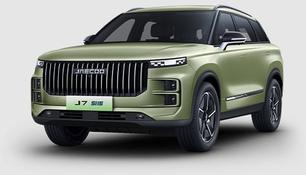
The J7 is, in essence, a scaled-up version of its smaller sibling, the J5 - a car my family affectionately dubbed the “Temu Range Rover” during our week with it. The resemblance remains.
The squared-off proportions, upright grille and slim lighting signatures lean heavily into that premium off-roader aesthetic, and there’s no doubt the look will appeal to buyers chasing presence without the associated price tag.
Compared to the J5, the J7 carries a touch more personality.
There’s a small racing-flag accent panel along the flanks, flush-fitting door handles and a set of 19-inch aerodynamic alloy wheels that add some visual flair.
Inside, the cabin is cleanly executed with its pared-back styling and the 13.2-inch central display dominates the dashboard. This makes it the visual anchor of the interior as physical buttons are minimal and most functions are accessed via the media screen. That screen-led design will divide opinion, but it does create a modern aesthetic.
The synthetic leather upholstery feels convincingly premium, and the materials do enough to lift the ambience beyond what you might expect at this price point.
The third Qashqai since the original took Europe by storm as the Pulsar hatch replacement in late 2006, the British-designed, engineered and built crossover uses a global Renault-Nissan-Mitsubishi Alliance transverse architecture.
As a result, achieving best-possible efficiency was a priority, with weight-saving, body-beefing aluminium deployed in the doors, bonnet and front guards.
Though an ageing design (launching in Europe back in 2021), a deft facelift in 2024 has kept the nicely proportioned and detailed design relatively fresh inside and out.
Size wise we’re in big small SUV territory, with the Qashqai measuring 4425mm, 1835mm, 1625mm and 2665mm in length, width, height and wheelbase respectively. This makes it quite a roomy little SUV inside.
In Australia, the expense of British sourcing places the Nissan in premium territory, so the series now kicks off from the mid-spec ST-L grade, bringing softer-touch materials, larger screens and more equipment as standard, raising the ambience somewhat.
Up front, the J7 Track delivers where it matters. The electric front seats offer heating and ventilation functions and feel supportive over longer drives. There’s enough width and shoulder room to avoid feeling hemmed in.
Access is good with wide door apertures and an easy step-in, step-out height from both rows. In the rear, the available space is generous, and the thick seat padding and supportive backrests will make longer journeys quite comfortable. The flat floor also means the middle seat isn’t automatically the punishment position for an adult.
Storage has been thoughtfully considered. Up front, the large centre console shelves make it easy to keep clutter contained, while the dual-opening middle console is deep enough to swallow a small handbag. There’s also a small side pocket beside the driver that’s ideal for keys or a garage remote.
Rear passengers will enjoy four device pockets, as well as a couple of map pockets. There are two cupholders and drink bottle holders in each row, as well as good-sized bins in each door.
With all rows in use, the boot has up to 500L of capacity, and the flat loading floor makes it easy to slide larger items in and out. Overall, it’s a usable and practical space for gear storage but you'll notice the lack of a powered tailgate as there isn't a dedicated handhold on the outside of the lid to easily open the boot.
There's also no charging ports or power outlets in the boot, which feels unusual for a plug-in hybrid. You have to make do with a tyre repair kit rather than a spare wheel but that's not unusual in this corner of the market.
The individual charging options are functional with a single USB-A and C port offered in each row and a 12-volt socket up front but you miss out on a wireless charging pad in this grade. The multimedia touchscreen is responsive and the layout is fairly intuitive to use. However, the lack of physical controls for simple adjustments like side mirror positioning or climate control can become frustrating. Some functions are just better served by buttons.
The wireless Apple CarPlay and Android Auto operate smoothly and the CarPlay has maintained a steady connection this week. The built-in sat nav is also easy enough to use.
Now Nissan’s smallest model in Australia if you discount the delightful Z sports car, the Qashqai feels like an SUV from the next-class up in terms of front-seat comfort and space, with true room to move.
Now while it may be getting on a bit now, lacking the dominating, screen-heavy displays of newer rivals (especially those from China and Germany), the current model’s interior design and layout remains a masterclass in style, functionality, refinement and quality. This is also quieter than before.
In fact, the Qashqai is very difficult to fault from the (supportively cushy) driver’s seat.
All controls are within easy reach, revealing the crossover’s excellent ergonomics, backed up by good vision all round, and ably aided by the helpful new surround-view camera set-up.
The multi-configurable crystal-clear instrumentation and the joy of actual switchgear and buttons are further bonuses.
This isn’t to say that that the touchscreen doesn’t play a major role here, as most of the vehicle and all multimedia functions are accessed quickly via the electronic displays. It’s just that the balance between analogue and digital is considered and balanced.
Plenty of thought has also gone into storage, with wide door bins, a deep centre console and big glove box, along with the presence of a smartphone charging shelf, nearby USB ports and handy cupholders. And the same applies for the natty little gear selector – once the driver masters it.
The only real bugbears are that the air conditioning seemed faulty in our test car, refusing to cool the vehicle down unless the coldest setting was selected. This has also inflicted the brand’s other recent SUVs. Is there an electrical issue going on, Nissan?
Plus, over-the-shoulder vision is pretty poor – a corollary of the sloping roofline and small back windows.
Moving to the rear seat area, both the non-reclinable backrests and non-slidable cushions are adequately supportive as well as spacious enough for most people, though taller folk will notice the limited knee room.
The expected array of amenities is present too, including air vents, USB-C ports, overhead grab handles, reading lights and a centre armrest with cupholders. Note the panoramic roof’s ability to flood the rear with light should not be underestimated, especially as it also comes with a blockout blind.
Moving into the boot area, the price to pay for all that e-Power efficiency is a shallower floor compared to the old turbo-petrol version. The Ti-L offers between 452 litres and 1376L of VDA capacity depending on whether the 60/40 backrest is up or not.
But, and this can be a deal breaker for some buyers, there is no spare wheel, just a tyre-repair kit, which is totally inadequate, shockingly costly to replenish and will completely destroy your expensive tyre.
Our advice is to consider the N-Design that comes with one, or get your friendly Nissan dealer to stump up for an aftermarket space-saver spare and jack combination kit.
There are two plug-in hybrid grades in the J7 line-up and we’re testing the entry-level Track here, priced at $43,990 drive-away. It’s a strategic price point because aside from its close relative, the Chery Tiggo 7 Super Hybrid, which undercuts it at $39,990 drive-away, the Track is the second-most affordable option among its immediate rivals.
By comparison, the GWM Haval H6 GT PHEV lists at $51,990 drive-away, while the MG HS Super Hybrid Excite comes in at $52,696 drive-away. The BYD Sealion 5 undercuts them all as the most affordable plug-in hybrid in the country right now, starting from $33,990 before on-road costs.
It’s worth noting that the H6 GT is offered in a single, well-specified grade, and its higher price reflects that broader equipment list. Even so, the J7 starts from a strong position before you get into its features.
For a base variant, the Track gets some good stuff like electric front seats with heating and ventilation, synthetic leather upholstery, remote start with pre-entry climate control and a full suite of LED exterior lighting. That’s the sort of kit you’d expect to climb trim levels for.
Practical touches are scattered throughout. The centre console is air-cooled, the driver’s seat has a memory function, there are steering wheel-mounted controls and dual-zone climate control comes as standard. Then there’s the built-in karaoke app. Entirely unnecessary, but mildly amusing, however, you will need to supply your own microphone!
Technology feels well-considered as there’s wired and wireless Apple CarPlay and Android Auto, built-in satellite navigation, a large 13.2-inch multimedia display and a 10.25-inch digital instrument cluster. The 360-degree camera system is clear and complemented by front and rear parking sensors.
You do miss out on a powered tailgate and some charging options as there’s no internal vehicle-to-load (V2L) AC outlet and no charging ports in the boot. Still, as a base offering, the J7 Track presents as a neat package.
How can a new model be both cheaper and more expensive than before?
When you add a $6725 less-expensive e-Power grade to make going hybrid cheaper, but then drop the old 1.3-litre turbo-petrol option across the range, that’s how.
Nissan says dropping the turbo was to help it dodge the Federal Government's New Vehicle Efficiency Standard (NVES) carbon pollution fines.
With the deletion of the old base ST petrol from $34,665 (all prices are before on-road costs), it’s now an $11,000 jump into Qashqai ST-L e-Power from $45,640. Which is new for 2026.
Other changes include a comprehensively improved hybrid powertrain offering more performance, less consumption and fewer emissions, a quieter interior, a better camera, extra advanced driver assist systems (ADAS) functionality and extended service intervals. More on those later on.
The ST-L includes dual-zone climate control, a 12.3-inch touchscreen, wireless Apple CarPlay and Android Auto, a 360-degree camera with under-bonnet view and better forward vision, a wireless charger, proximity key and a three-year connected app subscription, offering remote functionality, security alerts, location services and more.
On top of the $4000-extra Ti’s larger electronic instrumentation, powered driver’s seat, heated front seats, PVC/leather upholstery, ambient lighting, roof rails and 19-inch alloys, the more-luxurious Ti-L from $53,640 as tested gains quilted leather trim, massaging front seats, a head-up display, glass roof with sunshade, Bose audio upgrade and an inch-larger set of wheels. Another $500 adds the N-Design sports kit and blacked-out treatments, which really do look the part.
The Qashqai Ti-L delivers a lot of kit for the cash.
Small SUV alternatives swarm all over the Nissan, as it goes head-to-head with the Toyota C-HR, Subaru Crosstrek and Honda ZR-V hybrids, considered to be direct competitors.
There are also a litany of less-expensive rivals, including the Chery Tiggo 4, GWM Haval Jolion, Hyundai Kona, MG ZS and Toyota Corolla Cross hybrids.
It’s a good thing then that the Nissan has one or two unique traits that help make it stand out.
Both plug-in hybrid grades of the J7 share the same powertrain, pairing a 1.5-litre four-cylinder turbo-petrol engine with a single electric motor. Combined outputs sit at a healthy 255kW and 525Nm which is the same as its Chery cousin and makes it more powerful than its MG rival but the GWM Haval H6 GT has bigger outputs.
However, once the EV battery is depleted and the system leans more heavily on the petrol engine, the outputs drop significantly to 105kW and 215Nm. This shifts the J7 from feeling spritely to serviceable on the open road.
Power is sent exclusively to the front wheels, and towing capacity is rated at 750kg unbraked. That’s enough for a small box trailer but it won’t be hauling any serious weekend toys.
The biggest news for the 2026 Qashqai lays under the bonnet.
Being an e-Power, it still combines a 116kW/250Nm 1.5-litre, three-cylinder petrol-turbo engine.
Its job is to solely charge a 2.1kWh lithium-ion battery, with a 140kW/311Nm electric motor that alone drives the front wheels via a single-speed reduction-drive transmission.
But this plugless powertrain now features a 'five-in-one' hybrid set-up that integrates the electric motor, generator, inverter, increaser and reducer into a single and compact unit, helping to save weight and boost efficiency between components. There’s also a revised combustion set-up, ditching the old variable compression tech.
Up to a 0.7 litre per 100km average fuel-consumption drop, along with a 10 per cent power boost in Sport mode, are the headline improvements.
Combined outputs are rated at 140kW of power from 4900rpm to 5900rpm, or 151kW in Sport, while torque tops out at 311Nm from 0-3600rpm.
The numbers are much the same as before, but Nissan says this is a redesigned, third-generation e-Power system, and it debuts for Australia in the 2026-model Qashqai first.
Braked towing capacity remains at just 750kg.
The J7 Track has a Type 2 CCS charging port and accepts up to 6.6kW on AC power and up to 40kW on fast DC power. On that type of DC charger you can go from 30 - 80 per cent in as little as 20 minutes which is great for when you’re on the go. You can shop and charge without much fuss.
The 18.3kWh lithium-iron phosphate battery supports an electric-only driving range of up 90km (WLTP). That sits below its Haval and MG rivals with their respective WLTP ranges of 153km and 120km. Overall though, the J7 has a theoretical driving range over around 1200km, which is great. Of course, you will only see that type of range if you regularly charge it.
Jaecoo claims a combined fuel cycle usage (urban/extra-urban) of 1.0L/100km but my real-world usage has come out at 5.0L/100km even after regularly charging it. However, it's worth noting that I do a lot of longer, highway driving which is where plug-in hybrids are typically less efficient.
Jaecoo recommends a minimum 91 RON unleaded petrol to be used for the J7.
Nissan claims the e-Power averages just 4.1L/100km, down from 4.8L/100km, for a carbon-dioxide emissions rating of 98 grams/km.
Around town that drops to 3.8L/100km and rises to 4.3L/100km out on the highway run.
Helping out economy is the one-pedal driving function, that acts as a dynamo to slow the car down (not to a full stop, mind) while providing some additional battery recharge via a press of a button.
Brimming the 55L fuel tank with the required 95 RON premium unleaded petrol, expect a range of up to 1340km (up from 1140km) between refills.
In practice, driving in heavy city traffic and on fast motorway roads alike, we averaged 6.7L/100km, though this did include some fast driving on challenging, rural roads. The trip meter indicated 5.0L/100km.
This is where the J7 Track feels less resolved. It's not fundamentally flawed by any means but it's not as polished as it could be.
With a charged battery, acceleration is strong and immediate, and there’s enough punch for hills and confident overtaking. Even when the battery is running low, the drop in output doesn’t feel as dramatic in real-world conditions as the standalone engine figures might suggest. You won't win any drag races but it remains competent. It just loses some of the initial punch when accelerating.
Steering is light, which makes urban manoeuvring easy, and the suspension leans toward the softer side. Around town, that translates to a comfortable and compliant ride. Push it harder through bends, though, and the body control starts to feel a little loose.
Highway refinement is another area where there’s room for improvement. Road noise becomes noticeably more present at open-road speeds, although it remains quiet around town.
Visibility out the front and sides is good, and the driving position gives you a fairly commanding view of the road. I don’t feel like there are any large blind spots from my driving position.
There are three levels of regenerative braking, and running it in the strongest setting does a good job of harvesting energy. However, even on the lowest setting, the braking response feels abrupt. At low speeds when the system tends to remain in EV mode, the transition can feel lurchy.
The 360-degree camera system is clear and outside of the heavy-handed regen braking, the J7 is straightforward to park. Just be prepared for passengers, especially opinionated children, to comment on the body movement.
Jumping from the previous Qashqai e-Power to the latest version is telling, as the MY26 upgrades do seem to have altered the Nissan’s character a little.
Keeping in mind we are in the big-wheeled Ti-L at nearly $60K drive-away, we approached this test with higher expectations, as this is firmly into premium small SUV territory.
Yet, from the moment we pressed the start button, the Qashqai impressed us with its quietness and refinement.
Off-the-line acceleration is pure EV, meaning immediate response thanks to a wave of instant torque, at least initially, and followed by a silent yet lively performer, with plenty in store should the need arise for a speedy overtaking manoeuvre.
The e-Power is particularly rapid if you need to plug shrinking gaps in traffic.
After a while, the petrol-engine generator kicks in. At first, it’s noticeable, because the electric drivetrain is so hushed and the peace is thus breached, but you soon become used to it. And, yes, in the Ti-L at least, it’s much quieter than before.
Using the throttle when the e-Power is in hybrid mode doesn’t seem as disconnected as before, with the battery recharging at a fairly steady rev rate while the electric motor continues to do the driving. The whole transition between pure EV and range-extender EV is fairly seamless.
The e-Power offers three driving modes – Eco, Normal and Sport. Initially, the Qashqai’s performance did not feel as eager as before, but a solid prod of the throttle does prove otherwise, with plenty of power coursing through the front wheels in either of the first two settings.
Choosing Sport does liven things up noticeably, with clearly quicker speed as a result of that 10 per cent kilowatt hike.
While we would prefer a set of paddle shifters to do the job, the E-Pedal regenerative-braking system that helps provide some off-throttle slowing down works well enough around town, though a full stop in a timely manner isn’t possible.
Meanwhile, brandishing a MacPherson-style strut front and multi-link rear suspension set-up, the Qashqai’s steering is beautifully weighted and nicely balanced, meaning that it’s light enough for easy round-town manoeuvrability yet agile and planted for fun fast cornering handling. It isn’t a lightweight machine at 1705kg, but the chassis is fluid enough to entertain the keen driver. There’s definitely a European flair to this Japanese-branded British car’s dynamic attitude.
Even the ADAS tech works away quietly, nicely tuned for local conditions and barely bothering the Nissan’s occupants, though there is some intrusive lane-keep alert interference at times.
We’ve driven many Qashqais since 2022, and the 20-inch wheeled Ti-L (and N-Design) is probably the least comfortable of the available size options, lacking the suppleness of the smaller alternatives. It manages to smother the higher-frequency bumps, but feels a tad too firm over larger humps. Not bad, but for this reason alone we’d probably go Ti only and forsake some of the little luxuries.
Still, the Qashqai is a satisfying, well-resolved small SUV to drive, with the e-Power adding a veneer of smooth, slick sophistication that helps elevate the experience.
The J7 plug-in hybrid variant has a maximum five-star ANCAP safety rating from testing done in 2025 and scored well across its individual criteria with an 81 per cent for its adult protection, 85 per cent for child protection, 80 per cent for vulnerable road user and 84 per cent for its safety assist.
Passive safety items include eight airbags including a front centre airbag and drivers’ knee airbag. Families will like that there are two ISOFIX child seat mounts and three top-tether anchor points but realistically, two child seats will fit best. There are also manual child-safety locks on the doors, powered locks for the rear windows and intelligent seatbelt reminders for all five seats. Parking is easy with the front and rear parking sensors and 360-degree view camera system.
Active safety includes forward and rear collision warning, lane keeping aids, lane departure warning and prevention, blind-spot detection, side exit assist and a relatively unobtrusive driver monitoring system.
Other highlights include emergency lane keeping, which will activate when there’s no response from the driver and the rear cross-traffic alert also gets assisted braking. The lane keeping can oversteer at times and the adaptive cruise control is best without the assisted steering on. The J7 misses out on emergency call capability but otherwise, the safety equipment feels pretty robust.
There’s autonomous emergency braking with car, pedestrian and motorcyclist detection and is operational from 4.0 – 85km/h and up to 134km/h for car detection but it is more typical to see that top figure closer to 180km/h.
Though the pre-MY26 Nissan Qashqai achieved a five-star ANCAP rating, more stringent crash-test protocols have seen a drop to four stars for the latest version.
Scoring a high 91 per cent rating for Child Occupant Protection, it slipped to 78 per cent for Adult Occupant Protection, 68 per cent for Vulnerable Road User Protection and just 62 per cent for Safety Assist.
The Qashqai Ti-L e-Power is fitted with autonomous emergency braking (AEB) offering pedestrian, cyclist and back-over detection, as well as lane support systems including lane-keep alert/assist, blind-spot monitoring, a driver fatigue monitor, auto high beams, traffic sign recognition, adaptive cruise control, parking sensors, seven airbags including full outboard side/head protection and a front-centre item, and a vehicle approach sound for pedestrians and cyclists.
The car-to-car AEB operates from 5-130km/h, pedestrian and cyclist AEB from 10-80km/h, and the lane support systems between 60-250km/h.
Finally, the Qashqai features ISOFIX child-seat latches fitted to the outboard rear seat positions, while a trio of top tethers for straps are included across the rear bench.
The Chinese lucky number '8' is heavily featured in the ownership as the J7 is offered with an eight-year/unlimited km warranty, eight years of battery cover and roadside assistance, plus eight years of capped-price servicing where services average just $422 per visit. That's an impressive suite of terms for the class.
Servicing is well-spaced at every 12 months or 15,000 kilometres and for now the service network is still fairly small, with around 50 centres nationwide.
The Qashqai comes with a regular five-year/unlimited kilometre warranty with roadside assistance, but that can increase up to 10 years (and 300,000km) if the vehicle is serviced annually and on time at an authorised Nissan dealer.
Furthermore, the first five years cost $399 per service as part of Nissan’s capped-price servicing regime.
Service intervals are at every 15,000km or 12 months, whichever comes first.
Finally, there are about 180 dealers dotted around Australia.