What's the difference?
Jaecoo has entered the medium SUV space with the J7, pairing a plug-in hybrid powertrain with a sharply positioned price tag. On paper, it’s a compelling formula; electrified efficiency without the 'premium'.
But the J7 doesn’t arrive in a vacuum. It sits above its smaller sibling, the J5, and goes head-to-head with some increasingly polished rivals - the mechanically related Chery Tiggo 7 Super Hybrid, GWM Haval H6 GT PHEV, MG HS Super Hybrid and now the BYD Sealion 5. And all of them are chasing the same buyer.
So the question isn’t just whether the J7 is good value. It’s whether it carves out a clear identity of its own in a segment that’s quickly filling up.
For the first time in Australia, the mid-sized Hyundai Tucson is being offered with a hybrid powertrain – which combines its spritely turbo-powered engine with a fuel efficiency-improving electric motor. And it might be enough to swing you to becoming a hybrid fan.
The new powertrain makes the Tucson a proper competitor against Australia’s darling, the Toyota RAV4 but the Nissan X-Trail e-Power and Kia Sportage remain strong rivals.
This week I’m family-testing the mid-spec Elite Hybrid with the N Line option pack to see how the newly updated Tucson handles family life.
The Jaecoo J7 SHS Track enters the medium SUV segment with a sharp drive-away price and generous equipment list. The ongoing ownership benefits add strong value but the on-road driving experience needs some finessing and the cabin doesn't quite hit every mark for practicality. Although it's ‘on track’ to make waves in this corner of the market, it hasn't yet carved out an iron-clad niche for itself. It's worth a look but it's not class-leading.
The updated Hyundai Tucson Elite Hybrid N Line offers families space, features and easy-enough handling for everyday stuff and the occasional weekend adventure pursuits.
The price point is higher than the previous non-hybrid model but you get a lot of bang for your buck and my family was comfortable this week.
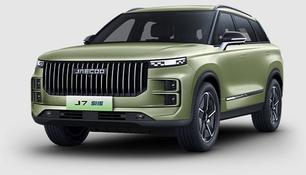
The J7 is, in essence, a scaled-up version of its smaller sibling, the J5 - a car my family affectionately dubbed the “Temu Range Rover” during our week with it. The resemblance remains.
The squared-off proportions, upright grille and slim lighting signatures lean heavily into that premium off-roader aesthetic, and there’s no doubt the look will appeal to buyers chasing presence without the associated price tag.
Compared to the J5, the J7 carries a touch more personality.
There’s a small racing-flag accent panel along the flanks, flush-fitting door handles and a set of 19-inch aerodynamic alloy wheels that add some visual flair.
Inside, the cabin is cleanly executed with its pared-back styling and the 13.2-inch central display dominates the dashboard. This makes it the visual anchor of the interior as physical buttons are minimal and most functions are accessed via the media screen. That screen-led design will divide opinion, but it does create a modern aesthetic.
The synthetic leather upholstery feels convincingly premium, and the materials do enough to lift the ambience beyond what you might expect at this price point.
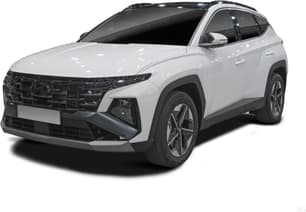
The Hyundai Tucson has seen a minor facelift on the exterior but most of the changes are in the cabin.
The N Line pack means that you get 19-inch alloy wheels over the standard 18-inch version as well as extended body panelling instead of black plastic trims. There is N Line badging across the car too, but N Line option pack does limit you to just four exterior colour choices.
The front features new stacked LED DRLs which tie in with the fang-like design of the rear LEDs. The origami-styled panelling looks more severe than the previous model which helps it stand out in a class that’s heavy on rivals.
The cabin features a completely reconfigured dashboard and now sports a large curved display panel that houses those upgraded tech screens and a new 6.6-inch climate control panel.
The centre console has been redesigned to look like it’s floating and now adds an extra-large storage cubby underneath it.
The upgraded interior makes the Tucson a leader for the mid-sized SUV segment and is very pleasant to spend time in.
Up front, the J7 Track delivers where it matters. The electric front seats offer heating and ventilation functions and feel supportive over longer drives. There’s enough width and shoulder room to avoid feeling hemmed in.
Access is good with wide door apertures and an easy step-in, step-out height from both rows. In the rear, the available space is generous, and the thick seat padding and supportive backrests will make longer journeys quite comfortable. The flat floor also means the middle seat isn’t automatically the punishment position for an adult.
Storage has been thoughtfully considered. Up front, the large centre console shelves make it easy to keep clutter contained, while the dual-opening middle console is deep enough to swallow a small handbag. There’s also a small side pocket beside the driver that’s ideal for keys or a garage remote.
Rear passengers will enjoy four device pockets, as well as a couple of map pockets. There are two cupholders and drink bottle holders in each row, as well as good-sized bins in each door.
With all rows in use, the boot has up to 500L of capacity, and the flat loading floor makes it easy to slide larger items in and out. Overall, it’s a usable and practical space for gear storage but you'll notice the lack of a powered tailgate as there isn't a dedicated handhold on the outside of the lid to easily open the boot.
There's also no charging ports or power outlets in the boot, which feels unusual for a plug-in hybrid. You have to make do with a tyre repair kit rather than a spare wheel but that's not unusual in this corner of the market.
The individual charging options are functional with a single USB-A and C port offered in each row and a 12-volt socket up front but you miss out on a wireless charging pad in this grade. The multimedia touchscreen is responsive and the layout is fairly intuitive to use. However, the lack of physical controls for simple adjustments like side mirror positioning or climate control can become frustrating. Some functions are just better served by buttons.
The wireless Apple CarPlay and Android Auto operate smoothly and the CarPlay has maintained a steady connection this week. The built-in sat nav is also easy enough to use.
The cabin up front is spacious with plenty of head- and legroom on offer. You also won’t jostle for elbow room either when you have a passenger.
The seats are comfortable with their heat function but you might still get fatigue on longer trips as you only get adjustable lumbar on the drivers side and it's simple at best.
The back seat has really good space for the class and no matter the passenger, they were comfortable back there. The seats in the rear are well-padded and access to this row is good for sliding in a child seat as the door aperture is wide.
Other amenities are average with directional air-vents, a single reading light, and a fold-down armrest. My seven-year-old son found the window sills to be quite high, so he didn’t get the view he wanted.
The individual storage is excellent for the class with the redesign as you get a dedicated storage shelf in front of the front passenger and a massive cubby that easily fits a handbag underneath the mid-sized centre console.
There are two cupholders and two drink bottle holders per row but the rear storage bins are skinny. The rear row also gets map pockets but again, these are shallow.
The upgraded technology is a must have and the new multimedia system is easy to use once you spend time with it and looks great with its graphics. The system has built-in satellite navigation, over-the-air updates and wireless connectivity for Apple CarPlay and Android Auto.
Connecting the CarPlay is simple and maintains a strong connection.
Charging options are great with two USB-C ports per row and the front also gets a wireless charging pad and a 12-volt socket to choose from. The centrally located position of the charging pad is handy and the liner grippy - so no phone movement.
Rounding out the practicality is the boot, which has a wide aperture and a loading space level with 582L of capacity available with all seats in use, which is good for the class.
The back row has a 60/40 split but don’t fold flat – they sort of spring up a bit, which might annoy when you do a big Bunnings run.
There is a 12-volt socket, a space-saver spare tyre underneath the floor and you get a powered tailgate in this model – which I always like.
There are two plug-in hybrid grades in the J7 line-up and we’re testing the entry-level Track here, priced at $43,990 drive-away. It’s a strategic price point because aside from its close relative, the Chery Tiggo 7 Super Hybrid, which undercuts it at $39,990 drive-away, the Track is the second-most affordable option among its immediate rivals.
By comparison, the GWM Haval H6 GT PHEV lists at $51,990 drive-away, while the MG HS Super Hybrid Excite comes in at $52,696 drive-away. The BYD Sealion 5 undercuts them all as the most affordable plug-in hybrid in the country right now, starting from $33,990 before on-road costs.
It’s worth noting that the H6 GT is offered in a single, well-specified grade, and its higher price reflects that broader equipment list. Even so, the J7 starts from a strong position before you get into its features.
For a base variant, the Track gets some good stuff like electric front seats with heating and ventilation, synthetic leather upholstery, remote start with pre-entry climate control and a full suite of LED exterior lighting. That’s the sort of kit you’d expect to climb trim levels for.
Practical touches are scattered throughout. The centre console is air-cooled, the driver’s seat has a memory function, there are steering wheel-mounted controls and dual-zone climate control comes as standard. Then there’s the built-in karaoke app. Entirely unnecessary, but mildly amusing, however, you will need to supply your own microphone!
Technology feels well-considered as there’s wired and wireless Apple CarPlay and Android Auto, built-in satellite navigation, a large 13.2-inch multimedia display and a 10.25-inch digital instrument cluster. The 360-degree camera system is clear and complemented by front and rear parking sensors.
You do miss out on a powered tailgate and some charging options as there’s no internal vehicle-to-load (V2L) AC outlet and no charging ports in the boot. Still, as a base offering, the J7 Track presents as a neat package.
There are now six variants for the Hyundai Tucson with the release of the hybrid powertrain and all six have the choice of being either a front-wheel-drive or all-wheel drive with either the petrol engine or hybrid powertrain. And every grade gets the option of adding the N Line style pack. So, there is no excuse for not getting the combo you actually want now.
The model on test is the mid-spec Elite Hybrid with the N Line option pack and its priced from $55,100 before on-road costs. That positions it towards the top end of the market but you get an SUV that's more feature-heavy than most of its rivals.
The standard equipment for the upgraded Elite Hybrid N Line now includes dual 12.3-inch technology screens, wireless Apple CarPlay and Android Auto, as well as a 6.6-inch climate control touchpad.
Other equipment includes a powered driver’s seat, heated front seats, suede/leather upholstery, dual-zone climate control, wireless charging pad, digital radio, four USB-C ports, keyless entry, push-button start, space-saver spare wheel and a powered tailgate.
The Kia Sportage SX hybrid is more affordable at $45,950 MSRP but unlike the Elite Hybrid it misses out on wireless connectivity for phone charging and phone integration apps.
The Toyota RAV4 XSE AWD is priced from $52,585 MSRP but misses out on the newer and bigger technology screens that the upgraded Elite Hybrid has.
The Nissan X-Trail Ti 4WD e-Power is the closest rival in terms of price ($55,090 MSRP) and available features.
Both plug-in hybrid grades of the J7 share the same powertrain, pairing a 1.5-litre four-cylinder turbo-petrol engine with a single electric motor. Combined outputs sit at a healthy 255kW and 525Nm which is the same as its Chery cousin and makes it more powerful than its MG rival but the GWM Haval H6 GT has bigger outputs.
However, once the EV battery is depleted and the system leans more heavily on the petrol engine, the outputs drop significantly to 105kW and 215Nm. This shifts the J7 from feeling spritely to serviceable on the open road.
Power is sent exclusively to the front wheels, and towing capacity is rated at 750kg unbraked. That’s enough for a small box trailer but it won’t be hauling any serious weekend toys.
The Elite Hybrid N Line model features a hybrid powertrain that combines an electric motor with a 1.6-litre four-cylinder turbo-petrol engine. They combine to produce 172kW of power and 367Nm of torque. Which is more than enough to make the mid-sized Tucson feel spirited.
This particular variant is AWD and uses a six-speed automatic transmission, which can over rev at times but is mostly smooth with its gear changes.
The J7 Track has a Type 2 CCS charging port and accepts up to 6.6kW on AC power and up to 40kW on fast DC power. On that type of DC charger you can go from 30 - 80 per cent in as little as 20 minutes which is great for when you’re on the go. You can shop and charge without much fuss.
The 18.3kWh lithium-iron phosphate battery supports an electric-only driving range of up 90km (WLTP). That sits below its Haval and MG rivals with their respective WLTP ranges of 153km and 120km. Overall though, the J7 has a theoretical driving range over around 1200km, which is great. Of course, you will only see that type of range if you regularly charge it.
Jaecoo claims a combined fuel cycle usage (urban/extra-urban) of 1.0L/100km but my real-world usage has come out at 5.0L/100km even after regularly charging it. However, it's worth noting that I do a lot of longer, highway driving which is where plug-in hybrids are typically less efficient.
Jaecoo recommends a minimum 91 RON unleaded petrol to be used for the J7.
The official combined cycle fuel consumption figure is a low 5.3L/100km, and my real-world usage came out at 6.0L after doing a lot of open-road driving where hybrids tend to be at their least efficient, so that is an excellent result.
The Tucson hybrid is the second best for fuel usage after the Toyota RAV4 hybrid, which sits at 4.8L/100km for combined usage. Overall, the new hybrid powertrain has proven itself to be pretty frugal.
Based on the official combined fuel cycle and 53L fuel tank, expect a theoretical driving range of up to 981km, which is great for a family road tripper.
This is where the J7 Track feels less resolved. It's not fundamentally flawed by any means but it's not as polished as it could be.
With a charged battery, acceleration is strong and immediate, and there’s enough punch for hills and confident overtaking. Even when the battery is running low, the drop in output doesn’t feel as dramatic in real-world conditions as the standalone engine figures might suggest. You won't win any drag races but it remains competent. It just loses some of the initial punch when accelerating.
Steering is light, which makes urban manoeuvring easy, and the suspension leans toward the softer side. Around town, that translates to a comfortable and compliant ride. Push it harder through bends, though, and the body control starts to feel a little loose.
Highway refinement is another area where there’s room for improvement. Road noise becomes noticeably more present at open-road speeds, although it remains quiet around town.
Visibility out the front and sides is good, and the driving position gives you a fairly commanding view of the road. I don’t feel like there are any large blind spots from my driving position.
There are three levels of regenerative braking, and running it in the strongest setting does a good job of harvesting energy. However, even on the lowest setting, the braking response feels abrupt. At low speeds when the system tends to remain in EV mode, the transition can feel lurchy.
The 360-degree camera system is clear and outside of the heavy-handed regen braking, the J7 is straightforward to park. Just be prepared for passengers, especially opinionated children, to comment on the body movement.
The new hybrid powertrain offers respectable power delivery that makes the Tucson feel zippy in the city and a relaxed cruiser on the open road.
There can be some over-revving when you’re trying to get up to speed and the accelerator and brake feel touchy at first until you get used to them.
On the hybrid side of things the Elite Hybrid has regenerative braking and there are moments of pure EV mode but it kicks in seemingly when it feels like it. When it is on, there’s practically no engine noise but when it's off, the cabin still remains fairly quiet.
My family went off the paved stuff this week and hit muddy and gravel roads on our quest to find a cool picnic spot, and the Elite Hybrid impressed with how it handled the different terrains. It’s not an off-roader but you can still do mini adventures.
The Tucson is mid-sized and has a very clear reversing camera with front and rear parking sensors, so it’s not too hard to manoeuvre or park.
The real negative feedback is that on three separate occasions, our test car randomly shifted into neutral while driving and to clarify, this did not occur while trying to shift into or out of 'drive' but while on the road, already in drive.
The first time it happened, I thought I had somehow bumped the column shifter but on the other two occasions, I happened to be watching my husband drive and he didn’t touch the shifter.
This is probably just a fault on out test car and not indicative of the model in general but it wasn't fun.
The J7 plug-in hybrid variant has a maximum five-star ANCAP safety rating from testing done in 2025 and scored well across its individual criteria with an 81 per cent for its adult protection, 85 per cent for child protection, 80 per cent for vulnerable road user and 84 per cent for its safety assist.
Passive safety items include eight airbags including a front centre airbag and drivers’ knee airbag. Families will like that there are two ISOFIX child seat mounts and three top-tether anchor points but realistically, two child seats will fit best. There are also manual child-safety locks on the doors, powered locks for the rear windows and intelligent seatbelt reminders for all five seats. Parking is easy with the front and rear parking sensors and 360-degree view camera system.
Active safety includes forward and rear collision warning, lane keeping aids, lane departure warning and prevention, blind-spot detection, side exit assist and a relatively unobtrusive driver monitoring system.
Other highlights include emergency lane keeping, which will activate when there’s no response from the driver and the rear cross-traffic alert also gets assisted braking. The lane keeping can oversteer at times and the adaptive cruise control is best without the assisted steering on. The J7 misses out on emergency call capability but otherwise, the safety equipment feels pretty robust.
There’s autonomous emergency braking with car, pedestrian and motorcyclist detection and is operational from 4.0 – 85km/h and up to 134km/h for car detection but it is more typical to see that top figure closer to 180km/h.
FINALLY! Hyundai has listened to the people.
They have found a workaround for the annoyingly intrusive beeping alerts associated with the traffic sign recognition and speed alert tech. Yes, they still alert unless you turn them off and yes, you still have to turn the damn thing off every time you get in the car, but you not longer have to access five to six menu pages to do so. Hurrah.
The Hyundai Tucson Elite Hybrid N Line has a robust safety features list and includes equipment like blind spot monitoring, driver attention monitoring, safe exit warning, rear occupant alert, forward collision warning, LED daytime running lights, rear cross-traffic alert, lane keeping aid, traffic sign recognition, intelligent seatbelt warning, adaptive cruise control, a reversing camera, and front/rear parking sensors.
Our test model misses out on lane departure alert and the lane keeping aid is too intrusive for every day driving. It gets to the point where you wonder who is driving, you or the car.
The Hyundai Tucson has a maximum five-star ANCAP safety rating from testing done in 2021 and the hybrid variants are covered by this as well. It has seven airbags, including, the newer front centre airbag.
The Tucson has two ISOFIX child seat mounts and three top-tethers.
Auto emergency braking (AEB) is standard and features car, pedestrian, cyclist and junction assist detection which is operational from 5.0 – 80km/h (85km/h for car) but it's usual to see a higher top speed for the car detection (usually 180km/h).
The Chinese lucky number '8' is heavily featured in the ownership as the J7 is offered with an eight-year/unlimited km warranty, eight years of battery cover and roadside assistance, plus eight years of capped-price servicing where services average just $422 per visit. That's an impressive suite of terms for the class.
Servicing is well-spaced at every 12 months or 15,000 kilometres and for now the service network is still fairly small, with around 50 centres nationwide.
Hyundai offers the Tucson with a five-year/unlimited km warranty and the battery is covered by an eight-year/160,000km warranty which is pretty standard for the class now.
You can pre-purchase servicing for up to five years and the breakdowns are as follows.
Three years or up to 30,000km for $1240 (average $413 per service).
Four years or up to 40,000km for $1700 (average $425 per service).
Five years or up to 50,000km for $2040 (average $408 per service).
The five-year pricing is comparable to its rivals and not outrageous for the class.
Servicing intervals could get annoying if you put a lot of kilometres on your car as they sit at every 12 months or 10,000km, whichever occurs first.