What's the difference?
Yep, it’s yet another new brand. And, yes, it’s from China.
You can be forgiven for not keeping up with the influx of new car brands in recent years, even as a professional I can find it challenging at times. But that’s why we’re here, to help you determine which brands to pay attention to and which ones you can probably ignore.
So which one is Jaecoo?
Well, the good news for the brand is that it comes from one of China’s biggest and most successful car companies, Chery, which has been a leading exporter for more than two decades, so it has a reasonable understanding of international markets.
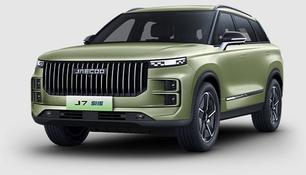
Jaecoo is designed to be a separate, stand-alone brand from Chery, and in Australia will be sold at specific Omoda-Jaecoo dealerships (as the Omoda 5 is also spun-off into yet another ‘new’ brand). The Jaecoo J7 we’re driving here is its first model, a mid-size SUV that will compete directly against the likes of the BYD Sealion 6, Toyota RAV4, Hyundai Tucson and more.
Because despite management referring to Jaecoo as a “luxury” brand and calling the J7 a “premium SUV” that’s all within the context of the Chery universe. Jaecoo is simply a more premium alternative to Chery, not a true luxury brand that will challenge the likes of Lexus, Mercedes-Benz and the rest on quality and, as you’ll soon see, price.
We’ve already sampled the entry-level J7 2WD but now we’re getting to experience the 4WD and range-topping SHS, which stands for Super Hybrid System, but is better known as a plug-in hybrid. The SHS is the model we spent the most time in and that’s what we’ll focus on in this review.
Chery/Jaecoo executives say that what it calls ‘new elites’ - people that are “moving up in the world” and are looking for a “fashionable” and “cool” car - are the target market. But as we’ll explain, the market for the J7 is likely to be much broader than just the fashionable elite and cool kids.
There has never been a better time to be shopping for an electric SUV in Australia, with the avalanche of Chinese brands constantly smashing through the price floor as they bid for the title of Australia’s cheapest.
MG led the charge with its S5, which is $40,490, drive-away. Then Leapmotor upped (or downed?) the ante with its B10 with a $38,990, drive-away, price tag. And now BYD has knocked them both out with its Atto 2, officially Australia’s cheapest electric SUV (at least for now), with a MSRP of $31,990, which, in NSW, translates to a drive-away cost of less than $35K.
Cheap is one thing. But cheerful? Let’s find out, shall we?
Based on our initial drive I certainly think the J7, especially the SHS Summit, does make a pretty compelling case to be on the consideration list for anyone looking to buy a mid-size hybrid SUV - plug-in or not.
It has a polished design, loads of tech and a fuel-efficient powertrain that provides adequate performance. But the real selling point is the price, which undercuts its key rivals to ensure it has your attention, especially in these days of increasingly expensive family vehicles.
And while the J7 certainly has appeal to design-oriented buyers and people that want something ‘cool’ or just different, the value it offers gives it mainstream appeal.
Note: CarsGuide attended this event as a guest of the manufacturer, with accommodation and meals provided.
The BYD Atto 2 isn't just the cheapest electric SUV in Australia, it's also one that doesn't feel all that cheap, which is a hell of a magic trick. If it's easy, comfortable city motoring you're after, the Atto 2 delivers in spades. But if your blood type is high octane, there are better driving EVs out there.
Note: CarsGuide attended this event as a guest of the manufacturer, with meals provided.
Note: The author, Andrew Chesterton, is a co-owner of Smart As Media, a content agency and media distribution service with a number automotive brands among its clients. When producing content for CarsGuide, he does so in accordance with the CarsGuide Editorial Guidelines and Code of Ethics, and the views and opinions expressed in this article are solely those of the author.
Design is an interesting subject to discuss with the J7, as it manages to simultaneously have a bold and distinctive look from some angles and yet has clearly been inspired by some other, more famous, premium brands from others.
To be blunt, from certain angles - namely the side profile and rear three-quarter - the J7 could be mistaken for a Range Rover Evoque at a distance. Obviously taking inspiration from rivals is nothing new in the car industry and the Jaecoo designers have also managed to give the J7 its own look when you get a bit closer and notice the details.
The most noticeable of these is the ‘waterfall-like’ grille, that the brand says symbolises “the life force of nature”, but also gives it a front profile that can’t be mistaken for anything else. Especially with the prominent ‘Jaecoo’ badge large and proudly placed in the middle of the grille - leaving you in no doubt what this is.
Overall, I’d call the exterior look of the J7 cohesive and leaving a more premium impression that what we’ve seen with Chery.
Inside, Jaecoo has followed the modern trend of going digital, with a small digital instrument display and then a larger central touchscreen. It provides a clean, modern look that leaves a good impression.
The Jaecoo designers also focused their attention on the touchpoints, elements like the door handles and arm rests, to try and give them a more premium feel. The trims used inside are also a cut above what we’ve experienced on other Chery models, and while not at a true luxury level, do stand out for what is a mainstream SUV.
One other major element of the SHS interior design worth mentioning is the central console, between the front seats. That’s because it’s unique in the SHS, offering a completely different layout to the petrol-powered models. The SHS moves the gear selector to the steering column, freeing up more small item storage space and cup holders, as well as a split-opening central storage box (instead of a rear-hinged one).
I think it’s a sharp-looking thing, this Atto 2. Kudos to BYD for not making the design look like it’s trying too hard, or like the Atto 2 is something it isn’t. It’s just smooth, sensible small SUV with styling that looks like it will age gracefully.
I like the chunky black moulding which makes it look a bit tougher than it is, plus the LED DRLs and swept back (and spoiler-equipped) roofline add a bit of visual drama.
Inside, BYD has made two pretty good choices. The first is that the cabin feels toned down from the one in the Atto 3 (which is all chunky wheel-style controls and vents).
This one feels far more sedate and conventional in its design, which I think is a win.
The other good decision is to equip the Atto 2 with soft plastics, rather than hard scratchy ones, in places like the door panels. In some cheaper cars, you feel your elbows constantly rubbing against cheap-feeling plastics, but that’s not the case here.
Too much stuff is still controlled through that central screen, and BYD has an awkward way of shortcutting functions. They call it a three-finger swipe, meaning that if you run three fingers across the screen horizontally you can adjust the climate-control’s fan speed, while swiping horizontally adjusts temp, but it feels like a weird movement.
From a space perspective the J7 offers up reasonable room for an SUV of this size, but falls short of the class-leaders in a few key areas. The front seats are nice and comfortable, and while the rear seats are well-appointed (with air-con vents and USB inputs) space is adequate rather than generous.
The same can be said about the boot, at least on the SHS grade. It’s on the smaller side for an SUV of this size, measuring 500 litres, compared to 542 litres offered by the RAV4 and 574 litres in the Sealion 6. And it’s even more disappointing when you factor in the lack of a spare wheel, with only a tyre repair kit under the floor.
Thankfully the 4WD offers the same space (500L) but gets a full-size spare, while the 2WD models have a claimed 584L and a temporary spare.
As for the technology, the decision to go for the one big central screen for all infotainment provides a hi-tech, clean look but it does lead to some obvious compromises.
Namely, the lack of any physical buttons (save for the hazards, unlocking and EV function) is disappointing from a user experience perspective. As many brands have found, screens have a ‘wow factor’ and save on the cost of buttons but are more challenging to operate when you’re on the move and that’s the case with the J7.
Obviously having Apple CarPlay or Android Auto makes for a familiar experience, but if you have to dive into the extensive Jaecoo-specific menus it can become difficult and distracting.
The Atto 2 measures 4310mm in length, 1830mm in width and 1675mm in height and it rides on a 2620mm wheelbase. It also sits on BYD’s fully-flat EV platform, which helps to maximise space in the back seat.
I’m 175cm tall and could get comfortable behind my own driving position, with enough knee and headroom to ensure I didn’t feel cramped.
There are two ISOFIX attachment points, one in each window seat in the back as well as USB-A and -C connection points.
Boot space is a not cavernous, but also not tiny, 380L with the rear seats in place, growing to 1320L with the rear pews folded flat. Both models also offer a V2L (Vehicle to Load) connection, too, so you can power up household devices.
The J7 line-up will consist of four grades initially, the 2WD Core, 2WD Track, AWD Ridge and SHS Summit, with the choice of two powertrains.
The range will begin at just $34,990 drive-away for the 2WD Core and $37,990 drive-away for the 2WD Track. These are powered by a 137kW/275Nm 1.6-litre turbocharged four-cylinder petrol engine paired to a seven-speed dual-clutch transmission and powering the front wheels.
The AWD Ridge is priced from $42,990 and has the same 1.6-litre engine, with the same performance but obviously powering all four wheels. The range is topped by the SHS Summit, priced from $47,990 drive-away.
For context, the Toyota RAV4 Hybrid (which isn’t a plug-in) is priced between $42,260 and $51,410, while the BYD Sealion 6 PHEV starts at $48,890 - so it’s clear where Jaecoo is hoping to woo buyers from.
Standard equipment on the J7 Core includes 18-inch alloy wheels, LED headlights, LED daytime running lights, a 10.2-inch digital instrument display and a 13.2-inch infotainment touchscreen, which incorporates wireless Apple CarPlay and Android Auto. The Track trim level adds a power tailgate, front parking sensors, 360-degree surround-view monitor, heated front seats, ambient lighting, dual-zone climate control, plus a wireless smartphone charger and an eight-speaker Sony sound system.
Stepping up to the AWD Ridge brings torque vectoring all-wheel drive, 19-inch alloy wheels, a full-size spare, a panoramic sunroof, heated and ventilated front seats, in-built dashcam and a 14.8-inch infotainment touchscreen.
The SHS Summit matches much of the specification of the Ridge, but gets unique 19-inch ‘aero’ alloy wheels, a head-up display and perforated synthetic leather seats.
All models are equipped with ‘Hello Jaecoo’, the brand’s voice-activated assistant.
This thing really is cheap. The BYD Atto 2 arrives with a two-model range kicking off with the Dynamic, at $31,990, before on-road costs, before stepping up to the Premium at $35,990 BOC. They both get the same motor and battery, by the way, so the extra money comes down to extra kit.
The Dynamic rides on 16-inch alloys wrapped in cheaper Westlake rubber, scores LED headlights and DRLs and gets rain-sensing wipers and heated wing mirrors. Inside, there’s a 10.1-inch central touchscreen, an 8.8-inch driver display, synthetic leather seats with manual adjustment up front and wireless Apple CarPlay and Android Auto linked to a four-speaker stereo.
The Premium rides on 17-inch alloys wearing better Hankook rubber, and there’s a panoramic glass roof with a shade and roof racks. Inside, the central screen grows to 12.8 inches, and there’s an eight-speaker stereo and a wireless charge pad. Your seats are now electronically adjusted and heated and cooled. Plus there’s some extra safety stuff, but we’ll cover that off in a second.
The J7 range has a choice of two powertrains, an internal combustion engine and the plug-in hybrid.
The 2WD and AWD are powered by the same 1.6-litre turbocharged four-cylinder petrol engine that makes 137kW and 275Nm. It’s paired to a seven-speed dual-clutch transmission, with the only major difference between the two models (obviously) being the driven wheels.
The SHS combines a newly-developed 1.5-litre four-cylinder turbocharged petrol engine, which makes 105kW, with a 150kW electric motor and a single-speed transmission.
Despite the electric motor, the SHS isn’t what you’d call ‘fast’ with a 0-100km/h time of 8.5 seconds, which the 2WD can reportedly better by taking just 8.1 seconds.
Both Atto 2 models share the same powertrain - a front-mounted electric motor producing 130kW/290Nm which is sent to the front tyres. It feels fairly sedate, even under flat-footed acceleration, though BYD reckons you can knock off the sprint to 100km/h in 7.9 seconds.
The SHS is equipped with an 18.3kWh lithium-iron-phosphate battery that provides a claimed 90km of electric-only driving range and helps the J7 achieve a claimed fuel consumption figure of just 1.0L/100km.
Jaecoo also quotes an EV-only range of up to 106km, but that is on the NEDC cycle, which is not as relevant for real-world driving than the WLTP test cycle that returns the lower figure. Even with the lesser number, 90km of EV-only driving will be more than enough for most people to do their daily commutes.
Jaecoo claims the SHS has a theoretical driving range of 1200km, thanks to its 60-litre fuel tank. However, to achieve that economy you need to run the J7 in its hybrid state, so somewhere closer to 1000km is more realistic - if you have a really light right foot.
As for the petrol-only models, the 2WD uses a claimed 7.0L/100km and the AWD 7.8L/100km.
Both models also share the same battery, a 51.1kWh LFP unit, which should unlock a WLTP driving range of 345km. AC charging is pegged at 7.0kW, so a good match for a standard home wallbox, while DC fast charging is 82kW. Using the latter, BYD says you should go from 10 to 80 per cent charged in 38 minutes.
This is one area where the entire Chinese car industry, not just Chery/Jaecoo, have a ways to go to become not only competitive but genuinely stand out. Dynamically the J7 is average, not bad, just very ‘mid’ as the kids say. It doesn’t do anything particularly badly, but nor does it do anything particularly well.
The steering is nice and light, which will be good for navigating traffic and car parks, the ride lacks control but isn’t uncomfortable and the performance of the SHS powertrain is smooth but not spectacular, at least from a performance perspective.
This might sound like a ‘motoring journalist’ argument, but we’ve seen in the past when brands, specifically Hyundai and Kia, hired local experts to fine-tune the ride and handling of vehicles it resulted in a better experience and helped translate into sales.
With some more fine-tuning to improve the ride, and therefore the comfort, the J7 could be near the top of the class not only in terms of value but also the driving experience.
Your drive experience in the Atto 2 very much depends on what you ask of it.
Or to put it another way, the first half of my drive route was a breezy run through the city and suburbs, then onto the freeway, before arriving at our destination.
It was probably 60 kays or so, and across it all the Atto 2 felt quiet and comfortable, with enough power at its disposal to easily get up to speed and stay there.
In the second half, though, I hunted down some twisting roads and cracks started to appear. The ride is pretty solid and there isn't huge amounts of body roll during more enthusiastic cornering.
But the steering is vague and there's plenty of slack – you can turn the wheel a fair bit without eliciting much response from the tyres.
Interestingly, turning the wheel with a bit of aggression also produced a weird sound up front, like you could hear the mechanicals shifting the tyres.
The tyres make a difference, too, with the Premium's more expensive Hankook rubber far happier to hang on without squealing than the Dynamic's Westlake tyres.
But context is key here. The Atto 2 is an accessible, affordable city-focused EV, and it performs those duties admirably. But if you're sold on a car-driver connection, there isn't much of that on offer here.
Safety across the range includes autonomous emergency braking (AEB), adaptive cruise control and lane departure warning. However, notably the 2WD Core is equipped with seven airbags, but the Track, Ridge and SHS models all have an additional driver’s knee airbag, something to be mindful of if you’re on a budget.
However, having active safety systems, and having active safety systems that are well-calibrated and usable are different things, especially given the sub-par experience we had with the Chery Tiggo 4 Pro and its erratic lane keeping assist.
Thankfully, part of the more premium Jaecoo experience is a smoother, better calibrated safety system. The lane keeping was much more capable of holding the J7 in the centre of the lane, providing a more seamless driving experience.
The driver attention system also seemed well calibrated, capable of tracking eye movement through sunglasses, and didn’t seem as hyperactive as many of these systems can be.
However, given the complex nature of the central infotainment screen, there is a chance you’ll set the attention alert off if you have to start looking through the various menus. That’s obviously a good thing, to keep your eyes on the road, but adding some physical buttons for the air-con and stereo would feel like a better, safer solution.
The J7 hasn’t been crash tested by ANCAP but Chery’s previous models have received five stars, so anything less would be a shock result given the premium positioning of the brand. Chery knows which boxes ANCAP likes ticked, so don't be surprised if it gets top marks from the safety body.
The Atto 2 is yet to be assessed by ANCAP but there’s no shortage of stuff. The entry-level car gets six airbags, rear parking sensors and all the usual traction tech. Then there’s active cruise, lane departure warning, blind spot monitoring, cross-traffic alert in both directions - the list goes on. In fact, the only things the Premium adds on top are a 360-degree camera and front parking sensors.
Jaecoo is giving would-be buyers every reason to take a chance on a new name. The J7 will be covered by an eight-year warranty, which again, adds to the premium experience as that’s an extra year to what Chery offers.
Jaecoo is also offering eight years of capped-price servicing and roadside assistance for J7 buyers. The vehicle will require annual services, but you’ll be paying $3372 to keep the SHS maintained those first eight years.
Naturally, the less-complex 2WD and 4WD models are slightly cheaper, with the 2WD servicing tallying $2952 and the 4WD setting you back $3332.
BYD’s warranty is an okay six years but just 150,000km, which is underwhelming compared to the best in the business. The battery is covered for eight years or 160,000km.
BYD vehicles typically have 12 month, 20,000km service intervals with capped price servicing, but the details are yet to be confirmed for the Atto 2.