What's the difference?
We’re in the new BMW iX3, the first production model to arrive on BMW’s Neue Klasse (new class) EV architecture. We’re testing the flagship 50 xDrive, and it begs the question: has BMW actually managed to make its next generation of EVs feel like a proper Bimmer? Buyers expect a lot from that badge when it comes to ride and handling, so does this electric SUV actually deliver?
Coincidence is a funny thing. The same week I had the Mini Cooper S 60 Years, the last VW Beetle rolled down the line in Mexico. VW blamed its mammoth €25bn investment in electric, but the reality is that nobody was buying that nostalgia trip anymore.
The story of Mini is quite different. BMW's aggressive expansion of the range beyond the three-door hatch has breathed all sorts of life into a brand that could have disappeared up its own Union Jack. Instead of sticking to the formula, the brand tried all sorts of things but has since settled on the hatch (three- and five-door), the Cabrio, the wacky Clubman semi-wagon and the Countryman SUV. BMW is now making lots of cars on the same platform, a nice two way street.
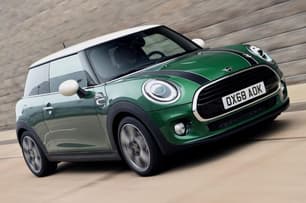
The Mini Cooper S is 60 years old and unlike the Beetle, it's powering on past its birthday and the company - no stranger to a special edition - has slapped together a classic combo of colours, stripes and badges.
The BMW iX3 50 xDrive is a seriously quick electric SUV that earns points for its family practicality, while its impressive range could go a long way towards easing range anxiety. The ride isn’t always as settled as I’d like, but for the most part, this is a well-executed premium EV.
The Mini 60 Years is another classic special edition Mini and its definitely one for the fans. I'm not at all fussed by it and would quite happily save my money for a standard Cooper S. The Mini is still one of the most playful, interesting cars from a mainstream car maker and while it doesn't please everyone with its size and weight, it's tremendous fun to drive.
It's the kind of car I could own and I always feel comfortable in - it's the perfect size for urban environments but is just as much at home belting down a freeway on a long trip or scooting down a B-road just because.
BMW has done a really good job with the iX3's styling. It’s distinctly futuristic without falling into that pillowy, blob-like look that some EVs have. The LED light signatures are gorgeous, although the illuminated kidney grille, from some angles, gives off bucktooth vibes. The rear indicators are also far too small.
The optioned 22-inch alloys are enormous and look fantastic, but are they worth the extra coin? Because in the EV world, size does matter and the larger the tyre, the bigger the hit to the driving range (in this case, roughly between 8-10 per cent).
Inside, BMW has avoided the same-same, slightly sterile feel of some EV cabins. There’s plenty of personality here, with the burgundy two-tone synthetic leather, stepped dashboard and seriously flashy displays bringing plenty of wow factor. The knitted accent panels across the dashboard add some welcomed warmth and texture to what could otherwise be a very tech-heavy cabin.
Always readily identifiable, Mini updates always add detail without touching the main game. I quite like the indicators, which are big LED rings surrounding the headlights, but then again I'm a sucker for lighting. I think the Mini looks terrific in three-door form and the Union Jack rear lights have grown on me. They're a bit silly but in a good way, which kind of sums up the car. The British Racing Green looks pretty good, too. Amusingly, the puddle lamp even has a 60 Years flavour.
You can spot the Cooper S by the centre exhaust and the 60 Years has its own set of 17-inch alloys.
The cabin is pretty much the same apart from the particularly warm hue of the leather. It's a classic colour for British cars but works nicely. In the Cooper S, the panoramic sunroof is split in two, but the front section opens. It does make the car feel a bit bigger, which is handy given it's pretty tight in there. The piping is a nice touch, too, although the Piano Black on the dash was so last decade rather than so last century but at least there isn't a slab of tacky wood. The fact the interior is otherwise unchanged means there are other cheap touches that somehow fail to ruin the ambience.
Mini calls its version of iDrive 'Visual Boost' for some reason, and it's displayed via a 6.5-inch screen set in a big round dial ringed by changeable LED lights.
The front row is spacious, and the sport seats offer plenty of adjustment to get comfortable. The massage function is particularly good when you’re sitting in a school pick-up line or waiting for the car to charge. Access is also easy, thanks to the comfortable step-in and step-out height.
There are a few storage options up front, including a shelf underneath the centre console, a couple of cupholders and drink bottle holders in the doors. Both the centre console and glovebox are on the shallow side, but I love the dual phone holders and the way they’re angled so you can still see your phone screen when you need to.
Charging options are good, with a 12-volt socket, two USB-C ports and a ventilated wireless charging pad. A second charging pad for your co-pilot would have been nice, though.
The displays look a little overwhelming at first, but the panoramic display is surprisingly intuitive to use while driving. In fact, I found it made the 3D head-up display feel somewhat redundant. The multimedia system is highly customisable and easy to navigate once you’ve spent some time getting familiar with it. Wireless Apple CarPlay was also easy to connect, and Android Auto is available too.
The rear row is just as spacious as the front, with a flat floor that will make middle-seat passengers happy. There’s also enough width for three kids to sit comfortably. The seats are firm but supportive, and I like the height of the centre armrest.
Storage back here isn’t quite as generous, with two cupholders and door-bin storage essentially covering the options. The hard seat backs are easy to clean, though, and my son was a fan of the rear climate controls, directional air vents and two USB-C ports.
There are three top-tether anchor points and two ISOFIX child-seat mounts, while the 40/20/40-split rear seat adds some useful flexibility when you need to carry a mix of passengers and cargo.
The boot offers up to 520 litres of capacity with all seats in use, which is plenty for a big grocery haul or a road trip’s worth of luggage. There’s a handy netted pocket on the side and a hard cargo cover, although, unsurprisingly for an EV, you only get a tyre repair kit rather than a spare wheel. The powered tailgate is also a welcome convenience.
Rounding everything off is a 58L frunk which houses all the charging cables.
Yep, it's a small car so expect things to be reasonably cosy. I fit in there fine but I am neither particularly tall nor broad. Taller folks will fit just fine in the front (but not too tall, don't be greedy) while larger people might find themselves uncomfortably close to their passengers.
The rear seat is bearable for children and patient adults on short trips. At least they'll be well hydrated because as well as the pair of cupholders up front there are a further three in the back for a total of five. The Mini joins the NC Mazda MX-5 as a car with a greater cup capacity than passenger capacity. Front seat passengers can keep the water topped up as there are also small bottle holders in the doors.
There are two USB ports in the front seat and a wireless charging pad that doesn't fit bigger phones under the armrest. If your iPhone is the smaller size, the combination of wireless CarPlay and charging pad is excellent.
The boot is surprisingly big for such a small car, beating many of its cheaper rivals with 211 litres with the seats in place and 731L with them folded down.
There are two variants available for the iX3, and we’re in the flagship 50 xDrive for this review. It starts from $109,900 before on-road costs, putting it in the same general territory as rivals like the Mercedes-Benz GLC400, from $112,200, and the Volvo EX60 Ultra P10, from $101,990.
Of course, like most European cars, that’s before you start adding options and our test car has quite a few.
There's $7700 22-inch M light alloy wheels and Frozen Space Silver metallic paint for another $6000. Topping it off is the M Sport Package Pro for $3500, which adds the BMW Iconic Glow Exterior Package — essentially some very swishy ambient lighting — red M Sport brake calipers, M seat belts, sport front seats and steering wheel, a 3D head-up display and a Harman Kardon sound system.
Standard equipment includes:
All up, our iX3 comes in at around $140,000 drive-away. With that in mind, it is a little surprising, then, that the rear seats miss out on heating and the front seats aren’t ventilated. Those feel like notable omissions in a car that otherwise leans heavily into premium comfort and technology.
There are four ways you can have your 60th Anniversary Mini. If you're happy with 1.5-litres of power, there is the three or five-door Cooper for $33,900 and $35,150 respectively. If you want a bit more grunt, you can step up to the Cooper S three-door (the car I had) for $43,900 and the five-door for $45,150. Eagle-eyed readers who know their Mini pricing will see a price rise of $4000, and Mini Australia says you get $8500 of value. All of those prices are before on-road costs.
The standard Cooper S package brings dual-zone climate control, keyless entry and start, driving mode selection, leather interior, reversing camera, sat nav, auto LED headlights and wipers, wireless Apple CarPlay, run-flat tyres and you can add all the 60 Years stuff on top of that.
Without putting too fine a point on it, the Mini isn't cheap to begin with, so whacking four grand on top of the already stiff pricing obviously doesn't improve matters. You do get more stuff, obviously, as suggested by the claimed $8500 figure.
That means British Racing Green IV metallic paint with Pepper White mirrors and roof or Midnight Black Lapis Luxury Blue with black mirrors and roof. Inside you get a choice of Dark Cacao with the green paint or Carbon Black with the blue paint. If you choose the latter you miss out on the special piping and details.
Cooper S buyers pick up wireless phone charging, Comfort Access pack, heated front seats and LED headlights while the Cooper S adds a panoramic sunroof, Harmon Kardon-branded system and head-up display.
The new BMW iX3 is built on an 800-volt platform and features a dual-motor all-wheel-drive set-up producing up to 345kW of power and 645Nm of torque. It can sprint from 0-100km/h in just 4.9 seconds, so in a nutshell, it’s pretty darn powerful and fast.
It might not be segment-leading when it comes to outright performance, but there’s certainly no shortage of grunt for a family SUV.
The Cooper S has the usual 2.0-litre turbocharged four (the Cooper has a 1.5-litre turbo three-cylinder), serving up 141kW and 280Nm. Power finds its way to the front wheels via a seven-speed twin-clutch transmission and will push the 1265kg Cooper S to 100km/h in 6.8 seconds.
The iX3 has a massive 108.7kWh lithium-ion NCM battery and a WLTP driving range of up to 805km. With the optional 22-inch alloys, that range does take a hit in our test vehicle, dropping to around 740km, which is still very good.
With my average consumption sitting at 15.5kWh/100km, I’ve actually beaten the claimed energy consumption of 18.8kWh/100km. That’s after a mix of highway and urban driving throughout the week, which is seriously impressive for a large, powerful electric SUV.
The iX3 has a Type 2/CCS charging port and can accept up to 22kW on an AC charger and a hefty 400kW on a fast DC charger. Finding a charger capable of delivering that much power will be the real challenge, but if you do, BMW claims a 10-80 per cent charge in just 21 minutes. That’s excellent charging performance and makes longer road trips considerably easier.
However, it does lose marks for missing out on vehicle-to-load (V2L) functionality. BMW Australia says the iX3 is equipped with the hardware for V2L, but the company is waiting on approvals for the required accessories before it can be rolled out to Australian versions. In other words, it's coming soon.
Mini reckons you'll get 5.6L/100km on the combined cycle. Maybe you could if you don't drive it like I did (I got an indicated figure of 9.4L/100km).
The Mini has stop-start to help cut fuel use around town and launch control to ruin those efforts.
The iX3 50 has plenty of power and torque to satisfy when you need to plant it on a hill or overtake. Power is delivered smoothly in Efficient mode, but it definitely feels more dynamic when you switch to Sport.
The suspension is nicely balanced around town and through corners, but occasionally the car feels a little unsettled on an uneven open road. This is where you start to wonder whether those big tyres are doing the car any favours.
The steering is lighter than expected, although you do get used to it after a couple of days. The car can also feel heavy when you need to stop quickly, to the point where the brakes can feel a smidge spongey. Otherwise, they’re responsive enough.
The cabin is impressively quiet around town, although road noise, again, likely helped along by those big tyres, creeps in a little more on the open road. To be clear, it’s only more noticeable by EV standards; this is still a quiet car compared with a combustion-powered SUV.
Visibility is quite good from my driving position, and I like the commanding view overall. SUVs do rule the roost in this regard. There are four regenerative braking levels, including B mode for one-pedal driving, and I’ve kept it on either level three or B throughout the week.
I also like that you can still creep at lower speeds in B mode, and the 360-degree camera is exceptionally clear. The way the camera view moves with the steering wheel takes a beat to get used to, though. If you're a little unsure, you can activate the parking assist function, and the car will park itself.
Driving a Mini is a unique experience. Almost no other car on sale today has the combination of that far-away, near-vertical windscreen and an A-pillar that is almost slim by today's standards. The side of the car is almost fifty percent glass, so vision is terrific.
It had been a little while since I drove a Mini Cooper S so I was looking forward to the Mini bounce that I've always loved and my wife despised. Somewhere along the way, that bounce has faded somewhat, to the point where my wife says she doesn't mind it anymore. That must be a good thing, because while the ride is more refined, it's still a blast to drive, even if you're just getting around in traffic.
The Mini just loves point and squirt driving. The quick, well-weighted steering helps you swing the nose in and out of gaps and the handy slab of torque from the 2.0-litre ensures you stay out of trouble while doing it. The Mini also loves haring down a country road, the more secure-feeling ride belying its short wheelbase. The weight of the car probably helps keep things on the straight and narrow. It's pretty clever to make the car feel grown-up while also maintaining its sense of playfulness.
The driving mode switch doesn't make a huge amount of difference, with Sport mode adding a few apologetic pops from the exhaust.
Complaints are few, but there are too many buttons on the steering wheel and to my mind are all in the wrong place. By necessity, the controller for the media screen is practically on the floor and is crowded in by the cupholders and huge handbrake lever. But that doesn't mean Mini should take away the handbrake.
I have my reasons.
The BMW iX3 has a maximum five-star ANCAP safety rating, based on testing conducted under the new 2026 protocols. It scored 71 per cent for Safe Driving, 83 per cent for Crash Avoidance, 86 per cent for Crash Protection and 95 per cent for Post-Crash Response.
Importantly, I found the safety systems unobtrusive in everyday driving, while the adaptive cruise control is nicely calibrated and doesn’t constantly feel like it’s fighting you for control.
Standard features include:
Like the rest of the range, the 60 Years has six airbags, ABS, stability and traction controls, forward collision warning, AEB (auto emergency braking), a reversing camera, speed sign recognition, and tyre pressure monitoring (it also has run-flat tyres and no spare, so that's an important consideration).
There are two top tether and ISOFIX points for the kiddies.
The Mini scored four out of a possible five ANCAP stars in April 2015. This was before AEB became standard earlier in 2019.
The iX3 is covered by a five-year/200,000km warranty, which is a fairly typical term at this end of the market. You can also pre-purchase a six-year servicing plan for $2420, which is a reasonable cost for a vehicle in this price bracket.
Maintenance is governed by BMW’s Condition Based Servicing system, so the car will tell you when it’s time to head in for a service. Depending on how you drive it, expect servicing to be required somewhere between 12 and 24 months.
As with parent company BMW, Mini only offers a three-year/unlimited kilometre warranty with roadside assist for the duration. You can buy an extension to five or hold your breath during negotiations with a dealer.
Servicing is condition-based - the car will tell you when it needs one. You can buy a servicing package that covers the basics for five years for about $1400 or step up to the near-$4000 option which throws in consumables like brake pads and wiper blades.