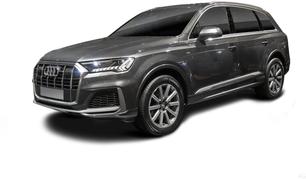
What's the difference?
The Audi Q7 has come in for its second facelift as it enters its ninth year of production while the younger Q8 is in for its first refresh.
But these two aren't like the Mitsubishi ASX and Eclipse Cross pair; Audi's MLB underpinnings were cutting edge at their launch 2015 and remain stand-out in the class with advanced suspension and chassis tech, connectivity and refinement.
A host of small visual and performance tweaks aim to make the range-topping SQ7 we're driving even better. But should you make the sensible seven-seat decision or go a little rogue and choose the sloping-roofed SQ8?
Did you know SsangYong translates to ‘Double Dragon’?
How friggin’ cool is that? Far cooler, at least, than the Korean brand’s history, which the word ‘tumultuous’ barely begins to cover.
After years of ownership woes and a near-bankruptcy, the brand came out the other side with enough stability to field a range of new vehicles, courtesy of its ambitious new owners - Indian giant Mahindra & Mahindra.
The Tivoli small SUV is the first car to launch under the new, cashed-up leadership and when it landed in Korea in 2015 it was solely responsible for the ‘Double Dragon’ brand turning its first profit in nine years.
Fast forward a few years, and a re-booted SsangYong is again confident enough to enter the Australian market, with a four-pronged, all-new SUV assault.
So, does the Tivoli have what it takes to break into our highly competitive small-SUV scene and help SsangYong pull a miraculous Korean turn-around, a-la-Hyundai?
I spent a week in the mid-spec Tivoli ELX diesel to find out.
There are newer options than the current Audi SQ7 and SQ8, including those which use the same platform, but don't write these luxury large SUVs off just yet.
It's a rare thing that a vehicle costing $200,000 has an air of pragmatism about it, but the SQ7 does. Its sensible leather upholstery, decent practicality, towing capability and near-excess of interior space make it a great family wagon.
As a counterpoint, the sharper looking SQ8 has minimal trade-off in comfort and interior room (at least for five) and is the kind of statement piece you'd expect for the price — especially in one of its loud paint colours.
Whichever way you leap, it's true that while the SQ7 and SQ8 are ageing, they are doing so gracefully and remain a superb option in this segment.
Note: CarsGuide attended this event as a guest of the manufacturer, with accommodation and meals provided.
I was asked the critical question while I had the Tivoli ELX on test – “Do you think people will buy this car?” After some time in thought, my answer was – “Not many… yet.”
Those who can look past the brand perceptions are getting an SUV which is damn near as good as anything on the market – and likely cheaper to run.
To that, you can say a lot of things: If only it cost slightly less. If only its rear was better looking. If only it had a five-star safety rating.
But here it is – the fact that the Tivoli can even hold a candle to its slick, finely tuned competition says a lot. The Double Dragon is back, and if it can afford to stick around for a while, perhaps it will stand a chance of putting the big players on notice.
If you're getting an SQ7, you'll want to tick the 'Black Pack' box because otherwise there are a lot of high-gloss silver details, especially at the rear that don't suit this tall and slightly awkward SUV.
The SQ8 is more convincing, appearing wider on the road with its new 'singleframe' grille design seemingly sucking it even closer to the tarmac like some kind of overgrown Audi RS3.
Both get an attractive new 2D design for the Audi rings and L-shaped grille details. These aid the SQ7's front end which is more muscular and purposeful than before.
The attractive lights have moved higher up the front end for enhanced presence, too. You get Matrix LEDs as standard but these candles are the hardcore HD Matrix items that feature laser light for further even longer light throw at night. They are simply awesome.
Fresh 22-inch alloy wheels and minor changes to badges finish off the exterior treatment for both cars.
The SQ8's bold specification — finished here in 'Sakhir Gold' — sets it apart from other SUVs as the metallic gold paint shimmers in the sunlight. The SQ8 is also available with whopping great 23-inch alloy wheels that you see here.
Inside, both cars share a similar architecture with 10.1-inch touchscreen for the multimedia and an 8.6-inch item below for heating and ventilation settings.
The SQ7 is a great example of a design ageing without dating, its confident horizontal lines and well-proportioned cabin features are as attractive as they were at launch, if less impressive than the related VW Touareg's whopping 15-inch screen or the minimalist Range Rover Sport.
Adding to the feeling of quality is that signature Audi smell — a combination of leather and the Sensory Package's perfume, no doubt. The SQ7 keeps a round-bottom steering wheel which remains one of the best in the business, it's just the right size and diameter trimmed with dimpled leather.
Final flourishes include the optional contrast red stitching and seatbelts as well as eye-catching turned aluminium trims.
SsangYong is hardly a brand known for its consistent or good-looking design. In the past, the brand has floundered between the squared-off lines of the Musso and the unresolved bulbous curves of the last-gen Korando.
The brand’s re-launch has finally brought it up to speed, with every car across its range featuring a consistent design language. It’s improved out of sight, but still isn’t without its flaws.
Up front, there’s an angry-looking, squared-off horizontally slotted grille, with angles galore wrapping around the small SUV’s sides.
The angles continue up the A-pillar and across the roof for a squared-off, European-influenced roofline.
Then, around the back things get… strange. A pronounced curvy ridge makes its way over the rear wheels and into a rounded-out boot. It seems at odds with the angular rear glass and lower garnish.
There’s just way too much going on around the back; it’s overly styled. The chintzy chrome finish around the lower reflectors doesn’t help, nor do the big round SsangYong badge and bold ‘T I V O L I’ typeface.
The 16-inch alloys on the EX and ELX grade are a simple 10-spoke matte-silver. They’re nothing special, but at least they're easy to clean.
Inside, things are also mixed. There’s plenty of good and bad. The seats are clad in a robust cloth with plenty of sponge for comfort, and there are sensibly placed soft surfaces in the doors and on the centre console for your elbows.
The dash has an aesthetically pleasing symmetrical theme to it and is finished mostly in decent plastics. The 7.0-inch media screen is pretty good, too, but the rest of the centre stack is a bit nasty and old fashioned.
There’s the mix of gloss plastic and silver surfaces, a giant climate control dial and the so-so buttons that litter its surface. It reminds me of Korean car designs past, like the Holden (Daewoo) Captiva and generations-old Hyundais. Credit where credit is due, though - it all feels much better built.
I’m actually a big fan of the Tivoli’s steering wheel, it has a ridged, chunky shape and is finished in a pleasing artificial-leather material. The function stalks behind it are solid, with rotary dials on them to control lights and wipers. As the primary touch-points for the driver it’s neat that they have a unique, SsangYong personality to them.
The difference between aged and dated is best summed up, though, by the excellent usability of the SQ7's cabin controls.
The separate screen for ventilation, for example, makes it simple to adjust seat or vent temperatures without interrupting the main screen's navigation instruction or other media systems.
When using wireless Apple CarPlay and Android Auto the top screen is entirely devoted to the other software with no remnants of Audi's system. It runs smoothly at all times.
Switching back to Audi's system, and there's a lack of contrast to the dark main screen and navigation. The touch targets are huge, though, and the satisfying click of the haptic feedback is welcome when driving. It seems expensive and natural in a world of feel-free touch operation.
Audi's 12.3-inch digital driver's display remains one of the best in the business. Legible and customisable with bespoke sport modes and the ability to show a full-size map, if you wish.
You can keeping devices charged with a wireless pad or there are two USB-C ports under the cushy centre armrest. A 12-volt socket is also available, and two more charge points are found in the back.
If there's one criticism in the front, it's the fairly limited storage. The door bins are big enough for a 600mL bottle but not much more and beneath the armrest the tray is shallow. The only other storage spots are the two cupholders which are the perfect size for a small take-away coffee.
While on the critiques, the drive mode selector is awkwardly hidden near the passenger below the touchscreen.
The seats are amazingly comfortable with ample support and power adjust for everything, including under-thigh length and bolsters. Several massage programs can be accessed through the menus, too.
Continuing the comfortable seating, the SQ7's second row is capacious with plenty of head, leg and toe room even for those over 180cm.
The bench slides forwards and backwards manually and the backrest is adjustable. A fold-down armrest contains two more small cupholders, and there are two separate climate zones, two vents and heated outboard seats.
However, folding and unfolding the second row is a bit complex and quite heavy work with a strange mix between electric and manual movement to access the third row — a Nissan Pathfinder does this better.
Once back there, the third row is passable for adults providing the second row is slid forward.
There are ISOFIX ports and top tether anchors for both power-deployed third row seats, so you can fit up to five children's seats in an SQ7.
The SQ8's second row is still generous but you do lose a small amount of headroom owing to the sloping roof design.
You also sacrifice some boot space, at 608L with five seats and 1755L with the second row folded. That's still a lot but the spacious SQ7's 793L/1921L figures are even better and 295L with all seven seats up is respectable. Both have sturdy 40/20/40 split-fold rear seats.
As the vehicles are equipped with air suspension, owners can raise or lower the boot floor to make it easier to load bulky objects if needed. A power tailgate is standard on both models.
A retractable luggage cover, netted pocket, boot lights and some underfloor storage complete the boot, however both cars lack a spare tyre of any sort. A tyre inflation kit is included.
The Tivoli might be a small SUV but it has a cavernous cabin. It’s seriously impressive and rivals some of the best players in this segment, like the Honda HR-V.
The front seat offers huge amounts of headroom, leagues of legroom, great space for your arms on either side and a fully telescopically adjustable steering wheel.
Storage is comprised of a shallow trench under the climate-control stack, decently sized cupholders in the centre console and doors, as well as a deep console box and a glovebox, which seems to disappear forever into the dash.
There’s also a rather odd trench cut out of the dash above the console box. It’s ridged and has a rubbery surface but seems useless for storing things, which will simply topple out when you accelerate.
As previously mentioned, there are comfortable surfaces for resting your elbows on for front occupants.
Room for back-seat dwellers is also excellent, with awesome legroom for the segment and leagues of airspace even for taller folk. There are the same padded elbow-rests in the doors and deep cupholders, but no air-conditioning vents or USB ports.
There are also weird elastic ropes on the back of the front seats for storing things (with mixed success) and a pull-down armrest.
The boot is rated at 423-litres (VDA), which is deceptively large (size-wise not far off the HR-V’s 437-litre space). The problem here is the shape of the boot itself. It’s deep from the floor to the retractable screen, and SsangYong says it will hold three golf bags, but it’s the narrow width and length which limit its potential.
I found it awkward to move some odd-shaped objects, like a heater and some boxes, and the high entry-point to the bootlid makes things a little difficult when moving heavier items.
Our ELX has significantly more room thanks to a space-saver spare under the boot floor. The Ultimate, which sits above has a full-size spare, further limiting boot space.
There are the same odd elastic ropes in the edges of the boot wall for smaller loose objects or cables.
Audi's range of Q7 and Q8 large SUVs starts at $117,284 for the 45TDI and there's a plug-in hybrid version from $152,284, both before on-road costs. The flagship SQ7 and SQ8 are $174,815 and $178,815, respectively.
The pair is a rare example of a discounted new car, albeit by a slim $585, so you'd expect these behemoths to offer comprehensive standard specification.
Features such as 22-inch alloy wheels, ambient interior lighting, soft close doors, power-adjust heated and ventilated seats, quad-zone climate control, 'Valcona' leather upholstery, a 17-speaker Bang & Olufsen sound system, full-length sunroof, navigation and a head-up display are included.
Naturally, options are available in packs and standalone choices with all vehicles we drove featuring at least one of the expensive box-ticks.
The 'Sensory Pack' seems a logical choice, bundling a 23-speaker, 1920-watt sound system with raising tweeters, 'Dinamica' headlining, massage seats, heated rear seats, Audi's air ioniser and interior perfume, extended leather upholstery and rear sun shades for $14,400.
Another major option is the $10,900 'Dynamic Package' with active roll stabilisation and Quattro Sport rear differential.
Stand-out stand-alone options include HD Matrix LED and Laser headlights combined with customisable OLED rear signatures ($3950) and the black exterior styling packages ($1850, or $2550 for the Plus version).
The as-tested price for the tow pack-equipped ($1500) 'Daytona Grey' car we spent most time in was rather high at $209,215 before on-road costs — that's over $30K worth of extras.
If SsangYong wants to roar back onto the market and challenge people’s perceptions of the brand, it’ll first need to get them in the door. After all, this low-ball strategy worked for Hyundai and Kia, who infiltrated Australia with models like the Excel and Rio, which offered all the features of more established brands at a cut price.
The challenge is not tarnishing your brand while you’re at it. Has SsangYong pulled it off with the Tivoli?
Our ELX is the mid-spec car, sitting above the entry-level EX and below the all-wheel-drive and diesel-only Ultimate.
The $29,990 ticket price for our front-wheel-drive diesel would be about right if the Tivoli was from any mainstream brand. For roughly the same money you can get a top-spec Mitsubishi ASX Exceed ($30,990), Honda HR-V RS ($31,990), fellow Korean Hyundai Kona Elite ($29,500), or a diesel-powered Mazda CX-3 Maxx Sport ($29,990).
Oh, and despite it looking quite large in the pictures, the Tivoli is most definitely a small SUV, being narrower than a Hyundai Kona and not as long as a CX-3.
Feature-wise, our ELX gets 16-inch alloy wheels, a 7-inch multimedia touchscreen with Apple CarPlay and Android Auto support, front & rear parking sensors with reversing camera, auto-dimming rear-view mirror, leather trim on the steering wheel, standard faire cloth seats (which weirdly remind me of Hyundai’s seats from about a generation ago), roof-rails, luggage screen in the boot, dual-zone climate control, privacy glass and halogen headlamps with LED DRLs.
Not bad. The safety offering is not only good but available across the range, so check the Safety section of this review out for more on that.
Missing at this price are leather trim (available on the Kona Elite and ASX), active cruise, LED front lighting and powered front seats. It’s not crazy value, but it’s also not bad at $29,990.
The SQ7 and SQ8 both use a 4.0-litre twin-turbo 'hot vee' V8 petrol after the diesel SQ7 was abandoned in mid-2022.
It is the same engine you'll find in just about every application of this MLB platform, including the Porsche Cayenne, Bentley Bentayga and Lamborghini Urus — though it makes more power elsewhere.
In Audi's two medium-sporty SUVs it produces 373kW at 5500rpm and 770Nm between 2000-4000rpm.
In practice, it's a swelling, punchy engine without much top-end sparkle — though 4.1 seconds to 100km/h is nothing to scoff at.
The V8 also produces a rather splendid soundtrack, striking the right balance between Detroit burble and motorsport bark for this application.
An eight-speed torque converter auto transmission has been retuned for improved shift logic and it remains buttery smooth. It's pleasing enough just manoeuvring slowly around a car park, where you can feel just well calibrated the long travel throttle and transmission logic are.
Our Tivoli is powered by a 1.6-litre four-cylinder turbo diesel engine producing 84kW and 300Nm of torque.
That seems a little low on the power front compared to petrol competitors, but the strong torque figure available from an almost instantaneous 1500rpm gives this engine a solid amount of get up and go.
If you aren’t opposed to diesel, I would strongly suggest this engine over its underpowered 1.6-litre petrol equivalent, as it has almost twice the available torque.
It might seem risky for SsangYong to be offering diesel in a segment where the fuel type is unpopular, but it makes sense from a global supply point of view, as diesel is largely the fuel of choice in the Tivoli’s home country of South Korea.
The ELX is front-wheel drive and can only be had with a six-speed torque converter auto transmission manufactured by Aisin.
With 2340kg to heave around, not even the 48-volt mild hybrid system can save the SQ7's fuel consumption — it's a thirsty beast.
The rated ADR combined cycle (urban, extra-urban) figure is 11.8L/100km and indulging in the ample performance resulted in 16.5L/100km on the trip computer. The SQ8 was much the same.
The SQ7 is certified to tow up to 3500kg (braked), equal to a Toyota LandCruiser or Nissan Patrol.
A fairly large 85L tank gives the SQ7 a theoretical driving range of around 720km from a fill-up. Naturally, 98 octane unleaded is required.
Over my week of mainly urban driving I scored a fuel-consumption figure of 7.8L/100km against a claimed urban figure of 7.4L/100km which is not too bad, but also not stellar.
The official claimed/combined usage figure is at a bold-sounding 5.5L/100km.
The Tivoli has a 47-litre fuel tank.
Our drive loop started in South-East Sydney where the SQ7's burbly V8 and air suspension fitted right in, easily soaking up the worst of the concrete expansion joints and sharp-edged potholes.
It is a joy to waft around in the refined SQ7 with its remarkably good vision out the front and back (with 360-degree cameras to help elsewhere). Standard rear-wheel steer allows the back tyres to rotate up to 5.0 degrees, giving the 5072mm long SQ7 a better turning circle (12.5m) than a Q3 small SUV.
Its driven home further by the excellent drive mode customisation. Along with the standard programs, you can set an 'Individual' mode up with various selections for the suspension, steering, powertrain response and exhaust noise.
Following the SQ7, our time in the SQ8 took in some more twisting roads and the combination of 23-inch alloys with firmer suspension settings meant that, even in 'Comfort', 'Auto' or 'Balanced' drive modes, the coupe-styled model had a busier ride.
Both SQ7 and SQ8 featured 'Sport' adaptive air suspension, sitting 15mm lower than normal with the ability to drop the ride height up to 40mm in 'Dynamic' mode or raise it 50mm in lift mode to get out of sticky situations.
Audi chose not to specify the Dynamic pack on the SQ8, though, and the difference is noticeable compared to the SQ7. The coupe SUV rolls a little more in hard cornering and doesn't engage the rear end in quite the same way.
Back in the SQ7, turn in may feel a little less sharp owing to the taller height but the active roll stabilisation and Quattro electronically-controlled limited-slip differential splitting power between the two rear wheels makes for a more confident vehicle with better punch out of corners.
Grip is prodigious and the SQ7 is always in control with 285/35R22 Bridgestone Turanza T005 tyres.
A 2.4-turn lock-to-lock steering system is well-judged, remaining light in Comfort but adding enough weight and precision in Dynamic.
The brakes — 400mm front rotors clamped by six-piston calipers with optional ceramics — are reassuring and feel Autobahn ready.
The Audi SQ7 with Dynamic Pack is like an Olympic swimmer that's put on some kilos and had a few kids but can still gap his teenage son in a 50-metre freestyle race.
This is perhaps the perfect expression of Audi's 'S' models USPs, being totally normal when pottering despite huge reserves of talent.
We never recommend that you drive blindfolded, but if you could and you drove the Tivoli, I honestly believe you’d have trouble telling it apart from any other small SUV on sale today.
The diesel engine feels strong from the get-go and pushes the 1390kg SUV along with a reasonable urgency. It’s no performance drivetrain, but it's as good as, if not better than, most of the petrol competitors.
The six-speed torque converter auto is mostly great around town but is old-school in that you can definitely feel each ratio. It also had the unfortunate habit of occasionally grabbing the wrong gear.
I once caught it out altogether under heavy acceleration and it spent a whole second fishing for the ratio it wanted. It’s still better than a continuously variable transmission (CVT) for driver engagement, though.
Steering is on the light side but is direct and offers decent feedback. The ELX offers three steering modes - 'Comfort', 'Normal', and 'Sport', which artificially alter the weight behind the steering. 'Normal' is by far the best.
The suspension was also notably impressive. Fellow Korean brands, Hyundai and Kia, have harked on for a long time about local tuning efforts, but I found the Tivoli’s suspension tune almost as good. It’s a slightly more spongey, comfort-focused tune, but I was impressed at how composed it felt in the corners.
The ELX has a cheap torsion-bar rear suspension setup, which could only really be noticed over rough road conditions.
Behind the wheel, the Tivoli was also surprisingly quiet at lower speeds. This makes for a nice, quiet drive around town, despite the diesel engine, but at speeds above 80km/h and engine rpms above 3000 the noise became significantly worse.
I’d say the Tivoli drives just as well as most Hyundais and Kias from just a few years ago. There’s room for improvement in the little details, but for the brand’s first effort since its international re-boot, it does a darned good job.
The Audi SQ7 is currently unrated by local ANCAP safety authority but Euro NCAP awarded a Q7 50TDI a maximum five stars in 2019.
It features eight airbags, adaptive cruise control, lane-keep assist, blind-spot monitoring, rear cross-traffic alert, surround-view monitor and exit-warning system to stop occupants dooring cyclists.
The adaptive cruise control is smooth and natural, although we found the lane-keep and lane-trace programs to be a little overbearing. Both can be easily disabled by holding the button at the end of the indicator stalk for about five seconds.
The Tivoli comes with a reasonably comprehensive safety offering, but there’s room to improve here, too.
On the active-safety front our ELX has auto emergency braking (AEB – works up to 180km/h), lane-departure warning (LDW), lane-keep assist (LKAS) and high-beam assist.
There’s no active cruise, blind-spot monitoring (BSM), traffic-sign recognition (TSR), or driver-attention alert (DAA) available on even the top-spec Ultimate.
The Tivoli has seven airbags, two ISOFIX child-seat mounting points on the rear outboard seats and top-tether anchorages across the second row, as well as the expected brake and stability controls (but no torque vectoring).
The Tivoli has received a four-star ANCAP safety rating as of 2016, however this is based on a EuroNCAP score and now-available lane-assist technologies were not factored into this test.
Audi recommends SQ7 and SQ8 owners bring their car in for a service every 12 months or 15,000km.
Service pricing is not cheap, with a five-year package costing $4600 for either model. For reference a basic service plan for a BMW X5 costs $3450 for five years.
Audi has moved to a five-year, unlimited kilometre warranty with owners able to extend that (for a fee) up to nine years with Audi Advantage. An extra two years of warranty and scheduled servicing costs $4360 for the SQ7 and $4160 for SQ8.
Additionally, customers get access to Audi's loyalty programs with event invitations, ambassador experiences and discounts offers from select partner companies.
The SsangYong Tivoli now leads the small SUV segment with a seven-year/unlimited-kilometre warranty, which is miles ahead of the acceptable industry standard of five years/unlimited kilometres offered by most competitors.
Service pricing comes in at a completely fixed and impressive-for-a-diesel $322 per yearly 15,000km service for the life of the warranty.
Extra service items are tidily laid out in a chart breaking down parts cost, labour, and total price, with the most notably expensive item being transmission fluid ($577), which, at worst, is recommended to be changed at 100,000km.
From this we can tell SsangYong intends to target Kia’s audience and use this part of the business to categorically beat its competition.