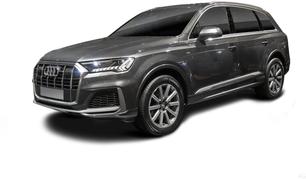
What's the difference?
The Audi Q7 has come in for its second facelift as it enters its ninth year of production while the younger Q8 is in for its first refresh.
But these two aren't like the Mitsubishi ASX and Eclipse Cross pair; Audi's MLB underpinnings were cutting edge at their launch 2015 and remain stand-out in the class with advanced suspension and chassis tech, connectivity and refinement.
A host of small visual and performance tweaks aim to make the range-topping SQ7 we're driving even better. But should you make the sensible seven-seat decision or go a little rogue and choose the sloping-roofed SQ8?
BMW’s X1 has changed. In a good way. Especially if you’re thinking about buying one as a family car.
Yep, last year the third-generation X1 arrived and after 13 years and three different attempts on a design, BMW has nailed it. And by ‘it’ I mean built a super practical and spacious small SUV that’s great to drive.
See, as a dad of two kids, when it comes to cars and my family ‘it’ means something totally different to what ‘it’ meant 10 years ago.
And that’s what this review is about: does the BMW X1, and specifically this xDrive20i M Sport variant we’ve tested here, make a good family car?
If you're thinking of buying it for your family then you need to read this and also consider the likes of Audi’s Q3 and the Mercedes-Benz GLB.
There are newer options than the current Audi SQ7 and SQ8, including those which use the same platform, but don't write these luxury large SUVs off just yet.
It's a rare thing that a vehicle costing $200,000 has an air of pragmatism about it, but the SQ7 does. Its sensible leather upholstery, decent practicality, towing capability and near-excess of interior space make it a great family wagon.
As a counterpoint, the sharper looking SQ8 has minimal trade-off in comfort and interior room (at least for five) and is the kind of statement piece you'd expect for the price — especially in one of its loud paint colours.
Whichever way you leap, it's true that while the SQ7 and SQ8 are ageing, they are doing so gracefully and remain a superb option in this segment.
Note: CarsGuide attended this event as a guest of the manufacturer, with accommodation and meals provided.
This new BMW X1 feels like it's been built by a team of parents because it’s one of the most practical and easy to use small SUVs my family and I have ever lived with and, trust me, they’ve seen a lot of test cars come through the Berry garage.
We loved the roomy interior with high ceilings, the clever storage everywhere from the giant door pockets to the floating centre armrest up front and big boot for our pram.
Entry and exit is easy through the tall and wide doors, something my back was thankful for every time I had to put our baby into her car seat.
Driving is easy, with great visibility and the engine that comes in the xDrive20i M Sport makes this X1 sporty and fun to pilot, too.
The only drawback is the price, it's a bit expensive but at the same time you are getting a high-quality feeling SUV.
If you're getting an SQ7, you'll want to tick the 'Black Pack' box because otherwise there are a lot of high-gloss silver details, especially at the rear that don't suit this tall and slightly awkward SUV.
The SQ8 is more convincing, appearing wider on the road with its new 'singleframe' grille design seemingly sucking it even closer to the tarmac like some kind of overgrown Audi RS3.
Both get an attractive new 2D design for the Audi rings and L-shaped grille details. These aid the SQ7's front end which is more muscular and purposeful than before.
The attractive lights have moved higher up the front end for enhanced presence, too. You get Matrix LEDs as standard but these candles are the hardcore HD Matrix items that feature laser light for further even longer light throw at night. They are simply awesome.
Fresh 22-inch alloy wheels and minor changes to badges finish off the exterior treatment for both cars.
The SQ8's bold specification — finished here in 'Sakhir Gold' — sets it apart from other SUVs as the metallic gold paint shimmers in the sunlight. The SQ8 is also available with whopping great 23-inch alloy wheels that you see here.
Inside, both cars share a similar architecture with 10.1-inch touchscreen for the multimedia and an 8.6-inch item below for heating and ventilation settings.
The SQ7 is a great example of a design ageing without dating, its confident horizontal lines and well-proportioned cabin features are as attractive as they were at launch, if less impressive than the related VW Touareg's whopping 15-inch screen or the minimalist Range Rover Sport.
Adding to the feeling of quality is that signature Audi smell — a combination of leather and the Sensory Package's perfume, no doubt. The SQ7 keeps a round-bottom steering wheel which remains one of the best in the business, it's just the right size and diameter trimmed with dimpled leather.
Final flourishes include the optional contrast red stitching and seatbelts as well as eye-catching turned aluminium trims.
This current generation of X1 arrived in late 2022 and finally looked more like part of the BMW SUV family with tall and boxy styling rather than the sleek, but raised hatchback it seemed to be before.
My test car had 'M Portimao Blue' metallic paint - a flattering hue that showed off the X1’s lines as you can see in the images.
I like the X1’s oversized grille which suits the angry looking front bumper that comes with the M Sport inclusions, but balanced by pretty headlights.
Inside, the X1 xDrive20i M Sport is modern and minimalist in design. I like the floating centre armrest in between the driver and front passenger and the way it creates a feeling of more space and adds more storage.
The double screens are nice, but we’re seeing this same design and tech now in budget cars such as the Chery Omoda 5 and Haval H6. BMW needs to be even slicker and more stylish if it wants to maintain its edge.
If you like your SUVs sporty looking then check out the BMW X2, X4 and X6. These are coupe style SUVs (but with four doors).
The difference between aged and dated is best summed up, though, by the excellent usability of the SQ7's cabin controls.
The separate screen for ventilation, for example, makes it simple to adjust seat or vent temperatures without interrupting the main screen's navigation instruction or other media systems.
When using wireless Apple CarPlay and Android Auto the top screen is entirely devoted to the other software with no remnants of Audi's system. It runs smoothly at all times.
Switching back to Audi's system, and there's a lack of contrast to the dark main screen and navigation. The touch targets are huge, though, and the satisfying click of the haptic feedback is welcome when driving. It seems expensive and natural in a world of feel-free touch operation.
Audi's 12.3-inch digital driver's display remains one of the best in the business. Legible and customisable with bespoke sport modes and the ability to show a full-size map, if you wish.
You can keeping devices charged with a wireless pad or there are two USB-C ports under the cushy centre armrest. A 12-volt socket is also available, and two more charge points are found in the back.
If there's one criticism in the front, it's the fairly limited storage. The door bins are big enough for a 600mL bottle but not much more and beneath the armrest the tray is shallow. The only other storage spots are the two cupholders which are the perfect size for a small take-away coffee.
While on the critiques, the drive mode selector is awkwardly hidden near the passenger below the touchscreen.
The seats are amazingly comfortable with ample support and power adjust for everything, including under-thigh length and bolsters. Several massage programs can be accessed through the menus, too.
Continuing the comfortable seating, the SQ7's second row is capacious with plenty of head, leg and toe room even for those over 180cm.
The bench slides forwards and backwards manually and the backrest is adjustable. A fold-down armrest contains two more small cupholders, and there are two separate climate zones, two vents and heated outboard seats.
However, folding and unfolding the second row is a bit complex and quite heavy work with a strange mix between electric and manual movement to access the third row — a Nissan Pathfinder does this better.
Once back there, the third row is passable for adults providing the second row is slid forward.
There are ISOFIX ports and top tether anchors for both power-deployed third row seats, so you can fit up to five children's seats in an SQ7.
The SQ8's second row is still generous but you do lose a small amount of headroom owing to the sloping roof design.
You also sacrifice some boot space, at 608L with five seats and 1755L with the second row folded. That's still a lot but the spacious SQ7's 793L/1921L figures are even better and 295L with all seven seats up is respectable. Both have sturdy 40/20/40 split-fold rear seats.
As the vehicles are equipped with air suspension, owners can raise or lower the boot floor to make it easier to load bulky objects if needed. A power tailgate is standard on both models.
A retractable luggage cover, netted pocket, boot lights and some underfloor storage complete the boot, however both cars lack a spare tyre of any sort. A tyre inflation kit is included.
My family found the X1 xDrive20i to be one of the most practical small SUVs we’ve lived with thanks to its spacious interior, clever cabin storage and plenty of convenient features.
I need to point out the door pockets - they’re the biggest I’ve ever seen. They’re more door buckets than pockets and super helpful over the week not just for bottles but for everything else that I needed to dump out of my own pockets and into them.
The floating centre armrest up front looks like an ironing board and has a tonne of storage underneath.
The wireless charging is handy but the holster is a bit un-user friendly in terms of access, but it held the phone tight and stopped it becoming a projectile when driving, which is what you want.
There are power outlets galore, too, proximity unlocking, and a gesture tailgate.
Legroom in the back is excellent and there’s so much headroom throughout.
The X1’s 540-litre boot capacity is excellent for the class and meant we could fit our baby’s big pram and the seven-year old’s scooter and still have room for the grocery shopping.
Audi's range of Q7 and Q8 large SUVs starts at $117,284 for the 45TDI and there's a plug-in hybrid version from $152,284, both before on-road costs. The flagship SQ7 and SQ8 are $174,815 and $178,815, respectively.
The pair is a rare example of a discounted new car, albeit by a slim $585, so you'd expect these behemoths to offer comprehensive standard specification.
Features such as 22-inch alloy wheels, ambient interior lighting, soft close doors, power-adjust heated and ventilated seats, quad-zone climate control, 'Valcona' leather upholstery, a 17-speaker Bang & Olufsen sound system, full-length sunroof, navigation and a head-up display are included.
Naturally, options are available in packs and standalone choices with all vehicles we drove featuring at least one of the expensive box-ticks.
The 'Sensory Pack' seems a logical choice, bundling a 23-speaker, 1920-watt sound system with raising tweeters, 'Dinamica' headlining, massage seats, heated rear seats, Audi's air ioniser and interior perfume, extended leather upholstery and rear sun shades for $14,400.
Another major option is the $10,900 'Dynamic Package' with active roll stabilisation and Quattro Sport rear differential.
Stand-out stand-alone options include HD Matrix LED and Laser headlights combined with customisable OLED rear signatures ($3950) and the black exterior styling packages ($1850, or $2550 for the Plus version).
The as-tested price for the tow pack-equipped ($1500) 'Daytona Grey' car we spent most time in was rather high at $209,215 before on-road costs — that's over $30K worth of extras.
In the space of driving this SUV and writing this review the list price of the X1 xDrive20i M Sport has risen from $68,900 to $73,400.
That price hike was part of an increase across the model range and all grades now cost more, even the entry-level sDrive18i which is now 13K less than the xDrive20i M Sport.
But you’re paying for the more powerful, athletic and only all-wheel drive one in the X1 range.
You’re also getting loads of standard features in the xDrive20i M Sport.
There’s the 10.25-inch instrument display with three different styles for your speedo and other gauges, while flowing into that is the 10.7-inch media screen with sat nav, wireless Apple CarPlay and Android Auto, and digital radio.
There are LED headlights, plus proximity unlocking, a head-up display, dual-zone climate control, a power tailgate, sports seats (the front ones are heated and power adjustable) and adaptive cruise control.
As the name suggests the xDrive20i M Sport is fitted with BMW M Sport goodies as standard. These include adaptive M Suspension, M leather steering wheel, M roof rails, M headliner and M interior trim.
My test car also had $8900 worth of options fitted including the sunroof, Harman Kardon stereo, the ‘Vernasca Black’ leather seats and 20-inch M light alloy multi-spoke wheels.
Is it good value? Well, you do get a lot of nice things here but at a $13,000 premium over the entry grade, plus the $3500 price jump in the past few weeks, I’d say the value isn’t great.
If you’re trying to keep the cost down, the sDrive18i is the budget pick.
The SQ7 and SQ8 both use a 4.0-litre twin-turbo 'hot vee' V8 petrol after the diesel SQ7 was abandoned in mid-2022.
It is the same engine you'll find in just about every application of this MLB platform, including the Porsche Cayenne, Bentley Bentayga and Lamborghini Urus — though it makes more power elsewhere.
In Audi's two medium-sporty SUVs it produces 373kW at 5500rpm and 770Nm between 2000-4000rpm.
In practice, it's a swelling, punchy engine without much top-end sparkle — though 4.1 seconds to 100km/h is nothing to scoff at.
The V8 also produces a rather splendid soundtrack, striking the right balance between Detroit burble and motorsport bark for this application.
An eight-speed torque converter auto transmission has been retuned for improved shift logic and it remains buttery smooth. It's pleasing enough just manoeuvring slowly around a car park, where you can feel just well calibrated the long travel throttle and transmission logic are.
The X1 xDrive20i M Sport has a more powerful engine than the grades below it in the range - it’s a 2.0-litre, turbo-petrol, four-cylinder making 150kW and 300Nm.
A seven-speed dual-clutch automatic transmission does the shifting for you.
This is also the only all-wheel drive X1 currently in the range.
With 2340kg to heave around, not even the 48-volt mild hybrid system can save the SQ7's fuel consumption — it's a thirsty beast.
The rated ADR combined cycle (urban, extra-urban) figure is 11.8L/100km and indulging in the ample performance resulted in 16.5L/100km on the trip computer. The SQ8 was much the same.
The SQ7 is certified to tow up to 3500kg (braked), equal to a Toyota LandCruiser or Nissan Patrol.
A fairly large 85L tank gives the SQ7 a theoretical driving range of around 720km from a fill-up. Naturally, 98 octane unleaded is required.
BMW says that after a combination of open and urban roads the X1 xDrive20i M Sport will use 7.4L/100km.
In my own testing my driving was mainly city and suburban, which uses quite a lot of fuel. We did dashes to birthday parties, the grocery shopping, school drop offs and all of it in busy traffic.
I recorded 8.9L/100km, but that’s not overly thirsty considering I was carrying two car seats with children, and all the gear that goes with them.
A small 45 litre tank means the xDrive 20i M Sport has a range of about 608km, which is on the shorter side.
Our drive loop started in South-East Sydney where the SQ7's burbly V8 and air suspension fitted right in, easily soaking up the worst of the concrete expansion joints and sharp-edged potholes.
It is a joy to waft around in the refined SQ7 with its remarkably good vision out the front and back (with 360-degree cameras to help elsewhere). Standard rear-wheel steer allows the back tyres to rotate up to 5.0 degrees, giving the 5072mm long SQ7 a better turning circle (12.5m) than a Q3 small SUV.
Its driven home further by the excellent drive mode customisation. Along with the standard programs, you can set an 'Individual' mode up with various selections for the suspension, steering, powertrain response and exhaust noise.
Following the SQ7, our time in the SQ8 took in some more twisting roads and the combination of 23-inch alloys with firmer suspension settings meant that, even in 'Comfort', 'Auto' or 'Balanced' drive modes, the coupe-styled model had a busier ride.
Both SQ7 and SQ8 featured 'Sport' adaptive air suspension, sitting 15mm lower than normal with the ability to drop the ride height up to 40mm in 'Dynamic' mode or raise it 50mm in lift mode to get out of sticky situations.
Audi chose not to specify the Dynamic pack on the SQ8, though, and the difference is noticeable compared to the SQ7. The coupe SUV rolls a little more in hard cornering and doesn't engage the rear end in quite the same way.
Back in the SQ7, turn in may feel a little less sharp owing to the taller height but the active roll stabilisation and Quattro electronically-controlled limited-slip differential splitting power between the two rear wheels makes for a more confident vehicle with better punch out of corners.
Grip is prodigious and the SQ7 is always in control with 285/35R22 Bridgestone Turanza T005 tyres.
A 2.4-turn lock-to-lock steering system is well-judged, remaining light in Comfort but adding enough weight and precision in Dynamic.
The brakes — 400mm front rotors clamped by six-piston calipers with optional ceramics — are reassuring and feel Autobahn ready.
The Audi SQ7 with Dynamic Pack is like an Olympic swimmer that's put on some kilos and had a few kids but can still gap his teenage son in a 50-metre freestyle race.
This is perhaps the perfect expression of Audi's 'S' models USPs, being totally normal when pottering despite huge reserves of talent.
Only a week before testing the X1 xDrive20i M Sport I’d been reviewing a BMW 330e and going from the 3 Series to the SUV was like changing my seating position from being in a bathtub to sitting on a bar stool.
Actually, the X1’s seat is far more comfortable than a stool and the refined quality is what you’d expect from BMW.
But compared to the low slung 330e the visibility and the upright driving angle of the X1 is very different.
It’s something you want in an SUV that puts practicality before performance.
As much as I liked the sporty sedan, as a dad I preferred being able to see better when parking in the X1, and this made life a lot easier.
Easy is a good word to describe what the X1 xDrive20i M Sport is like to drive - from that visibility to the light steering, comfortable ride and that great engine with all-wheel drive.
That 2.0-litre four-cylinder has more than enough grunt to run up the steep hills in my neighbourhood without struggling, the transmission is smooth and the all-wheel drive system adds a bit more reassurance in the wet weather.
All of this makes for an easy, enjoyable drive.
The Audi SQ7 is currently unrated by local ANCAP safety authority but Euro NCAP awarded a Q7 50TDI a maximum five stars in 2019.
It features eight airbags, adaptive cruise control, lane-keep assist, blind-spot monitoring, rear cross-traffic alert, surround-view monitor and exit-warning system to stop occupants dooring cyclists.
The adaptive cruise control is smooth and natural, although we found the lane-keep and lane-trace programs to be a little overbearing. Both can be easily disabled by holding the button at the end of the indicator stalk for about five seconds.
The X1xDrive20i M Sport like all X1s scored the maximum five-star ANCAP rating in 2022.
A score of 88 per cent was given to child protection and the ANCAP report found that a 10-year old and six-year old in the second row had adequate to good protection in a front offset collision and a side impact.
For child seats there are two ISOFIX points and three top tether anchor mounts across the second row.
As you would expect from a model that’s hasn’t even been around a year yet, the X1 xDrive20i M Sport has the very latest in advanced safety tech.
There’s AEB which is operational from 5.0km/h to 210km/h and also works at road junctions. There’s lane keeping assistance, blind-spot warning and rear cross-traffic alert.
There are curtain airbags for front and rear passengers, a centre airbag for the driver and co-pilot along with frontal airbags plus side chest and side pelvis airbags.
Audi recommends SQ7 and SQ8 owners bring their car in for a service every 12 months or 15,000km.
Service pricing is not cheap, with a five-year package costing $4600 for either model. For reference a basic service plan for a BMW X5 costs $3450 for five years.
Audi has moved to a five-year, unlimited kilometre warranty with owners able to extend that (for a fee) up to nine years with Audi Advantage. An extra two years of warranty and scheduled servicing costs $4360 for the SQ7 and $4160 for SQ8.
Additionally, customers get access to Audi's loyalty programs with event invitations, ambassador experiences and discounts offers from select partner companies.
The X1 xDrive20i M Sport is covered by BMW’s five-year/unlimited kilometre warranty.
A five-year/80,000km service plan through BMW will cost $2150. You’ll be looking to pay an average of $430 per service every 12 months.