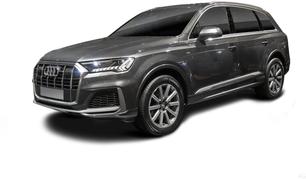
What's the difference?
The Audi Q7 has come in for its second facelift as it enters its ninth year of production while the younger Q8 is in for its first refresh.
But these two aren't like the Mitsubishi ASX and Eclipse Cross pair; Audi's MLB underpinnings were cutting edge at their launch 2015 and remain stand-out in the class with advanced suspension and chassis tech, connectivity and refinement.
A host of small visual and performance tweaks aim to make the range-topping SQ7 we're driving even better. But should you make the sensible seven-seat decision or go a little rogue and choose the sloping-roofed SQ8?
The 2022 Mitsubishi Eclipse Cross has a new high-tech powertrain that allows it to run as an electric car, or run using the petrol engine, or even use both at the same time.
But the new hybrid SUV is not like a Toyota hybrid - because this one can be plugged in at home to recharge the batteries, and you should be able to get at least 50 kilometres of EV driving out of just a few dollars worth of electricity.
We’re talking about the new 2022 Mitsubishi Eclipse Cross Plug-in Hybrid EV, or PHEV as we’ve called it in the past. The brand has renamed it to include both ‘Hybrid’ and ‘EV’ in the name because, well, it reckons those terms have a bit more cut-through today than when the company first launched its Outlander PHEV back in 2014.
But with the new Eclipse Cross PHEV variants attracting a huge premium over the regular petrol-turbo models, does the extra money buy you a better car? Let’s find out.
There are newer options than the current Audi SQ7 and SQ8, including those which use the same platform, but don't write these luxury large SUVs off just yet.
It's a rare thing that a vehicle costing $200,000 has an air of pragmatism about it, but the SQ7 does. Its sensible leather upholstery, decent practicality, towing capability and near-excess of interior space make it a great family wagon.
As a counterpoint, the sharper looking SQ8 has minimal trade-off in comfort and interior room (at least for five) and is the kind of statement piece you'd expect for the price — especially in one of its loud paint colours.
Whichever way you leap, it's true that while the SQ7 and SQ8 are ageing, they are doing so gracefully and remain a superb option in this segment.
Note: CarsGuide attended this event as a guest of the manufacturer, with accommodation and meals provided.
The Mitsubishi Eclipse Cross Plug-in Hybrid EV is an interesting inclusion for the brand, especially as it is typically considered a ‘value player’ in the market.
But with negligible real-world fuel consumption benefits if you drive beyond the limited EV range and a high price premium over the non-PHEV models, it’s important you see if the sums add up for your particular needs.
Primarily going to use the car for running around town? Cool. Think the 50-ish-kay EV range will work for you and make you happy? Amazing. Sold on the look of the car? Hat tipped.
But let me say this - if you are considering the Eclipse Cross PHEV, there are some alternatives you should also have on your list, including the MG HS PHEV, the Hyundai Ioniq PHEV, Kia Niro PHEV, and - the one I’d buy - a Toyota RAV4 Hybrid. For me, plug-in hybrid tech is a bit of a halfway house, in most instances offering too high a price premium for the range you’re getting to drive electric. Heck, a Kona Electric isn’t much more than the top-spec Exceed PHEV, and I’d have that if I wanted a real day-to-day EV experience.
If you're getting an SQ7, you'll want to tick the 'Black Pack' box because otherwise there are a lot of high-gloss silver details, especially at the rear that don't suit this tall and slightly awkward SUV.
The SQ8 is more convincing, appearing wider on the road with its new 'singleframe' grille design seemingly sucking it even closer to the tarmac like some kind of overgrown Audi RS3.
Both get an attractive new 2D design for the Audi rings and L-shaped grille details. These aid the SQ7's front end which is more muscular and purposeful than before.
The attractive lights have moved higher up the front end for enhanced presence, too. You get Matrix LEDs as standard but these candles are the hardcore HD Matrix items that feature laser light for further even longer light throw at night. They are simply awesome.
Fresh 22-inch alloy wheels and minor changes to badges finish off the exterior treatment for both cars.
The SQ8's bold specification — finished here in 'Sakhir Gold' — sets it apart from other SUVs as the metallic gold paint shimmers in the sunlight. The SQ8 is also available with whopping great 23-inch alloy wheels that you see here.
Inside, both cars share a similar architecture with 10.1-inch touchscreen for the multimedia and an 8.6-inch item below for heating and ventilation settings.
The SQ7 is a great example of a design ageing without dating, its confident horizontal lines and well-proportioned cabin features are as attractive as they were at launch, if less impressive than the related VW Touareg's whopping 15-inch screen or the minimalist Range Rover Sport.
Adding to the feeling of quality is that signature Audi smell — a combination of leather and the Sensory Package's perfume, no doubt. The SQ7 keeps a round-bottom steering wheel which remains one of the best in the business, it's just the right size and diameter trimmed with dimpled leather.
Final flourishes include the optional contrast red stitching and seatbelts as well as eye-catching turned aluminium trims.
You’re going to be able to tell the PHEV model from its more conventional counterparts by those oversized ‘Plug-in Hybrid EV’ badges on the front doors, and if you want to tell those behind you what you’re driving, there’s also a ‘PHEV’ badge there, too. Wait, wasn’t the plan to do away with the term ‘PHEV’, Mitsubishi?
But aside from that, the outside features just the different 18-inch alloy wheels (which are the same on all PHEV models, no matter the cost - I think that’s a bit lame, because if I’m spending $7500 on the Exceed I’d like a different wheel design!). Oh, and the Aspire and Exceed get that different lower front splitter, too.
Plus the PHEV has two fuel filler doors - one on each side of the car over the rear wheels. The driver’s side one is the EV charging ports (x2 - detailed below), and the passenger’s side one is for the petrol. Note: while the EV port is push-openable, the petrol cap still requires you to lift a lever in the driver’s footwell.
It may be categorised a small SUV but at 4545mm long, riding on a 2670mm wheelbase, 1805mm wide and 1685mm tall, it’s big for its boots. The popular Mazda CX-5 is only 5mm longer, and it plays in the midsize SUV segment!
Inside there are some design differences, with a specific gear joystick-style selector, and a different instrument panel.
It is impressive how the brand has managed to shoehorn a petrol engine, two electric motors, a battery pack and more into the car, but there are some practicality implications. Read about them in the next section.
The difference between aged and dated is best summed up, though, by the excellent usability of the SQ7's cabin controls.
The separate screen for ventilation, for example, makes it simple to adjust seat or vent temperatures without interrupting the main screen's navigation instruction or other media systems.
When using wireless Apple CarPlay and Android Auto the top screen is entirely devoted to the other software with no remnants of Audi's system. It runs smoothly at all times.
Switching back to Audi's system, and there's a lack of contrast to the dark main screen and navigation. The touch targets are huge, though, and the satisfying click of the haptic feedback is welcome when driving. It seems expensive and natural in a world of feel-free touch operation.
Audi's 12.3-inch digital driver's display remains one of the best in the business. Legible and customisable with bespoke sport modes and the ability to show a full-size map, if you wish.
You can keeping devices charged with a wireless pad or there are two USB-C ports under the cushy centre armrest. A 12-volt socket is also available, and two more charge points are found in the back.
If there's one criticism in the front, it's the fairly limited storage. The door bins are big enough for a 600mL bottle but not much more and beneath the armrest the tray is shallow. The only other storage spots are the two cupholders which are the perfect size for a small take-away coffee.
While on the critiques, the drive mode selector is awkwardly hidden near the passenger below the touchscreen.
The seats are amazingly comfortable with ample support and power adjust for everything, including under-thigh length and bolsters. Several massage programs can be accessed through the menus, too.
Continuing the comfortable seating, the SQ7's second row is capacious with plenty of head, leg and toe room even for those over 180cm.
The bench slides forwards and backwards manually and the backrest is adjustable. A fold-down armrest contains two more small cupholders, and there are two separate climate zones, two vents and heated outboard seats.
However, folding and unfolding the second row is a bit complex and quite heavy work with a strange mix between electric and manual movement to access the third row — a Nissan Pathfinder does this better.
Once back there, the third row is passable for adults providing the second row is slid forward.
There are ISOFIX ports and top tether anchors for both power-deployed third row seats, so you can fit up to five children's seats in an SQ7.
The SQ8's second row is still generous but you do lose a small amount of headroom owing to the sloping roof design.
You also sacrifice some boot space, at 608L with five seats and 1755L with the second row folded. That's still a lot but the spacious SQ7's 793L/1921L figures are even better and 295L with all seven seats up is respectable. Both have sturdy 40/20/40 split-fold rear seats.
As the vehicles are equipped with air suspension, owners can raise or lower the boot floor to make it easier to load bulky objects if needed. A power tailgate is standard on both models.
A retractable luggage cover, netted pocket, boot lights and some underfloor storage complete the boot, however both cars lack a spare tyre of any sort. A tyre inflation kit is included.
Up front, the cabin is a pretty smart place, with nice enough materials and finishes, and a few good storage options. There’s a cubby in front of the shifter, but oddly enough it doesn’t have a wireless charger (there are 2x USB 2.0 ports above) and isn’t quite big enough for a smartphone (even the smaller ones don’t fit there all that easily), and there are cup holders between the seats, a decent covered centre console bin, and door pockets large enough for bottles.
The PHEV models get a different instrument cluster dial for EV driving readout info, but all have the old-school 4.2-inch TFT colour display that lacks the size and usability of some rivals with larger info screens - the MG HS PHEV, for instance, has a 12.3-inch digital display, which shows you a lot more info than this tiny little screen does. Heck, there’s not even a digital speedometer in there - and you only get one if you buy the Exceed model, which has a head-up display (HUD).
That’s part of the problem with the way this car’s interface operates. If you want the most detailed information you need to use the touchscreen media system, but that negates the usability of the media functions. On multiple occasions I found myself switching between Apple CarPlay phone calls and searching for that particular driving info screen I found most useful (there are about 15 screens to choose from, and plenty of them are hard to decipher).
It’s a huge disappointment for a customer who might want to see all that detailed information but also listen to a podcast, answer a call, follow their phone’s mapping or just have anything other than the hybrid info come up on the infotainment screen. The screen itself - an 8.0-inch unit, with sat nav integrated into the top spec only - is fine, but small compared to today’s rivals.
In the back seat, there’s a compromise for cabin space. The leg room is good, but the seat has been bumped up to accommodate some of the electrical hardware and the petrol tank, meaning someone my size (182cm/6’0”) will find they’ve got enough room for their legs but not their head, and those even larger will really need to take care getting in and out. While pre-facelift examples of this car had a clever sliding second row seat, that’s gone. It was never a feature in any PHEV version, and undoubtedly the layout of the battery pack has something to do with that.
The double pane sunroof no doubt eats into the space in the rear to a degree as well, and in the Exceed it likely feels a bit more cramped because of the black headliner.
While three adults could potentially fit across the back row for very short trips, there are dual ISOFIX and three top-tether points for child seats. The Exceed is the one you want if you’re aiming to treat your rear-seat passengers right: it has heated rear outboard seats, rear directional air vents and two USB ports for charging - the ES and Aspire miss out on all that stuff.
Boot space is 359L (VDA) for PHEV models, which is a step down from the 405 litres (VDA) for the non-hybrid models. There is extra hardware under the floor, and you don’t get a spare wheel in the PHEV models either - instead there’s a tyre repair kit. For context, we only just managed to fit all three CarsGuide hard suitcases (124L, 95L and 36L) in the boot of the PHEV version, while it was far less of an issue in the non-PHEV.
Oddly, no model comes with a power tailgate.
Audi's range of Q7 and Q8 large SUVs starts at $117,284 for the 45TDI and there's a plug-in hybrid version from $152,284, both before on-road costs. The flagship SQ7 and SQ8 are $174,815 and $178,815, respectively.
The pair is a rare example of a discounted new car, albeit by a slim $585, so you'd expect these behemoths to offer comprehensive standard specification.
Features such as 22-inch alloy wheels, ambient interior lighting, soft close doors, power-adjust heated and ventilated seats, quad-zone climate control, 'Valcona' leather upholstery, a 17-speaker Bang & Olufsen sound system, full-length sunroof, navigation and a head-up display are included.
Naturally, options are available in packs and standalone choices with all vehicles we drove featuring at least one of the expensive box-ticks.
The 'Sensory Pack' seems a logical choice, bundling a 23-speaker, 1920-watt sound system with raising tweeters, 'Dinamica' headlining, massage seats, heated rear seats, Audi's air ioniser and interior perfume, extended leather upholstery and rear sun shades for $14,400.
Another major option is the $10,900 'Dynamic Package' with active roll stabilisation and Quattro Sport rear differential.
Stand-out stand-alone options include HD Matrix LED and Laser headlights combined with customisable OLED rear signatures ($3950) and the black exterior styling packages ($1850, or $2550 for the Plus version).
The as-tested price for the tow pack-equipped ($1500) 'Daytona Grey' car we spent most time in was rather high at $209,215 before on-road costs — that's over $30K worth of extras.
The 2022 Eclipse Cross PHEV line-up is expensive compared to the petrol-turbo models.
The ES AWD has a list price (all prices MSRP, before on-road costs) of $46,490, while the mid-spec Aspire costs $49,990 and the top-end Exceed lists at $53,990.
I know they’re not like-for-like in every instance - the ES and Aspire petrol-turbo models are 2WD, not AWD, for example, and there are some specification differences, too - but the price jump from each respective non-PHEV version is $15,500 (ES), $14,250 (Aspire) and $12,500 (Exceed).
Yikes.
You’d really, really have to want the EV driving experience to justify that additional expenditure, right?
Here’s a rundown of the specifications across the three PHEV grades.
Standard for the $46,490 ES grade are 18-inch alloy wheels, LED daytime running lights, halogen headlights, keyless entry and push-button start, cloth interior trim, manual front seat adjustment, an 8.0-inch touchscreen media system with Apple CarPlay and Android auto, a reversing camera, a four speaker stereo, digital radio and a rear cargo blind.
Step up to the $49,990 Aspire and you score LED headlights and fog lights, a lower body kit, heated front seats, faux-leather and microsuede trim, auto wipers, adaptive cruise control, an eight-speaker stereo, surround view camera, front and rear parking sensors, and an array of safety equipment that we’ll cover off in the safety section.
Choosing the range-topping $53,990 Exceed model nets you leather seat trim, a heated steering wheel, a head-up display - making it the only grade with a digital speedo! - as well as sat nav, a dual pane sunroof, and a black headliner in the cabin.
The SQ7 and SQ8 both use a 4.0-litre twin-turbo 'hot vee' V8 petrol after the diesel SQ7 was abandoned in mid-2022.
It is the same engine you'll find in just about every application of this MLB platform, including the Porsche Cayenne, Bentley Bentayga and Lamborghini Urus — though it makes more power elsewhere.
In Audi's two medium-sporty SUVs it produces 373kW at 5500rpm and 770Nm between 2000-4000rpm.
In practice, it's a swelling, punchy engine without much top-end sparkle — though 4.1 seconds to 100km/h is nothing to scoff at.
The V8 also produces a rather splendid soundtrack, striking the right balance between Detroit burble and motorsport bark for this application.
An eight-speed torque converter auto transmission has been retuned for improved shift logic and it remains buttery smooth. It's pleasing enough just manoeuvring slowly around a car park, where you can feel just well calibrated the long travel throttle and transmission logic are.
The plug-in hybrid version runs a non-turbocharged 2.4-litre Atkinson cycle petrol engine producing just 94kW and 199Nm.
Meagre outputs, but the petrol unit is backed by two electric motors - the front motor has outputs of 60kW/137Nm, while the rear motor produces 70kW/195Nm. It’s all controlled by a single-speed transmission.
There is no ‘combined power output’ figure, but there is a 13.8kWh lithium-ion battery pack as part of the equation as well.
The engine can power the battery pack in series hybrid driving mode, so if you want to top up the batteries before you get to a city, you can. And there is regenerative braking, of course. More on recharging in the next section.
With 2340kg to heave around, not even the 48-volt mild hybrid system can save the SQ7's fuel consumption — it's a thirsty beast.
The rated ADR combined cycle (urban, extra-urban) figure is 11.8L/100km and indulging in the ample performance resulted in 16.5L/100km on the trip computer. The SQ8 was much the same.
The SQ7 is certified to tow up to 3500kg (braked), equal to a Toyota LandCruiser or Nissan Patrol.
A fairly large 85L tank gives the SQ7 a theoretical driving range of around 720km from a fill-up. Naturally, 98 octane unleaded is required.
The Eclipse Cross PHEV has an official combined cycle fuel consumption figure of 1.9L/100km. That’s astounding, really, but you need to realise that the test calculation is only for the first 100 kays - there’s a really good chance your real-world consumption will be a lot higher, as you can only deplete the battery charge once before calling on the engine (and your petrol tank) to juice it back up.
Electric driving range is stated at 55km based on NEDC cycle testing, while the WLTP rating is a more realistic 45km. In our testing we fell between the two during our “fully charged” 100km run, in which the electric charge initially ran for 50km. But, over the 100km run, the dashboard info screen said the car used “82 per cent” electric driving, while somehow also showing 3.9L/100km for petrol consumption.
I did the numbers at the fuel filler, and the actual return was 4.5L/100km. That’s okay, but not nearly as spectacular as you might hope, and I’ve seen very close in a RAV4 hybrid - which in most instances is cheaper than the Eclipse Cross despite being bigger and, frankly, a lot better.
I also ran the car for a further 100 kays without plugging in, just to see what the ‘worst case scenario’ might be - and it wasn’t too bad, with the fuel consumption jumping to a real-world return of 5.5L/100km. But again, that’s worse than you’ll likely get with a RAV4…
When it comes to charging/recharging, there is available AC charging using a Type 2 plug that can fully recharge the battery in as little as 3.5 hours, according to the brand. DC fast charging with a CHAdeMO plug should fill from zero to 80 per cent in 25 minutes. Maximum charge input is 3.6kW.
Like me, you’ll want to do the maths to see what is going to be the most economical way to run your car - aside from just plugging it in at the office and hoping nobody notices.
A standard 10-amp household plug - which should take about seven hours to replenish the batteries - could cost as little as $1.88 to get back your circa-50km EV range - that’s based on overnight charging, off-peak, on an average 13.6c/kWh electricity price. Of course, if you’re considering a PHEV, you might have a solar array and the electricity could well be free. Good for you.
But remember, there’s more to it than just the electricity costs - you need to also consider the additional purchase budget required just to get into the PHEV model over a regular Eclipse Cross.
Our drive loop started in South-East Sydney where the SQ7's burbly V8 and air suspension fitted right in, easily soaking up the worst of the concrete expansion joints and sharp-edged potholes.
It is a joy to waft around in the refined SQ7 with its remarkably good vision out the front and back (with 360-degree cameras to help elsewhere). Standard rear-wheel steer allows the back tyres to rotate up to 5.0 degrees, giving the 5072mm long SQ7 a better turning circle (12.5m) than a Q3 small SUV.
Its driven home further by the excellent drive mode customisation. Along with the standard programs, you can set an 'Individual' mode up with various selections for the suspension, steering, powertrain response and exhaust noise.
Following the SQ7, our time in the SQ8 took in some more twisting roads and the combination of 23-inch alloys with firmer suspension settings meant that, even in 'Comfort', 'Auto' or 'Balanced' drive modes, the coupe-styled model had a busier ride.
Both SQ7 and SQ8 featured 'Sport' adaptive air suspension, sitting 15mm lower than normal with the ability to drop the ride height up to 40mm in 'Dynamic' mode or raise it 50mm in lift mode to get out of sticky situations.
Audi chose not to specify the Dynamic pack on the SQ8, though, and the difference is noticeable compared to the SQ7. The coupe SUV rolls a little more in hard cornering and doesn't engage the rear end in quite the same way.
Back in the SQ7, turn in may feel a little less sharp owing to the taller height but the active roll stabilisation and Quattro electronically-controlled limited-slip differential splitting power between the two rear wheels makes for a more confident vehicle with better punch out of corners.
Grip is prodigious and the SQ7 is always in control with 285/35R22 Bridgestone Turanza T005 tyres.
A 2.4-turn lock-to-lock steering system is well-judged, remaining light in Comfort but adding enough weight and precision in Dynamic.
The brakes — 400mm front rotors clamped by six-piston calipers with optional ceramics — are reassuring and feel Autobahn ready.
The Audi SQ7 with Dynamic Pack is like an Olympic swimmer that's put on some kilos and had a few kids but can still gap his teenage son in a 50-metre freestyle race.
This is perhaps the perfect expression of Audi's 'S' models USPs, being totally normal when pottering despite huge reserves of talent.
If you’re after that electric car thrill of near-silent, almost mind-blowing acceleration, the Eclipse Cross mightn’t be the right car for you
But if swift progress and the buzz you get from taking off from the traffic lights without any hesitation at all is more your thing, it could be great for you. And if you’re not quite ready to go “full EV”, then it’s probably something you’re considering.
The EV driving mode is the best driving mode in this car. You can run it just on the petrol engine to ensure you save your battery range, and you might choose to do that when you’re driving on the freeway and know you’re approaching an urban area where the EV goodness will be better used. Or you could have it so it's using battery and petrol power, and that’s where you’ll get maximum combined performance.
But running the car in the default, EV-prioritised mode means you will make the best of this powertrain's strengths, because - for the fifty odd kays you’ll get out of the battery - it’s pretty good.
It’s also impressive the way this powertrain dips between petrol engine, battery pack or both at higher speeds. When the battery range had depleted on my test drive, the engine kicked in almost imperceptibly, working to power the car and also generate more electricity for the battery pack. It then dipped out of petrol, back to battery, and so on and so forth, multiple times during my drive.
The best thing about the way it did so was that it was smooth. There is barely any vibration from the petrol engine, the transmission doesn’t have any gears to fumble with, and overall the refinement is really good.
There are drive modes - Eco, Normal, Snow, Gravel and Tarmac - and in my test I kept to Normal. I did fiddle with the regenerative braking reactiveness, though, using the paddleshifters to dial up or down the aggressiveness of the energy recoup system. It doesn’t feel as aggressive as some pure electric cars, but thankfully it has a decent pedal feel and progression when you apply the brakes yourself.
The steering is light and lacks feel, and doesn’t offer that much engagement or involvement. That might matter to you if you’re like me. I wish it was more fun. But at least it’s easy to park.
While the suspension is fine and comfortable on the highway, it can feel wooden and the ride is quite lumpy at low speeds. It never really feels all that well resolved for urban driving, which is a bit of a downer considering that’s likely where a car like this will spend most of its time
The tune of the suspension - being a bit firm at lower pace - surprisingly doesn’t have any payoff when it comes to cornering, as it lacks a bit of body control, shifting its weight side to side.
All in all it is a decent plug-in hybrid offering – and will be perfectly suitable to someone who wants some EV driving as a part of their lifestyle. It’s just a matter of doing the maths as to whether it will work for you.
The Audi SQ7 is currently unrated by local ANCAP safety authority but Euro NCAP awarded a Q7 50TDI a maximum five stars in 2019.
It features eight airbags, adaptive cruise control, lane-keep assist, blind-spot monitoring, rear cross-traffic alert, surround-view monitor and exit-warning system to stop occupants dooring cyclists.
The adaptive cruise control is smooth and natural, although we found the lane-keep and lane-trace programs to be a little overbearing. Both can be easily disabled by holding the button at the end of the indicator stalk for about five seconds.
All Mitsubishi Eclipse Cross models have been awarded a five-star ANCAP crash test safety rating based on 2017 testing for the pre-facelift model.
The range has increasing levels of safety technology the more you spend, but all variants have forward autonomous emergency braking (AEB) with forward collision warning (operates between 5km/h and 80km/h) and the AEB includes pedestrian detection (between 15km/h and 140km/h).
Standard on all grades is a reversing camera, rear parking sensors, seven airbags (dual front, driver’s knee, front side, side curtain for both rows), active Yaw control, stability control, and anti-lock brakes (ABS) with brake force distribution. Lane departure warning is standard too.
Spend up on the Aspire for adaptive cruise control, blind-spot monitoring, rear cross-traffic alert, and front parking sensors. From Aspire up to Exceed, there’s the addition of the brand’s Ultrasonic Misacceleration Mitigation System, which can dull throttle response to prevent potential low speed collisions.
No speed sign recognition is available, and therefore no smart cruise control either. Plus there is no lane centring system fitted either, and nor is there a driver attention monitoring system, so it’s falling behind on the tech front.
The Mitsubishi Eclipse Cross is built in Japan.
Audi recommends SQ7 and SQ8 owners bring their car in for a service every 12 months or 15,000km.
Service pricing is not cheap, with a five-year package costing $4600 for either model. For reference a basic service plan for a BMW X5 costs $3450 for five years.
Audi has moved to a five-year, unlimited kilometre warranty with owners able to extend that (for a fee) up to nine years with Audi Advantage. An extra two years of warranty and scheduled servicing costs $4360 for the SQ7 and $4160 for SQ8.
Additionally, customers get access to Audi's loyalty programs with event invitations, ambassador experiences and discounts offers from select partner companies.
There’s a huge 10 year/200,000 kilometre warranty on offer - but it’s valid if you maintain your car with Mitsubishi’s dedicated dealer service network over the 10 years/200,000km timeline, or else you get a five-year/100,000km plan.
But while the rest of the car will be covered by that decade-long warranty if you service it with Mitsubishi, the battery is only covered for eight years/160,000km, no matter where you have the car serviced.
Maintenance is due every 12 months/15,000km. But just a note - the more complex powertrain means higher service costs than the regular turbo-petrol versions. The annual fees are: $299, $399, $299, $399, $299, $799, $299, $799, $399, $799; so an average cost of $339 for the first five years, or $558.90 per visit over 10 years/150,000kn.
Included for customers who service their car with the brand is four years of roadside assist.
Do you have questions over reliability, issues, concerns, recalls, automatic transmission problems, or anything else of that ilk? Check out our Mitsubishi Eclipse Cross problems page.