What's the difference?
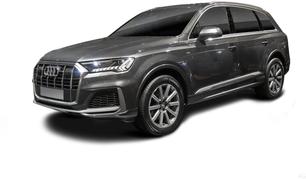
The Audi Q7 has come in for its second facelift as it enters its ninth year of production while the younger Q8 is in for its first refresh.
But these two aren't like the Mitsubishi ASX and Eclipse Cross pair; Audi's MLB underpinnings were cutting edge at their launch 2015 and remain stand-out in the class with advanced suspension and chassis tech, connectivity and refinement.
A host of small visual and performance tweaks aim to make the range-topping SQ7 we're driving even better. But should you make the sensible seven-seat decision or go a little rogue and choose the sloping-roofed SQ8?
Mazda has a tendency to have a lot of similar looking horses in the stable; blink and you'll miss the (very) subtle differences between the CX-8 and the CX-9 but if you're not super keen on the bulk of the CX-9 and you've outgrown the space of the CX-5... this one's for you.
Especially, if you've been considering its competition - the Hyundai Santa Fe Elite CRDi AWD and Toyota Kluger GXL AWD. Both of which have become known for their features and space.
So, how does it compare? The CX-8 GT SP diesel all-wheel drive seats seven, has a decent boot space (albeit, when the third row isn't in use) and handles like a dream.
Perfect combination? Maybe. I've been driving it for the last week with my family to find out for you.
There are newer options than the current Audi SQ7 and SQ8, including those which use the same platform, but don't write these luxury large SUVs off just yet.
It's a rare thing that a vehicle costing $200,000 has an air of pragmatism about it, but the SQ7 does. Its sensible leather upholstery, decent practicality, towing capability and near-excess of interior space make it a great family wagon.
As a counterpoint, the sharper looking SQ8 has minimal trade-off in comfort and interior room (at least for five) and is the kind of statement piece you'd expect for the price — especially in one of its loud paint colours.
Whichever way you leap, it's true that while the SQ7 and SQ8 are ageing, they are doing so gracefully and remain a superb option in this segment.
Note: CarsGuide attended this event as a guest of the manufacturer, with accommodation and meals provided.
So, what did my family think about the Mazda CX-8 GT SP diesel all-wheel drive? I love how it performs on the road - it's super easy to drive and you don't notice how large it is in a car park.
There are some great family-friendly features scattered throughout and I like how practical this is too with the extra seats and top-tether points. The multimedia system isn’t my favourite and I would have preferred to have seen a few extra airbags and a 360-degree view camera, but overall, it’s a good family car and gets an 8.0/10 from me.
My son loved the sun blinds and the cool colour of the seats. He also gives it an 8.0/10.
If you're getting an SQ7, you'll want to tick the 'Black Pack' box because otherwise there are a lot of high-gloss silver details, especially at the rear that don't suit this tall and slightly awkward SUV.
The SQ8 is more convincing, appearing wider on the road with its new 'singleframe' grille design seemingly sucking it even closer to the tarmac like some kind of overgrown Audi RS3.
Both get an attractive new 2D design for the Audi rings and L-shaped grille details. These aid the SQ7's front end which is more muscular and purposeful than before.
The attractive lights have moved higher up the front end for enhanced presence, too. You get Matrix LEDs as standard but these candles are the hardcore HD Matrix items that feature laser light for further even longer light throw at night. They are simply awesome.
Fresh 22-inch alloy wheels and minor changes to badges finish off the exterior treatment for both cars.
The SQ8's bold specification — finished here in 'Sakhir Gold' — sets it apart from other SUVs as the metallic gold paint shimmers in the sunlight. The SQ8 is also available with whopping great 23-inch alloy wheels that you see here.
Inside, both cars share a similar architecture with 10.1-inch touchscreen for the multimedia and an 8.6-inch item below for heating and ventilation settings.
The SQ7 is a great example of a design ageing without dating, its confident horizontal lines and well-proportioned cabin features are as attractive as they were at launch, if less impressive than the related VW Touareg's whopping 15-inch screen or the minimalist Range Rover Sport.
Adding to the feeling of quality is that signature Audi smell — a combination of leather and the Sensory Package's perfume, no doubt. The SQ7 keeps a round-bottom steering wheel which remains one of the best in the business, it's just the right size and diameter trimmed with dimpled leather.
Final flourishes include the optional contrast red stitching and seatbelts as well as eye-catching turned aluminium trims.
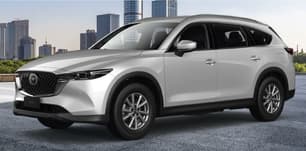
To be honest, I can't really tell the CX-8 and CX-9 apart on the road. They're both large SUVs that sport the classic Mazda bonnet - sharp and long. Up close, the CX-9 has a bulkier shape but otherwise they are remarkably similar.
The CX-8's darkened grille generates some interest with its lattice-work and there are enough shiny chrome accents scattered about the car that it looks pretty.
Yet, the sporty sharpness that Mazda is known for is still hinted at with its shaping and the 19-inch black alloy wheels.
Our model is finished in 'Platinum Quartz Metallic' and it is the highlight for the exterior styling for me. I think because it's such an interesting colour to look at - it varies a lot depending on lighting conditions. Sometimes, it almost has a sheen of pink to it and at others, it looks like pearly sand.
The interior looks polished and refined with its burgundy leather trim and soft-touchpoints. Again, there is a lot of chrome inside to make otherwise dull features, like air vents, pop out.
The difference between aged and dated is best summed up, though, by the excellent usability of the SQ7's cabin controls.
The separate screen for ventilation, for example, makes it simple to adjust seat or vent temperatures without interrupting the main screen's navigation instruction or other media systems.
When using wireless Apple CarPlay and Android Auto the top screen is entirely devoted to the other software with no remnants of Audi's system. It runs smoothly at all times.
Switching back to Audi's system, and there's a lack of contrast to the dark main screen and navigation. The touch targets are huge, though, and the satisfying click of the haptic feedback is welcome when driving. It seems expensive and natural in a world of feel-free touch operation.
Audi's 12.3-inch digital driver's display remains one of the best in the business. Legible and customisable with bespoke sport modes and the ability to show a full-size map, if you wish.
You can keeping devices charged with a wireless pad or there are two USB-C ports under the cushy centre armrest. A 12-volt socket is also available, and two more charge points are found in the back.
If there's one criticism in the front, it's the fairly limited storage. The door bins are big enough for a 600mL bottle but not much more and beneath the armrest the tray is shallow. The only other storage spots are the two cupholders which are the perfect size for a small take-away coffee.
While on the critiques, the drive mode selector is awkwardly hidden near the passenger below the touchscreen.
The seats are amazingly comfortable with ample support and power adjust for everything, including under-thigh length and bolsters. Several massage programs can be accessed through the menus, too.
Continuing the comfortable seating, the SQ7's second row is capacious with plenty of head, leg and toe room even for those over 180cm.
The bench slides forwards and backwards manually and the backrest is adjustable. A fold-down armrest contains two more small cupholders, and there are two separate climate zones, two vents and heated outboard seats.
However, folding and unfolding the second row is a bit complex and quite heavy work with a strange mix between electric and manual movement to access the third row — a Nissan Pathfinder does this better.
Once back there, the third row is passable for adults providing the second row is slid forward.
There are ISOFIX ports and top tether anchors for both power-deployed third row seats, so you can fit up to five children's seats in an SQ7.
The SQ8's second row is still generous but you do lose a small amount of headroom owing to the sloping roof design.
You also sacrifice some boot space, at 608L with five seats and 1755L with the second row folded. That's still a lot but the spacious SQ7's 793L/1921L figures are even better and 295L with all seven seats up is respectable. Both have sturdy 40/20/40 split-fold rear seats.
As the vehicles are equipped with air suspension, owners can raise or lower the boot floor to make it easier to load bulky objects if needed. A power tailgate is standard on both models.
A retractable luggage cover, netted pocket, boot lights and some underfloor storage complete the boot, however both cars lack a spare tyre of any sort. A tyre inflation kit is included.
The CX-8 is a very practical family hauler because there's ample room in all three rows. Yes, even adults will be able to squeeze into that third row without too many complaints!
All rows enjoy well-cushioned seats and up front they are electrically adjustable, but unfortunately, only the driver's side has lumbar support.
The middle row can slide forward manually or by using the electric button found on the side of the seats... but doing it yourself is way faster.
They do slide far enough forward that you won't embarrass yourself too much when you have to clamber into the third row. Where the seats have a 50/50 split-fold and manual adjustments (accessed via the boot).
In the first two rows there are lots of individual storage options but the front enjoys the most. The middle console is deep enough to be useful and I like the dual opening lid. Each row gets a couple of cupholders and drink bottle holders, too.
The charging options are great, with each row getting two USB-C ports and the front getting a wireless charging pad and 12-volt socket.
All of the controls and dials feel within easy reach and the 10.25-inch touchscreen multimedia system graphics are clear.
You can use it as a touchscreen or opt for the rotary dial but switching between the two was awkward for me. Especially, since the touchscreen function is disabled when you are using the wireless Apple CarPlay. This also has wired Android Auto, for those users.
The amenities are practical throughout with a dark headliner, three-zone climate control and heated outboard seats and retractable sun-blinds in the middle row.
Good news for families because there are five top-tether points across the back rows and ISOFIX child seat mounts on the outboard seats in middle row, in case you need them.
You can fit a 0-4 rearward facing child seat and it shouldn’t impact on front passenger comfort.
My six-year old found it super easy to get in and out of this car because of the 205mm ground clearance and wide door apertures. He enjoyed the high seating position, too, but was disappointed he couldn’t see out of the sunroof!
The boot space is a bit cramped with all three rows are in use at 209L but folding the third row opens up a more respectable 775L - perfect for the average family and its stuff!
The loading space is level, with the temporary spare tyre and clever storage compartments housed underneath. There is a retractable cargo blind and net, luggage anchor points and a 12-volt port, too.
And, as always, I love a powered tailgate, which this has!
Audi's range of Q7 and Q8 large SUVs starts at $117,284 for the 45TDI and there's a plug-in hybrid version from $152,284, both before on-road costs. The flagship SQ7 and SQ8 are $174,815 and $178,815, respectively.
The pair is a rare example of a discounted new car, albeit by a slim $585, so you'd expect these behemoths to offer comprehensive standard specification.
Features such as 22-inch alloy wheels, ambient interior lighting, soft close doors, power-adjust heated and ventilated seats, quad-zone climate control, 'Valcona' leather upholstery, a 17-speaker Bang & Olufsen sound system, full-length sunroof, navigation and a head-up display are included.
Naturally, options are available in packs and standalone choices with all vehicles we drove featuring at least one of the expensive box-ticks.
The 'Sensory Pack' seems a logical choice, bundling a 23-speaker, 1920-watt sound system with raising tweeters, 'Dinamica' headlining, massage seats, heated rear seats, Audi's air ioniser and interior perfume, extended leather upholstery and rear sun shades for $14,400.
Another major option is the $10,900 'Dynamic Package' with active roll stabilisation and Quattro Sport rear differential.
Stand-out stand-alone options include HD Matrix LED and Laser headlights combined with customisable OLED rear signatures ($3950) and the black exterior styling packages ($1850, or $2550 for the Plus version).
The as-tested price for the tow pack-equipped ($1500) 'Daytona Grey' car we spent most time in was rather high at $209,215 before on-road costs — that's over $30K worth of extras.
The GT SP diesel AWD is one of the premium models, sitting third from the top and will cost you $65,560, before on road costs.
However, its price tag positions it as the most expensive compared to its rivals. With the closest rival being the Kluger at $65,310 and the most affordable being the Santa Fe at $60,000.
You do get a stylish-looking package with lots of features for your cash, like heated front seats, heated rear outboard seats, a tilt and slide sunroof, and premium leather interior trim.
There's some great tech scattered throughout, too, like the 10.25-inch touchscreen multimedia system, wireless charging pad, USB-A ports in the third row, Bose Premium sound system with 10 speakers, wireless Apple CarPlay and wired Android Auto.