What's the difference?
We know the story of Mazda’s sudden EV push already, but I’ll recap it quickly.
On one side, soaring fuel prices and helpful incentives combined to lure Aussie buyers into EVs in record numbers. But Mazda doesn’t really have any to sell. On the other side, tightening NVES (New Vehicle Efficiency Standard) regulations punish brands that aren’t using EVs to lower their fleet emissions. But Mazda doesn’t really have any to sell.
The answer lay not in Japan, but in China, where Mazda has been able to capitalise on its relationship with Changan to get new EVs on the road quickly. The first was the 6e sedan, and this is the second arrival, the CX-6e.
And yes, that means that under the skin of this undeniably sexy electric SUV it’s very similar to something from Deepal, but the brand insists it’s still very much a Mazda everywhere else.
And so with this, Mazda rides into the electric SUV fray. But how does it stack up?
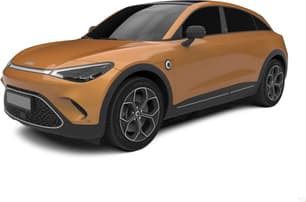
Smart is back.
Not with the classic ForTwo two-seater city car, oddball four-seater ForFour hatch or dinky Roadster targa top. Those were yesterday’s cars.
Today, Smart – as a 50/50 joint-venture between Germany’s Mercedes-Benz (the brand’s originator) and China’s Geely – is all about SUVs. Electric SUVs.
The boxy #1 (pronounced “hashtag-one”) is a small SUV and the sleeker #3 is the coupe-esque performance crossover version. Both are made in China and use Geely technologies.
We take a long, hard look at the range-topping #3 Brabus, the speediest, sexiest and exxiest of the lot. Let’s go.
It might be the product of the brand's Chinese partnership, and in fact it might not even be a Mazda under the skin, but it definitely feels more like the Japanese brand than you might be expecting.
Does it feel quite enough like a Mazda? That's going to be up to you. But it certainly looks the part, inside and out.
Note: CarsGuide attended this event as a guest of the manufacturer with travel, accommodation and meals provided.
Note: The author, Andrew Chesterton, is a co-owner of Smart As Media, a content agency and media distribution service with a number of automotive brands among its clients. When producing content for CarsGuide, he does so in accordance with the CarsGuide Editorial Guidelines and Code of Ethics, and the views and opinions expressed in this article are solely those of the author.
The #3 Brabus is very nearly one of the great bargains of 2024, with the sort of style, luxury, features, performance and grip you’d expect from the much-more-expensive GLA AMG 45. It’s that good.
What would make it great is a sunblock for the hot glass roof on a sunny day, Australian road tuning for the infuriating ADAS tech and a revised steering tune that didn’t make it feel inconsistent at times.
See past these, though, and the #3 Brabus exceeds expectations.
We’re glad Smart is back.
Mazda's designer is rightly proud of what he's managed to achieve here, and says every panel, and everything you touch inside, is Japanese, not Chinese.
The brand has inarguably made a very attractive SUV here. It’s sleek and modern feeling, but it has soul and character, too. Oh, and the brand insists the aerodynamic raised air curtain on the bonnet was done by Mazda first, and not the Ferrari Luce.
The black and swept-back roofline lends a sporty feel, too, while both the 19- and 21-inch alloy options suit the vibe.
But there is one view I’m not keen on, and that’s standing (or driving) directly behind it. Stay close to the car and you don’t really notice it, but take a few steps back — or follow behind one — and the rear end looks somehow blobby and out of proportion.
It's the one weak spot in an otherwise very good looking package.
The Mazda treatment has occurred in the cabin, too, and the touchpoints are suitably plush, though it is entirely lacking in tactile buttons or switches.
Pride of place instead is the massive screen, which is a whopping 26.4 inches. Honestly, though, only about half of that is of any real use. The passenger side has super limited functionality – it's limited to stuff like changing the theme of the screen or the radio station – and so it feels wasted and a bit pointless on that side of the cabin.
Smart says Mercedes designed the #3 and it shows.
In silhouette, or when glanced peripherally, it could be the love child of the A-Class and EQA. Only the friendly face betrays its non-Benz heritage.
Longer and wider than the #1, it is also 80mm lower – achieved via a lower ride height, flatter seats and a thinner floor.
Helped by a 35mm wheelbase stretch, it provides a nicely-balanced and proportioned crossover, with a decent drag coefficient of 0.27. The Brabus’ big wheels also fill out the arches very nicely.
Key length/width/height/wheelbase dimensions are 4400mm/1844mm/1556mm and 2785mm, respectively.
Unusually for a coupe/crossover mash-up, there’s slightly more room inside compared to the upright donor model.
Let’s take a longer look in there.
At 4850mm long and 1620mm tall, the CX-6e is longer but lower than the CX-5. But I'm 175cm, and I had no problem getting comfortable in the backseat. The leg room is huge, and I didn't find the headroom an issue at all, with clear air above me, even with the swept back roofline.
That's probably the biggest practicality perk here, with the backseat properly cavernous in that way they often are in modern EVs. There are also air vents and temperature controls for backseat riders, as well as cupholders in the middle-seat pulldown divider.
At the boot, you'll find 363 litres of storage space measured to the parcel tray (so more if you stack to the ceiling), and a total 1434 litres should you fold the second row and load all the way to the ceiling.
What you won't find, though, is a spare tyre. If you get stuck, a puncture kit is your only hope.
On first approach, you ask yourself whether the #3 is a crossover or a small-to-medium SUV. The low roof and cool frameless doors certainly suggest the former, as do the comparatively small apertures.
That said, with the windows down, those sash-less doors help entry and egress.
Once ensconced inside a long if slightly narrow cabin, the #3 offers ample room for even the tallest adults up front, as well as a reasonably spacious back seat area, though you’d call that more of a '2+1' seater given the lack of girth for three. Most folk shouldn’t struggle to find the right driving position, either.
Presumably keen to impart a generic Mercedes vibe, the #3’s interior is somewhat reminiscent of a GLA’s, albeit from last decade – down to the pronounced T-shape dash featuring a trio of circular vents in the middle, a standalone screen above and (unconvincing) metal-look plastic trim below.
Understandably, like so much of the Brabus, this might appeal to aspiring A45 AMG owners, but it seems oddly dated, given the advanced electrification going on underneath.
Likewise, none of the minimalism cleverness of the ForTwo city-car original is referenced, even digitally. A lost opportunity, really. The OG Smart is an icon.
Meanwhile, ahead of the driver, a narrow digital strip looks twee and cheap, as if ripped from a Japanese 'Kei' car. It’s a strange design detail for a $71K SUV.
Still, the #3’s cabin layout is largely a success, and much of that is due to the first-class quality and finish. Unlike some of the aforementioned Benzes of the previous decade, squeaks and rattles are notable by their absence.
Depending on your body, the racy sports seats up front are either perfectly bolstered or far-too snug, but they provide a decent level of comfort and support. And they position you just right for controlling the centre display, which dominates all.
The 12.8-inch touchscreen feels slick, responsive and right-sized for the car. At first, it can also seem like info-overload and perhaps a bit cheesy with its animal animations, but real thought has gone into it to provide an extraordinary level of functionality.
Across the top are icons for access to media, sat-nav, apps and camera view settings, while the bottom row is for various climate and trip info. While somewhat logically presented, the charging-station list seemed outdated and/or at-times incorrect in our test car.
Mercifully, the Smart has a row of short-cut buttons for 'Vehicle Modes' (including turning off the infernal lane assist and one-pedal accelerator/braking), 'Driving Mode' ('Eco'/'Comfort'/'Sport'/'Brabus'), glass demisters, climate and display-off.
Annoyingly, the latter is closest to reach, revealing the #3’s left-hand drive market bias, as the driver must stretch across to access the first two (and more important) settings.
There are also several handy screen-activated modes including 'Entertainment Mode' that temporarily leaves the accessories and climate control on; 'Rest Mode' reclines the driver’s seat down flat and dims the interior lights; 'Energise Mode' is designed to pep you up; and 'Pet Mode' keeps a climate-controlled atmosphere while deactivating all buttons that a stray paw might press. Clever.
There’s lots more besides, and using the touchscreen is better in this than most other Chinese vehicles, but it remains fiddly and distracting.
It’s also worth pointing out that the fixed glass roof needs a blockout for Australia. A Smart spokesperson said an aftermarket cover is available, but as supplied to us, sitting under it over a run of hot days is almost unbearable without a hat. This is not good enough.
Thankfully, the other basics are all A-OK.
The climate system coped well the hot sun bearing down through the glass, plenty of useful storage makes up for the disappointingly shallow glove box, while the chilled centre console and massive door bins proved especially handy.
USB access is easy, the wireless Bluetooth/Apple CarPlay performed more consistently than in any recent test vehicle and the standard Beats audio brings brilliant sound.
Out back, most people under 180cm should at least avoid scraping that glass ceiling, and there’s a reasonable amount of room for boots and long knees if the front occupants are sympathetic, but you’d be stretching the truth calling the rear seat packaging SUV-esque.
On the other hand, it’s beautifully presented, boasts a comfy and supportive backrest/cushion for outboard passengers and even a do-able centre pew for shorter-distance riders.
And it provides every expected amenity, including air vents, USB-C ports, door storage, a folding centre armrest with cupholders, and overhead handles/lighting/coat hooks.
And while we’ve already complained about the glass roof, it floods the cabin with light, to make it seem airier than it is. Narrow front seats with a see-through slit further enhance this feeling.
Further back, the 370-litre boot is reasonably long and surprisingly deep thanks to a removable upper floor that’s good for stuffing the optional home charging cables in.
And, of course, it can be extended to 1160L via the split-fold backrests to provide extra loading practicality. And there’s even a small (15L) amount of storage under the bonnet.
Maximum towing capacity is 1600kg for a braked trailer.
Discounting temporary drive-away offers, the Mazda CX-6e range opens at $53,990 plus on-road costs for the GT, and then climbs to $56,990 for the flagship Azami. There’s not a huge gap between those numbers, and that’s because both cars share the same battery and engine, and a lot of the same equipment.
As I write, the cheapest Tesla Model Y (the big dog in the electric SUV fight) is $58,900, so you'd have to argue Mazda has the pricing right.
The GT opens with:
Stepping up to the Azami gets you bigger 21-inch alloys and digital wing mirrors — the latter of which I don’t like.
If it was my money, you’d find me in a GT.
Though originally brought to market by Mercedes, Smart was never pitched as a premium brand, as it is now.
Back in the late ‘90s, Smart was an early attempt at better urban mobility. The ForTwo was a tad over 2.5 metres long by 1.5m wide and 1.5m tall.
Today, the #1 and #3 share their modular EV platform with Geely’s other small crossovers, including the Volvo EX30 and Zeekr X, while a stretched version underpins the related Polestar 4.
While the #1 starts from a sharp $54,900 (all prices are before on-road costs) for the Pro+, at the other end of the spectrum, the #3 Brabus flagship, with dual motors for all-wheel drive (AWD) and Porsche 911-style acceleration, will set you back $70,900.
Not bad, given it also includes a body kit, extra driving modes, beefier suspension, stronger brakes and retuned traction controls.
Now, that might sound steep against the growing choice of more-affordable EV alternatives out there, but consider that most of the cheaper ones are significantly slower, less sporty and/or not as highly equipped, including the Hyundai Kona Electric, Jeep Avenger and Mini Countryman.
The #3 Brabus’ fiercest foe, the bestselling Tesla Model Y in top Performance guise, is more powerful but costs $12K more and is slightly slower from 0-100km/h.
The $70K Volvo EX30 Twin Motor Performance Ultra costs $1K less and matches the Smart performance-wise as they share the same tech, but it’s considerably smaller.
Meanwhile, the closely-related Zeekr X is $6K cheaper but looks bizarre and is still largely unknown in Australia. At least Smart has that long-time Merc association to fall back on.
In fact, it is distributed by the latter’s biggest dealer group globally, LSH Automotive.
Speaking of which, how does the #3 Brabus stack up against the similar Mercedes EQA and other luxury EV rivals? The less-powerful Merc 250+ is $14K more, has less kit and is nowhere near as powerful. Same goes for BMW iX2, Lexus UX300e and Volvo C40 Recharge (alias EC40).
The #3 Brabus seems to be in a goldilocks zone of premium, performance EV SUVs. The most expensive Smart offers thoughtful value for money. For a change, the car actually lives up to its name.
Predictably, it’s also well stocked, with matrix LED headlights, electric heated/vented front seats, a 12.8-inch touchscreen, head-up display, 640W Beats audio, a foot-actuated powered tailgate, 360-degree camera views, the full advanced driver-assist safety enchilada, auto parking assist, 20-inch alloys and a panoramic glass roof.
Unfortunately, fitted on every Smart, that last one does not come with a factory built-in sunblock, which is completely unacceptable under our hot Australian sun. And no crossover or SUV should be without a spare wheel, either.
These are the #3’s only real deal-breakers.
The #3 Brabus employs one permanent magnet synchronous electric motor per axle, for dual-motor, all-wheel drive performance via a single-speed ‘transmission’.
They provide plenty of poke, totalling 315kW of power (115kW front, 200kW rear) and 543Nm of torque (200Nm front, 343Nm rear).
Tipping the scales at 1910kg, this means the Brabus delivers an impressive power-to-weight ratio of 165kW/tonne – enough for it to scoot from zero to 100km/h in 3.7 seconds, on the way to a 180km/h top speed.
To put those figures in perspective, the similarly-priced VW Golf R only manages 156kW/tonne and 4.8sec to 100.
Delivering the range is a 78kWh LFP battery, producing a WLTP driving range of up to 484kms. The DC charge rate is capped at 194kW, which should take you from 10-80 per cent charged in 24 minutes. AC charging is up to 11kW, too.
All #3s headed to Australia for now are fitted with the larger of the two battery packs available – a 66kWh lithium nickel cobalt manganese (NCM) item.
In the Brabus, it is rated to average up to 415km of WLTP-certified range, which is between 20-40km shy of the mid-spec Premium version.
Smart says the WLTP average energy consumption is 17.7kWh/100km. Our 3000km-old test car’s trip computer displayed a life-cycle average of 14.6kWh/100km since delivery.
During our week with the Brabus, we managed an average of 19.4kWh/100km, and that was over a 95km period of sustained highway driving at 114km/h with cruise control on and climate control set at 18 degrees (to combat the radiant heat from that glass roof).
With a big 22kW AC charger and 150kW DC charger capability, the former will replenish that 66kWh battery in about 32 hours using a home plug or 10 hours with an optional 7.0kW Wallbox, while the latter will need just over an hour from 10-80 per cent with a common 50kW DC charger.
It's not just outside and in the cabin where Mazda has worked its magic, it has done a whole bunch of stuff under the skin as well, retuning things like the steering, the suspension and the brakes, changing the tyre brand, and tweaking the damping to deliver a car that drives more like a Mazda than what you might of an electric Chinese SUV.
And it does feel more engaged from behind the wheel, but it also feels a little bit like Mazda has done the very best they can do with the package they've been given, rather than start from a clean sheet of paper.
There are some elements of the drive experience I'm not 100 per cent convinced by. One of them is a fairly busy ride, even on relatively smooth and straight roads, where it can feel a bit bouncy through the suspension. And another is the fact that it feels like it's been dialed up to 11 in places – the accelerator, for example, is super responsive, so even breathing on it can get that kind of surging feeling through the cabin, reminding you to be a little bit more gentle with your inputs.
Elsewhere, though, it is a composed and quiet package. We did a lot of driving through the city and then on flowing country roads, and it handled it all well. In fact, Melbourne is beset by potholes at the moment, and I actually targeted a few of them to see how it would handle them, and while the ride can feel busy in places, it does also soak up those really big road imperfections really well.
The two-tonne-plus kerb weight only really lets itself be known in super tight and twisty stuff. Otherwise, the CX-6e is happy just to flow along, a feeling helped by the not-stratospheric power outputs which suit the nature of this electric Mazda, too.
If you were to blindfold me, I probably wouldn't immediately guess that I was driving a Mazda, but equally, I wouldn't say I was driving some new brand of Chinese SUV either. I think it straddles those two worlds, and it does it pretty well.
Whatever notions ‘Smart’ might evoke, the #3 Brabus obliterates them. This is no buzzy little city-car runabout, but a surprisingly mature and athletic driving machine. This is a seriously rapid performer.
A trio of driving modes give you a hint of what you’re in for. Eco is lightness and fluff. Not very Brabus, but smooth and calm enough for relaxed commuting. And it’s far from slow, scooting off the line with zip and zest. Enough for most.
Comfort is actually a good all-round setting to be in, with an eager yet controlled level of performance. Strong acceleration and instant accelerator reaction show you mean business – if you’re in the mood. Still civilised and serene otherwise.
Sport ups the ante, as you’d expect, providing a decent whack of speed and immediate response. Actually, this is enough to keep up with most sports car costing thrice the price, while maintaining the driver-assist safety net. Fun without the fear.
Brabus mode is off-the-leash fury, turning the #3 into a convincing AMG alternative thanks to blistering thrust and a powerful punch across the spectrum. More (artificial) noise, more drama, more speed, more fireworks. The 'Launch Control' pins you to your seatback.
Yet even in the latter setting, the Smart behaves with a maturity beyond the brand’s reputation, capable of quick corners with exceptional (AWD-enhanced) body control and roadholding grip, without a punishing ride.
Underneath, a unique suspension tune for the MacPherson-style struts up front and multi-link rear end keep the Brabus hunkered down more effectively at speed.
And even in pouring rain, there are no complaints about the Brabus’ assured and confident handling. Yes, the suspension is firm, but it’s far from uncomfortable, so, an acceptable trade-off.
Plus, though not strictly one-pedal driving, the regenerative braking pressure is enough for slowing down and speeding up in the ebb and flow of traffic in its strongest mode.
Where we’re less happy is in the #3’s steering. It brings three weight modes to the table – but only two are useful, 'Light' and 'Standard'. Super-easy yet not totally devoid of substance, Light is great for around town and general commuting.
But when you lean on it at speed, the steering, whilst crisp and reactive, is not always linear in feel or motion, especially when accelerating at the same time, as you might when coming out of a fast corner.
Depending on how hard you are on the accelerator, there can be a visible step when turned from the straight ahead that can be quite disconcerting. It’s a bit like when slurping in a lumpy bit in a smoothie.
So, what about 'Sport' mode? Here, the steering is just as described above, but with added weight and not much more. Not worth it. Best is Standard mode.
Another disappointment is the advanced driver-assist safety (ADAS) tech’s state of tune. It’s in a state, literally.
The intrusive and apparently non-permanently switch-off-able lane-keep systems, especially, end up resisting what the driver intends, and even fight to steer the car where it thinks it needs to be. This is frustrating and potentially dangerous.
It’s been reported that Geely, and not Mercedes, undertook the development of these ADAS systems. We’re getting sick of (mostly Chinese) manufacturers rolling the arm over and imposing this sort of nannying and ultimately counter-intuitive driving interference tech.
This needs to be fixed. It stops the #3 Brabus from being a great performance bargain.
There’s no ANCAP rating yet, but Mazda is hopeful of five stars. It is waiting for EuroNCAP testing, but for now the CX-6e launches as an unrated vehicle.
I do like the fact that both models share the same safety package (I don't think you should have to spend more money to be safer), which means things like:
Not all of it feels particularly Mazda, though. The driver attention monitor, for example, gets more annoying the more time you spend with it (every time you yawn it will tell you to pull over, for example), and the over-speed warning chirps you every time you stray over the limit by even a kay or two.
The #3 range scores a maximum five-star ANCAP crash-test safety rating. It managed high-80s to 90 per cent in all disciplines – Adult Occupant Protection, Child Occupant Protection, Vulnerable Road User and Safety Assist systems.
A full suite of ADAS is fitted, from Autonomous Emergency Braking (operable from 5.0-150km/h car-to-car) with junction, cross-path, pedestrian, cyclist and motorcyclist detection (5.0-85km/h), lane-keep assist (from 65-180km/h) and cross-traffic alert (front and rear), to blind-spot warning and traffic-sign recognition tech.
You’ll also find adaptive cruise control (with stop/go function), highway and traffic jam assist, automatic parking assist, front and rear parking sensors, 360-degree camera and adaptive high beam assist.
Included, too, are seven airbags (dual front, side chest, side head and front-centre), along with two ISOFIX child-seat fixtures and child-seat anchorage points in the back seat.
The CX-6e is covered by Mazda’s five-year, unlimited-kilometre warranty, which is a little underwhelming by today’s standards. The battery is covered for eight years or 160,000kms.
Service intervals are 12 months or 20,000kms, and a capped-price servicing program will see you paying a total $1860 over the first five years of ownership.
The #3 offers a (decidedly-average) five-year or (disappointing) 130,000km warranty, whichever comes first. There is also roadside assistance available for free during this period.
Given other EV manufacturers are going seven and even 10 years in the case of MG, with most including unlimited kilometres, this could be better.
Scheduled maintenance is every 12 months or every 20,000km.
Smart provides a pre-paid four-year/80,000km service plan for $3120, which comes to $780 annually. This seems quite expensive for an EV, even a premium one.