What's the difference?
We know the story of Mazda’s sudden EV push already, but I’ll recap it quickly.
On one side, soaring fuel prices and helpful incentives combined to lure Aussie buyers into EVs in record numbers. But Mazda doesn’t really have any to sell. On the other side, tightening NVES (New Vehicle Efficiency Standard) regulations punish brands that aren’t using EVs to lower their fleet emissions. But Mazda doesn’t really have any to sell.
The answer lay not in Japan, but in China, where Mazda has been able to capitalise on its relationship with Changan to get new EVs on the road quickly. The first was the 6e sedan, and this is the second arrival, the CX-6e.
And yes, that means that under the skin of this undeniably sexy electric SUV it’s very similar to something from Deepal, but the brand insists it’s still very much a Mazda everywhere else.
And so with this, Mazda rides into the electric SUV fray. But how does it stack up?
Make no mistake, you are looking at the biggest challenge the all-conquering Tesla Model Y has ever faced in Australia.
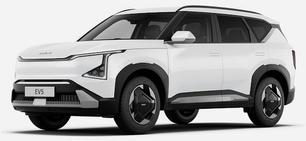
It’s the Kia EV5, a mid-size, all-electric SUV the Korean brand thinks will be its best-selling EV by some margin.
Oh, and it’s cheaper than the Tesla, by more than a little bit.
So, is this the electric SUV that might finally put an end to Tesla’s winning run in Australia?
It might be the product of the brand's Chinese partnership, and in fact it might not even be a Mazda under the skin, but it definitely feels more like the Japanese brand than you might be expecting.
Does it feel quite enough like a Mazda? That's going to be up to you. But it certainly looks the part, inside and out.
Note: CarsGuide attended this event as a guest of the manufacturer with travel, accommodation and meals provided.
Note: The author, Andrew Chesterton, is a co-owner of Smart As Media, a content agency and media distribution service with a number of automotive brands among its clients. When producing content for CarsGuide, he does so in accordance with the CarsGuide Editorial Guidelines and Code of Ethics, and the views and opinions expressed in this article are solely those of the author.
The size is right, the price is right and the drive is right – three things that make the Kia EV5 a pretty formidable foe, and the kind of vehicle that might finally be able to break through the wall of the temple of Tesla in Australia.
Note: CarsGuide attended this event as a guest of the manufacturer, with accommodation and meals provided.
Mazda's designer is rightly proud of what he's managed to achieve here, and says every panel, and everything you touch inside, is Japanese, not Chinese.
The brand has inarguably made a very attractive SUV here. It’s sleek and modern feeling, but it has soul and character, too. Oh, and the brand insists the aerodynamic raised air curtain on the bonnet was done by Mazda first, and not the Ferrari Luce.
The black and swept-back roofline lends a sporty feel, too, while both the 19- and 21-inch alloy options suit the vibe.
But there is one view I’m not keen on, and that’s standing (or driving) directly behind it. Stay close to the car and you don’t really notice it, but take a few steps back — or follow behind one — and the rear end looks somehow blobby and out of proportion.
It's the one weak spot in an otherwise very good looking package.
The Mazda treatment has occurred in the cabin, too, and the touchpoints are suitably plush, though it is entirely lacking in tactile buttons or switches.
Pride of place instead is the massive screen, which is a whopping 26.4 inches. Honestly, though, only about half of that is of any real use. The passenger side has super limited functionality – it's limited to stuff like changing the theme of the screen or the radio station – and so it feels wasted and a bit pointless on that side of the cabin.
If you’re familiar with any of Kia’s EV designs, and specifically the EV9, you’ll already know the Kia EV5, which looks a lot like a shrunken version of the company’s biggest electric 4WD.
But this one looks a bit smaller, a bit more familiar looking, and maybe a bit more accessible than the hyper-modern EV9.
Honestly, it looks like a contemporary, mid-size SUV that could be powered by anything.
There are a couple of EV5 design elements I really like. The first is the combination of hard edges and subtle curves, which combine really well. I also love the lighting treatment up front, which gives the EV5 a bold and unique light signature, especially at night.
Inside, it’s another story of familiarity, with a clean, high-tech cabin and Kia’s common twin-screen set-up. Actually, it’s more a triple screen, with two 12.3-inch screens, and a 5.0-inch climate monitor between them.
The materials are all nice, and they look great, but they don’t exactly melt under the touch, and that gives the EV5’s cabin a hard edge I don’t love.
I do, however, love the inclusion of some physical buttons, so you’re not pawing through the screen to access every in-car function.
And one final design quirk. I know it looks like it has an old-school bench front seat, but you can’t use it as a third seat in front. Kia says it’s just a design flourish. But it is also somewhere safe to pop your phone or other small valuables to stop them sliding about when you're on the road.
At 4850mm long and 1620mm tall, the CX-6e is longer but lower than the CX-5. But I'm 175cm, and I had no problem getting comfortable in the backseat. The leg room is huge, and I didn't find the headroom an issue at all, with clear air above me, even with the swept back roofline.
That's probably the biggest practicality perk here, with the backseat properly cavernous in that way they often are in modern EVs. There are also air vents and temperature controls for backseat riders, as well as cupholders in the middle-seat pulldown divider.
At the boot, you'll find 363 litres of storage space measured to the parcel tray (so more if you stack to the ceiling), and a total 1434 litres should you fold the second row and load all the way to the ceiling.
What you won't find, though, is a spare tyre. If you get stuck, a puncture kit is your only hope.
At 4615mm in length, 1875mm in width, 1715mm in height, and with a wheelbase of 2750mm, the Kia EV5 is roughly the same size as a Tesla Model Y, so if you’re ever sat in the back of the Tesla, you’ll have a fair idea of what to expect here.
Sitting behind my own 175cm driving position, I found I had a heap of knee room, more than enough headroom, and I reckon you could fit three adults across the back seat pretty easily, too.
There are a couple of design flourishes I really like, too. The pull-down divider that separates the backseat is home to two cupholders, which isn’t unusual, but what is new to me is the unique positioning of the USB charge ports, which are in the middle-back of the front seats, right above the storage pocket, so you have somewhere to pop your phone and cable when you're charging.
There is also a deep storage draw between the two front seats. It’s just for extra storage in the Air and Earth, but in the GT-Line it’s heated and cooled, which means hot pies or cold drinks when you’re on the move.
The EV5 might be an all-electric vehicle, but it’s still a mid-size SUV, which means there are certain standards it has to hit to be taken seriously, and one of those is boot space.
Up front there’s 67 litres of space in the fruit, or frunk, while the boot holds 513L with the rear seats in place – that number obviously growing as you begin folding them flat.
It is also a hugely customisable space. There’s heaps of under-floor storage below the removable panels. There’s also vehicle-to-load capability, which takes the form of a standard power point in the boot that can use the vehicle’s battery to power pretty much whatever you want.
Finally, there are adjustable luggage hooks, so you can carry bigger or smaller bags as you wish.
Discounting temporary drive-away offers, the Mazda CX-6e range opens at $53,990 plus on-road costs for the GT, and then climbs to $56,990 for the flagship Azami. There’s not a huge gap between those numbers, and that’s because both cars share the same battery and engine, and a lot of the same equipment.
As I write, the cheapest Tesla Model Y (the big dog in the electric SUV fight) is $58,900, so you'd have to argue Mazda has the pricing right.
The GT opens with:
Stepping up to the Azami gets you bigger 21-inch alloys and digital wing mirrors — the latter of which I don’t like.
If it was my money, you’d find me in a GT.
The cheapest EV5, the Air, arrives in two guises, Standard Range or Long Range, and the former is something of a bargain.
It’s the only EV5 to get included on-road costs, and Kia is asking $56,770, on the road. That puts it well below the Tesla Model Y. As of right now, the single-motor Tesla is $60,868, on the road, in NSW.
Next is the Air Long Range, which lists at $61,170, before on-road costs. The EV5 Earth occupies the middle rung, at $64,770, before on-roads, while the yet-to-arrive flagship, the GT-Line, is a considerable $71,770, before on-road costs.
Air models get 18-inch alloys, LED lighting all around, roof racks and power mirrors, while inside there are cloth and synthetic leather seats, with a massage function for the driver, along with a synthetic leather steering wheel and LED interior lighting.
Tech is covered by twin 12.3-inch screens, with a smaller 5.0-inch climate screen sandwiched between them, and there’s in-built nav, a six-speaker stereo and Apple CarPlay and Android Auto.
The Earth then adds 19-inch alloys, gloss black exterior design flourishes and privacy glass, while inside, the seats are now entirely synthetic leather. You also get a second V2L connection, as well as a powered tailgate.
Finally, the GT-Line gets pretty much everything Kia could throw at it, including 20-inch alloys, auto-flush door handles, a panoramic sunroof, two-tone seats which are now billed as offering "premium relaxation", wireless phone charging, fingerprint recognition, a heated steering wheel and an augmented-reality head-up display.
The entry-level EV5 Air is available in Standard Range or Long Range guises, both powered by a single front-mounted electric motor, producing 160kW and 310Nm.
The Standard Range will clip 0-100km/h in 8.5 seconds, while the extra weight of the bigger battery slows down the sprint in the Long Range, taking around 8.9 seconds.
The Earth is a twin-motor AWD offering, with a motor at each axle, lifting outputs to 230kW and 480Nm, dropping the sprint to a brisk-feeling 6.1 seconds. The incoming GT-Line gets the same powertrain.
Delivering the range is a 78kWh LFP battery, producing a WLTP driving range of up to 484kms. The DC charge rate is capped at 194kW, which should take you from 10-80 per cent charged in 24 minutes. AC charging is up to 11kW, too.
The Air Standard Range gets a 64.2 kWh lithium iron phosphate battery, weighing in at a hefty 428kg, which delivers a claimed driving range of 400km. The Air Long Range, the Earth and the incoming GT-Line all share the same 88.1kWh battery, upping the range to 555km, 500km and 470km, respectively.
So, if driving range is at the very top of your must-have list, the Air Long Range is the car for you.
All cars can take 7.0kW home AC charging, while the dual-motor versions are set up for 11kW AC charging. Fast charging. When it comes to fast charging, all models can plug into a 350kW charger, taking them from 10 percent to 80 per cent in less than 40minutes.
It's not just outside and in the cabin where Mazda has worked its magic, it has done a whole bunch of stuff under the skin as well, retuning things like the steering, the suspension and the brakes, changing the tyre brand, and tweaking the damping to deliver a car that drives more like a Mazda than what you might of an electric Chinese SUV.
And it does feel more engaged from behind the wheel, but it also feels a little bit like Mazda has done the very best they can do with the package they've been given, rather than start from a clean sheet of paper.
There are some elements of the drive experience I'm not 100 per cent convinced by. One of them is a fairly busy ride, even on relatively smooth and straight roads, where it can feel a bit bouncy through the suspension. And another is the fact that it feels like it's been dialed up to 11 in places – the accelerator, for example, is super responsive, so even breathing on it can get that kind of surging feeling through the cabin, reminding you to be a little bit more gentle with your inputs.
Elsewhere, though, it is a composed and quiet package. We did a lot of driving through the city and then on flowing country roads, and it handled it all well. In fact, Melbourne is beset by potholes at the moment, and I actually targeted a few of them to see how it would handle them, and while the ride can feel busy in places, it does also soak up those really big road imperfections really well.
The two-tonne-plus kerb weight only really lets itself be known in super tight and twisty stuff. Otherwise, the CX-6e is happy just to flow along, a feeling helped by the not-stratospheric power outputs which suit the nature of this electric Mazda, too.
If you were to blindfold me, I probably wouldn't immediately guess that I was driving a Mazda, but equally, I wouldn't say I was driving some new brand of Chinese SUV either. I think it straddles those two worlds, and it does it pretty well.
First things first – I spend most of my time behind the wheel of the EV5 Earth, which though it shares its dual-motor powertrain with the GT-Line, is actually the fastest of the lot owing to the extra weight of Kia's flagship.
That means zero to 100km/h in just over six seconds, and trust me when I say this, that is more than fast enough. I know you read about EVs knocking off the sprint to 100km/h in supercar-besting times, but you don't need that sort of crazy acceleration in a family-focused mid-size SUV.
Actually, forget needing, you don't want it. The EV5 feels more than punchy enough, without shaving years off your life every time you plant your foot.
Fit for purpose, then, which is exactly how I'd describe the rest of the EV5's very good drive experience. Kia's Australian ride and handling wizards have once again had their way with the EV5, and the result is an EV that handles most everything Australian road surfaces can throw it at it with ease.
Surprisingly, it's maybe not quite as dynamically sharp as the bigger EV9, but it's always comfortable, without feeling floaty or disconnected, and it will happily grip its way around tighter corners without tipping from side to side, either.
There are a couple of small quirks, though. The first is the steering, which is definitely responsive and confidence inspiring, but it also has a kind of artificial weight or heaviness at times that feels a bit disconnected from what's happening beneath the tyres. And the cabin can be a little noisy through wind, too.
But these are small beans, really. The EV5 is comfortable and capable, and without the harsh ride or too-sharp steering that can be found in some of its rivals.
We drove it for hours across all sorts of road surfaces, and in all sorts of conditions, and found very, very little to complain about.
There’s no ANCAP rating yet, but Mazda is hopeful of five stars. It is waiting for EuroNCAP testing, but for now the CX-6e launches as an unrated vehicle.
I do like the fact that both models share the same safety package (I don't think you should have to spend more money to be safer), which means things like:
Not all of it feels particularly Mazda, though. The driver attention monitor, for example, gets more annoying the more time you spend with it (every time you yawn it will tell you to pull over, for example), and the over-speed warning chirps you every time you stray over the limit by even a kay or two.
Every EV5 gets a comprehensive safety offering, including 'Advanced AEB' that includes junction crossing, lane oncoming and lane changing alerts. There’s rear-cross-traffic alert, semi-autonomous highway cruising and a whole heap more.
If you want a blind-spot view monitor, surround-view monitor or remote park assist, you’ll need to spring for the GT-Line.
The EV5 hasn’t been crash-tested yet, but Kia will be shooting for the maximum five-star ANCAP rating.
The CX-6e is covered by Mazda’s five-year, unlimited-kilometre warranty, which is a little underwhelming by today’s standards. The battery is covered for eight years or 160,000kms.
Service intervals are 12 months or 20,000kms, and a capped-price servicing program will see you paying a total $1860 over the first five years of ownership.
The EV5 is covered by Kia’s seven-year, unlimited-kilometre warranty, and you can prepay your servicing costs, too.
Three years will set you back $980, five years is $1535 and the full seven years will set you back $2431 ($347 per workshop visit), which is category competitive.