What's the difference?
We know the story of Mazda’s sudden EV push already, but I’ll recap it quickly.
On one side, soaring fuel prices and helpful incentives combined to lure Aussie buyers into EVs in record numbers. But Mazda doesn’t really have any to sell. On the other side, tightening NVES (New Vehicle Efficiency Standard) regulations punish brands that aren’t using EVs to lower their fleet emissions. But Mazda doesn’t really have any to sell.
The answer lay not in Japan, but in China, where Mazda has been able to capitalise on its relationship with Changan to get new EVs on the road quickly. The first was the 6e sedan, and this is the second arrival, the CX-6e.
And yes, that means that under the skin of this undeniably sexy electric SUV it’s very similar to something from Deepal, but the brand insists it’s still very much a Mazda everywhere else.
And so with this, Mazda rides into the electric SUV fray. But how does it stack up?
Mini and electricity were always destined to be together. Of course a sporty, prestigious and quirky little car favoured by urban dwellers was going to be the perfect match for an electric powertrain.
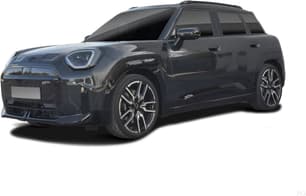
And while the Aceman SUV isn't the first fully electric vehicle for the brand it is a welcome addition that's quintessentially Mini, even if it is made in China.
The Aceman fills the gap between the Mini Cooper hatch and Countryman SUV and rivals a range of small electric premium SUVs such as the Alfa Romeo Junior and even the Volvo EX30.
The variant of this four-door, five-seater Aceman we are testing is the SE.
It might be the product of the brand's Chinese partnership, and in fact it might not even be a Mazda under the skin, but it definitely feels more like the Japanese brand than you might be expecting.
Does it feel quite enough like a Mazda? That's going to be up to you. But it certainly looks the part, inside and out.
Note: CarsGuide attended this event as a guest of the manufacturer with travel, accommodation and meals provided.
Note: The author, Andrew Chesterton, is a co-owner of Smart As Media, a content agency and media distribution service with a number of automotive brands among its clients. When producing content for CarsGuide, he does so in accordance with the CarsGuide Editorial Guidelines and Code of Ethics, and the views and opinions expressed in this article are solely those of the author.
The Aceman could be the perfect Mini - bigger than a Cooper, smaller than a Countryman. It’s also surprisingly spacious and practical. The price is about right compared to rivals, and so is the battery size and range.
What the Mini has that others don’t is its unique and playful design and ‘attitude’. True to the Mini ethos it's not a restrained car, it’s whimsical in its design but serious in its ability. It's a great car to drive both dynamically and in terms of comfort.
Mazda's designer is rightly proud of what he's managed to achieve here, and says every panel, and everything you touch inside, is Japanese, not Chinese.
The brand has inarguably made a very attractive SUV here. It’s sleek and modern feeling, but it has soul and character, too. Oh, and the brand insists the aerodynamic raised air curtain on the bonnet was done by Mazda first, and not the Ferrari Luce.
The black and swept-back roofline lends a sporty feel, too, while both the 19- and 21-inch alloy options suit the vibe.
But there is one view I’m not keen on, and that’s standing (or driving) directly behind it. Stay close to the car and you don’t really notice it, but take a few steps back — or follow behind one — and the rear end looks somehow blobby and out of proportion.
It's the one weak spot in an otherwise very good looking package.
The Mazda treatment has occurred in the cabin, too, and the touchpoints are suitably plush, though it is entirely lacking in tactile buttons or switches.
Pride of place instead is the massive screen, which is a whopping 26.4 inches. Honestly, though, only about half of that is of any real use. The passenger side has super limited functionality – it's limited to stuff like changing the theme of the screen or the radio station – and so it feels wasted and a bit pointless on that side of the cabin.
New Minis are all about design, sometimes, in my opinion, to a fault. The Aceman is very 'Mini' with its big googly eyes, little rectangular ‘grille’, blob-like tail-lights and a side profile that resembles a house brick.
That’s how all new Minis look with each model having its own distinguishing characteristics. In the Aceman's case it has more triangular headlights than the Cooper and Countryman but more rounded tail-lights and black plastic cladding around the lower grille, wheel arches and side skirts.
Our test car is painted 'Blazing Blue', with a black roof.
Inside the upholstery is 'Vescin Dark Petrol', a kind of grey blue. The stitched dash is made of recycled polyester and is knitted in 'Dark Petrol' and orange fabric.
I like Mini interiors and I love the multitude of buttons for everything. It's a refreshing change in a world where physical dials and controls are disappearing from car cabins.
The circular OLED screen is pretty and a hat-tip to early Minis with their centre speedo.
Is the Aceman an SUV or hatch? I honestly don’t know and I’ve lived with it for a week. It’s officially classified as an SUV, but it looks like a four-door hatchback with a slightly raised ride height.
If anything the Aceman looks like a cross between the Cooper and the Countryman, not quite a hatch, not quite an SUV, but probably just right for most people.
The Aceman’s dimensions make this car seem small at 4070mm long, 1754mm wide and 1514mm tall, but considering the fairly diminutive exterior the inside is impressively spacious.
At 4850mm long and 1620mm tall, the CX-6e is longer but lower than the CX-5. But I'm 175cm, and I had no problem getting comfortable in the backseat. The leg room is huge, and I didn't find the headroom an issue at all, with clear air above me, even with the swept back roofline.
That's probably the biggest practicality perk here, with the backseat properly cavernous in that way they often are in modern EVs. There are also air vents and temperature controls for backseat riders, as well as cupholders in the middle-seat pulldown divider.
At the boot, you'll find 363 litres of storage space measured to the parcel tray (so more if you stack to the ceiling), and a total 1434 litres should you fold the second row and load all the way to the ceiling.
What you won't find, though, is a spare tyre. If you get stuck, a puncture kit is your only hope.
OK, the moment I typed the word 'spacious’ in that previous section on Design I had a concern. You might think the Aceman is somehow huge on the inside, but it’s not. What it is, however, is cleverly designed so as to maximise the available space and at 188cm tall I’m a good test for this.
Space up front for me in the driver’s seat is excellent, and that goes for head, elbow and legroom. The second row is cramped for me and I can’t sit behind my driving position, but my children were happy back there - one almost a teenager and the other in a child seat.
Storage is good with door pockets, a tray for rear passengers with USB ports, cupholders up front and a wireless charging nook, plus a small box with a lid between the front seats.
The boot has a 300-litre cargo capacity which isn't bad given the car’s size.
Where is the Mini Aceman made? Yes, as I said in the intro the Aceman is made in China as a joint venture between GWM and BMW.
You knew BMW owns Mini right? Of course you did.
But as for being made in China, don’t let that put you off. Some of the best electric cars I've driven all come from China and the worst… not from China.
Discounting temporary drive-away offers, the Mazda CX-6e range opens at $53,990 plus on-road costs for the GT, and then climbs to $56,990 for the flagship Azami. There’s not a huge gap between those numbers, and that’s because both cars share the same battery and engine, and a lot of the same equipment.
As I write, the cheapest Tesla Model Y (the big dog in the electric SUV fight) is $58,900, so you'd have to argue Mazda has the pricing right.
The GT opens with:
Stepping up to the Azami gets you bigger 21-inch alloys and digital wing mirrors — the latter of which I don’t like.
If it was my money, you’d find me in a GT.
Shortly after the Aceman launched around a year ago Mini dropped the base E grade, leaving the SE and spicy JCW as the only grades left.
The Aceman SE lists for $60,990 before on-road costs. Another five grand will get you into the high-performance Aceman JCW.
Frankly, the SE feels plenty powerful and sporty and the features list is also plentiful.
Standard gear includes 19-inch alloy wheels, proximity unlocking, panoramic glass roof, black roof rails, JCW bucket-style sport seats, a Harman Kardon sound system, 240mm circular OLED central media display, digital radio, head-up display, wireless Apple CarPlay and Android Auto, wireless phone charging, sat nav, ambient lighting, LED headlights and tail-lights.
The interior fabrics and colour styling show in the images are all standard, too.
The value is good considering the Mini Aceman is a prestige car, and you’ll pay a similar amount for entry-grade rivals such as Alfa Romeo's Junior, Volvo’s EX30 and the Zeekr X.
The Mini Aceman is fully electric and while there is talk of a combustion version coming in the future, whether that happens or not is yet to be confirmed. Besides, an electric powertrain is perfect for the Aceman.
In the SE grade the single electric motor drives the front wheels and makes 160kW and 330Nm which is enough to fling the little rectangular beastie from 0-100km/h in 7.1 seconds.
Just as a comparison the five-door Mini Cooper S has a combustion engine that makes 150kW and 300Nm and 0-100km/h comes in 6.8 seconds.
Delivering the range is a 78kWh LFP battery, producing a WLTP driving range of up to 484kms. The DC charge rate is capped at 194kW, which should take you from 10-80 per cent charged in 24 minutes. AC charging is up to 11kW, too.
The Aceman has a 49.2kWh battery which sounds small and it is compared with larger cars, but is the same size as similar vehicles such as the Volvo EX30 (49kWh) and Alfa Romeo Junior Elettrica (51kWh).
The DC charge rate of 95kW is disappointingly slow. The EX30 has up to 153kW. The AC charging speed is a standard 11kW.
Charging from 10-80 per cent using a DC charger takes 31 minutes.
Energy consumption is 14.4kWh/100km over combined driving conditions which is neither excessive nor super efficient. My own driving saw 15.4kWh, according to the trip computer.
Range is up to 406km, which also is close to rivals but could be better.
It's not just outside and in the cabin where Mazda has worked its magic, it has done a whole bunch of stuff under the skin as well, retuning things like the steering, the suspension and the brakes, changing the tyre brand, and tweaking the damping to deliver a car that drives more like a Mazda than what you might of an electric Chinese SUV.
And it does feel more engaged from behind the wheel, but it also feels a little bit like Mazda has done the very best they can do with the package they've been given, rather than start from a clean sheet of paper.
There are some elements of the drive experience I'm not 100 per cent convinced by. One of them is a fairly busy ride, even on relatively smooth and straight roads, where it can feel a bit bouncy through the suspension. And another is the fact that it feels like it's been dialed up to 11 in places – the accelerator, for example, is super responsive, so even breathing on it can get that kind of surging feeling through the cabin, reminding you to be a little bit more gentle with your inputs.
Elsewhere, though, it is a composed and quiet package. We did a lot of driving through the city and then on flowing country roads, and it handled it all well. In fact, Melbourne is beset by potholes at the moment, and I actually targeted a few of them to see how it would handle them, and while the ride can feel busy in places, it does also soak up those really big road imperfections really well.
The two-tonne-plus kerb weight only really lets itself be known in super tight and twisty stuff. Otherwise, the CX-6e is happy just to flow along, a feeling helped by the not-stratospheric power outputs which suit the nature of this electric Mazda, too.
If you were to blindfold me, I probably wouldn't immediately guess that I was driving a Mazda, but equally, I wouldn't say I was driving some new brand of Chinese SUV either. I think it straddles those two worlds, and it does it pretty well.
There’s not a Mini model I haven’t driven in the past 15 years and the Aceman lives up to the sporty and engaging feel that makes these little cars fun to pilot, even if it’s just down the road to get milk.
Good, instant acceleration, quick steering that’s a little on the heavy side and a comfortable suspension tune that can handle quick corners while keeping the car flat makes the Aceman a liveable and enjoyable car.
A range of noises - Mini calls it a 'Sonic Universe' - provides a soundtrack to your driving and while they’re all a bit embarrassing, only one can be heard outside the vehicle and it’s not too cringeworthy.
The Mini Aceman drives like a small, sporty prestige car, meaning there’s a solid, planted feel with good handling and comfort to go with it.
And its tiny proportions makes it super easy to pilot through tight laneways and park in impossibly small places.
There’s no ANCAP rating yet, but Mazda is hopeful of five stars. It is waiting for EuroNCAP testing, but for now the CX-6e launches as an unrated vehicle.
I do like the fact that both models share the same safety package (I don't think you should have to spend more money to be safer), which means things like:
Not all of it feels particularly Mazda, though. The driver attention monitor, for example, gets more annoying the more time you spend with it (every time you yawn it will tell you to pull over, for example), and the over-speed warning chirps you every time you stray over the limit by even a kay or two.
The Mini Aceman was awarded the maximum five-star ANCAP rating in 2025. The safety equipment list is vast and includes tech from auto emergency braking (AEB), lane keeping assistance and blind spot warning to rear cross-traffic alert with braking, exit warning and auto parking.
The Aceman has a puncture repair kit in the place of a spare tyre.
For child seats there are two ISOFIX points and three top tether anchor points.
The CX-6e is covered by Mazda’s five-year, unlimited-kilometre warranty, which is a little underwhelming by today’s standards. The battery is covered for eight years or 160,000kms.
Service intervals are 12 months or 20,000kms, and a capped-price servicing program will see you paying a total $1860 over the first five years of ownership.
Mini covers the Aceman with a five-year/unlimited kilometre warranty and while that's the standard for prestige makers such as BMW and Mercedes-Benz, it falls short of mainstream coverage with some brands now offering seven years or more of coverage.
The Aceman’s battery is covered by an eight-year/100,000km warranty, which is the norm right across the industry.
Mini has conditions-based servicing so rather than a specific schedule, the car's computer will tell you when it is due for a service.
Mini offers owners pre-paid service packages priced from $1575 for four years and $2360 for six years.