What's the difference?
We know the story of Mazda’s sudden EV push already, but I’ll recap it quickly.
On one side, soaring fuel prices and helpful incentives combined to lure Aussie buyers into EVs in record numbers. But Mazda doesn’t really have any to sell. On the other side, tightening NVES (New Vehicle Efficiency Standard) regulations punish brands that aren’t using EVs to lower their fleet emissions. But Mazda doesn’t really have any to sell.
The answer lay not in Japan, but in China, where Mazda has been able to capitalise on its relationship with Changan to get new EVs on the road quickly. The first was the 6e sedan, and this is the second arrival, the CX-6e.
And yes, that means that under the skin of this undeniably sexy electric SUV it’s very similar to something from Deepal, but the brand insists it’s still very much a Mazda everywhere else.
And so with this, Mazda rides into the electric SUV fray. But how does it stack up?
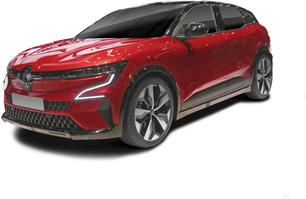
The hotly anticipated Renault Megane E-Tech has arrived on our shores but we're only getting the mid-spec variant for now.
Renault's newest EV is related to the well-known Megane in name only because it has been built from the ground up as an EV. It’s not a hatchback, like its namesake, either, rather a crossover, which means it’s a bit lower than some of its small SUV rivals.
It faces firm competition in the likes of the Hyundai Kona Electric, Volvo C40 and newcomer bZ4X from Toyota. In this review we'll see how Renault's cutest EV handles life with my family of three.
It might be the product of the brand's Chinese partnership, and in fact it might not even be a Mazda under the skin, but it definitely feels more like the Japanese brand than you might be expecting.
Does it feel quite enough like a Mazda? That's going to be up to you. But it certainly looks the part, inside and out.
Note: CarsGuide attended this event as a guest of the manufacturer with travel, accommodation and meals provided.
Note: The author, Andrew Chesterton, is a co-owner of Smart As Media, a content agency and media distribution service with a number of automotive brands among its clients. When producing content for CarsGuide, he does so in accordance with the CarsGuide Editorial Guidelines and Code of Ethics, and the views and opinions expressed in this article are solely those of the author.
The design for the Renault Megane E-Tech is top-notch and the eco-conscious footprint is even better. It’s an easy and comfortable car to be in but the price is a smidge too high in my opinion when you consider there’s currently only one choice for us Aussies and it’s a mid-spec variant at that. It also misses out on some items its rivals have but is a solid EV to consider for urban dwellers.
Mazda's designer is rightly proud of what he's managed to achieve here, and says every panel, and everything you touch inside, is Japanese, not Chinese.
The brand has inarguably made a very attractive SUV here. It’s sleek and modern feeling, but it has soul and character, too. Oh, and the brand insists the aerodynamic raised air curtain on the bonnet was done by Mazda first, and not the Ferrari Luce.
The black and swept-back roofline lends a sporty feel, too, while both the 19- and 21-inch alloy options suit the vibe.
But there is one view I’m not keen on, and that’s standing (or driving) directly behind it. Stay close to the car and you don’t really notice it, but take a few steps back — or follow behind one — and the rear end looks somehow blobby and out of proportion.
It's the one weak spot in an otherwise very good looking package.
The Mazda treatment has occurred in the cabin, too, and the touchpoints are suitably plush, though it is entirely lacking in tactile buttons or switches.
Pride of place instead is the massive screen, which is a whopping 26.4 inches. Honestly, though, only about half of that is of any real use. The passenger side has super limited functionality – it's limited to stuff like changing the theme of the screen or the radio station – and so it feels wasted and a bit pointless on that side of the cabin.
The E-Tech’s plump body panelling gives me some cute marshmallow vibes from certain angles but there are enough features to keep it looking slick, like the fun LED headlights, massive 20-inch alloys and optional two-tone paintwork.
I’m also a fan of the door handles on the E-Tech as they add some nice focal points, because the front has auto-flush handles that pop out on approach and the back door handles are positioned on the C-pillar.
If you're eco-conscious the E-Tech ticks the box because Renault has designed it to be 90 per cent recyclable.
The body is made of aluminium and can be reformed and shaped into new products at the end of its life. The interior materials are made from recycled fabrics and trims; even the lithium-ion battery is free from any rare earth minerals.
Head inside the cabin and the grey knit trims and upholstery on the seats, doors and dashboard creates a cabin space that feels warm and inviting. It's a similar feel to the Polestar 2 - simple but refined.
Although, with my kid around I have higher anxiety about dirtying them!
At 4850mm long and 1620mm tall, the CX-6e is longer but lower than the CX-5. But I'm 175cm, and I had no problem getting comfortable in the backseat. The leg room is huge, and I didn't find the headroom an issue at all, with clear air above me, even with the swept back roofline.
That's probably the biggest practicality perk here, with the backseat properly cavernous in that way they often are in modern EVs. There are also air vents and temperature controls for backseat riders, as well as cupholders in the middle-seat pulldown divider.
At the boot, you'll find 363 litres of storage space measured to the parcel tray (so more if you stack to the ceiling), and a total 1434 litres should you fold the second row and load all the way to the ceiling.
What you won't find, though, is a spare tyre. If you get stuck, a puncture kit is your only hope.
The E-Tech’s cabin is fairly roomy up front with plenty of head- and legroom. The front seats are super comfortable with powered lumbar support and I wouldn’t mind them not being powered if the price point was a bit lower.
The rear seat is comfortable enough once you get seated but the top of the door apertures are low, and I have to duck my head to get in and out.
Your head also brushes against the roof lining in the back which isn't terribly comfortable, especially considering there is no fold-down armrest to lean on.
The front row benefits the most with individual storage and you get a lot of options to choose from but the centre console is one of the most practical I’ve seen for the class. Lots of pockets and nooks that feature adjustable 'walls'.
You get a single permanent cupholder but with the removable walls, accommodation for a second cup or bottle, can be catered for.
Underneath the multimedia screen you get a dedicated phone shelf, which I love using.
In the rear, you get two map pockets and shallow bin storage in each door.
The charging options are good with two USB-C ports in each row as well as a 12-volt outlet and a wireless charging pad up front but you miss out on V2L (Vehicle to Load) functionality in this model.
The 9.0-inch touchscreen multimedia system looks great headlining the dash and is easy to access and use. The system rebooted once on me while driving but other than that everything is responsive.
You get wireless Apple CarPlay and Android Auto and the CarPlay is easy to get started.
The steering wheel has numerous stalks, controls, regen paddle shifters and even the gearshifter on the column, too. It takes a beat to get used to it but I like how driver orientated it is.
The boot offers great storage at 440L but it’s a deep well, which might be annoying if you’re unloading heavier gear. There is underfloor storage for the cables, too, and like I said, you miss out on a powered tailgate.
Discounting temporary drive-away offers, the Mazda CX-6e range opens at $53,990 plus on-road costs for the GT, and then climbs to $56,990 for the flagship Azami. There’s not a huge gap between those numbers, and that’s because both cars share the same battery and engine, and a lot of the same equipment.
As I write, the cheapest Tesla Model Y (the big dog in the electric SUV fight) is $58,900, so you'd have to argue Mazda has the pricing right.
The GT opens with:
Stepping up to the Azami gets you bigger 21-inch alloys and digital wing mirrors — the latter of which I don’t like.
If it was my money, you’d find me in a GT.
For the moment, the Megane E-Tech is being offered in only one grade for the Australian market and that’s the Techno EV60, which is the mid-level version of Renault’s brand new EV.
The EV60 is priced from $64,990, before on-road costs, and that positions it right in the middle of its rivals. The nearest competitor is the Hyundai Kona Extended Range at $60,500 MSRP, newcomer Toyota bZ4X 2WD slides in at $66,000 MSRP and the Volvo C40 Plus sits at $78,990 MSRP.
The E-Tech comes with a decent array of features for a mid-spec variant and premium items include heated front seats, a heated steering wheel, a digital rear view mirror and wireless functionality for Apple CarPlay and Android Auto but you do miss out on items like a powered tailgate and electric front seats which most of its rivals sport.
Technology looks good with a 9.0-inch touchscreen multimedia system, 12.3-inch digital instrument cluster, dual-zone climate control, faster USB-C ports (four total) and a wireless charging pad.
Sound is covered by the Arkamys Auditorium sound system with six speakers and the mood can be set with the 48-way configurable ambient lighting system.
Despite missing out on a powered tailgate, the EV60 has some features that still offer convenience like keyless entry, heated and auto-folding side mirrors and auto-folding flush door handles that pop out on approach (front only).
The Techno EV60 has a single electric motor. It produces a power output of 160kW and 300Nm of torque, and Renault says it will sprint from 0-100km/h in 7.4-seconds.
That's perfectly adequate for keeping up with traffic or getting around town. You only notice a sluggishness with power when you have a full load of gear. Flipping it to 'Sport' mode make it feel peppier, if you ever need it.
Delivering the range is a 78kWh LFP battery, producing a WLTP driving range of up to 484kms. The DC charge rate is capped at 194kW, which should take you from 10-80 per cent charged in 24 minutes. AC charging is up to 11kW, too.
The official energy consumption figure is 15.6kWh/100km and I averaged 13.9kWh after a fair mix between urban and open-road driving.
That’s outstanding consumption but the official driving range for this E-Tech’s 60kWh lithium-ion battery is up to 454km, which is similar to the Hyundai Kona Electric but I still had an eye on the range during longer trips.
The E-Tech has a Type 2 CCS charging port which means you can benefit from faster DC charging speeds, however, it can only accept a top speed of 7.4kW on AC power.
On a 7.4kW AC charger, you can go from 0-100 per cent in a little over nine hours but on a standard 2.3kW house plug, that jumps up to over 30-hours.
On a 130kW DC charger expect to go from 15-80 per cent in as little as 30 minutes, which is pretty convenient if you have access to one.
Sadly, the E-Tech doesn’t have vehicle-to-load capability, so you can’t power or charge bigger items.
It's not just outside and in the cabin where Mazda has worked its magic, it has done a whole bunch of stuff under the skin as well, retuning things like the steering, the suspension and the brakes, changing the tyre brand, and tweaking the damping to deliver a car that drives more like a Mazda than what you might of an electric Chinese SUV.
And it does feel more engaged from behind the wheel, but it also feels a little bit like Mazda has done the very best they can do with the package they've been given, rather than start from a clean sheet of paper.
There are some elements of the drive experience I'm not 100 per cent convinced by. One of them is a fairly busy ride, even on relatively smooth and straight roads, where it can feel a bit bouncy through the suspension. And another is the fact that it feels like it's been dialed up to 11 in places – the accelerator, for example, is super responsive, so even breathing on it can get that kind of surging feeling through the cabin, reminding you to be a little bit more gentle with your inputs.
Elsewhere, though, it is a composed and quiet package. We did a lot of driving through the city and then on flowing country roads, and it handled it all well. In fact, Melbourne is beset by potholes at the moment, and I actually targeted a few of them to see how it would handle them, and while the ride can feel busy in places, it does also soak up those really big road imperfections really well.
The two-tonne-plus kerb weight only really lets itself be known in super tight and twisty stuff. Otherwise, the CX-6e is happy just to flow along, a feeling helped by the not-stratospheric power outputs which suit the nature of this electric Mazda, too.
If you were to blindfold me, I probably wouldn't immediately guess that I was driving a Mazda, but equally, I wouldn't say I was driving some new brand of Chinese SUV either. I think it straddles those two worlds, and it does it pretty well.
I have mostly loved driving the E-Tech. It's easy to cruise around in and the power is adequate for open-road driving but it prefers an urban environment.
The power can feel a bit lacklustre when you are carrying lots of people or gear but you mostly feel that when you're on a steep incline and trying to keep up your speed.
The steering is crisp and that makes the E-Tech very responsive to drive. The power is delivered smoothly and it feels well-balanced when you put your foot down.
There is more roll in corners than I was expecting but the car still feels firmly planted.
The ride comfort is great. The suspension is more firm than soft which means you feel the road but it's not a major bother. There is a bit of wind noise at higher speeds, as if the door isn’t properly sealed by a millimetre but it doesn't annoy me.
The regenerative braking is controlled by paddles on the steering wheel and you have three levels plus a one-pedal function to choose from.
The single pedal set-up is pretty smooth, even in stop/start traffic, but it’s great to be able to quickly change modes on the go.
The smaller size of the E-Tech makes it an easy car to manoeuvre in a small car park. You get front, rear and side parking sensors which is great because the reversing camera isn’t as clear as it should be for this price level.
There’s no ANCAP rating yet, but Mazda is hopeful of five stars. It is waiting for EuroNCAP testing, but for now the CX-6e launches as an unrated vehicle.
I do like the fact that both models share the same safety package (I don't think you should have to spend more money to be safer), which means things like:
Not all of it feels particularly Mazda, though. The driver attention monitor, for example, gets more annoying the more time you spend with it (every time you yawn it will tell you to pull over, for example), and the over-speed warning chirps you every time you stray over the limit by even a kay or two.
The E-Tech has a maximum five-star ANCAP safety rating from testing in 2022 and has seven airbags, including a front centre airbag.
The EV60 comes with lots of passive safety features including dusk sensing auto LED headlights, LED DRLs, a rear fog light, child safety locks, tyre pressure monitoring, traffic sign recognition tech, an intelligent seatbelt warning, a reversing camera plus front, rear and side parking sensors.
Active safety equipment includes items like blind-spot monitoring, driver attention alert, rear collision warning, forward collision warning, rear cross-traffic alert, lane departure alert, lane keeping aid, and adaptive cruise control (with stop and go).
You also get a digital rear view mirror which is essential as the back window is narrow and the camera feed provides a clearer view than you’d have without it.
The rear row also features ISOFIX child seat mounts on the outboard seats and three top tethers but two seats will fit best. The front passenger seat also has ISOFIX child seat mounts and a top tether.
AEB with car, pedestrian, cyclist and junction turning assist function is operational from 8.0-80km/h (160km/h for cars) but it is common to see that starting figure sit closer to 5.0km/h.
The CX-6e is covered by Mazda’s five-year, unlimited-kilometre warranty, which is a little underwhelming by today’s standards. The battery is covered for eight years or 160,000kms.
Service intervals are 12 months or 20,000kms, and a capped-price servicing program will see you paying a total $1860 over the first five years of ownership.
The E-Tech comes with a five-year/100,000km warranty, but it’s usual to see an unlimited km term for the class. The battery is covered by an eight-year or up to 160,000km warranty term.
Service intervals are reasonable at every 12 months or 30,000km and you also get five-years roadside assistance included.
Pricing over the first five years ranges from a low of $230.04 to a high of $519.62, averaging out at pretty competitive $317.72 per service. No capped-price deal is available.