What's the difference?
We know the story of Mazda’s sudden EV push already, but I’ll recap it quickly.
On one side, soaring fuel prices and helpful incentives combined to lure Aussie buyers into EVs in record numbers. But Mazda doesn’t really have any to sell. On the other side, tightening NVES (New Vehicle Efficiency Standard) regulations punish brands that aren’t using EVs to lower their fleet emissions. But Mazda doesn’t really have any to sell.
The answer lay not in Japan, but in China, where Mazda has been able to capitalise on its relationship with Changan to get new EVs on the road quickly. The first was the 6e sedan, and this is the second arrival, the CX-6e.
And yes, that means that under the skin of this undeniably sexy electric SUV it’s very similar to something from Deepal, but the brand insists it’s still very much a Mazda everywhere else.
And so with this, Mazda rides into the electric SUV fray. But how does it stack up?
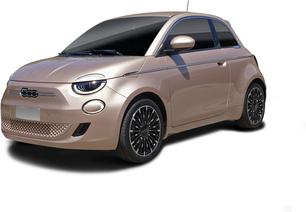
You wouldn’t know it to look at it, but this is a brand-new — as in really and truly all-new — Fiat 500.
That has got to be a big deal for fans of Fiat’s pint-sized city car, with a genuinely all-new 500 about rare as spotting Halley’s Comet soaring over Turin. The last time was way back in 2007, by the way, and that car will remain on sale alongside this new one for the foreseeable.
But that’s not the only surprise. This 500 is also entirely electric, properly modern inside, and it has actual technology in its cabin and on its safety list.
Fiat reckons this is a big reset for the 500. And that there will never be another all-new petrol model again.
So, how does this new 500e stack up against the recent flood of small EVs, predominantly from China?
Let’s go find out.
It might be the product of the brand's Chinese partnership, and in fact it might not even be a Mazda under the skin, but it definitely feels more like the Japanese brand than you might be expecting.
Does it feel quite enough like a Mazda? That's going to be up to you. But it certainly looks the part, inside and out.
Note: CarsGuide attended this event as a guest of the manufacturer with travel, accommodation and meals provided.
Note: The author, Andrew Chesterton, is a co-owner of Smart As Media, a content agency and media distribution service with a number of automotive brands among its clients. When producing content for CarsGuide, he does so in accordance with the CarsGuide Editorial Guidelines and Code of Ethics, and the views and opinions expressed in this article are solely those of the author.
A fun, funky EV which will no doubt appeal to lovers of Italian style, but also one which struggles a little on the range and price front.
Still, there’s no doubt that electrification has improved the Fiat 500 formula.
Mazda's designer is rightly proud of what he's managed to achieve here, and says every panel, and everything you touch inside, is Japanese, not Chinese.
The brand has inarguably made a very attractive SUV here. It’s sleek and modern feeling, but it has soul and character, too. Oh, and the brand insists the aerodynamic raised air curtain on the bonnet was done by Mazda first, and not the Ferrari Luce.
The black and swept-back roofline lends a sporty feel, too, while both the 19- and 21-inch alloy options suit the vibe.
But there is one view I’m not keen on, and that’s standing (or driving) directly behind it. Stay close to the car and you don’t really notice it, but take a few steps back — or follow behind one — and the rear end looks somehow blobby and out of proportion.
It's the one weak spot in an otherwise very good looking package.
The Mazda treatment has occurred in the cabin, too, and the touchpoints are suitably plush, though it is entirely lacking in tactile buttons or switches.
Pride of place instead is the massive screen, which is a whopping 26.4 inches. Honestly, though, only about half of that is of any real use. The passenger side has super limited functionality – it's limited to stuff like changing the theme of the screen or the radio station – and so it feels wasted and a bit pointless on that side of the cabin.
It looks, well, it looks like a Fiat 500.
It’s actually bigger in every dimension than an ICE cinquecento, but it doesn’t really look like it, which is a good thing.
The 17-inch wheels look great, and big against the very small Fiat, and I like the hidden doorhandles, which make the already smooth-looking 500’s flanks look a little smoother still. But I can take or leave the little DRLs up front that are meant to act as little illuminated eyebrows for the headlights, which come over a bit too cutesy.
But I think the highest compliment I can pay it is that it looks like a regular Fiat 500 — one of the most successful reincarnations of a timeless design ever — and not some modern, eco-friendly version that would have killed the look.
In the cabin, however, it’s definitely a more modern affair, with the big screen, the horizontal push-button gear selector, and the nifty push-button door openers.
Still, it’s all pretty familiar Fiat 500, only a little nicer, even if some of the plastics are far too hard and scratchy for a vehicle this expensive.
There are five colours available: Ice white, Onyx black, Rose gold, Ocean green and Celestial blue.
At 4850mm long and 1620mm tall, the CX-6e is longer but lower than the CX-5. But I'm 175cm, and I had no problem getting comfortable in the backseat. The leg room is huge, and I didn't find the headroom an issue at all, with clear air above me, even with the swept back roofline.
That's probably the biggest practicality perk here, with the backseat properly cavernous in that way they often are in modern EVs. There are also air vents and temperature controls for backseat riders, as well as cupholders in the middle-seat pulldown divider.
At the boot, you'll find 363 litres of storage space measured to the parcel tray (so more if you stack to the ceiling), and a total 1434 litres should you fold the second row and load all the way to the ceiling.
What you won't find, though, is a spare tyre. If you get stuck, a puncture kit is your only hope.
The 500e is 29mm taller, 61mm longer and 56mm wider than the current ICE Fiat 500 (now 1529mm, 3631mm and 1683mm respectively), and it rides on a longer wheelbase, too .
That means more front-seat room and head room, but there’s still not oodles of space in the four-seat cabin, and especially in the back, where things are pretty tight.
I’m 175cm tall, and my head touches the ceiling in the back, and if I had another full-size human in the back with me, I’d want it to be someone I know well, because we’d be well and truly aquatinted by the time we got to our destination.
The front seats are more accomodating, but there is a strange tightness to the pedal area for the driver. It’s so tight, in fact, that when you rest your left foot, you have to be careful not to accidentally clip the brake pedal when driving.
The boot is a small 185 litres, too. But you’re not buying this for practicality perks, are you?
Discounting temporary drive-away offers, the Mazda CX-6e range opens at $53,990 plus on-road costs for the GT, and then climbs to $56,990 for the flagship Azami. There’s not a huge gap between those numbers, and that’s because both cars share the same battery and engine, and a lot of the same equipment.
As I write, the cheapest Tesla Model Y (the big dog in the electric SUV fight) is $58,900, so you'd have to argue Mazda has the pricing right.
The GT opens with:
Stepping up to the Azami gets you bigger 21-inch alloys and digital wing mirrors — the latter of which I don’t like.
If it was my money, you’d find me in a GT.
The 500e is not cheap by modern small EV standards — we’re looking at you, China — but it does arrive in one well-equipped trim level, called La Prima, with paint the only available option.
It's also, quite shockingly for anyone who has driven an ICE Fiat 500 lately, stacked with some truly high-tech kit.
There’s heated seats for the first time ever, for example, and there’s 10.25-inch central screen with Apple CarPlay and Android Auto, and wireless charging.
There’s a digital driver display, too, plus there’s faux-leather on the seats and dash, a panoramic glass sunroof and fancy push-button front doors (though with a mechanical back-up lever hidden in the door pockets should something go pear shaped).
Outside, you’ll find 17-inch alloys, as well as LED lightning all around, including the DRLs, and there’s keyless entry and push-button start, too.
But, and it’s a significant but, the 500e lists at $52,500 before on-roads , which — when you consider its size, battery and range — really edges it into the premium EV space.
A similar-sized EV from China can be had for under $40k, which means you are going to have to really love the 500e to drop that extra $15k or so.
A single front-mounted electric motor delivers the power here, with 87kW and 220Nm on offer. Enough, Fiat says, to knock off 100km/h in 9.0 seconds. But it does feel quicker than that in real life, thanks to the way electric vehicles deliver their power.
There’s the usual EV single-speed gearbox, too, with power sent to the front wheels.
Delivering the range is a 78kWh LFP battery, producing a WLTP driving range of up to 484kms. The DC charge rate is capped at 194kW, which should take you from 10-80 per cent charged in 24 minutes. AC charging is up to 11kW, too.
The Fiat 500e’s 42kWh battery provides a smallish 311km driving range on paper, but when we got in it was more like 290km at 96per cent charged. A city car, then, rather than a long-distance hauler.
When it does come time to charge, you’re set up for 85kW DC fast charging which should take you from zero to 80 percent in 35 minutes.
It's not just outside and in the cabin where Mazda has worked its magic, it has done a whole bunch of stuff under the skin as well, retuning things like the steering, the suspension and the brakes, changing the tyre brand, and tweaking the damping to deliver a car that drives more like a Mazda than what you might of an electric Chinese SUV.
And it does feel more engaged from behind the wheel, but it also feels a little bit like Mazda has done the very best they can do with the package they've been given, rather than start from a clean sheet of paper.
There are some elements of the drive experience I'm not 100 per cent convinced by. One of them is a fairly busy ride, even on relatively smooth and straight roads, where it can feel a bit bouncy through the suspension. And another is the fact that it feels like it's been dialed up to 11 in places – the accelerator, for example, is super responsive, so even breathing on it can get that kind of surging feeling through the cabin, reminding you to be a little bit more gentle with your inputs.
Elsewhere, though, it is a composed and quiet package. We did a lot of driving through the city and then on flowing country roads, and it handled it all well. In fact, Melbourne is beset by potholes at the moment, and I actually targeted a few of them to see how it would handle them, and while the ride can feel busy in places, it does also soak up those really big road imperfections really well.
The two-tonne-plus kerb weight only really lets itself be known in super tight and twisty stuff. Otherwise, the CX-6e is happy just to flow along, a feeling helped by the not-stratospheric power outputs which suit the nature of this electric Mazda, too.
If you were to blindfold me, I probably wouldn't immediately guess that I was driving a Mazda, but equally, I wouldn't say I was driving some new brand of Chinese SUV either. I think it straddles those two worlds, and it does it pretty well.
This is the probably the best-driving example of the Fiat 500 I’ve ever climbed into. Sure, it’s not quite as engaging as self-shifting a perky little manual, but it’s smoother, easier and more comfortable, and a whole lot better than ICE vehicles fitted with Fiat's odd dual-logic automatic gearbox.
The EV transition genuinely suits the little Fiat, admittedly sapping a little character, but also thoroughly modernising the drive experience, with smooth, constant acceleration, sharp-enough steering and a ride that’s mostly settled, only really becoming crashy over the bigger road imperfections.
The small dimensions here also help the EV reincarnation. Yes, it’s heavier than you might expect, weighing in at 1290kg (tare), with the batteries adding several hundred kilograms to the equation, but the 500e still doesn’t feel overly heavy, with the little Fiat remaining pretty light on its feet.
There are three drive modes on board, including the catchy Sherpa mode (because it will help get you where you’re going), which, when you’re running low on battery, kills the climate control and anything else it needs to preserve range and get you home.
But you can’t shake the feeling that the 500e is a little expensive for such a specialist tool. It’s unashamedly a city car, but one that will cost you more than $50k, and which doesn’t feel quite premium enough in the cabin to justify that asking price.
There’s no ANCAP rating yet, but Mazda is hopeful of five stars. It is waiting for EuroNCAP testing, but for now the CX-6e launches as an unrated vehicle.
I do like the fact that both models share the same safety package (I don't think you should have to spend more money to be safer), which means things like:
Not all of it feels particularly Mazda, though. The driver attention monitor, for example, gets more annoying the more time you spend with it (every time you yawn it will tell you to pull over, for example), and the over-speed warning chirps you every time you stray over the limit by even a kay or two.
There’s a heap of active safety stuff on board (again, unusual for a 500), with active cruise control, traffic sign recognition, front, rear and side parking sensors, blind-spot monitoring, AEB with pedestrian and cyclist detection, and more.
Still, the 500e only secured a four-star ANCAP safety rating, scoring just below the five-star cut off in Adult Occupant Protection, Child Occupant Protection and Safety Assist, with a lack of a centre airbag not helping.
The CX-6e is covered by Mazda’s five-year, unlimited-kilometre warranty, which is a little underwhelming by today’s standards. The battery is covered for eight years or 160,000kms.
Service intervals are 12 months or 20,000kms, and a capped-price servicing program will see you paying a total $1860 over the first five years of ownership.
The fly in Fiat’s ointment is its ownership proposition, with a three-year, 150,000km warranty now way below par in Australia these days, even if the battery is covered for the standard eight years.
Servicing is every 12 months or 15,000kms, and will cost $250 a pop for the first eight years, which is commendably cheap.