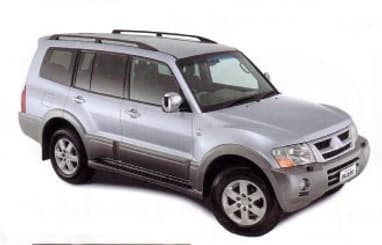
Mitsubishi Pajero 2004 Problems

Are you having problems with your 2004 Mitsubishi Pajero? Let our team of motoring experts keep you up to date with all of the latest 2004 Mitsubishi Pajero issues & faults. We have gathered all of the most frequently asked questions and problems relating to the 2004 Mitsubishi Pajero in one spot to help you decide if it's a smart buy.

Used Mitsubishi Pajero review: 2000-2020 - including NM, NP, NS, NT, NW, and NX
By David Morley · 15 Jul 2020
Mitsubishi's long-lived Pajero off-roader is one of the last, true, off-road specialist vehicles.
Read the article
Used Mitsubishi Pajero review: 1991-2015
By Ewan Kennedy · 24 Feb 2016
Ewan Kennedy reviews the Mitsubishi Pajero from 1991, 1992, 1993, 1994, 1995, 1996, 1997, 1998, 2000, 2001, 2002, 2003, 2004, 2005, 2006, 2007, 2008, 2009 2010, 2011, 2012, 2013, 2014 as a used buy.
Read the article
Used Mitsubishi Pajero review: 2001-2016
By Ewan Kennedy · 08 Aug 2017
When introduced to Australia in 1983, the Mitsubishi Pajero was arguably the first affordable 4WD that was a family wagon rather than a truck-based 4WD.However, this is a genuine SUV, not a passenger car with a tough looking body, Pajero is competent off-road, being able to handle most situations likely to be encountered by an adventurous family in the great Aussie countryside or on beaches.Though it began its life in downunder as a body-on-chassis 4WD, it became a monocoque for improved ride and comfort in 2000. Good engineering meant the post-2000 models retained similar strength to the chassis models. All have a low-range case for tough, slow conditions.While we are considering the monocoque models from the year 2000 in this feature you should be aware the older ones may be past their use-by date. Unless you can do a fair bit of your own mechanical work you're probably better off considering models from the new generation in December 2006.Mitsubishi’s sophisticated Super Select drivetrain permits the use of all-wheel-drive under any circumstance. For example, safe traction on wet sealed roads if you opt for AWD, or lower fuel consumption on dry dirt roads if you go for 2WD. AWD can be engaged or disengaged on the fly at any speed up to 100 km/h.Midway through 2013 Pajero was brought right up to date in its infotainment and safety equipment. These models are popular with buyers who can't come up with the dollars to buy a brand new one.Mitsubishi Pajero comes as a station wagon with either two or four passenger doors. The two-door was never particularly popular and imports stopped with the all-new model of 2000. They reappeared with the when the new model was launched at the start of end of 2006, then disappeared due to lack of buyer interest in 2010.All short-wheelbase Pajeros have five seats, the long-wheelbase models have either five or seven. The rearmost two seats in the seven-seat models are better suited to kids than adults but with a bit of squeezing up the Pajero can handle seven grown-ups.Though the first Pajeros had a petrol four-cylinder engine, all petrols under review here are V6s. This was a 3.5 twin-cam unit until September 2003 when it was uprated to a 3.8-litre.Diesel power is preferred by most buyers, the large four-cylinder units, 2.8 then 3.2 litres, have good torque and seem to enjoy hard work.Pajero is offered in manual and automatic transmissions, with the latter being almost universal in later years.The Australian Mitsubishi dealer network is long established and well-organised. Spare parts are generally available for all but the oldest models. Prices can be relatively high as 4WD bits are more rugged and can come as a surprise if you've only owned sedans in the past.Insurance premiums are about average for this class and there doesn’t seem to be much difference of opinion on the insurance risk amongst the major insurance companies.Note that the Pajero Sport launched at the end of 2015 is actually a replacement for the outgoing Challenger, not an additional version of the standard Pajero range.If you suspect a Pajero has been used off-road look for damage to door sills, door surfaces and bumper corners. Be very wary if the protection plates have been pushed up onto the mechanical items move them.Check out the interior carefully because carting bored kids about can be tough on any vehicle. Damage to the cargo area is another sign of hard use.Poor engine maintenance is hard on turbos and can lead to complete failure if the oil hasn't been changed on time. Check the service book.Be sure all gears in a manual box engage easily and that the clutch is light and quiet in its action.Automatic transmissions should go into Drive and Reverse promptly and easily.Listen for, and feel for, noises and roughness in the complete driveline.Make sure the brakes pull the Pajero up evenly, even on dirt.
Read the article
Mitsubishi Pajero 2004: What can I claim from insurance?
Answered by David Morley · 01 Feb 2020

I don’t know of any insurance companies that will pay out an increased amount because of recent repairs. The presumption would have been that your car was worth the $6000 agreed-value amount only if it was in good working order and not in a damaged state. Following that presumption is the fact that, if it needed $1500 spent on it to bring it back to that condition, that’s simply a wear and tear cost that is not the insurer’s problem. It’s a cruel world, no?

As for the payout figure including (or not) the registration refund, I’d imagine that would be up to the insurer and would be included in the dreaded fine-print. From what I can gather, this is a pretty common inclusion on most policy wordings, and many insurers will adjust the payout down to include the policy excess (if, unlike your case, Tracey, you were at fault) and the unused portion of the CTP insurance and registration. But get this: Some insurers will even deduct the costs of the rest of the year’s insurance premium from your payout, even if you were paying the premium monthly! Never gloss over the fine print.

Mitsubishi Pajero 2004: Rear axle problems
Answered by Graham Smith · 07 Dec 2012

I would strongly argue the case that the failure is a safety related issue and shouldn't affect the warranty. Besides the company has already admitted to you that there is a problem, which it seems to me leaves them with nowhere to go.


Mitsubishi Pajero 2004: Using a performance chip
Answered by Carsguide.com.au · 19 Jul 2011

I too have read the claims made by makers of these chips as well, but I don’t have the evidence that confirms the benefits, so I would leave well enough alone. By your admission the Pajero is doing the job, so I wouldn’t change it.

Pajero timing chain
Answered by Graham Smith · 10 May 2012

Timing chains do not need to be replaced regularly as timing belts do, so there is no requirement in the service schedule for such a replacement. But they do wear and can become slack over time, and when that happens they do need to be replaced. If you don't replace them in that situation you risk them breaking or jumping teeth on the drive gears and if either of those things happened you could do serious internal damage to the engine. I'd be inclined to follow your mechanic's advice.

My 2004 Mitsubishi Pajero will turn over but won't start
Answered by David Morley · 13 Jan 2025

This sounds – on the surface – very much like a problem with the car’s body computer. The body computer controls all the electrical functions you’ve just listed as well as potentially being responsible for controlling the immobiliser. If the computer isn’t telling the immobiliser to switch off, you could easily find that the engine will turn but not fire.

It doesn’t work every time, but one way to reboot the body computer is to disconnect the battery and leave it overnight. This will sometimes restore the computer to factory settings (for want of a better term). If the computer is on the way out, however, this reboot may not be permanent. The other thing to check is the battery inside the ignition key. A flat or weak battery here can also mean the immobiliser doesn’t switch off and the engine will refuse to start. If none of that does the trick, an auto electrician is your best bet.

Mitsubishi Pajero timing chain/belt
Answered by Graham Smith · 12 Apr 2012

That's correct, the 3.2-litre turbo-diesel engine has a timing chain, not a belt, so doesn't need to be replaced.

Toyota Prado: Buying for age or mileage?
Answered by Graham Smith · 31 Jul 2015

In this case I would be tempted to go for the older car with the fewer kilometres, as long as you were sure the odometer reading is correct.

Disclaimer: You acknowledge and agree that all answers are provided as a general guide only and should not be relied upon as bespoke advice. Carsguide is not liable for the accuracy of any information provided in the answers.
Have a new question for the CarsGuide team?
More than 9,000 questions asked and answered.
Complete guide to Mitsubishi Pajero 2004
Complete guide to Mitsubishi Pajero 2004 CarsGuide Logo
Reviews, price, specs and more