What's the difference?
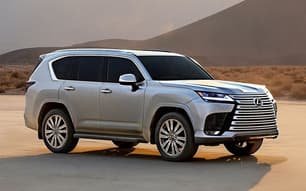
The march away from diesel power and towards a petrol-hybrid future in off-roaders continues. Okay, so it’s a full-sized Lexus we’re talking about, but the off-road credentials of the Toyota LandCruiser 300 Series-based Lexus LX have never been in question, have they?
The full-sized, super-lux Lexus LX might never see the Simpson Desert or the Old Telegraph Track, but that doesn’t mean it couldn’t tackle either with a fair degree of ease. So there’s no way Lexus would allow a new hybrid driveline to compromise any of that. Besides, this is the same driveline that will take the LandCruiser on its next step, so you better believe it’s the real deal.
Of course, the Lexus badge and somewhat frightening price tag also infer a high degree of plush and tech, and, let’s be honest, those elements are more likely to get a leading role in the LX’s day-to-day strut, as opposed to the walk-on part played by the off-road stuff.
So does all this make the LX one huge, high-tech mash up of conflicting priorities, then? That probably depends on how pragmatically you view motor vehicles generally, but one thing’s for sure, if the hybrid LX is paving the way for the next generation of LandCruiser powerplants and drivelines, then we’re all ears.
Did you know SsangYong translates to ‘Double Dragon’?
How friggin’ cool is that? Far cooler, at least, than the Korean brand’s history, which the word ‘tumultuous’ barely begins to cover.
After years of ownership woes and a near-bankruptcy, the brand came out the other side with enough stability to field a range of new vehicles, courtesy of its ambitious new owners - Indian giant Mahindra & Mahindra.
The Tivoli small SUV is the first car to launch under the new, cashed-up leadership and when it landed in Korea in 2015 it was solely responsible for the ‘Double Dragon’ brand turning its first profit in nine years.
Fast forward a few years, and a re-booted SsangYong is again confident enough to enter the Australian market, with a four-pronged, all-new SUV assault.
So, does the Tivoli have what it takes to break into our highly competitive small-SUV scene and help SsangYong pull a miraculous Korean turn-around, a-la-Hyundai?
I spent a week in the mid-spec Tivoli ELX diesel to find out.
Huge specification in terms of convenience and safety gear are matched by an equally huge range of abilities in this vehicle. As well as rock hopping with the best of them, this is also a phenomenal touring rig and a more-than-capable off-roader. Of course, whether you can see yourself clambering up the side of a muddy creek crossing in $202,000 worth of vehicle is a personal matter, but rest assured, the Lexus will do it if you ask it to.
In the case of the hybrid LX, however, the vehicle now has an extra dimension to cover off, and from what we can see, it does take the efficiency and running costs of the big wagon to a new, better place. Mind you, that may only be the case if diesel continues to cost a dollar-a-litre more than petrol at the bowser.
The shift to petrol power also brings with it a level of mechanical background noise that we’re not entirely sure fits the Lexus legend, while additions such as the camera-based rear-view mirror system seems to be a conversation starter rather than an actual improvement.
I was asked the critical question while I had the Tivoli ELX on test – “Do you think people will buy this car?” After some time in thought, my answer was – “Not many… yet.”
Those who can look past the brand perceptions are getting an SUV which is damn near as good as anything on the market – and likely cheaper to run.
To that, you can say a lot of things: If only it cost slightly less. If only its rear was better looking. If only it had a five-star safety rating.
But here it is – the fact that the Tivoli can even hold a candle to its slick, finely tuned competition says a lot. The Double Dragon is back, and if it can afford to stick around for a while, perhaps it will stand a chance of putting the big players on notice.
In a styling sense, that big, bold, deep grille at the front won’t be to everybody’s liking, but we reckon it’s pretty well matched with the otherwise taut skin of the LX’s body.
Inside, the plush look and feel is the dominant factor, but if you look really closely, there’s a fair bit of generic Lexus stuff on show. Is that a criticism? Hardly. The leather looks and feels luxe and only some hard plastics (such as on the door cappings) belie the car’s LandCruiser origins.
SsangYong is hardly a brand known for its consistent or good-looking design. In the past, the brand has floundered between the squared-off lines of the Musso and the unresolved bulbous curves of the last-gen Korando.
The brand’s re-launch has finally brought it up to speed, with every car across its range featuring a consistent design language. It’s improved out of sight, but still isn’t without its flaws.
Up front, there’s an angry-looking, squared-off horizontally slotted grille, with angles galore wrapping around the small SUV’s sides.
The angles continue up the A-pillar and across the roof for a squared-off, European-influenced roofline.
Then, around the back things get… strange. A pronounced curvy ridge makes its way over the rear wheels and into a rounded-out boot. It seems at odds with the angular rear glass and lower garnish.
There’s just way too much going on around the back; it’s overly styled. The chintzy chrome finish around the lower reflectors doesn’t help, nor do the big round SsangYong badge and bold ‘T I V O L I’ typeface.
The 16-inch alloys on the EX and ELX grade are a simple 10-spoke matte-silver. They’re nothing special, but at least they're easy to clean.
Inside, things are also mixed. There’s plenty of good and bad. The seats are clad in a robust cloth with plenty of sponge for comfort, and there are sensibly placed soft surfaces in the doors and on the centre console for your elbows.
The dash has an aesthetically pleasing symmetrical theme to it and is finished mostly in decent plastics. The 7.0-inch media screen is pretty good, too, but the rest of the centre stack is a bit nasty and old fashioned.
There’s the mix of gloss plastic and silver surfaces, a giant climate control dial and the so-so buttons that litter its surface. It reminds me of Korean car designs past, like the Holden (Daewoo) Captiva and generations-old Hyundais. Credit where credit is due, though - it all feels much better built.
I’m actually a big fan of the Tivoli’s steering wheel, it has a ridged, chunky shape and is finished in a pleasing artificial-leather material. The function stalks behind it are solid, with rotary dials on them to control lights and wipers. As the primary touch-points for the driver it’s neat that they have a unique, SsangYong personality to them.
Like many hybrids, cargo capacity takes a bit of a blow. In this case, placement of the battery under the cargo floor means a reduction in luggage capacity from 1109 litres to 899 litres. In the seven-seat variant, capacity is 883 litres with the rearmost row folded flat. The rear seat folds 60:40 and there are good, solid tie-down points in the rear. There’s no under-floor storage, however, apart from a small compartment just behind the rear seat which locates the tools and safety triangle.
The tailgate is powered (if a bit slow in its action) and there are cup-holders atop each suspension tower, clearly a hang-over from the seven-seat variant which is not available in F Sport trim. The cargo blind is a good addition, as is the 1500-Watt power socket in the cargo bay.
In the cabin, there are plenty of grab handles and the side steps give shorter folk a leg up when entering or leaving. Once you’re in, the front seats are terrifically comfortable as well as featuring a massage function on top of the heating and cooling functions. The steering wheel is also heated.
Paddle shifts might seem odd in a vehicle like this, but they are brilliant in off-road situations, although you need to first select manual mode on the shifter to have the paddles hold each gear for more than a few seconds in most of the on-road driving modes.
Speaking of the shifter, Lexus has seen fit to once again reinvent this simple control. You now need to pull the handle towards you and up for Reverse, across and down for Drive while Park remains a separate button even though it looks like just another icon on the lever.
A pair of cup holders live over to the passenger’s side of the centre console, and there are a pair of USB charge ports as well as an HDMI port in the dashboard. But the switches for the power windows are located almost directly under the driver’s interior door pull, forcing some unorthodox wrist geometry.
At least the buttons for the climate control and off-road functions such as diff locks and ride height are, indeed, buttons and not menu items. The simple knob to control the stereo on-off and volume is a great touch, too. So is the cooled centre console under a cover that opens from either side.
The rear seat is big and wide but the high floor dictated by the body-on-frame construction means those with long legs will have their knees bent while ever they’re in the back seat. The seat cushion itself is pretty flat, too, but the backrest does recline through a wide range of angles.
Reading lights, lots of air vents and a full set of climate controls ease the pain of riding in the back, but if you want cup holders, you need to keep the centre rear seat free so the armrest that houses the holders can be lowered and snapped open. Adding to the impression that plenty of thought has gone into the rear seat environment are the pull-up sun blinds on each window. Why don’t all cars have these?
The Tivoli might be a small SUV but it has a cavernous cabin. It’s seriously impressive and rivals some of the best players in this segment, like the Honda HR-V.
The front seat offers huge amounts of headroom, leagues of legroom, great space for your arms on either side and a fully telescopically adjustable steering wheel.
Storage is comprised of a shallow trench under the climate-control stack, decently sized cupholders in the centre console and doors, as well as a deep console box and a glovebox, which seems to disappear forever into the dash.
There’s also a rather odd trench cut out of the dash above the console box. It’s ridged and has a rubbery surface but seems useless for storing things, which will simply topple out when you accelerate.
As previously mentioned, there are comfortable surfaces for resting your elbows on for front occupants.
Room for back-seat dwellers is also excellent, with awesome legroom for the segment and leagues of airspace even for taller folk. There are the same padded elbow-rests in the doors and deep cupholders, but no air-conditioning vents or USB ports.
There are also weird elastic ropes on the back of the front seats for storing things (with mixed success) and a pull-down armrest.
The boot is rated at 423-litres (VDA), which is deceptively large (size-wise not far off the HR-V’s 437-litre space). The problem here is the shape of the boot itself. It’s deep from the floor to the retractable screen, and SsangYong says it will hold three golf bags, but it’s the narrow width and length which limit its potential.
I found it awkward to move some odd-shaped objects, like a heater and some boxes, and the high entry-point to the bootlid makes things a little difficult when moving heavier items.
Our ELX has significantly more room thanks to a space-saver spare under the boot floor. The Ultimate, which sits above has a full-size spare, further limiting boot space.
There are the same odd elastic ropes in the edges of the boot wall for smaller loose objects or cables.
While the LX line-up incorporates off-road oriented versions dubbed Overtrail, that specification is not available in the hybrid variety LX700h. Instead, the LX hybridised line-up kicks off with the Sport Luxury grades in either five or seven-seat layouts and a list price of $196,000 and $199,800 respectively. The F Sport is the new LX flagship model with its $202,000 price-tag (all prices are plus on-road costs) and is only available in five-seat configuration.
As you might imagine for a flagship badge for a maker like Lexus, there’s really nothing missing from the specification. In the case of the hybrid variants, that includes 22-inch alloy wheels, power sunroof, full leather trim and a hands-free tailgate. Those feature are part of the Enhancement Pack on lesser versions, but have been added to all hybrid LXs.
You also get four-zone climate-control, heated, cooled and massaging front seats, keyless entry and start, steering wheel-mounted controls, paddle shifters, automatic headlights and wipers, heated mirrors, soft-close doors, 12.3-inch touchscreen, digital radio, embedded sat-nav, wireless Apple CarPlay and Android Auto, head-up display, premium audio system and pretty much everything else you’ve ever seen fitted to a car.
The F Sport variant we’ve tested here is the big daddy and adds four-way adjustable head rests in the front, a heated steering wheel, specific aluminium trim, aluminium pedals, F Sport-specific gear knob, ventilated and heated rear seats, and a digital rear-view mirror.
If SsangYong wants to roar back onto the market and challenge people’s perceptions of the brand, it’ll first need to get them in the door. After all, this low-ball strategy worked for Hyundai and Kia, who infiltrated Australia with models like the Excel and Rio, which offered all the features of more established brands at a cut price.
The challenge is not tarnishing your brand while you’re at it. Has SsangYong pulled it off with the Tivoli?
Our ELX is the mid-spec car, sitting above the entry-level EX and below the all-wheel-drive and diesel-only Ultimate.
The $29,990 ticket price for our front-wheel-drive diesel would be about right if the Tivoli was from any mainstream brand. For roughly the same money you can get a top-spec Mitsubishi ASX Exceed ($30,990), Honda HR-V RS ($31,990), fellow Korean Hyundai Kona Elite ($29,500), or a diesel-powered Mazda CX-3 Maxx Sport ($29,990).
Oh, and despite it looking quite large in the pictures, the Tivoli is most definitely a small SUV, being narrower than a Hyundai Kona and not as long as a CX-3.
Feature-wise, our ELX gets 16-inch alloy wheels, a 7-inch multimedia touchscreen with Apple CarPlay and Android Auto support, front & rear parking sensors with reversing camera, auto-dimming rear-view mirror, leather trim on the steering wheel, standard faire cloth seats (which weirdly remind me of Hyundai’s seats from about a generation ago), roof-rails, luggage screen in the boot, dual-zone climate control, privacy glass and halogen headlamps with LED DRLs.
Not bad. The safety offering is not only good but available across the range, so check the Safety section of this review out for more on that.
Missing at this price are leather trim (available on the Kona Elite and ASX), active cruise, LED front lighting and powered front seats. It’s not crazy value, but it’s also not bad at $29,990.
The hybrid driveline of the vehicle we’re looking at here marks a further expansion of buyer choice when it comes to how their Lexus LX is powered. The twin-turbocharged petrol and diesel variants will continue alongside the newcomer, although you can bet Lexus (and Toyota) will be watching the sales charts closely to see where consumer tastes fall.
The hybrid set-up here starts with the twin-turbocharged 3.4-litre petrol V6 (a lot of people - Toyota included - are calling it a 3.5, but at 3445cc, it’s not) from the Lexus LX600.
But instead of bolting directly to the 10-speed transmission, in this case, there’s a single electric motor and clutch unit sandwiched between the engine and transmission. That means the Lexus retains mechanical four-wheel drive, while the electric motor can provide extra urge for acceleration or towing as well as offering EV-only operation when it’s required (mainly in stop-start traffic).
Crucially, it also means the vehicle retains those traditional off-road qualities of low-range gearing and permanent four-wheel drive. The electric motor also contributes torque to the equation when the driver selects either Rock, Dirt or Deep Snow modes to maintain a steady flow of Newton metres.
The petrol V6 contributes a healthy 305kW and 650Nm to the picture, while the electric motor adds a further 36kW and 250Nm. When all that’s harnessed up, there’s a total of 341kW of power and 790Nm of torque on tap, allowing for a braked towing capacity of 3500kg. It also makes this variant the torquiest Lexus LX ever.
Interestingly, Lexus says the conventional 12-volt starting system and alternator for the petrol engine, means that unit could continue to operate if any part of the EV system failed.
One of the big questions over hybrid drivelines in off-road conditions is what happens if the vehicle suddenly finds itself partly under water. In this case, says Lexus, there are additional waterproofing measures which should prevent any problems mid-creek.
The F Sport grade gets a Torsen (torque-sensing) rear differential and firmer dampers for an overall sportier feel.
At 2780kg, the LX hybrid is heavy, and is at least 100kg more than the LX600 due to the batteries and other hybrid gear.
Our Tivoli is powered by a 1.6-litre four-cylinder turbo diesel engine producing 84kW and 300Nm of torque.
That seems a little low on the power front compared to petrol competitors, but the strong torque figure available from an almost instantaneous 1500rpm gives this engine a solid amount of get up and go.
If you aren’t opposed to diesel, I would strongly suggest this engine over its underpowered 1.6-litre petrol equivalent, as it has almost twice the available torque.
It might seem risky for SsangYong to be offering diesel in a segment where the fuel type is unpopular, but it makes sense from a global supply point of view, as diesel is largely the fuel of choice in the Tivoli’s home country of South Korea.
The ELX is front-wheel drive and can only be had with a six-speed torque converter auto transmission manufactured by Aisin.
Here’s where the hybrid driveline really comes into its own. On paper, at least.
Despite the added kiloWatts and Newton metres, the 700h manages an official fuel consumption figure of 10 litres per 100km. That compares with 11.9/100km for the 305kW LX600, although it’s still more than the 8.9L of the 227kW diesel-powered LX500d.
But the hybrid’s big advantage will come in city and suburban traffic where the stop-start nature of things will enable the driveline to harvest braking energy and turn that back into electricity for the battery.
Our testing showed an average of 11.2 litres per 100km in mixed conditions which blew out to 13.0 litres with more urban running. That’s pretty handy in the context of a vehicle like this and won’t be far from the real-world numbers of the diesel LX.
The Lexus carries 98 litres of petrol, split between one 68-litre tank and a 30-litre sub tank. That should give it a theoretical range of almost 800km, but again, that will depend largely on where and how it’s used.
Over my week of mainly urban driving I scored a fuel-consumption figure of 7.8L/100km against a claimed urban figure of 7.4L/100km which is not too bad, but also not stellar.
The official claimed/combined usage figure is at a bold-sounding 5.5L/100km.
The Tivoli has a 47-litre fuel tank.
At low speeds, threading your way through traffic or parking, the LX feels like it needs a lot of real estate. Which makes sense given the 5.1-metre overall length that puts it on par with a lot of dual-cab utes. The width of almost two metres plays into things, too, and reversing down the average driveway will often have the sensors chirping at you constantly.
What’s interesting, though, is the way the Lexus seems to shrink once you’re up and running in a more open setting. Even a winding road reveals a car that is easy to place in corners and seems to feed back lots of the right sort of information in terms of what the wheels are doing and where they’re placed. The result is that you can actually hustle the LX along quite smartly if you need to.
The ride remains composed yet there’s a level of control that helps keep the big, high LX relatively flat through corners and responding sharply to the helm. Even those huge wheels and tyres and their corresponding unsprung mass don’t intrude. It’s a great trick.
Less easy to appreciate, however, is the driveline, specifically the twin-turbo petrol V6. Frankly, it’s just not as refined as we were expecting. I wouldn’t mind betting Lexus has tuned the exhaust system to make the LX sound like there’s a petrol V8 under that heavily sculpted bonnet. And at low revs, it kind of works with a rhythmic, muted, yet guttural sort of bass coming through.
But rev it harder and the engine soon reveals itself to be a V6 with all the secondary vibration and resonance that implies. Simply, this vehicle is neither as smooth nor as quiet as the Lexus brand would suggest and the harder you rev it, the more it descends into NVH (noise, vibration and harshness) territory. The issue is made worse by the fact that the rest of the package is so darn quiet.
Even the stop-start - a technology that is now well understood - doesn’t seem quite as slick as it should be. Taking off from a green light with the petrol engine stopped, the Lexus often produces a small `sonic bump’ from the driveline as the V6 fires into life. It’s felt more than heard. But it’s still puzzling in the context of this make and model.
The transmission, meantime, is as silky as you’d imagine with upshifts and even downshifts that are barely perceptible. It would be nice, though, if the transmission obeyed the paddles a bit more faithfully. As it is, the chosen gear is only held for a few seconds unless you also pull the shift lever into manual mode.
I’ll also take issue with the rear-view mirror that includes a camera view as well as a conventional mirror option. I can see the point of having a camera-view mirror (when the cargo area is piled high, for instance) but I’ve never yet met one that works properly. The problem is that the camera view that pops up on the mirror’s screen is never as faithful as it should be. Also, if you wear glasses to read, you’ll also need them to focus on the image properly. While a conventional mirror has the same depth of field as looking through the windscreen, the camera-generated view does not. Also, when used through a wet rear window in low light, the camera view is borderline useless. This tech clearly has a ways to go.
We never recommend that you drive blindfolded, but if you could and you drove the Tivoli, I honestly believe you’d have trouble telling it apart from any other small SUV on sale today.
The diesel engine feels strong from the get-go and pushes the 1390kg SUV along with a reasonable urgency. It’s no performance drivetrain, but it's as good as, if not better than, most of the petrol competitors.
The six-speed torque converter auto is mostly great around town but is old-school in that you can definitely feel each ratio. It also had the unfortunate habit of occasionally grabbing the wrong gear.
I once caught it out altogether under heavy acceleration and it spent a whole second fishing for the ratio it wanted. It’s still better than a continuously variable transmission (CVT) for driver engagement, though.
Steering is on the light side but is direct and offers decent feedback. The ELX offers three steering modes - 'Comfort', 'Normal', and 'Sport', which artificially alter the weight behind the steering. 'Normal' is by far the best.
The suspension was also notably impressive. Fellow Korean brands, Hyundai and Kia, have harked on for a long time about local tuning efforts, but I found the Tivoli’s suspension tune almost as good. It’s a slightly more spongey, comfort-focused tune, but I was impressed at how composed it felt in the corners.
The ELX has a cheap torsion-bar rear suspension setup, which could only really be noticed over rough road conditions.
Behind the wheel, the Tivoli was also surprisingly quiet at lower speeds. This makes for a nice, quiet drive around town, despite the diesel engine, but at speeds above 80km/h and engine rpms above 3000 the noise became significantly worse.
I’d say the Tivoli drives just as well as most Hyundais and Kias from just a few years ago. There’s room for improvement in the little details, but for the brand’s first effort since its international re-boot, it does a darned good job.
It will come as no surprise to learn that the expensive LX range is well equipped safety wise, nor that the flagship version of that range features every driver aid ever dreamed up by engineers.
That includes autonomous emergency braking that incorporates pedestrian and cyclist recognition, intersection turn assist, lane-keeping assistance, lane-departure warning, blind-spot monitoring, road-sign recognition, hill-start assist, front and rear parking sensors, a reversing camera with 360-degree views, rear cross-traffic alert and braking and tyre-pressure monitoring.
On top of that, the LX gains the safety additions revealed at the 2025 facelift of the LX line-up, including emergency driving stop, safe-exit monitoring and a forward-facing camera.
There are no less than 10 airbags in the LX, including rear-seat cushion airbags and side-curtain airbags for every outboard seating position.
What’s perhaps even more impressive is that the driver aids are beautifully calibrated to the point where other carmakers should pay close attention when calibrating their own. Where some cars physically fight the driver for control of the wheel in the name of lane-keeping assistance, the Lexus instead offers a polite suggestion of a better course than the one the driver is currently on.
The Lexus LX series hasn’t been crash tested by ANCAP, but the 300-Series LandCruiser on which it’s based scored the full five safety stars when it was tested in 2022.
The Tivoli comes with a reasonably comprehensive safety offering, but there’s room to improve here, too.
On the active-safety front our ELX has auto emergency braking (AEB – works up to 180km/h), lane-departure warning (LDW), lane-keep assist (LKAS) and high-beam assist.
There’s no active cruise, blind-spot monitoring (BSM), traffic-sign recognition (TSR), or driver-attention alert (DAA) available on even the top-spec Ultimate.
The Tivoli has seven airbags, two ISOFIX child-seat mounting points on the rear outboard seats and top-tether anchorages across the second row, as well as the expected brake and stability controls (but no torque vectoring).
The Tivoli has received a four-star ANCAP safety rating as of 2016, however this is based on a EuroNCAP score and now-available lane-assist technologies were not factored into this test.
Lexus offers a five-year, unlimited-kilometre warranty on its vehicles and throws in three years’ worth of subscription to the Lexus Encore owner privileges and benefits program. Those extras include Lexus on Demand, valet parking, roadside assistance and even complimentary access to Qantas airport lounges.
There’s also five years of capped-price servicing available.
As well as the overall five-year/unlimited kilometre warranty, there’s eight years and 160,000km of cover for the hybrid battery. That can be extended to up to 10 years provided the battery is checked for degradation every year after the fifth year.
Servicing for the LX is every six months or 10,000km which is much more frequent than much of the competition, but reflects the heavy-duty nature of the vehicle.
Lexus has about 30 dealerships in Australia, primarily in urban locations, but for many servicing and repair jobs, a Toyota dealership or service centre should be able to handle things on the LandCruiser 300-Series-based LX.
The SsangYong Tivoli now leads the small SUV segment with a seven-year/unlimited-kilometre warranty, which is miles ahead of the acceptable industry standard of five years/unlimited kilometres offered by most competitors.
Service pricing comes in at a completely fixed and impressive-for-a-diesel $322 per yearly 15,000km service for the life of the warranty.
Extra service items are tidily laid out in a chart breaking down parts cost, labour, and total price, with the most notably expensive item being transmission fluid ($577), which, at worst, is recommended to be changed at 100,000km.
From this we can tell SsangYong intends to target Kia’s audience and use this part of the business to categorically beat its competition.