What's the difference?
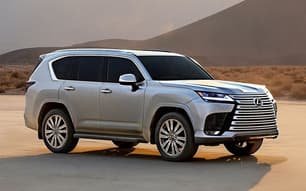
The march away from diesel power and towards a petrol-hybrid future in off-roaders continues. Okay, so it’s a full-sized Lexus we’re talking about, but the off-road credentials of the Toyota LandCruiser 300 Series-based Lexus LX have never been in question, have they?
The full-sized, super-lux Lexus LX might never see the Simpson Desert or the Old Telegraph Track, but that doesn’t mean it couldn’t tackle either with a fair degree of ease. So there’s no way Lexus would allow a new hybrid driveline to compromise any of that. Besides, this is the same driveline that will take the LandCruiser on its next step, so you better believe it’s the real deal.
Of course, the Lexus badge and somewhat frightening price tag also infer a high degree of plush and tech, and, let’s be honest, those elements are more likely to get a leading role in the LX’s day-to-day strut, as opposed to the walk-on part played by the off-road stuff.
So does all this make the LX one huge, high-tech mash up of conflicting priorities, then? That probably depends on how pragmatically you view motor vehicles generally, but one thing’s for sure, if the hybrid LX is paving the way for the next generation of LandCruiser powerplants and drivelines, then we’re all ears.
The e-tron S was inevitable.
The marriage of the latest automotive trends – sporty electrified SUVs with specific performance bits, the e-tron S is as much rooted in Audi’s future as it is in the present.
Having been one of the earliest fully electric German cars in the space, and now with a few years of age on it. Can the e-tron S shine as one of the best? Read on to find out.
Huge specification in terms of convenience and safety gear are matched by an equally huge range of abilities in this vehicle. As well as rock hopping with the best of them, this is also a phenomenal touring rig and a more-than-capable off-roader. Of course, whether you can see yourself clambering up the side of a muddy creek crossing in $202,000 worth of vehicle is a personal matter, but rest assured, the Lexus will do it if you ask it to.
In the case of the hybrid LX, however, the vehicle now has an extra dimension to cover off, and from what we can see, it does take the efficiency and running costs of the big wagon to a new, better place. Mind you, that may only be the case if diesel continues to cost a dollar-a-litre more than petrol at the bowser.
The shift to petrol power also brings with it a level of mechanical background noise that we’re not entirely sure fits the Lexus legend, while additions such as the camera-based rear-view mirror system seems to be a conversation starter rather than an actual improvement.
The e-tron S looks mean, feels premium, and blends serious power with surprising grace under pressure. I still can’t shake the feeling I had with the standard e-tron, though, that this car is an Audi sports SUV first and an electric car second, and its weight holds it back from being as fun to drive as I think some rivals are.
If you love Audi and you want to go electric without stepping into something too unfamiliar it’s a great option. If you want an electric car which takes full advantage of what the next generation of technology can offer, keep an eye out, there’s plenty of fresh metal on the way.
In a styling sense, that big, bold, deep grille at the front won’t be to everybody’s liking, but we reckon it’s pretty well matched with the otherwise taut skin of the LX’s body.
Inside, the plush look and feel is the dominant factor, but if you look really closely, there’s a fair bit of generic Lexus stuff on show. Is that a criticism? Hardly. The leather looks and feels luxe and only some hard plastics (such as on the door cappings) belie the car’s LandCruiser origins.
The e-tron S looks properly mean, with its adjustable ride-height suspension and enormous wheels combining nicely with the extra subtle sporty highlights to make for a squat SUV which clearly means business.
The width is especially evident with those accentuated wheelarches and the lines set by the lower wing to draw your eyes out to its edges. In profile it's easy to see its long wheelbase and tapered rear roofline, giving even the SUV a slinkier frame than you may be used to when looking at the comparatively boxy Q5.
The thing that strikes me about Audi’s e-tron range, though, is how little a departure it is. It ambiguously slots somewhere above the Q5 and below the Q7, but sticks very closely to the German brand’s styling script.
Sure, it looks a bit lower to the ground, and a bit meaner than you might expect for an EV, but it’s not as much of a departure as Jaguar’s I-Pace or BMW’s iX.
I suppose the biggest advantage here is nobody is going to say the e-tron’s overall visage is controversial, and certainly, it will appeal to existing fans of Audi’s design.
Inside it follows much the same theme, with all the key touchpoints and styling elements nearly identical to other Audis in the range, if not very similar.
It feels like a sensible, refined place in the cabin, with the only whacky pieces being the extra touchscreen for the climate unit and the strange thumb-operated shifter mounted on a floating piece which looks and feels like it could be the throttle control for a jet engine.
The dash is a bit more integrated and modern than in the conservative Q5 or Q7, with the air vents leading to the digital instrument cluster as part of an aesthetic three-terrace design which runs across the entire dash and into the doors.
The screens which appear in place of wing mirrors take a bit of getting used to. Aside from those notable departures, the interior continues the theme of sticking closely to the Audi formula, providing a more modern space which will still be familiar to existing fans of the brand.
Like many hybrids, cargo capacity takes a bit of a blow. In this case, placement of the battery under the cargo floor means a reduction in luggage capacity from 1109 litres to 899 litres. In the seven-seat variant, capacity is 883 litres with the rearmost row folded flat. The rear seat folds 60:40 and there are good, solid tie-down points in the rear. There’s no under-floor storage, however, apart from a small compartment just behind the rear seat which locates the tools and safety triangle.
The tailgate is powered (if a bit slow in its action) and there are cup-holders atop each suspension tower, clearly a hang-over from the seven-seat variant which is not available in F Sport trim. The cargo blind is a good addition, as is the 1500-Watt power socket in the cargo bay.
In the cabin, there are plenty of grab handles and the side steps give shorter folk a leg up when entering or leaving. Once you’re in, the front seats are terrifically comfortable as well as featuring a massage function on top of the heating and cooling functions. The steering wheel is also heated.
Paddle shifts might seem odd in a vehicle like this, but they are brilliant in off-road situations, although you need to first select manual mode on the shifter to have the paddles hold each gear for more than a few seconds in most of the on-road driving modes.
Speaking of the shifter, Lexus has seen fit to once again reinvent this simple control. You now need to pull the handle towards you and up for Reverse, across and down for Drive while Park remains a separate button even though it looks like just another icon on the lever.
A pair of cup holders live over to the passenger’s side of the centre console, and there are a pair of USB charge ports as well as an HDMI port in the dashboard. But the switches for the power windows are located almost directly under the driver’s interior door pull, forcing some unorthodox wrist geometry.
At least the buttons for the climate control and off-road functions such as diff locks and ride height are, indeed, buttons and not menu items. The simple knob to control the stereo on-off and volume is a great touch, too. So is the cooled centre console under a cover that opens from either side.
The rear seat is big and wide but the high floor dictated by the body-on-frame construction means those with long legs will have their knees bent while ever they’re in the back seat. The seat cushion itself is pretty flat, too, but the backrest does recline through a wide range of angles.
Reading lights, lots of air vents and a full set of climate controls ease the pain of riding in the back, but if you want cup holders, you need to keep the centre rear seat free so the armrest that houses the holders can be lowered and snapped open. Adding to the impression that plenty of thought has gone into the rear seat environment are the pull-up sun blinds on each window. Why don’t all cars have these?
As an electric vehicle, the e-tron has certain advantages over its combustion equivalents, and overall makes for an accomplished family-sized SUV. But there are areas where more could be done to take advantage of its high-voltage features and abundant footprint.
Up front in the cabin is a good place, with both occupants treated to lavish seats with plenty of head and legroom, great adjustability, and plenty of width in the cabin.
The finishes are beyond premium with thick chunks of well-padded leather meeting your elbows, hands, and knees at every point. As always the lovely Audi switchgear exists in most places, but the removal of solid toggles and buttons in favour of an extra touch panel feels unnecessary.
There’s still a physical volume knob, and while the climate touchscreen is plenty large enough to have a shortcut button for every function without needing a sub-menu, it feels like you have to move your eyes too far from the road to know you’re going to jab it in the right spot.
Even the main touch panel has an interesting haptic feedback effect for each press, designed to mimic the solidly-sprung button hardware the brand has used in the past.
The screen looks amazing and is fast and sharp, key hallmarks of computer hardware that's up to the task, although the resolution is so high the touch elements when using Apple CarPlay end up being a little small and hard to stab at while you’re trying to keep your eyes on the road.
For storage there’s a big bottle holder and bin in the doors, a large cutaway with a storage tray, dual bottle holders, and power outlets in the centre, with a further smallish storage area under the armrest console.
Unlike some EVs there’s no huge cutaway under what was traditionally considered the transmission tunnel, although there is a small bay with the USB-C ports.
The rear seat feels good for space, with an almost flat floor and decent legroom and width, although headroom could be better.
There are netted pockets on the backs of the front seats and decently-sized bottle holders in the doors, with a further set in the drop-down armrest.
The quad-zone climate with its own touch panel and adjustable centre vents is a nice touch in the rear, as is the set of USB-C ports below. The hard backings to the front seats and built-in sun blinds our car had will even be great for kids.
The boot measures in at 660 litres, which is high for the segment. It fit our three-piece CarsGuide demo luggage set with room to spare, and that's despite the massive battery pack under the floor.
There’s auxiliary storage, too, with a further bay under the boot floor and a second small tray situated under the bonnet, both useful for keeping your charging paraphernalia.
While the LX line-up incorporates off-road oriented versions dubbed Overtrail, that specification is not available in the hybrid variety LX700h. Instead, the LX hybridised line-up kicks off with the Sport Luxury grades in either five or seven-seat layouts and a list price of $196,000 and $199,800 respectively. The F Sport is the new LX flagship model with its $202,000 price-tag (all prices are plus on-road costs) and is only available in five-seat configuration.
As you might imagine for a flagship badge for a maker like Lexus, there’s really nothing missing from the specification. In the case of the hybrid variants, that includes 22-inch alloy wheels, power sunroof, full leather trim and a hands-free tailgate. Those feature are part of the Enhancement Pack on lesser versions, but have been added to all hybrid LXs.
You also get four-zone climate-control, heated, cooled and massaging front seats, keyless entry and start, steering wheel-mounted controls, paddle shifters, automatic headlights and wipers, heated mirrors, soft-close doors, 12.3-inch touchscreen, digital radio, embedded sat-nav, wireless Apple CarPlay and Android Auto, head-up display, premium audio system and pretty much everything else you’ve ever seen fitted to a car.
The F Sport variant we’ve tested here is the big daddy and adds four-way adjustable head rests in the front, a heated steering wheel, specific aluminium trim, aluminium pedals, F Sport-specific gear knob, ventilated and heated rear seats, and a digital rear-view mirror.
A base, before-on-road costs asking price (MSRP) of $168,400 for the e-tron S in SUV form puts this sporty model a step above two of its most notable rivals, the Mercedes-Benz EQC (currently tops out at $141,300), and Jaguar I-Pace (currently tops out at $155,550), but below the menacing, full-fat BMW iX M60 (at $222,900), or the incoming updated Tesla Model X Plaid ($206,449).
To be fair here, only the iX M60 and Model X are pitched as performance variants in their respective ranges, with the Mercedes and Jaguar lacking either an AMG or SVR model respectively to represent their performance line-ups.
To that end, the e-tron S ups the ante when it comes to its power output with an impressive 370kW/973Nm across three motors, two at the rear, and one at the front. More on this in the Drivetrain part of this review.
Suffice it to say, it’s a lot of power. The e-tron is high-spec across the range, too, with the S scoring massive 21-inch alloy wheels, ‘Valcona’ leather interior trim, a heavily digitised cabin consisting of a 12.3-inch digital instrument cluster, 10.1-inch multimedia touchscreen, and a second 8.6-inch touch panel for the car’s climate functions.
The e-tron S also gets wireless Apple CarPlay and Android Auto connectivity, with matching wireless phone charger, built-in navigation, a 16-speaker Bang and Olufsen sound system, full LED lighting for the head and tail-lights and throughout the cabin, quad-zone climate control, heated front seats with power adjust, and a panoramic sunroof.
Finally, the S also has performance enhancing features like progressive (variable ratio) steering and adaptive air suspension.
Obviously, with the high level of standard gear, there’s not as much to put on the options list, although our car also had the weird $3500 ‘Virtual Exterior Mirrors’ which grant it concept-car like cameras with adjustable touch-panels inside the car in place of standard wing mirrors.
I don’t like these, but Audi says nearly half of all e-tron buyers are choosing them. More on this later.
There’s also the option to upgrade the car’s AC charger from 11kW to 22kW which could be very appealing if you have a public station nearby capable of putting out such power. This option will set you back a further $6900.
The last item on the list is the 'Sensory Package' ($9600) which bundles improved Matrix LED headlights in with soft close doors complete with puddle lamps, extended Nappa leather trim in the cabin, rear sunshades and heated rear seats. Our car had this option pack, too.
The hybrid driveline of the vehicle we’re looking at here marks a further expansion of buyer choice when it comes to how their Lexus LX is powered. The twin-turbocharged petrol and diesel variants will continue alongside the newcomer, although you can bet Lexus (and Toyota) will be watching the sales charts closely to see where consumer tastes fall.
The hybrid set-up here starts with the twin-turbocharged 3.4-litre petrol V6 (a lot of people - Toyota included - are calling it a 3.5, but at 3445cc, it’s not) from the Lexus LX600.
But instead of bolting directly to the 10-speed transmission, in this case, there’s a single electric motor and clutch unit sandwiched between the engine and transmission. That means the Lexus retains mechanical four-wheel drive, while the electric motor can provide extra urge for acceleration or towing as well as offering EV-only operation when it’s required (mainly in stop-start traffic).
Crucially, it also means the vehicle retains those traditional off-road qualities of low-range gearing and permanent four-wheel drive. The electric motor also contributes torque to the equation when the driver selects either Rock, Dirt or Deep Snow modes to maintain a steady flow of Newton metres.
The petrol V6 contributes a healthy 305kW and 650Nm to the picture, while the electric motor adds a further 36kW and 250Nm. When all that’s harnessed up, there’s a total of 341kW of power and 790Nm of torque on tap, allowing for a braked towing capacity of 3500kg. It also makes this variant the torquiest Lexus LX ever.
Interestingly, Lexus says the conventional 12-volt starting system and alternator for the petrol engine, means that unit could continue to operate if any part of the EV system failed.
One of the big questions over hybrid drivelines in off-road conditions is what happens if the vehicle suddenly finds itself partly under water. In this case, says Lexus, there are additional waterproofing measures which should prevent any problems mid-creek.
The F Sport grade gets a Torsen (torque-sensing) rear differential and firmer dampers for an overall sportier feel.
At 2780kg, the LX hybrid is heavy, and is at least 100kg more than the LX600 due to the batteries and other hybrid gear.
The S-branded e-tron sets itself apart from the rest of the range with a seriously powerful set of three motors. There are two on the rear axle, and one on the front axle.
The total combined output of this collection is 370kW/973Nm, which for a combustion car, would be unprecedented.
To be fair, these figures are under a ‘boost’ mode, with the car generating a still strong 300kW/800Nm in most situations.
The three motor drivetrain allows for an electric version of Audi’s ‘quattro’ all-wheel drive system which the brand says can react to changes in 30 milliseconds and move torque appropriately.
The system is rear-biased, and in the name of efficiency the front motor is only used when required under acceleration or cornering.
Here’s where the hybrid driveline really comes into its own. On paper, at least.
Despite the added kiloWatts and Newton metres, the 700h manages an official fuel consumption figure of 10 litres per 100km. That compares with 11.9/100km for the 305kW LX600, although it’s still more than the 8.9L of the 227kW diesel-powered LX500d.
But the hybrid’s big advantage will come in city and suburban traffic where the stop-start nature of things will enable the driveline to harvest braking energy and turn that back into electricity for the battery.
Our testing showed an average of 11.2 litres per 100km in mixed conditions which blew out to 13.0 litres with more urban running. That’s pretty handy in the context of a vehicle like this and won’t be far from the real-world numbers of the diesel LX.
The Lexus carries 98 litres of petrol, split between one 68-litre tank and a 30-litre sub tank. That should give it a theoretical range of almost 800km, but again, that will depend largely on where and how it’s used.
The e-tron may be electric, but it’s also a performance car. To that end, its energy consumption, relative to the field, is behind the pace.
In fact, at a whopping 27.8kWh/100km, driving the e-tron around feels like the electric equivalent of steering a big V8.
It produced one of the highest consumption numbers I have seen from any EV during my time with it. Considering this number is even below the WLTP consumption number, which is 28.4kWh/100km, that's not great.
For comparison, the Mercedes-Benz EQC's official number is just 20.8kWh/100km, while the Jaguar I-Pace consumes 21.2kWh/100km according to the WLTP procedure.
Yes, they aren’t performance cars in the same sense, but it’s still a big difference.
I made sure to take it out and stretch the e-tron’s legs to assess its performance in its more sporty driving modes, but the majority of my time with the car was spent in a more comfort-oriented setting and with the regenerative braking set to maximum.
Possibly as a result of its real-world consumption, my car was showing about 350km of range on a full charge, a little below the official WLTP number of 364km, although it is worth noting the enormous 21-inch alloys do their part to reduce the range. The car ships with 20-inch wheels in Europe.
The good news is the e-tron is capable of charging fast, with its max DC charging speed set at 150kW (allowing for a 5.0-80 per cent charge time for its 95kWh battery of 30 minutes), and its AC charging speed set at 11kW, which allows a slow-charging time of around seven hours.
If you intend to park on the street or live in a unit where installing charge infrastructure is impossible, I would strongly recommend you consider the 22kW AC charging upgrade which will cut the AC charge time in half.
While there are few public stations currently capable of the full 22kW in Australia, it will future-proof your car for ideal convenience charging for when they're more commonplace.
At low speeds, threading your way through traffic or parking, the LX feels like it needs a lot of real estate. Which makes sense given the 5.1-metre overall length that puts it on par with a lot of dual-cab utes. The width of almost two metres plays into things, too, and reversing down the average driveway will often have the sensors chirping at you constantly.
What’s interesting, though, is the way the Lexus seems to shrink once you’re up and running in a more open setting. Even a winding road reveals a car that is easy to place in corners and seems to feed back lots of the right sort of information in terms of what the wheels are doing and where they’re placed. The result is that you can actually hustle the LX along quite smartly if you need to.
The ride remains composed yet there’s a level of control that helps keep the big, high LX relatively flat through corners and responding sharply to the helm. Even those huge wheels and tyres and their corresponding unsprung mass don’t intrude. It’s a great trick.
Less easy to appreciate, however, is the driveline, specifically the twin-turbo petrol V6. Frankly, it’s just not as refined as we were expecting. I wouldn’t mind betting Lexus has tuned the exhaust system to make the LX sound like there’s a petrol V8 under that heavily sculpted bonnet. And at low revs, it kind of works with a rhythmic, muted, yet guttural sort of bass coming through.
But rev it harder and the engine soon reveals itself to be a V6 with all the secondary vibration and resonance that implies. Simply, this vehicle is neither as smooth nor as quiet as the Lexus brand would suggest and the harder you rev it, the more it descends into NVH (noise, vibration and harshness) territory. The issue is made worse by the fact that the rest of the package is so darn quiet.
Even the stop-start - a technology that is now well understood - doesn’t seem quite as slick as it should be. Taking off from a green light with the petrol engine stopped, the Lexus often produces a small `sonic bump’ from the driveline as the V6 fires into life. It’s felt more than heard. But it’s still puzzling in the context of this make and model.
The transmission, meantime, is as silky as you’d imagine with upshifts and even downshifts that are barely perceptible. It would be nice, though, if the transmission obeyed the paddles a bit more faithfully. As it is, the chosen gear is only held for a few seconds unless you also pull the shift lever into manual mode.
I’ll also take issue with the rear-view mirror that includes a camera view as well as a conventional mirror option. I can see the point of having a camera-view mirror (when the cargo area is piled high, for instance) but I’ve never yet met one that works properly. The problem is that the camera view that pops up on the mirror’s screen is never as faithful as it should be. Also, if you wear glasses to read, you’ll also need them to focus on the image properly. While a conventional mirror has the same depth of field as looking through the windscreen, the camera-generated view does not. Also, when used through a wet rear window in low light, the camera view is borderline useless. This tech clearly has a ways to go.
Does the e-tron live up to the promise set by sporty Audis which have come before it? The answer is interesting.
There is no doubt the e-tron S is rapid, at times absurdly so. If you stick it in the required S mode and hunker the suspension down, planting the accelerator makes its claimed 0-100km/h sprint time of 4.5 seconds suddenly very real.
It lurches ahead without so much as a squeak from its enormous tyres, grabbing the road with its front axle as it warps you forward.
So yes, this electric performance car is no doubt quick. It is also heavy. Weighing in at a tare mass of 2830kg, the e-tron S is quite literally massive.
The trouble is, while its powerful electric motors are great at overcoming this gravitational obstacle in a straight line, it’s in the corners and at low speeds where you feel every bit of it.
The e-tron crashes over larger bumps, it’s suspension struggling to deal with the combination of its weight and low-profile tyres, while it can also feel cumbersome in the corners around town.
The suspension is better at levelling things out once you gain a bit of pace, and the tyres work with the all-wheel drive system to put in a Herculean effort when carving up bends at speed, but there’s the ever-present lurch of weight always working against you.
This feeling isn’t helped by the steering tune, which even in its most comfort-oriented setting feels hefty and slow to turn. In the default sport mode, ‘dynamic’, it takes effort to push this car around corners.
Despite the unsettling feeling of it, though, the car holds on for dear life, and I never once felt as though the tyres were remotely in danger of breaking traction when put under pressure.
Is it a performer, then? Absolutely, there’s something mind bending about a vehicle so heavy going so quickly.
Does it feel fun to drive? Less so. I enjoyed the connectivity of the Porsche Taycan offers at speed more than I enjoyed the e-tron S, and its weight and girth demand a nice wide piece of tarmac for you to really wring it.
It’s far from a darty and engaging car like the Q5 can be despite its mammoth power outputs.
Elsewhere, the drive experience feels very Audi, though. The touchpoints and feedback are mostly familiar, as are the software and ergonomics.
The virtual wing mirrors are more of an inconvenience than anything else. This car is already hard to see out of, with big C-pillars and a tall belt line, and the digital exterior mirrors offer what feels like a limited angle of vision and make it extra hard to see out at night.
Some things fall to the wayside a little. The e-tron’s drive system almost hides the regenerative braking setting several menus deep, which, once activated, allows you to set it using the paddle-shifters on the wheel.
Audi says the regen will account for nearly 30 per cent of the car’s range, which is odd because even at the highest setting it feels a bit mild, relying on the user to manually operate the brake for a ‘blended braking’ mode to make up the difference.
It’s a bit of a stretch from the single-pedal driving modes offered on some rival cars.
My theory here, as with this car’s look and feel, is the e-tron is primarily designed to be familiar to an existing Audi customer, or someone coming out of a purely combustion premium rival.
It will come as no surprise to learn that the expensive LX range is well equipped safety wise, nor that the flagship version of that range features every driver aid ever dreamed up by engineers.
That includes autonomous emergency braking that incorporates pedestrian and cyclist recognition, intersection turn assist, lane-keeping assistance, lane-departure warning, blind-spot monitoring, road-sign recognition, hill-start assist, front and rear parking sensors, a reversing camera with 360-degree views, rear cross-traffic alert and braking and tyre-pressure monitoring.
On top of that, the LX gains the safety additions revealed at the 2025 facelift of the LX line-up, including emergency driving stop, safe-exit monitoring and a forward-facing camera.
There are no less than 10 airbags in the LX, including rear-seat cushion airbags and side-curtain airbags for every outboard seating position.
What’s perhaps even more impressive is that the driver aids are beautifully calibrated to the point where other carmakers should pay close attention when calibrating their own. Where some cars physically fight the driver for control of the wheel in the name of lane-keeping assistance, the Lexus instead offers a polite suggestion of a better course than the one the driver is currently on.
The Lexus LX series hasn’t been crash tested by ANCAP, but the 300-Series LandCruiser on which it’s based scored the full five safety stars when it was tested in 2022.
The regular e-tron range is considered very safe by ANCAP which awarded it a maximum five stars with strong scores across all categories in 2019, although it does exclude the S which was not released at the time of testing.
The S has the same suite of active safety features as the rest of the range, though, which includes freeway-speed auto emergency braking (up to 250km/h) with pedestrian, cyclist detection, and intersection assist, lane departure warning with lane keep assist, blind-spot monitoring with rear cross-traffic alert, adaptive high-beams, adaptive cruise control (with eco-assist and stop-and-go functions), as well as a clear exit warning.
The 360-degree camera suite is welcome, as is airbag coverage for the front, side for both front and rear rows, as well as curtains.
ISOFIX points feature on the rear outboard seats, and there are top tethers across all three rear seats.
Lexus offers a five-year, unlimited-kilometre warranty on its vehicles and throws in three years’ worth of subscription to the Lexus Encore owner privileges and benefits program. Those extras include Lexus on Demand, valet parking, roadside assistance and even complimentary access to Qantas airport lounges.
There’s also five years of capped-price servicing available.
As well as the overall five-year/unlimited kilometre warranty, there’s eight years and 160,000km of cover for the hybrid battery. That can be extended to up to 10 years provided the battery is checked for degradation every year after the fifth year.
Servicing for the LX is every six months or 10,000km which is much more frequent than much of the competition, but reflects the heavy-duty nature of the vehicle.
Lexus has about 30 dealerships in Australia, primarily in urban locations, but for many servicing and repair jobs, a Toyota dealership or service centre should be able to handle things on the LandCruiser 300-Series-based LX.
Audi has followed its Volkswagen parent in upgrading its warranty to five years and unlimited kilometres, finally leaving BMW and its three-year warranty behind.
The e-tron’s high-voltage battery components are covered by a separate eight-year and 160,000km warranty, but the big win, especially in this premium segment, is the first six years of servicing (covering three 24 monthly or 30,000km visits) is free.
Oh, and your public charging is largely free for the same period too, as Audi throws in a six-year ChargeFox subscription.
Six years pretty much cost-free? Audi, how far you’ve come.