What's the difference?
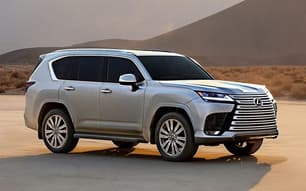
The march away from diesel power and towards a petrol-hybrid future in off-roaders continues. Okay, so it’s a full-sized Lexus we’re talking about, but the off-road credentials of the Toyota LandCruiser 300 Series-based Lexus LX have never been in question, have they?
The full-sized, super-lux Lexus LX might never see the Simpson Desert or the Old Telegraph Track, but that doesn’t mean it couldn’t tackle either with a fair degree of ease. So there’s no way Lexus would allow a new hybrid driveline to compromise any of that. Besides, this is the same driveline that will take the LandCruiser on its next step, so you better believe it’s the real deal.
Of course, the Lexus badge and somewhat frightening price tag also infer a high degree of plush and tech, and, let’s be honest, those elements are more likely to get a leading role in the LX’s day-to-day strut, as opposed to the walk-on part played by the off-road stuff.
So does all this make the LX one huge, high-tech mash up of conflicting priorities, then? That probably depends on how pragmatically you view motor vehicles generally, but one thing’s for sure, if the hybrid LX is paving the way for the next generation of LandCruiser powerplants and drivelines, then we’re all ears.
There are good surprises and bad surprises. Like the time I was driving my ute and the steering wheel came off. Bad surprise. Or the time the chicken shop accidentally gave me a large chips when I paid for a medium. Good surprise. The Haval H6 also surprised me. And it was up there with a large chips type of surprise.
See, my expectations of Haval have been of a brand which is really big in China where its owned by Great Wall Motors, but can’t keep up with the likes of Toyota and Mazda when it comes to driving and styling. Instead, their strength seemed to be just value-for-money.
Surprise! The new generation H6 isn’t just good value-for-money any more. It’s still really well priced but it has stunning looks, too. But that wasn’t the biggest surprise.
If you are considering a mid-sized SUV such as a Toyota RAV4 or Mazda CX-5, I strongly suggest you widen the net and consider the H6, too. Let me explain.
Huge specification in terms of convenience and safety gear are matched by an equally huge range of abilities in this vehicle. As well as rock hopping with the best of them, this is also a phenomenal touring rig and a more-than-capable off-roader. Of course, whether you can see yourself clambering up the side of a muddy creek crossing in $202,000 worth of vehicle is a personal matter, but rest assured, the Lexus will do it if you ask it to.
In the case of the hybrid LX, however, the vehicle now has an extra dimension to cover off, and from what we can see, it does take the efficiency and running costs of the big wagon to a new, better place. Mind you, that may only be the case if diesel continues to cost a dollar-a-litre more than petrol at the bowser.
The shift to petrol power also brings with it a level of mechanical background noise that we’re not entirely sure fits the Lexus legend, while additions such as the camera-based rear-view mirror system seems to be a conversation starter rather than an actual improvement.
The H6 could be the turning point for Haval in Australia. The brand’s first big success that changes the way Aussies view this Chinese carmaker. The H6’s great value and stunning looks will win over many but add an excellent warranty, advanced safety tech, plus the surprisingly good, and you have a package that appears right up there with the likes of the Toyota RAV4 and Mazda CX-5.
The sweet spot of the range would have to be the Lux - the car I tested with its leatherette seats, privacy glass and dual-zone climate control.