What's the difference?
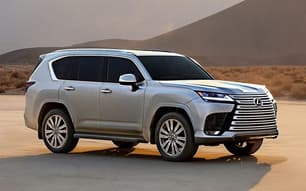
The march away from diesel power and towards a petrol-hybrid future in off-roaders continues. Okay, so it’s a full-sized Lexus we’re talking about, but the off-road credentials of the Toyota LandCruiser 300 Series-based Lexus LX have never been in question, have they?
The full-sized, super-lux Lexus LX might never see the Simpson Desert or the Old Telegraph Track, but that doesn’t mean it couldn’t tackle either with a fair degree of ease. So there’s no way Lexus would allow a new hybrid driveline to compromise any of that. Besides, this is the same driveline that will take the LandCruiser on its next step, so you better believe it’s the real deal.
Of course, the Lexus badge and somewhat frightening price tag also infer a high degree of plush and tech, and, let’s be honest, those elements are more likely to get a leading role in the LX’s day-to-day strut, as opposed to the walk-on part played by the off-road stuff.
So does all this make the LX one huge, high-tech mash up of conflicting priorities, then? That probably depends on how pragmatically you view motor vehicles generally, but one thing’s for sure, if the hybrid LX is paving the way for the next generation of LandCruiser powerplants and drivelines, then we’re all ears.
ONE of the great motoring successes of the past decade has been the Mercedes-Benz GLA, catapulting the brand to unparalleled prominence in the premium small SUV field and kicking off the posh little coupe-hatch crossover craze.
Cynics might say that it is essentially a jumped-up A-Class hatchback, much like the Subaru XV is basically an Impreza in stilettos. But while the small German crossover is built on the same MFA2 platform as its smaller transverse-engined Benz brethren, no body panels are shared, granting it a distinct look and personality. Unlike the little Suby…
The H247-series GLA launched in Australia in 2020 is second-generation, featuring a longer wheelbase and appreciably more space, but a shorter overall length than the popular original from 2013. It's also substantially taller.
Here we take a long, hard look at the bestselling GLA 250 4Matic.
Huge specification in terms of convenience and safety gear are matched by an equally huge range of abilities in this vehicle. As well as rock hopping with the best of them, this is also a phenomenal touring rig and a more-than-capable off-roader. Of course, whether you can see yourself clambering up the side of a muddy creek crossing in $202,000 worth of vehicle is a personal matter, but rest assured, the Lexus will do it if you ask it to.
In the case of the hybrid LX, however, the vehicle now has an extra dimension to cover off, and from what we can see, it does take the efficiency and running costs of the big wagon to a new, better place. Mind you, that may only be the case if diesel continues to cost a dollar-a-litre more than petrol at the bowser.
The shift to petrol power also brings with it a level of mechanical background noise that we’re not entirely sure fits the Lexus legend, while additions such as the camera-based rear-view mirror system seems to be a conversation starter rather than an actual improvement.
With Mercedes-Benz’s vast number of SUVs, there is room for an urban luxury crossover niche, and the GLA delivers in spades.
Indeed, in 250 4Matic guise, it is that rare thing – a high-riding hatch with dynamics to shame most dedicated pocket-rockets. It really is a hoot if you find the right road, regardless of weather conditions. The Benz has towering talent.
However, even without desirable options like adaptive dampers and a full suite of driver-assist safety technology, the GLA is expensive, does not quite carry off the price tag from an interior quality point of view, and struggles to maintain the degree of comfort and refinement expected from a Mercedes – with or without the $3K necessary to score adaptive dampers.
Still, especially because of the way the GLA looks, goes, stops and steers, if you can afford it, you’ll be rewarded. There’s never been a more rounded GLA.