What's the difference?
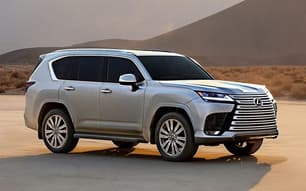
The march away from diesel power and towards a petrol-hybrid future in off-roaders continues. Okay, so it’s a full-sized Lexus we’re talking about, but the off-road credentials of the Toyota LandCruiser 300 Series-based Lexus LX have never been in question, have they?
The full-sized, super-lux Lexus LX might never see the Simpson Desert or the Old Telegraph Track, but that doesn’t mean it couldn’t tackle either with a fair degree of ease. So there’s no way Lexus would allow a new hybrid driveline to compromise any of that. Besides, this is the same driveline that will take the LandCruiser on its next step, so you better believe it’s the real deal.
Of course, the Lexus badge and somewhat frightening price tag also infer a high degree of plush and tech, and, let’s be honest, those elements are more likely to get a leading role in the LX’s day-to-day strut, as opposed to the walk-on part played by the off-road stuff.
So does all this make the LX one huge, high-tech mash up of conflicting priorities, then? That probably depends on how pragmatically you view motor vehicles generally, but one thing’s for sure, if the hybrid LX is paving the way for the next generation of LandCruiser powerplants and drivelines, then we’re all ears.
A good car in its own right, the Mazda CX-60 has nevertheless been one of the most disappointing new-model releases of recent times.
After the ongoing critical and commercial success of the CX-5, its somewhat larger premium mid-sized sibling should have been a slam dunk, with BMW-evoking longitudinal drivetrain and terrific in-line six-cylinder engine choices, as well as the surprisingly far-sighted option of a plug-in hybrid electric vehicle (PHEV) from the get-go.
Yet, when launched internationally during 2022, the quality, packaging and performance were overshadowed by high prices, a jarring ride, odd handling and erratic transmission calibration, particularly in the aforementioned PHEV.
Now there’s been a wholesale re-think surrounding all of the CX-60’s objectionable systems, as well as a new, lower priced grade, among other updates.
Is it the SUV Mazda should have launched in the first place? Let’s find out.
Huge specification in terms of convenience and safety gear are matched by an equally huge range of abilities in this vehicle. As well as rock hopping with the best of them, this is also a phenomenal touring rig and a more-than-capable off-roader. Of course, whether you can see yourself clambering up the side of a muddy creek crossing in $202,000 worth of vehicle is a personal matter, but rest assured, the Lexus will do it if you ask it to.
In the case of the hybrid LX, however, the vehicle now has an extra dimension to cover off, and from what we can see, it does take the efficiency and running costs of the big wagon to a new, better place. Mind you, that may only be the case if diesel continues to cost a dollar-a-litre more than petrol at the bowser.
The shift to petrol power also brings with it a level of mechanical background noise that we’re not entirely sure fits the Lexus legend, while additions such as the camera-based rear-view mirror system seems to be a conversation starter rather than an actual improvement.
Have no doubts. The MY25 version of the CX-60 is the SUV that Mazda should have launched in Australia in 2023.
It fulfils the promise of its sophisticated specification, builds on the extensive dynamic abilities of previous models, and now provides a compelling – and unique – choice for medium-SUV buyers who do not need an extended seven-seater.
It may still looks a bit daggy from some angles outside, and we’d like a little bit less suspension noise on the inside, but the CX-60 should now be on Australian family-car shortlists.
Note: CarsGuide attended this event as a guest of the manufacturer, with accommodation and meals provided.