What's the difference?
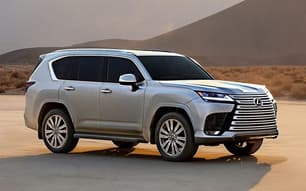
The march away from diesel power and towards a petrol-hybrid future in off-roaders continues. Okay, so it’s a full-sized Lexus we’re talking about, but the off-road credentials of the Toyota LandCruiser 300 Series-based Lexus LX have never been in question, have they?
The full-sized, super-lux Lexus LX might never see the Simpson Desert or the Old Telegraph Track, but that doesn’t mean it couldn’t tackle either with a fair degree of ease. So there’s no way Lexus would allow a new hybrid driveline to compromise any of that. Besides, this is the same driveline that will take the LandCruiser on its next step, so you better believe it’s the real deal.
Of course, the Lexus badge and somewhat frightening price tag also infer a high degree of plush and tech, and, let’s be honest, those elements are more likely to get a leading role in the LX’s day-to-day strut, as opposed to the walk-on part played by the off-road stuff.
So does all this make the LX one huge, high-tech mash up of conflicting priorities, then? That probably depends on how pragmatically you view motor vehicles generally, but one thing’s for sure, if the hybrid LX is paving the way for the next generation of LandCruiser powerplants and drivelines, then we’re all ears.
Welcome to the future - where your Mercedes-Benz is a Nissan and your Nissan is a Mercedes-Benz.
Lost already? Let me catch you up. Infiniti is the premium arm of Nissan, in much the same way Lexus is the premium arm of Toyota, and the Q30 is Infiniti’s hatchback.
Thanks to the state of various global manufacturing alliances the Q30 is mechanically, largely a previous-generation Mercedes-Benz A-Class, with a similar arrangement seeing the new Mercedes-Benz X-Class ute comprised largely of Nissan Navara underpinnings.
Recently, the Q30 has had its range of variants trimmed from a confusing five down to two, and the one we’re testing here is the top-spec Sport.
Make sense? I hope so. The Q30 Sport joined me on an 800km trip along the east coast in the height of summer. So, can it make the most of its German/Japanese roots? Read on to find out.
Huge specification in terms of convenience and safety gear are matched by an equally huge range of abilities in this vehicle. As well as rock hopping with the best of them, this is also a phenomenal touring rig and a more-than-capable off-roader. Of course, whether you can see yourself clambering up the side of a muddy creek crossing in $202,000 worth of vehicle is a personal matter, but rest assured, the Lexus will do it if you ask it to.
In the case of the hybrid LX, however, the vehicle now has an extra dimension to cover off, and from what we can see, it does take the efficiency and running costs of the big wagon to a new, better place. Mind you, that may only be the case if diesel continues to cost a dollar-a-litre more than petrol at the bowser.
The shift to petrol power also brings with it a level of mechanical background noise that we’re not entirely sure fits the Lexus legend, while additions such as the camera-based rear-view mirror system seems to be a conversation starter rather than an actual improvement.
The Q30 Sport is a left-field choice in the premium hatch segment. For those who don’t care about badge equity and are looking for something different, the Q30 provides maybe 70 per cent the feel of its well-established competition while offering decent value courtesy of standard safety and spec inclusions.
The biggest letdown is how much better it could be with just a little extra in every department. Even in this top-spec the drive experience is a bit generic, and it’s missing an up-to-date multimedia experience limiting its appeal to a younger audience.
Even with its promising mixed heritage, the Q30 hardly feels more than the sum of its parts.