What's the difference?
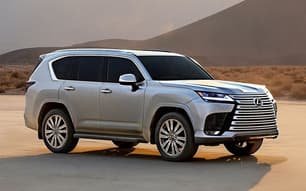
The march away from diesel power and towards a petrol-hybrid future in off-roaders continues. Okay, so it’s a full-sized Lexus we’re talking about, but the off-road credentials of the Toyota LandCruiser 300 Series-based Lexus LX have never been in question, have they?
The full-sized, super-lux Lexus LX might never see the Simpson Desert or the Old Telegraph Track, but that doesn’t mean it couldn’t tackle either with a fair degree of ease. So there’s no way Lexus would allow a new hybrid driveline to compromise any of that. Besides, this is the same driveline that will take the LandCruiser on its next step, so you better believe it’s the real deal.
Of course, the Lexus badge and somewhat frightening price tag also infer a high degree of plush and tech, and, let’s be honest, those elements are more likely to get a leading role in the LX’s day-to-day strut, as opposed to the walk-on part played by the off-road stuff.
So does all this make the LX one huge, high-tech mash up of conflicting priorities, then? That probably depends on how pragmatically you view motor vehicles generally, but one thing’s for sure, if the hybrid LX is paving the way for the next generation of LandCruiser powerplants and drivelines, then we’re all ears.
Four years is a long time in the Australian automotive sector. Back in 2022, the Kia EV6 made a big splash as a cool, edgy EV with a focus on driver engagement.
It won a bunch of awards and was praised for its dynamism and design. Kia’s first dedicated EV was a winner! But in the years since it’s been overshadowed by a gaggle of newer and cheaper electric cars, largely from China.
More than a year after it made its global debut, Kia Australia has finally launched the facelifted EV6 in Australia. It brings with it a number of changes, most notably a new front end design, as well as a multimedia and software upgrade, chassis refinements, local ride and handling tuning tweaks and bigger batteries for more driving range.
But is it too little, too late for the Kia EV6? Have buyers moved on from this once ground-breaking EV to more affordable Chinese options? Read on to find out why this EV shouldn’t be so easily forgotten.
Huge specification in terms of convenience and safety gear are matched by an equally huge range of abilities in this vehicle. As well as rock hopping with the best of them, this is also a phenomenal touring rig and a more-than-capable off-roader. Of course, whether you can see yourself clambering up the side of a muddy creek crossing in $202,000 worth of vehicle is a personal matter, but rest assured, the Lexus will do it if you ask it to.
In the case of the hybrid LX, however, the vehicle now has an extra dimension to cover off, and from what we can see, it does take the efficiency and running costs of the big wagon to a new, better place. Mind you, that may only be the case if diesel continues to cost a dollar-a-litre more than petrol at the bowser.
The shift to petrol power also brings with it a level of mechanical background noise that we’re not entirely sure fits the Lexus legend, while additions such as the camera-based rear-view mirror system seems to be a conversation starter rather than an actual improvement.
It’s fair to say the Kia EV6 is not the most affordable mid-to-large electric SUV money can buy. Especially in the era of cheaper Chinese models.
It also lacks some of the practicalities of a few rivals. If that’s your focus and you’re dead set on buying a Kia, then the EV5 is the clear choice.
But that’s not the sole purpose of this car.
It doubles as family transport and a car for driving enthusiasts. It’s the sort of EV that can convert EV non-believers.
After a week with the EV6, it’s not a car I’ll forget easily. And I urge buyers looking in the EV space not to overlook this pioneering model. It’s a brilliant car to drive and the GT-Line RWD is the value pick of the whole line-up.
In a styling sense, that big, bold, deep grille at the front won’t be to everybody’s liking, but we reckon it’s pretty well matched with the otherwise taut skin of the LX’s body.
Inside, the plush look and feel is the dominant factor, but if you look really closely, there’s a fair bit of generic Lexus stuff on show. Is that a criticism? Hardly. The leather looks and feels luxe and only some hard plastics (such as on the door cappings) belie the car’s LandCruiser origins.
When I first saw the Kia EV6, I have to admit I wasn’t a massive fan of the design. I was, and still am, a massive fan of the mechanically related Hyundai Ioniq 5. Perhaps one of the many reasons that model won Best Medium SUV Under $130,000 at the 2026 CarsGuide Car of the Year Awards!
But the 2026 facelift has given me a renewed appreciation of the Kia’s design.
The overall shape is the same but the front, which was arguably its least appealing angle, has been redesigned.
It’s 15mm longer thanks to the new front bumper design, and it has adopted a completely new headlight signature that's in keeping with the EV3, EV4, EV5 and EV9. The front looks meaner, more aggressive, but in a really hot way.
There’s also a new bumper at the rear but the tail-lights are pretty much the same.
Overall it’s a much sharper look, helping to breathe new life into the EV6.
The visual changes are more subtle inside, but it was already a nice cabin to begin with. The big changes include the new version of Kia’s dual-screen set-up which is more modern and centred than the previous version, and there’s more visually appealing graphics.
The other key change is the steering wheel. For GT-Line and GT grades, Kia’s dropped the polarising two-spoke wheel in favour of a sportier and more premium three-spoke, dual-tone wheel found in other models, including the EV3. The base Air retains the two-spoke wheel.
Like many hybrids, cargo capacity takes a bit of a blow. In this case, placement of the battery under the cargo floor means a reduction in luggage capacity from 1109 litres to 899 litres. In the seven-seat variant, capacity is 883 litres with the rearmost row folded flat. The rear seat folds 60:40 and there are good, solid tie-down points in the rear. There’s no under-floor storage, however, apart from a small compartment just behind the rear seat which locates the tools and safety triangle.
The tailgate is powered (if a bit slow in its action) and there are cup-holders atop each suspension tower, clearly a hang-over from the seven-seat variant which is not available in F Sport trim. The cargo blind is a good addition, as is the 1500-Watt power socket in the cargo bay.
In the cabin, there are plenty of grab handles and the side steps give shorter folk a leg up when entering or leaving. Once you’re in, the front seats are terrifically comfortable as well as featuring a massage function on top of the heating and cooling functions. The steering wheel is also heated.
Paddle shifts might seem odd in a vehicle like this, but they are brilliant in off-road situations, although you need to first select manual mode on the shifter to have the paddles hold each gear for more than a few seconds in most of the on-road driving modes.
Speaking of the shifter, Lexus has seen fit to once again reinvent this simple control. You now need to pull the handle towards you and up for Reverse, across and down for Drive while Park remains a separate button even though it looks like just another icon on the lever.
A pair of cup holders live over to the passenger’s side of the centre console, and there are a pair of USB charge ports as well as an HDMI port in the dashboard. But the switches for the power windows are located almost directly under the driver’s interior door pull, forcing some unorthodox wrist geometry.
At least the buttons for the climate control and off-road functions such as diff locks and ride height are, indeed, buttons and not menu items. The simple knob to control the stereo on-off and volume is a great touch, too. So is the cooled centre console under a cover that opens from either side.
The rear seat is big and wide but the high floor dictated by the body-on-frame construction means those with long legs will have their knees bent while ever they’re in the back seat. The seat cushion itself is pretty flat, too, but the backrest does recline through a wide range of angles.
Reading lights, lots of air vents and a full set of climate controls ease the pain of riding in the back, but if you want cup holders, you need to keep the centre rear seat free so the armrest that houses the holders can be lowered and snapped open. Adding to the impression that plenty of thought has gone into the rear seat environment are the pull-up sun blinds on each window. Why don’t all cars have these?
Under Australia’s vehicle categorisation, the Kia EV6 is classed as a large SUV. Which is not correct. Yes, it’s long and wide but it isn’t large. It’s medium. Also, is it an SUV? Or is it a low-slung coupe-style fastback? Perhaps a bit of both.
The EV6 has a decent amount of space in the cabin, but family-friendly practically might not be its strongest suit.
In the front row, headroom is limited. The sunroof is partly to blame for this, but the EV6’s front seats have always felt a little cramped for taller folks. Finding my perfect driving position took a bit longer as a result. Popping your sunglasses on your head is a no-no for a six footer like me. There is, however, plenty of space across the front of the cabin.
The front seats offer excellent upper body bolstering but could do with a little more for the thighs. But they are delightfully comfortable and look gorgeous.
The elevated centre console provides a high-set armrest and under that is a massive central bin, then there is a huge amount of open space underneath.
It houses two shallow and narrow cupholders with a phone charger, gear shifter, vehicle on/off and seat/steering wheel heating buttons. Yay buttons!
Climate control is managed via a digital panel separate to the main screen. It features smart dials that switch between air con and audio and sat-nav controls. Speaking of which, the air con flow is excellent.
Kia’s updated multimedia system brings it into line with other newer models. It’s a pleasure to use this system. Large tiles drill down into logical sub-menus, you can swipe every which way and the resolution is excellent. It’s also easy to navigate.
There are three USB-C charge ports under the centre stack.
Taller passengers might need to duck their head when getting in the second row, due to the lower sloping roofline. Once seated, the EV6 features that quirk of some older EVs where the rear seats are heavily bucketed and your knees sit up high because of the positioning of the under-floor battery. A lot of newer EVs keep the rear footwell free of battery packs to ensure more foot room and a more comfortable rear-seat experience.
There’s heaps of leg room behind my seating position, and headroom isn’t bad back there. It’s certainly better than the front. I had about 2.0cm between my head and the roof liner.
It feels a little dark back there due to the high window line, privacy glass and small rear window.
The rear seats are comfy but on the firmer side. There’s a fold-down arm rest with two shallow cupholders, and a small bottle will fit in the door.
You get two map pockets, USB-C ports on the back of both front seats, and chest-level side air vents.
You can lower the 60/40 split rear seats via a lower lever on the seat base. They fold almost flat, too. You can also lower the seats via a lever in the boot which is a handy feature.
The EV6 Air RWD’s boot can swallow 490 litres of cargo, and that drops to 480L for all other grades.
The boot area allows for a decent amount of usable space but the sloping tailgate means you won’t fit tall items.
Under-floor storage is limited but could easily fit flatter items like a charging cable. It also houses the tyre repair kit which is sadly what you get instead of any form of spare wheel. The boot also has a number of bag hooks, speakers and a light.
A front storage compartment under the bonnet can take 52 litres in the RWD grades, dropping to 20L in AWD versions.
While the LX line-up incorporates off-road oriented versions dubbed Overtrail, that specification is not available in the hybrid variety LX700h. Instead, the LX hybridised line-up kicks off with the Sport Luxury grades in either five or seven-seat layouts and a list price of $196,000 and $199,800 respectively. The F Sport is the new LX flagship model with its $202,000 price-tag (all prices are plus on-road costs) and is only available in five-seat configuration.
As you might imagine for a flagship badge for a maker like Lexus, there’s really nothing missing from the specification. In the case of the hybrid variants, that includes 22-inch alloy wheels, power sunroof, full leather trim and a hands-free tailgate. Those feature are part of the Enhancement Pack on lesser versions, but have been added to all hybrid LXs.
You also get four-zone climate-control, heated, cooled and massaging front seats, keyless entry and start, steering wheel-mounted controls, paddle shifters, automatic headlights and wipers, heated mirrors, soft-close doors, 12.3-inch touchscreen, digital radio, embedded sat-nav, wireless Apple CarPlay and Android Auto, head-up display, premium audio system and pretty much everything else you’ve ever seen fitted to a car.
The F Sport variant we’ve tested here is the big daddy and adds four-way adjustable head rests in the front, a heated steering wheel, specific aluminium trim, aluminium pedals, F Sport-specific gear knob, ventilated and heated rear seats, and a digital rear-view mirror.
One of the challenges for Kia and the EV6 is price and positioning. In the four years since its launch, the price of EVs of a comparable size has come down considerably.
You can get a medium-to-large electric SUV in the low-$40K range these days from one of a number of new Chinese players.
But not many of those cars have the same focus on driveability as the EV6.
Wisely, Kia has kept prices essentially as they were as part of the 2026 facelift. Each grade has only gone up by $70 apiece.
The EV6 kicks off with the Air RWD (rear-wheel drive, single motor) from $72,660, before on-road costs. The GT-Line RWD (the grade I will focus on for this review) costs $79,660 and the GT-Line AWD (all-wheel drive, dual motor) is $87,660 - an $8000 jump from the RWD.
It tops out at $99,660 for the performance-honed GT.
This pricing puts the EV6 somewhere between the new crop of affordable EVs like the BYD Sealion 7, Zeekr 7X and more premium offerings like the BMW iX3 or Audi Q4 etron.
It’s closer in price to another sporty EV, the Cupra Tavascan ($60,990-$82,490), as well as the Kia’s mechanical cousin, the Hyundai Ioniq 5 ($76,200-$115,000).
The facelift ushers in new standard gear including fresh 19 to 21-inch alloy wheel designs, vehicle-to-load (V2L) functionality, new twin 12.3-inch driver and multimedia screens, updated software with enhanced graphics, wireless Apple CarPlay and Android Auto (it was previously wired) and over-the-air updates.
Other standard gear in the base Air includes reclining rear seatbacks, synthetic leather seats, manual front seat adjustment, five USB-C ports, a wireless phone charger, a retractable cargo cover, six-speaker audio, digital radio and dual-zone climate control.
The GT-Line RWD I am testing adds a 14-speaker Meridian audio system, heated and ventilated front seats, a heated steering wheel, ambient lighting, alloy sports pedals, a sunroof, hands-free power tailgate, eight-way power driver and front passenger seats, synthetic black suede/white leather seats and remote park assist.
The flagship GT gains special sports bucket seats, two more USB-C ports in the rear, heated rear seats and a bigger dollop of performance.
When you look at the base pricing compared to the fully-loaded standard kit of the more affordable EVs, it doesn’t look like great value. But the GT-Line RWD is the pick of the EV6 grades as it isn’t missing much. You could also argue the overall build quality, gripping performance (more on that in the Driving section), reliability and Kia’s extensive dealer network is worth the extra spend.
The hybrid driveline of the vehicle we’re looking at here marks a further expansion of buyer choice when it comes to how their Lexus LX is powered. The twin-turbocharged petrol and diesel variants will continue alongside the newcomer, although you can bet Lexus (and Toyota) will be watching the sales charts closely to see where consumer tastes fall.
The hybrid set-up here starts with the twin-turbocharged 3.4-litre petrol V6 (a lot of people - Toyota included - are calling it a 3.5, but at 3445cc, it’s not) from the Lexus LX600.
But instead of bolting directly to the 10-speed transmission, in this case, there’s a single electric motor and clutch unit sandwiched between the engine and transmission. That means the Lexus retains mechanical four-wheel drive, while the electric motor can provide extra urge for acceleration or towing as well as offering EV-only operation when it’s required (mainly in stop-start traffic).
Crucially, it also means the vehicle retains those traditional off-road qualities of low-range gearing and permanent four-wheel drive. The electric motor also contributes torque to the equation when the driver selects either Rock, Dirt or Deep Snow modes to maintain a steady flow of Newton metres.
The petrol V6 contributes a healthy 305kW and 650Nm to the picture, while the electric motor adds a further 36kW and 250Nm. When all that’s harnessed up, there’s a total of 341kW of power and 790Nm of torque on tap, allowing for a braked towing capacity of 3500kg. It also makes this variant the torquiest Lexus LX ever.
Interestingly, Lexus says the conventional 12-volt starting system and alternator for the petrol engine, means that unit could continue to operate if any part of the EV system failed.
One of the big questions over hybrid drivelines in off-road conditions is what happens if the vehicle suddenly finds itself partly under water. In this case, says Lexus, there are additional waterproofing measures which should prevent any problems mid-creek.
The F Sport grade gets a Torsen (torque-sensing) rear differential and firmer dampers for an overall sportier feel.
At 2780kg, the LX hybrid is heavy, and is at least 100kg more than the LX600 due to the batteries and other hybrid gear.
The EV6 has a range of powertrains depending on the grade. The Air and GT-Line RWD have a single motor set-up offering 168kW of power and 350Nm of torque, and the GT-Line AWD dual-motor pumps out 239kW and 605Nm.
Kia has boosted power in the high-performance GT by 18 kilowatts to a bonkers 448kW.
These figures are higher than some cheaper rivals and on par with other similarly priced EVs.
The 0-100km/h sprint time for the rear-drive grades is 7.7 seconds, dropping to 5.3 seconds for the GT-Line AWD, while the GT can do it in a blistering 3.5 seconds when engaging Launch Control.
Here’s where the hybrid driveline really comes into its own. On paper, at least.
Despite the added kiloWatts and Newton metres, the 700h manages an official fuel consumption figure of 10 litres per 100km. That compares with 11.9/100km for the 305kW LX600, although it’s still more than the 8.9L of the 227kW diesel-powered LX500d.
But the hybrid’s big advantage will come in city and suburban traffic where the stop-start nature of things will enable the driveline to harvest braking energy and turn that back into electricity for the battery.
Our testing showed an average of 11.2 litres per 100km in mixed conditions which blew out to 13.0 litres with more urban running. That’s pretty handy in the context of a vehicle like this and won’t be far from the real-world numbers of the diesel LX.
The Lexus carries 98 litres of petrol, split between one 68-litre tank and a 30-litre sub tank. That should give it a theoretical range of almost 800km, but again, that will depend largely on where and how it’s used.
All EV6 grades get a bigger under-floor lithium-ion battery, up from the 77.4 kilowatt hour unit in the previous model to 84kWh.
Driving range is up more than 50km in rear-wheel drive variants to 582km in the Air and 560km in the GT-Line, according to the WLTP testing cycle.
The GT-Line AWD’s range is now 522km (up from 484km), and the range-topping dual-motor GT offers 450km of range - a 26km increase.
All EV6 grades have vehicle-to-load charging via a port under the rear seating row or by using an extender for the external CCS Type 2 charging port.
Maximum DC charging is 10.5kW but the EV6 supports AC charging infrastructure up to 400 and 800 volts.
Using a 50kW fast charger should take 80 minutes to get from 10 to 80 per cent full, while a 350kW charger takes 18 minutes. Slow AC charging at home with three-phase power should take about seven-and-a-half hours.
Official energy consumption varies between grades. The Air RWD is 15.9kWh/100km, GT-Line RWD is 16.9kWh, GT-Line AWD is 17.7kWh and GT is 20.9kWh.
The car’s trip computer recorded an efficiency figure of 19.1kW/h when I handed it back, but I engaged in some enthusiastic driving. Factoring in the usable battery capacity (80kWh), the EV6 GT-Line RWD’s theoretical range is 473km.
It has multi-mode regenerative braking that is exceptionally smooth, including one-pedal driving, various EV sounds to choose from and a utility mode function to save battery life.
There’s even a soft close function for the charge flap that’s integrated nicely in the driver’s side rear tail-light.
At low speeds, threading your way through traffic or parking, the LX feels like it needs a lot of real estate. Which makes sense given the 5.1-metre overall length that puts it on par with a lot of dual-cab utes. The width of almost two metres plays into things, too, and reversing down the average driveway will often have the sensors chirping at you constantly.
What’s interesting, though, is the way the Lexus seems to shrink once you’re up and running in a more open setting. Even a winding road reveals a car that is easy to place in corners and seems to feed back lots of the right sort of information in terms of what the wheels are doing and where they’re placed. The result is that you can actually hustle the LX along quite smartly if you need to.
The ride remains composed yet there’s a level of control that helps keep the big, high LX relatively flat through corners and responding sharply to the helm. Even those huge wheels and tyres and their corresponding unsprung mass don’t intrude. It’s a great trick.
Less easy to appreciate, however, is the driveline, specifically the twin-turbo petrol V6. Frankly, it’s just not as refined as we were expecting. I wouldn’t mind betting Lexus has tuned the exhaust system to make the LX sound like there’s a petrol V8 under that heavily sculpted bonnet. And at low revs, it kind of works with a rhythmic, muted, yet guttural sort of bass coming through.
But rev it harder and the engine soon reveals itself to be a V6 with all the secondary vibration and resonance that implies. Simply, this vehicle is neither as smooth nor as quiet as the Lexus brand would suggest and the harder you rev it, the more it descends into NVH (noise, vibration and harshness) territory. The issue is made worse by the fact that the rest of the package is so darn quiet.
Even the stop-start - a technology that is now well understood - doesn’t seem quite as slick as it should be. Taking off from a green light with the petrol engine stopped, the Lexus often produces a small `sonic bump’ from the driveline as the V6 fires into life. It’s felt more than heard. But it’s still puzzling in the context of this make and model.
The transmission, meantime, is as silky as you’d imagine with upshifts and even downshifts that are barely perceptible. It would be nice, though, if the transmission obeyed the paddles a bit more faithfully. As it is, the chosen gear is only held for a few seconds unless you also pull the shift lever into manual mode.
I’ll also take issue with the rear-view mirror that includes a camera view as well as a conventional mirror option. I can see the point of having a camera-view mirror (when the cargo area is piled high, for instance) but I’ve never yet met one that works properly. The problem is that the camera view that pops up on the mirror’s screen is never as faithful as it should be. Also, if you wear glasses to read, you’ll also need them to focus on the image properly. While a conventional mirror has the same depth of field as looking through the windscreen, the camera-generated view does not. Also, when used through a wet rear window in low light, the camera view is borderline useless. This tech clearly has a ways to go.
This is where the EV6 excels. There’s a lot more competition out there now, but the good news is the EV6 still impresses on the road.
I am purely focusing on the GT-Line RWD for this section as it’s the grade I had for a week.
It’s not brutally quick from a standing start, but it offers a nice, linear build up of speed. It adds speed quite quickly when at pace and this is more than enough poke for most people.
If you are intent on more power and speed, but without stretching to the GT flagship, the GT-Line AWD might be your cup of Jarrah. Although that is an $8000 premium over the RWD.
If you want to save the cash the RWD has drive modes ('Eco', 'Normal', 'Sport', 'Snow', 'MyDrive'), so you can add some spice with Sport mode.
The EV6’s precise steering has a little weight to it and good feedback.
On dynamically engaging roads the EV6 doesn’t feel its two-tonne weight. It has loads of grip when you lean into a corner and remains flat through the twisty stuff. There’s the tiniest hint of lateral movement in the car but there’s a lack of top-heavy body roll.
Thanks to the rear-wheel drive configuration, it’s also playful. The rear flicked out briefly when turning in wet conditions, but otherwise the stability control keeps everything in check.
This car has clearly been engineerd by driving enthusiasts for driving enthusiasts.
The ride quality is a little jittery on uneven roads. It’s not cushy like the EV5. You will feel tram/train tracks, potholes and random bumps. I detected a little vibration through the steering wheel on crumby roads. The Continental Premium Contact 6 (255/45 R20) tyres have a decent sidewall but they can’t soak up everything.
As well as being dynamically excellent, it’s also a lovely cruiser on smooth freeways and roads.
Other related points - it has a large turning circle (11.6m) and visibility is impeded by enormous B- and C-pillars, small rear windows and a middle-seat headrest.
It will come as no surprise to learn that the expensive LX range is well equipped safety wise, nor that the flagship version of that range features every driver aid ever dreamed up by engineers.
That includes autonomous emergency braking that incorporates pedestrian and cyclist recognition, intersection turn assist, lane-keeping assistance, lane-departure warning, blind-spot monitoring, road-sign recognition, hill-start assist, front and rear parking sensors, a reversing camera with 360-degree views, rear cross-traffic alert and braking and tyre-pressure monitoring.
On top of that, the LX gains the safety additions revealed at the 2025 facelift of the LX line-up, including emergency driving stop, safe-exit monitoring and a forward-facing camera.
There are no less than 10 airbags in the LX, including rear-seat cushion airbags and side-curtain airbags for every outboard seating position.
What’s perhaps even more impressive is that the driver aids are beautifully calibrated to the point where other carmakers should pay close attention when calibrating their own. Where some cars physically fight the driver for control of the wheel in the name of lane-keeping assistance, the Lexus instead offers a polite suggestion of a better course than the one the driver is currently on.
The Lexus LX series hasn’t been crash tested by ANCAP, but the 300-Series LandCruiser on which it’s based scored the full five safety stars when it was tested in 2022.
The EV6 doesn’t gain anything too new from a safety perspective with this update but it comes standard with the usual driver aids like auto emergency braking with car, pedestrian, cyclist and junction turning, lane keep assist, ‘Lane Following Assist’, blind-spot collision warning and assist with rear cross-traffic alert and assist, safe exit warning, multi-collision braking, adaptive cruise control, a speed limiter, reversing camera and front and rear parking sensors.
The lane keeping aid tugs a little at the wheel and it subtly moves the car to the left line marking on motorways, but it’s not too intrusive.
There are seven airbags including a side centre airbag, three top tether anchors and two ISOFIX points.
The EV6 was awarded a maximum five-star rating from ANCAP back in 2022 and that rating should carry over until it expires at the end of 2028.
As with any modern Kia - or Hyundai and Genesis for that matter - I turn off a bunch of the driver aids as soon as I get behind the wheel to ensure I remain sane. Thankfully, there is a configurable favourite button (a star) on the steering wheel that takes you straight to the driver safety menu, otherwise you have to dig through multiple menus.
I turn off the infuriating overspeed warning and the driver attention alert every single time I drive this car because they are so deeply annoying.
If safety features are too distracting to leave on, are they really safe?
Lexus offers a five-year, unlimited-kilometre warranty on its vehicles and throws in three years’ worth of subscription to the Lexus Encore owner privileges and benefits program. Those extras include Lexus on Demand, valet parking, roadside assistance and even complimentary access to Qantas airport lounges.
There’s also five years of capped-price servicing available.
As well as the overall five-year/unlimited kilometre warranty, there’s eight years and 160,000km of cover for the hybrid battery. That can be extended to up to 10 years provided the battery is checked for degradation every year after the fifth year.
Servicing for the LX is every six months or 10,000km which is much more frequent than much of the competition, but reflects the heavy-duty nature of the vehicle.
Lexus has about 30 dealerships in Australia, primarily in urban locations, but for many servicing and repair jobs, a Toyota dealership or service centre should be able to handle things on the LandCruiser 300-Series-based LX.
The EV6 is covered by Kia’s solid seven year/unlimited kilometre warranty and it has a battery warranty of seven years or 150,000 kilometres, whichever occurs first.
The service schedule is every 12 months or 15,000km.
Kia offers service plans of three, five and seven years with pricing for Air and GT-Line of $728 for three years, $1391 for five years and $2055 for seven years.
The GT is a little pricer at $842, $1570 and $2319, respectively.
This pricing isn’t astronomical, but it is more expensive than the Cupra Tavascan and MG IM6.
Kia has 147 dealerships across the country covering metro, urban and rural areas and all of them service EVs.