What's the difference?
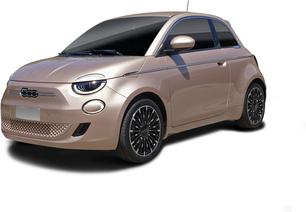
You wouldn’t know it to look at it, but this is a brand-new — as in really and truly all-new — Fiat 500.
That has got to be a big deal for fans of Fiat’s pint-sized city car, with a genuinely all-new 500 about rare as spotting Halley’s Comet soaring over Turin. The last time was way back in 2007, by the way, and that car will remain on sale alongside this new one for the foreseeable.
But that’s not the only surprise. This 500 is also entirely electric, properly modern inside, and it has actual technology in its cabin and on its safety list.
Fiat reckons this is a big reset for the 500. And that there will never be another all-new petrol model again.
So, how does this new 500e stack up against the recent flood of small EVs, predominantly from China?
Let’s go find out.
Cupra is not trying to fit in.
In a car market that is getting more and more crowded the Volkswagen Group-owned Spanish performance brand is looking to stand out. Which is why its refreshed Leon hatchback range has added the most unlikely of new models - a small wagon.
The conventional hatchback is struggling to survive against the onslaught of SUVs, and almost every brand has abandoned the wagon in all its sizes, but not Cupra. It has added the Leon Sportstourer to its facelifted Leon hatchback range, giving buyers looking for something different a new alternative.
This new compact wagon is powered by a plug-in hybrid powertrain and joins the Leon hatch in a three-pronged line-up initially, with the Leon S mild-hybrid and VZx hot hatch. A red hot VZx version of the Sportstourer and plug-in hybrid hatch are locked in to join the local Cupra range in 2026, but for now we’ll focus on this trio.
A fun, funky EV which will no doubt appeal to lovers of Italian style, but also one which struggles a little on the range and price front.
Still, there’s no doubt that electrification has improved the Fiat 500 formula.
There's a lot to like about the updated Leon line-up, but probably not by lots of people. It won't be a best-seller, Cupra doesn't need or even want it to be. What it will do is offer something different, and in the case of the Sportstourer something very rare.
The S and VZx will face stiffer competition in the hatchback markets, primarily from Volkswagen, Audi and even Skoda, and it's hard to pick an area where they really stand out from the competition, apart from the unique styling. Not that they aren't pleasant cars to drive, it's just a crowded market.
Which is why the Sportstourer, especially with its plug-in hybrid powertrain, has a chance to be something that really sets Cupra apart from its rivals. Dynamic, efficient and different, it won’t fit in - and that’s exactly what the brand is hoping for.
Note: CarsGuide attended this event as a guest of the manufacturer, with meals provided.
It looks, well, it looks like a Fiat 500.
It’s actually bigger in every dimension than an ICE cinquecento, but it doesn’t really look like it, which is a good thing.
The 17-inch wheels look great, and big against the very small Fiat, and I like the hidden doorhandles, which make the already smooth-looking 500’s flanks look a little smoother still. But I can take or leave the little DRLs up front that are meant to act as little illuminated eyebrows for the headlights, which come over a bit too cutesy.
But I think the highest compliment I can pay it is that it looks like a regular Fiat 500 — one of the most successful reincarnations of a timeless design ever — and not some modern, eco-friendly version that would have killed the look.
In the cabin, however, it’s definitely a more modern affair, with the big screen, the horizontal push-button gear selector, and the nifty push-button door openers.
Still, it’s all pretty familiar Fiat 500, only a little nicer, even if some of the plastics are far too hard and scratchy for a vehicle this expensive.
There are five colours available: Ice white, Onyx black, Rose gold, Ocean green and Celestial blue.
Design is a key tenet of Cupra’s ethos, because while it may share Volkswagen mechanical DNA, the Spanish brand wants to really stand apart when you look at or sit inside the Leon.
While it may be the same size as a VW Golf, it certainly doesn’t look or feel like one. Yes, there’s the typical Volkswagen build quality to the fit and finishes, but overall it has a unique Spanish style to it.
On the exterior, Cupra has given the Leon a major visual overhaul with the front end featuring a new-look grille, bumper and headlights. At the rear the tail-lights have been redesigned and now incorporate the logo into a single horizontal light bar that runs the width of the rear.
Inside there’s some new materials, but the most notable change is the introduction of a 12.9-inch multimedia screen. Ambient lightning available on all three models helps to highlight the cabin design.
The 500e is 29mm taller, 61mm longer and 56mm wider than the current ICE Fiat 500 (now 1529mm, 3631mm and 1683mm respectively), and it rides on a longer wheelbase, too .
That means more front-seat room and head room, but there’s still not oodles of space in the four-seat cabin, and especially in the back, where things are pretty tight.
I’m 175cm tall, and my head touches the ceiling in the back, and if I had another full-size human in the back with me, I’d want it to be someone I know well, because we’d be well and truly aquatinted by the time we got to our destination.
The front seats are more accomodating, but there is a strange tightness to the pedal area for the driver. It’s so tight, in fact, that when you rest your left foot, you have to be careful not to accidentally clip the brake pedal when driving.
The boot is a small 185 litres, too. But you’re not buying this for practicality perks, are you?
While we’re talking about two different bodystyles here - hatch and wagon - the front seats are the same. So you are treated to Cupra’s stylish but thoughtful layout, which looks nice but also has good practicality.
The seats themselves are comfortable, even after extended periods behind the wheel, while there’s cupholders, sizeable door pockets, a lidded centre console box and a wireless smartphone charging pad.
The previously mentioned 12.9-inch multimedia screen dominates the centre console, sitting proudly at the top of the fascia. Unfortunately, Cupra (like Volkswagen) has fallen to the modern trend of ‘touch controls’ rather than physical buttons.
Not to sound like an old man yelling at clouds, but these touch-sensitive sliders are simply not as user-friendly, especially in a moving vehicle, as a traditional physical button or dial. While the multimedia system is easy to use, especially with Android Auto or Apple CarPlay fully integrated, adding dials for the stereo (on/off and volume) and the climate control would have been great.
Otherwise, the 12-speaker Sennheiser sound system with subwoofer and 390W amplifier sounds great, offering a premium in-car entertainment experience to match the Cupra’s price and positioning.
As for space in the back, which is obviously where the hatch and Sportstourer vary. There isn’t a lot to split them in terms of passenger space. These are both small cars, so neither offer the kind of room you’d get from an equivalent-sized SUV. The real difference is the cargo capacity, the hatch pair offer 344L (or 888L with the rear seats down) whereas the Sportstourer has a more generous 470L/1045L.
The 500e is not cheap by modern small EV standards — we’re looking at you, China — but it does arrive in one well-equipped trim level, called La Prima, with paint the only available option.
It's also, quite shockingly for anyone who has driven an ICE Fiat 500 lately, stacked with some truly high-tech kit.
There’s heated seats for the first time ever, for example, and there’s 10.25-inch central screen with Apple CarPlay and Android Auto, and wireless charging.
There’s a digital driver display, too, plus there’s faux-leather on the seats and dash, a panoramic glass sunroof and fancy push-button front doors (though with a mechanical back-up lever hidden in the door pockets should something go pear shaped).
Outside, you’ll find 17-inch alloys, as well as LED lightning all around, including the DRLs, and there’s keyless entry and push-button start, too.
But, and it’s a significant but, the 500e lists at $52,500 before on-roads , which — when you consider its size, battery and range — really edges it into the premium EV space.
A similar-sized EV from China can be had for under $40k, which means you are going to have to really love the 500e to drop that extra $15k or so.
Knowing that hatchbacks and wagons aren’t big sellers and Cupra’s desire to stay boutique rather than mainstream, the line-up is relatively simple.
The Leon S kicks off the range at $46,990 (all prices listed exclude on-road costs) and comes with 18-inch black and silver alloy wheels, LED headlights, keyless entry and ignition, heated sports bucket seats, tri-zone climate control and a six-speaker sound system with Apple CarPlay and Android Auto.
The Leon VXz starts at $64,990 and includes 19-inch black and copper alloy wheels, multi-link rear suspension, adaptive dampers, front locking differential, upgraded brakes, quad exhaust and Cupra drive modes. There’s also leather-appointed seats and a 12-speaker Sennheiser sound system.
The VZe Sportstourer completes the line-up priced at $69,990 featuring unique 19-inch black and copper alloys, LED headlights and tail-lights, a power tailgate with handsfree opening and black roof rails. Inside it gets leather-appointed sports seats, heated front seats and steering wheel, tri-zone climate control, native navigation, Apple CarPlay and Android Auto plus the 12-speaker Sennheiser stereo.
A single front-mounted electric motor delivers the power here, with 87kW and 220Nm on offer. Enough, Fiat says, to knock off 100km/h in 9.0 seconds. But it does feel quicker than that in real life, thanks to the way electric vehicles deliver their power.
There’s the usual EV single-speed gearbox, too, with power sent to the front wheels.
The three Leon models all feature a different powertrain, as each is targeting a distinctly different buyer.
The Leon S is powered by a 110kW/250Nm 1.5-litre turbocharged petrol engine with mild-hybrid assistance.
The Leon VZx gets a more potent 2.0-litre four-cylinder turbo-petrol engine that makes 221kW/400Nm, to put it right at the heart of the hot hatch market.
The Leon VZe Sportstourer manages to combine efficiency with performance, with a 1.5-litre turbo-petrol engine paired to an electric motor to make an efficient 200kW and 400Nm.
The one thing all three have in common is a seven-speed dual-clutch transmission and front-wheel drive.
The Fiat 500e’s 42kWh battery provides a smallish 311km driving range on paper, but when we got in it was more like 290km at 96per cent charged. A city car, then, rather than a long-distance hauler.
When it does come time to charge, you’re set up for 85kW DC fast charging which should take you from zero to 80 percent in 35 minutes.
Naturally, the three different powertrains provide three very different fuel economy numbers.
The mild-hybrid system in the Leon S allows it to use just 5.4L/100km, which provides a theoretical range of up to 833km thanks to its 45-litre fuel tank.
The VZx is the thirstiest member of the range, not surprisingly, using 7.6L/100km. With its 50-litres tank it has a theoretical driving range of approximately 650km.
Finally, the Sportstourer VZe manages a claimed 0.4L/100km on paper, thanks to its 20kWh battery providing up to 121km of electric-only driving range. Obviously achieving that claimed figure in the real world is incredibly difficult (as it is with any PHEV) but we still managed to use just 2.4L/100km on our mostly extra-urban test drive, which is still a good return.
This is the probably the best-driving example of the Fiat 500 I’ve ever climbed into. Sure, it’s not quite as engaging as self-shifting a perky little manual, but it’s smoother, easier and more comfortable, and a whole lot better than ICE vehicles fitted with Fiat's odd dual-logic automatic gearbox.
The EV transition genuinely suits the little Fiat, admittedly sapping a little character, but also thoroughly modernising the drive experience, with smooth, constant acceleration, sharp-enough steering and a ride that’s mostly settled, only really becoming crashy over the bigger road imperfections.
The small dimensions here also help the EV reincarnation. Yes, it’s heavier than you might expect, weighing in at 1290kg (tare), with the batteries adding several hundred kilograms to the equation, but the 500e still doesn’t feel overly heavy, with the little Fiat remaining pretty light on its feet.
There are three drive modes on board, including the catchy Sherpa mode (because it will help get you where you’re going), which, when you’re running low on battery, kills the climate control and anything else it needs to preserve range and get you home.
But you can’t shake the feeling that the 500e is a little expensive for such a specialist tool. It’s unashamedly a city car, but one that will cost you more than $50k, and which doesn’t feel quite premium enough in the cabin to justify that asking price.
Obviously there are three very different variants in the Leon range, with three different powertrains and two different body styles, and yet there is a familiar feeling between all three when you’re behind the wheel.
This is arguably the ‘most Volkswagen-y’ element of the Cupras, with the solid, stable Volkswagen underpinnings coming through. This is, of course, not a criticism, but rather highlights the positive connections between Cupra and its parent company, which has allowed it to make an immediate impression on the Australian market.
However, it also means the Leons feel so familiar that they don’t leave you with a unique impression and driving character.
For example, the VZx is almost too good, too quick and too clinical. It lacks the excitement and engagement rival hot hatches offer, notably the Hyundai i30 N and Honda Civic Type R, but instead compensates by just being really capable.
Obviously, that may not be seen as a negative by everyone and for those who want that sort of engaging, dare I say ‘fun and edgy’, driving experience the Leon VZx may not be precisely what they are looking for. Still, the engine is potent and even the lack of all-wheel drive doesn’t dampen its performance abilities too significantly compared to the likes of a VW Golf R or Audi S3.
The Leon S offers a different proposition, a warmed up hatch, rather than something hot. On that front it delivers, providing a well-mannered drive but without the punch of the VZx.
The Sportstourer is arguably the pick of the range, with its combination of sharp driving dynamics and very efficient powertrain. At no point do you feel like Cupra compromised its sporty intent to make the Sportstourer save fuel. Instead, the PHEV powertrain offers plenty of performance when you need it but is otherwise quiet and efficient the rest of the time, helping it to sip fuel at a much lower rate than its Leon hatchback alternatives.
There’s a heap of active safety stuff on board (again, unusual for a 500), with active cruise control, traffic sign recognition, front, rear and side parking sensors, blind-spot monitoring, AEB with pedestrian and cyclist detection, and more.
Still, the 500e only secured a four-star ANCAP safety rating, scoring just below the five-star cut off in Adult Occupant Protection, Child Occupant Protection and Safety Assist, with a lack of a centre airbag not helping.
The Cupra trio come loaded with plenty of safety features including 10 airbags for excellent passive protection plus autonomous emergency braking, front and rear cross-traffic alert, blind spot warning and driver fatigue monitoring.
For convenience and safety there’s also adaptive cruise control, front and rear parking sensors and even self-parking.
As the Leon has had no major structural changes, the original 2021 five-star ANCAP rating still applies. However, it should be noted that ANCAP updated its testing protocols in 2023, so that five-star rating is different to a five-star rating applied since then.
The fly in Fiat’s ointment is its ownership proposition, with a three-year, 150,000km warranty now way below par in Australia these days, even if the battery is covered for the standard eight years.
Servicing is every 12 months or 15,000kms, and will cost $250 a pop for the first eight years, which is commendably cheap.
All three Leons are covered by Cupra Australia’s standard warranty, which covers the first five-years/unlimited kilometres. Which is good, especially for a new and more premium brand, even if it’s obviously short of the best-in-market.
Servicing is required every 12 months/15,000km, whichever comes first, and Cupra is offering a servicing pack special until the end of 2025, of $1990 for five years. That works out to an average of $398 per year.
Cupra is expanding its dealer network in Australia too. The Leon drive event we attended began at the newly-opened Cupra Macarther in Sydney’s growing west. There’s also a new dealership at Melbourne’s Essendon Fields.
Of course, one of the key advantages that Cupra has over many other new brands to Australia is its Volkswagen/Audi connections, which allows its models to be serviced at those dealerships as well. That provides a much larger footprint for customers to find somewhere convenient to service their car, which cannot be underestimated.