What's the difference?
You wouldn’t know it to look at it, but this is a brand-new — as in really and truly all-new — Fiat 500.
That has got to be a big deal for fans of Fiat’s pint-sized city car, with a genuinely all-new 500 about rare as spotting Halley’s Comet soaring over Turin. The last time was way back in 2007, by the way, and that car will remain on sale alongside this new one for the foreseeable.
But that’s not the only surprise. This 500 is also entirely electric, properly modern inside, and it has actual technology in its cabin and on its safety list.
Fiat reckons this is a big reset for the 500. And that there will never be another all-new petrol model again.
So, how does this new 500e stack up against the recent flood of small EVs, predominantly from China?
Let’s go find out.
This is arguably the car that really made Toyota's GR performance division really take off. And it just got a bit better.
The GR Yaris was already an awesome thing, but more power, an interior refresh and a bunch of mechanical changes aim to lift the bar again. And even better, you can now get one without the third pedal.
So how much better is the 2025 Toyota GR Yaris now? And is the auto any good? We've driven this rally-bred hero on track and in Victoria's high country to find out.
A fun, funky EV which will no doubt appeal to lovers of Italian style, but also one which struggles a little on the range and price front.
Still, there’s no doubt that electrification has improved the Fiat 500 formula.
You already could have argued the GR Yaris was the best car Toyota made even before its update.
The GR Yaris’ refreshed interior and its slight bump in performance are the result of plenty of feedback from owners and even racing drivers that Toyota took on board, and the result is an even better sports car.
It helps that it’s not prohibitively expensive in the grand scheme of the new-car market these days.
Now, I reckon even fans of the rear-drive Toyota GR86 might start to doubt their preferences after a stint behind the wheel.
Note: CarsGuide attended this event as a guest of the manufacturer, with accommodation and meals provided.
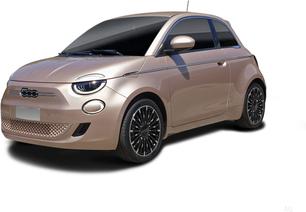
It looks, well, it looks like a Fiat 500.
It’s actually bigger in every dimension than an ICE cinquecento, but it doesn’t really look like it, which is a good thing.
The 17-inch wheels look great, and big against the very small Fiat, and I like the hidden doorhandles, which make the already smooth-looking 500’s flanks look a little smoother still. But I can take or leave the little DRLs up front that are meant to act as little illuminated eyebrows for the headlights, which come over a bit too cutesy.
But I think the highest compliment I can pay it is that it looks like a regular Fiat 500 — one of the most successful reincarnations of a timeless design ever — and not some modern, eco-friendly version that would have killed the look.
In the cabin, however, it’s definitely a more modern affair, with the big screen, the horizontal push-button gear selector, and the nifty push-button door openers.
Still, it’s all pretty familiar Fiat 500, only a little nicer, even if some of the plastics are far too hard and scratchy for a vehicle this expensive.
There are five colours available: Ice white, Onyx black, Rose gold, Ocean green and Celestial blue.
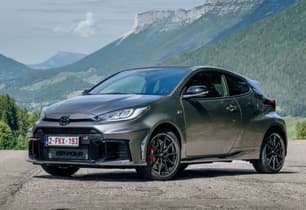
The GR Yaris isn’t just a regular Yaris with sports bits stuck on, and because of that it looks fantastic.
It’s properly aggressive, sculpted to look more like a rally car than other Yarises (I’m not calling them ‘Yarii’), even down to the fact it’s a two-door design.
A carbon-fibre roof, aluminium bonnet, doors and tailgate, plus a series of functional aerodynamic and cooling features prove the Yaris doesn’t just look like this for show, though.
The redesigned front bumper directs air to more radiators for extra cooling but also through to the front wheel arches to cool the brakes.
Another change is the tail-light bar, which spans the rear and does away with the light integrated into the rear spoiler, which is now also body coloured. Down below that, larger exhaust tips reflect a more powerful engine.
There’s also significant change inside. The repositioning of some elements for better ergonomics make the GR Yaris a much more driver-oriented space inside, and despite some soft-touch materials it has a race car vibe to it.
The interior centre stack no longer looks like a standard Toyota interior, and the fact Toyota went to the effort and cost to do this purely because of driver feedback shows how serious it is about its GR division’s future.
The 500e is 29mm taller, 61mm longer and 56mm wider than the current ICE Fiat 500 (now 1529mm, 3631mm and 1683mm respectively), and it rides on a longer wheelbase, too .
That means more front-seat room and head room, but there’s still not oodles of space in the four-seat cabin, and especially in the back, where things are pretty tight.
I’m 175cm tall, and my head touches the ceiling in the back, and if I had another full-size human in the back with me, I’d want it to be someone I know well, because we’d be well and truly aquatinted by the time we got to our destination.
The front seats are more accomodating, but there is a strange tightness to the pedal area for the driver. It’s so tight, in fact, that when you rest your left foot, you have to be careful not to accidentally clip the brake pedal when driving.
The boot is a small 185 litres, too. But you’re not buying this for practicality perks, are you?
The changes to the GR Yaris interior come down to useability as a sports car.
Thanks to the update, some pre-update complaints about ergonomics like the driver’s seat being too high or impeded visibility have been addressed.
The seat is now 25mm lower and feels much more natural in terms of eye-level and body positioning, but also allows more space above to fit a helmet on your bonce.
The pedals have also moved for easier heel-toeing, while the steering column angle has been adjusted to feel more natural.
Additionally, the dash panel is now tilted towards the driver by 15 degrees more and there’s better visibility between the dash and rear-view mirror with the multimedia screen now integrated into the centre stack.
Essentially, the Yaris has undergone a generation-level update in the interior and is much better for it.
Everything falls to hand without the driver needing to move their shoulders, but at the same time it doesn’t feel cramped.
While the second row is near unusable for adults - plus only seating two - the 174-litre boot is only 39L less than the GR Corolla. It’s not much space at all, really, but fold the seats down and there’s space for track day gear, maybe even a spare tyre or two. Not that there’s a standard space-saver spare with the car. Just a repair kit.
The 500e is not cheap by modern small EV standards — we’re looking at you, China — but it does arrive in one well-equipped trim level, called La Prima, with paint the only available option.
It's also, quite shockingly for anyone who has driven an ICE Fiat 500 lately, stacked with some truly high-tech kit.
There’s heated seats for the first time ever, for example, and there’s 10.25-inch central screen with Apple CarPlay and Android Auto, and wireless charging.
There’s a digital driver display, too, plus there’s faux-leather on the seats and dash, a panoramic glass sunroof and fancy push-button front doors (though with a mechanical back-up lever hidden in the door pockets should something go pear shaped).
Outside, you’ll find 17-inch alloys, as well as LED lightning all around, including the DRLs, and there’s keyless entry and push-button start, too.
But, and it’s a significant but, the 500e lists at $52,500 before on-roads , which — when you consider its size, battery and range — really edges it into the premium EV space.
A similar-sized EV from China can be had for under $40k, which means you are going to have to really love the 500e to drop that extra $15k or so.
The GR Yaris comes in two grades, now called GT and GTS, and they're both available with either a six-speed manual or eight-speed automatic transmission.
The ‘entry’ GT comes in at $55,490 plus on-road costs for the manual or $57,990 for the automatic, and has plenty of kit for a performance-focused light hatchback including heated suede and leather-accented sports bucket seats, a leather heated steering wheel and leather-wrapped gearshift, aluminium pedals and park brake lever.
On the tech front you get an 8.0-inch multimedia touchscreen and 12.3-inch digital instrument cluster, USB-C and 12V power sockets, an eight-speaker JBL audio system, wireless Apple CarPlay and Android Auto and digital radio.
The GTS comes in at $60,490 or $62,990 for the manual and auto respectively, and add some performance extras like a set of 18-inch BBS forged alloy wheels wrapped in Michelin Pilot Sports 4S tyres, red GR brake calipers and upgraded GR sports seats.
The GTS also gains a Torsen limited-slip differential, upgraded GR suspension, a sub-radiator for better cooling as well as intercooler spray.
At this price point, the GR Yaris is wanting for proper rivals. Similarly-priced cars like the Hyundai i30 N and VW Golf GTI are bigger, front-drive and less focused, while similarly-sized cars are either less powerful or less capable, like the Abarth 695 or Hyundai i20 N.
A single front-mounted electric motor delivers the power here, with 87kW and 220Nm on offer. Enough, Fiat says, to knock off 100km/h in 9.0 seconds. But it does feel quicker than that in real life, thanks to the way electric vehicles deliver their power.
There’s the usual EV single-speed gearbox, too, with power sent to the front wheels.
The GR Yaris now makes 221kW (at 6500rpm) and 400Nm (between 3250 and 4600rpm) from its 1.6-litre three-cylinder turbocharged petrol engine, dubbed G16E-GTS in Toyota code.
Outputs are up 21kW and 30Nm from before, and both the six-speed manual and eight-speed torque converter automatic have matching figures.
Normal, Track and Gravel modes for the AWD system can distribute torque either 60:40 (front/rear) in Normal, 53:47 in Gravel or variably as needed in Track.
Toyota says, weirdly, both versions can hit 100km/h in 5.1 seconds and max out at 230km/h. We expect you’d need to be fairly handy to match the auto’s acceleration in a manual.
The Fiat 500e’s 42kWh battery provides a smallish 311km driving range on paper, but when we got in it was more like 290km at 96per cent charged. A city car, then, rather than a long-distance hauler.
When it does come time to charge, you’re set up for 85kW DC fast charging which should take you from zero to 80 percent in 35 minutes.
Toyota claims the GR Yaris sips 8.2L/100km of fuel (which needs to be 98 RON by the way) in manual, or 9.1L/100km as an auto.
Its 50-litre tank means you should be able to get more than 500km out of a tank of fuel if driving frugally, but let’s be honest, are you going to do that in a tiny all-wheel-drive hot hatch with a 0-100kmh time that would embarrass a great number of Aussie V8s?
This is the probably the best-driving example of the Fiat 500 I’ve ever climbed into. Sure, it’s not quite as engaging as self-shifting a perky little manual, but it’s smoother, easier and more comfortable, and a whole lot better than ICE vehicles fitted with Fiat's odd dual-logic automatic gearbox.
The EV transition genuinely suits the little Fiat, admittedly sapping a little character, but also thoroughly modernising the drive experience, with smooth, constant acceleration, sharp-enough steering and a ride that’s mostly settled, only really becoming crashy over the bigger road imperfections.
The small dimensions here also help the EV reincarnation. Yes, it’s heavier than you might expect, weighing in at 1290kg (tare), with the batteries adding several hundred kilograms to the equation, but the 500e still doesn’t feel overly heavy, with the little Fiat remaining pretty light on its feet.
There are three drive modes on board, including the catchy Sherpa mode (because it will help get you where you’re going), which, when you’re running low on battery, kills the climate control and anything else it needs to preserve range and get you home.
But you can’t shake the feeling that the 500e is a little expensive for such a specialist tool. It’s unashamedly a city car, but one that will cost you more than $50k, and which doesn’t feel quite premium enough in the cabin to justify that asking price.
To get straight to the point, the GR Yaris might be the best car Toyota builds if you’re a keen driver.
Most who’ve driven it in the past will know it’s extremely fun with a manual gearbox, but after the update it’s impressive how capable the new auto makes it, too.
For a start, while its GR Corolla sibling feels as it is - a hot hatch based on the Corolla - the GR Yaris feels bespoke.
From behind the wheel, as a performance car, there isn’t really anything that jumps out as a red flag.
Now that it’s got more power and torque, it’s also an even more convincing choice in Toyota’s hot hatch duo in terms of power-to-weight ratio.
Of course, it still holds up well as a car for day-to-day duties, if looking a little brash while doing so. In Normal drive mode with the diff set to front-bias, the GR Yaris feels ready to take on the suburbs.
But knock it into Sport and set the diff to Track, and you’ll find the rear wheels working harder out of corners as the Yaris sends torque backwards to avoid the front wheels spinning.
The Yaris’ suspension is definitely on the stiffer side of things, but it’s compliant considering the focused nature of the GR, and even sharp bumps you might expect to rattle the car don’t feel harsh.
At the same time, the GR doesn’t feel like it’s dulling any useful feedback from the suspension or steering, the latter being very direct but not too heavy.
It’s altogether very confidence-inspiring, and combined with the fact the GR Yaris is actually very capable, it makes for a rather quick car point-to-point. It means even if you make a small mistake, say coming into a corner on track, you don’t feel as punished on the way out because there’s a mix of power and composure to get you out of it.
Some of the best things about the Yaris though, are the things that speak to your heart a little more than your head. The sound of the exhaust itself but also the turbo flutter when you lift off after boost - even just the way it looks inside and out.
There’s a heap of active safety stuff on board (again, unusual for a 500), with active cruise control, traffic sign recognition, front, rear and side parking sensors, blind-spot monitoring, AEB with pedestrian and cyclist detection, and more.
Still, the 500e only secured a four-star ANCAP safety rating, scoring just below the five-star cut off in Adult Occupant Protection, Child Occupant Protection and Safety Assist, with a lack of a centre airbag not helping.
The GR Yaris isn’t the same as its non-GR cousins, and therefore the five-star rating ANCAP gave the Yaris a few years back doesn’t apply here.
Still, Toyota takes safety pretty seriously and the GR comes with the kit to back that up. Six airbags for a start, plus a decent reversing camera, auto emergency braking (AEB), a blind spot monitor, safe-exit assist, anti-skid brakes with brake assist and plenty of traction help.
There’s also a slew of features that fall under the ‘Toyota Safety Sense’ suite including a pre-collision system, intersection collision avoidance in daylight, emergency steering assist, adaptive cruise control, lane trace and steering assist with lane centring, lane departure alert, road sign assist for speed signs and auto high beam.
The fly in Fiat’s ointment is its ownership proposition, with a three-year, 150,000km warranty now way below par in Australia these days, even if the battery is covered for the standard eight years.
Servicing is every 12 months or 15,000kms, and will cost $250 a pop for the first eight years, which is commendably cheap.
Toyota’s five-year/unlimited kilometre warranty covers the GR Yaris, with an extra two-year warranty on the engine and driveline.
Toyota also offers a capped price of $310 on the first six services, though intervals of six months or 10,000km (whichever comes first) mean that capped price will only get you through three years of ownership.