What's the difference?
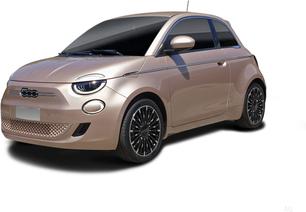
You wouldn’t know it to look at it, but this is a brand-new — as in really and truly all-new — Fiat 500.
That has got to be a big deal for fans of Fiat’s pint-sized city car, with a genuinely all-new 500 about rare as spotting Halley’s Comet soaring over Turin. The last time was way back in 2007, by the way, and that car will remain on sale alongside this new one for the foreseeable.
But that’s not the only surprise. This 500 is also entirely electric, properly modern inside, and it has actual technology in its cabin and on its safety list.
Fiat reckons this is a big reset for the 500. And that there will never be another all-new petrol model again.
So, how does this new 500e stack up against the recent flood of small EVs, predominantly from China?
Let’s go find out.
With its EV-led design, the updated flagship Hyundai Kona Electric model, the Premium Extended Range, is a small SUV that's big on space and luxury features.
Which feels increasingly necessary for EVs to compete in an ever-expanding market where change is celebrated and expectations remain high.
Competition includes the newcomer Renault Megane E-Tech, the Kia Niro EV and even the Volvo C40. I've been driving the top model for a week to see how Hyundai's cutest EV fared with my little family of three.
A fun, funky EV which will no doubt appeal to lovers of Italian style, but also one which struggles a little on the range and price front.
Still, there’s no doubt that electrification has improved the Fiat 500 formula.
The Hyundai Kona Premium Extended Range offers a great amount of passenger comfort and space but its ongoing costs are a bit more expensive for the class and its low safety rating is surprising given its strength in that category in the past.
However, it drives well, looks good, and has great storage space so it's still in the race!
It looks, well, it looks like a Fiat 500.
It’s actually bigger in every dimension than an ICE cinquecento, but it doesn’t really look like it, which is a good thing.
The 17-inch wheels look great, and big against the very small Fiat, and I like the hidden doorhandles, which make the already smooth-looking 500’s flanks look a little smoother still. But I can take or leave the little DRLs up front that are meant to act as little illuminated eyebrows for the headlights, which come over a bit too cutesy.
But I think the highest compliment I can pay it is that it looks like a regular Fiat 500 — one of the most successful reincarnations of a timeless design ever — and not some modern, eco-friendly version that would have killed the look.
In the cabin, however, it’s definitely a more modern affair, with the big screen, the horizontal push-button gear selector, and the nifty push-button door openers.
Still, it’s all pretty familiar Fiat 500, only a little nicer, even if some of the plastics are far too hard and scratchy for a vehicle this expensive.
There are five colours available: Ice white, Onyx black, Rose gold, Ocean green and Celestial blue.
The design for the Kona has always been a win in my books because it’s cute and functional.
Hyundai also designed the EV Kona first then based the fuel-powered versions on it. So, you get a flat floor in the back row, a cool-looking front with extended body panelling and some futuristic pleating across the panels.
The exterior LED lights are pretty cool as a lot of them resemble pixels and can be found in multiple spots at the front and rear. The long LED strip light across the front also sets it apart from it's fuel-based siblings.
The interior exudes a good sense of luxury with its light-coloured leather upholstery and trims. Coupled with the sunroof the cabin space is bright and cheery.
The 64-colour ambient lighting adds a touch of fun and the update sees some minor tweaks to accent panels where black plastic has been dropped in favour of a brushed metal look.
The dashboard has been redesigned with dual 12.3-inch technology screens (one for media, one for instruments), now standard across all variants instead of just the top model, which is great to see.
The 500e is 29mm taller, 61mm longer and 56mm wider than the current ICE Fiat 500 (now 1529mm, 3631mm and 1683mm respectively), and it rides on a longer wheelbase, too .
That means more front-seat room and head room, but there’s still not oodles of space in the four-seat cabin, and especially in the back, where things are pretty tight.
I’m 175cm tall, and my head touches the ceiling in the back, and if I had another full-size human in the back with me, I’d want it to be someone I know well, because we’d be well and truly aquatinted by the time we got to our destination.
The front seats are more accomodating, but there is a strange tightness to the pedal area for the driver. It’s so tight, in fact, that when you rest your left foot, you have to be careful not to accidentally clip the brake pedal when driving.
The boot is a small 185 litres, too. But you’re not buying this for practicality perks, are you?
The Kona's size has increased for its second generation, which means more occupant space and storage capacity. The front offers more space than you’d expect for a small SUV and I’d describe it as roomy, even for someone taller than my 168cm height.
The rear row also has fantastic head- and legroom for the class but it's the storage options which clinch the practicality for me.
Up front the centre console is still the hero for storage with multiple nooks and spaces for items like keys, phones and wallets. You get two retractable cupholders, a 1.5L drink bottle holder in each door and a good-sized middle console and glove box.
In the rear, you get map pockets, 0.7L drink bottle holders in each door and two cupholders in a fold-down centre armrest.
The boot sees an additional 33L, expanding the overall capacity to 407L with all seats in use. That jumps up to 1241L when the rear row is folded. Underneath the adjustable floor, you get a temporary spare wheel.
The electric front seats aren’t as comfortable as the previous generation. They’re narrower, firmer and sit a bit higher than I remember. Though I still love the added comfort functions they have, including a reclining relaxation mode.
The rear seats are better cushioned and offer longer under-thigh supports and middle seaters should be comfortable thanks to the flat floor.
The technology looks good and the 12.3-inch touchscreen multimedia system is easy to use once you spend some time with it. You get built-in satellite navigation, wireless Apple CarPlay and wired Android Auto.
The 12.3-inch digital instrument panel isn't customisable but all information is easily seen as is the colour head-up display.
Charging options are great throughout the car with each row getting two USB-C ports, the front also featuring a wireless charging pad and 12-volt outlet. The next-gen model sees the Kona get V2L (Vehicle To Load) capability, too, which is great.
The 500e is not cheap by modern small EV standards — we’re looking at you, China — but it does arrive in one well-equipped trim level, called La Prima, with paint the only available option.
It's also, quite shockingly for anyone who has driven an ICE Fiat 500 lately, stacked with some truly high-tech kit.
There’s heated seats for the first time ever, for example, and there’s 10.25-inch central screen with Apple CarPlay and Android Auto, and wireless charging.
There’s a digital driver display, too, plus there’s faux-leather on the seats and dash, a panoramic glass sunroof and fancy push-button front doors (though with a mechanical back-up lever hidden in the door pockets should something go pear shaped).
Outside, you’ll find 17-inch alloys, as well as LED lightning all around, including the DRLs, and there’s keyless entry and push-button start, too.
But, and it’s a significant but, the 500e lists at $52,500 before on-roads , which — when you consider its size, battery and range — really edges it into the premium EV space.
A similar-sized EV from China can be had for under $40k, which means you are going to have to really love the 500e to drop that extra $15k or so.
There are a whopping eight variants for the Kona range and you have a choice of four powertrains – petrol, turbo-petrol, hybrid or fully electric like our flagship Premium Extended Range model.
The model on test is priced from $68,000, before on-road costs, and that positions it in the middle of its rivals.
Based on a NSW, 2000 postcode you can pick up the Kia Niro EV GT-Line for $66,590 MSRP and the Volvo C40 Plus variant for $78,990 MSRP.
The most affordable rival is the newcomer, Renault Megane E-Tech for $64,990 but it's important to note the E-Tech is only offered in a mid-spec variant for the Australian market at the moment.
Compared to it's rivals, the flagship electric Kona is well-priced but it’s a hefty $20K jump up from the equally equipped top petrol version.
Being top dog, you should expect a host of premium features like a sunroof, heated, ventilated and power-adjustable front seats, heated rear outboard seats, a heated steering wheel and eight-speaker premium Bose audio.
The front seats also feature a 'relaxation mode' where they act as a recliner, providing a comfortable option for charging sessions.
Practical features include a handsfree powered tailgate, 27L frunk storage, remote parking assist (from the key fob), over-the-air updates for the built-in satellite navigation and Hyundai connected services app.
Unusually for an EV, you also get a temporary spare wheel in this model instead of a repair kit.
Other features include some A-grade tech like dual 12.3-inch technology screens, fast USB-C ports, a wireless charging pad, and vehicle-to-load function in the form of a three-pin standard house socket so you charge larger appliances.
A single front-mounted electric motor delivers the power here, with 87kW and 220Nm on offer. Enough, Fiat says, to knock off 100km/h in 9.0 seconds. But it does feel quicker than that in real life, thanks to the way electric vehicles deliver their power.
There’s the usual EV single-speed gearbox, too, with power sent to the front wheels.
The Premium Extended Range model is front-wheel drive and has an electric motor with outputs of 150kW and 255Nm.
It’s not as spritely as some of its rivals but it’s able to hold its own on the open road. Just don't expect it to blow your hair back.
The Fiat 500e’s 42kWh battery provides a smallish 311km driving range on paper, but when we got in it was more like 290km at 96per cent charged. A city car, then, rather than a long-distance hauler.
When it does come time to charge, you’re set up for 85kW DC fast charging which should take you from zero to 80 percent in 35 minutes.
The official energy consumption figure for the Premium Extended Range model is 16.7kWh/100km and a week of mostly urban road driving resulted in an average of 16.6kWh/100km.
That's very good consumption and the official driving range from the 64.8kWh lithium-ion battery is up to 444km but I’d have my eye on the range on a longer journey.
The top electric Kona has a Type 2 CCS charging port which means you can benefit from faster DC charging speeds.
But it can also accept a top speed of 10.4kW on AC power. On an 11kW AC charger, you can go from 0-100 per cent in a little over 6.5-hours.
The Premium Extended Range model can only accept up to 100kW on DC charging, which is lower than its rivals, and you can go from 10-80 per cent in just over an hour on a 50kW system and in as little as 45 minutes on an 100kW system.
Again, it's figures are a tad slower and lower than rivals but not inconvenient for everyday use.
This is the probably the best-driving example of the Fiat 500 I’ve ever climbed into. Sure, it’s not quite as engaging as self-shifting a perky little manual, but it’s smoother, easier and more comfortable, and a whole lot better than ICE vehicles fitted with Fiat's odd dual-logic automatic gearbox.
The EV transition genuinely suits the little Fiat, admittedly sapping a little character, but also thoroughly modernising the drive experience, with smooth, constant acceleration, sharp-enough steering and a ride that’s mostly settled, only really becoming crashy over the bigger road imperfections.
The small dimensions here also help the EV reincarnation. Yes, it’s heavier than you might expect, weighing in at 1290kg (tare), with the batteries adding several hundred kilograms to the equation, but the 500e still doesn’t feel overly heavy, with the little Fiat remaining pretty light on its feet.
There are three drive modes on board, including the catchy Sherpa mode (because it will help get you where you’re going), which, when you’re running low on battery, kills the climate control and anything else it needs to preserve range and get you home.
But you can’t shake the feeling that the 500e is a little expensive for such a specialist tool. It’s unashamedly a city car, but one that will cost you more than $50k, and which doesn’t feel quite premium enough in the cabin to justify that asking price.
The top model's single motor delivers smooth power in most instances but you can lose traction if your accelerate too quickly from a standstill.
Mostly urban kilometres covered during this test and despite the Kona not having the punchiest motor, I’ve still had moments of it feeling zippy.
The steering feels like it’s in the middle of firm and makes for responsive manoeuvring. You get some roll when cornering and the car can feel a bit light-footed when you’re shooting across traffic but otherwise it's well-balanced.
The ride comfort is very good in terms of suspension, where it feels well-cushioned but not too floaty.
Road noise isn’t intrusive, either, but there's some wind noise, even at lower speeds.
It’s an old gripe but the speed-sign recognition tech in a lot of Hyundai and Kia models is intrusive and annoying with how often it chimes at you.
It's worth the effort to turn off the warning sounds every time you drive, particularly if you're in the city. Usually, this would be in the safety section but it affects the driving enjoyment.
When it comes to parking, the Kona's compact dimensions make it your best friend in a car park. A fabulously clear 360-degree camera system also helps.
There’s a heap of active safety stuff on board (again, unusual for a 500), with active cruise control, traffic sign recognition, front, rear and side parking sensors, blind-spot monitoring, AEB with pedestrian and cyclist detection, and more.
Still, the 500e only secured a four-star ANCAP safety rating, scoring just below the five-star cut off in Adult Occupant Protection, Child Occupant Protection and Safety Assist, with a lack of a centre airbag not helping.
The 2024 electric Kona has a long list of safety systems but surprisingly its previous-generation model’s five-star ANCAP safety score hasn’t been matched, with the new version getting four stars from testing in 2023.
Penalty points have been applied across a few items and its individual protection scores for vulnerable road users and safety assist systems are at 64 per cent and 62 per cent, respectively.
The Kona has seven airbags, including a front centre airbag and a highlight feature is the blind-spot view monitor which shows you a camera feed of your blind spot on the dashboard.
Other standard features include blind-spot monitoring, driver attention warning, safe exit warning, rear occupant alert, full LED lights, rear cross-traffic alert, lane departure alert, lane keeping aid, adaptive cruise control, a 360-degree view camera system, as well as front, rear and side parking sensors.
The Kona has AEB with forward collision warning which is operational from 5.0-85km/h for pedestrian and vulnerable road user detection and 10-180km/h for car detection.
For any families out there, the Kona has ISOFIX child seat mounts on the rear outboard seats and three top-tether anchor points but two seats will fit best.
The fly in Fiat’s ointment is its ownership proposition, with a three-year, 150,000km warranty now way below par in Australia these days, even if the battery is covered for the standard eight years.
Servicing is every 12 months or 15,000kms, and will cost $250 a pop for the first eight years, which is commendably cheap.
Servicing costs for the Hyundai Kona are quite expensive for the class and you can pre-purchase one, two or three services. Services cost $520 (one service), $1040 (two services), or $1560 (three services). It's typical to see EV servicing sit closer to the $250 mark.
Warranty terms are pretty typical, though, the Kona coming with a five-year/unlimited km warranty and the battery covered by an eight-year, or up to 160,000km warranty term.
Servicing intervals are every two years or 30,000km, whichever occurs first.