What's the difference?
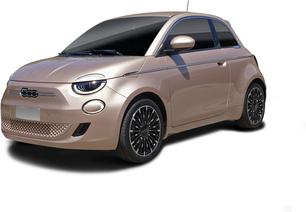
You wouldn’t know it to look at it, but this is a brand-new — as in really and truly all-new — Fiat 500.
That has got to be a big deal for fans of Fiat’s pint-sized city car, with a genuinely all-new 500 about rare as spotting Halley’s Comet soaring over Turin. The last time was way back in 2007, by the way, and that car will remain on sale alongside this new one for the foreseeable.
But that’s not the only surprise. This 500 is also entirely electric, properly modern inside, and it has actual technology in its cabin and on its safety list.
Fiat reckons this is a big reset for the 500. And that there will never be another all-new petrol model again.
So, how does this new 500e stack up against the recent flood of small EVs, predominantly from China?
Let’s go find out.
The entry-point into one of Australia's most popular brands has been around for almost 10 years in its current generation, but the Mazda2 has had a refresh.
Possibly for the last time in its current lifespan, the small hatchback gets a facelift to remain appealing, Mazda hopes, to first-car-buyers.
Mazda's up against not only direct rivals, like the Suzuki Swift and Toyota Yaris, but also the shifting market.
Mazda has sold just over 3500 Mazda2s so far this year, but almost 11,000 CX-3 small SUVs, the latter based on our friend here's platform.
It's a name with a little over two decades behind it, but can it be a first-car-favourite in an increasingly difficult small car market?
A fun, funky EV which will no doubt appeal to lovers of Italian style, but also one which struggles a little on the range and price front.
Still, there’s no doubt that electrification has improved the Fiat 500 formula.
While Mazda's insistence that the Mazda2 is a 'first-car' could be very limited by the incomes of most teenagers or early-20s city-dwellers, the starting price being close enough to $20,000 for a dynamically enjoyable and convenient small car isn't to be scoffed at.
The new styling of the Mazda2 is well executed, and as an alternative to small SUVs (which continue to become more popular) it's a sensible option, especially considering its efficiency and ease of use.
The lower specifications in the range are probably the best in terms of value, as even the features on the higher grades aren't groundbreaking, and the Pure SP definitely exudes the most style cred.
It looks, well, it looks like a Fiat 500.
It’s actually bigger in every dimension than an ICE cinquecento, but it doesn’t really look like it, which is a good thing.
The 17-inch wheels look great, and big against the very small Fiat, and I like the hidden doorhandles, which make the already smooth-looking 500’s flanks look a little smoother still. But I can take or leave the little DRLs up front that are meant to act as little illuminated eyebrows for the headlights, which come over a bit too cutesy.
But I think the highest compliment I can pay it is that it looks like a regular Fiat 500 — one of the most successful reincarnations of a timeless design ever — and not some modern, eco-friendly version that would have killed the look.
In the cabin, however, it’s definitely a more modern affair, with the big screen, the horizontal push-button gear selector, and the nifty push-button door openers.
Still, it’s all pretty familiar Fiat 500, only a little nicer, even if some of the plastics are far too hard and scratchy for a vehicle this expensive.
There are five colours available: Ice white, Onyx black, Rose gold, Ocean green and Celestial blue.
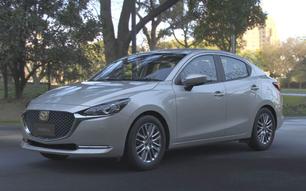
Aside from the Pure SP, the Mazda2's styling changes are subtle. Mazda's design team aimed to move the model's looks slightly away from the previous ‘premium' chrome-adorned look to a sportier and more ‘aggressive' style.
A redesigned front bumper and mesh grille, with the rear's nip and tuck being more subtle, don't need to do much to keep the hatchback looking fresh. Despite being almost a decade old, the Mazda2 looks, to some extent, like it could be a new generation.
The Pure SP in particular is a highlight, with the blocked grille evoking some ‘electrification' vibes, while the coloured-accent treatment at the front and rear of most variants is a welcome addition for something different.
The range of differing wheels is also a plus point for the Mazda2 range, with each model having its own distinct characteristics.
Inside, the Pure SP also gets a stand-out panel across the dash in a lighter colour like mint, while others get different seat trims and colour accents in places like the vent surrounds.
New colours for the range are 'Aero Grey Metallic' and 'Air Stream Blue Metallic'.
The 500e is 29mm taller, 61mm longer and 56mm wider than the current ICE Fiat 500 (now 1529mm, 3631mm and 1683mm respectively), and it rides on a longer wheelbase, too .
That means more front-seat room and head room, but there’s still not oodles of space in the four-seat cabin, and especially in the back, where things are pretty tight.
I’m 175cm tall, and my head touches the ceiling in the back, and if I had another full-size human in the back with me, I’d want it to be someone I know well, because we’d be well and truly aquatinted by the time we got to our destination.
The front seats are more accomodating, but there is a strange tightness to the pedal area for the driver. It’s so tight, in fact, that when you rest your left foot, you have to be careful not to accidentally clip the brake pedal when driving.
The boot is a small 185 litres, too. But you’re not buying this for practicality perks, are you?
The Mazda2's interior is mostly unchanged through the facelift, with the car's overall dimensions unchanged and not affecting space for its occupants.
Up front, the two seats are comfortable for adults and arm, shoulder, and head room is ample.
Storage space for drinks, phones, or small bags and wallets is sufficient, though not quite road-trip-worthy.
In the rear seats, adults will find enough space to be comfortable for short trips but might get a little restless after a while.
Headroom when sitting upright is tight for anyone around 182cm (six-feet) tall, and a lack of armrest and little storage save for the doors means loose items will be joining occupants on the seat or sitting on the floor.
The Mazda2 has a claimed 250 litres of luggage space in the boot, which is fine for a small hatchback, but short of rivals like the Toyota Yaris' 270L.
The 500e is not cheap by modern small EV standards — we’re looking at you, China — but it does arrive in one well-equipped trim level, called La Prima, with paint the only available option.
It's also, quite shockingly for anyone who has driven an ICE Fiat 500 lately, stacked with some truly high-tech kit.
There’s heated seats for the first time ever, for example, and there’s 10.25-inch central screen with Apple CarPlay and Android Auto, and wireless charging.
There’s a digital driver display, too, plus there’s faux-leather on the seats and dash, a panoramic glass sunroof and fancy push-button front doors (though with a mechanical back-up lever hidden in the door pockets should something go pear shaped).
Outside, you’ll find 17-inch alloys, as well as LED lightning all around, including the DRLs, and there’s keyless entry and push-button start, too.
But, and it’s a significant but, the 500e lists at $52,500 before on-roads , which — when you consider its size, battery and range — really edges it into the premium EV space.
A similar-sized EV from China can be had for under $40k, which means you are going to have to really love the 500e to drop that extra $15k or so.
Mazda has managed to keep pricing for its entry model relatively low for the segment. In fact, the base Pure in manual form starts from $22,410, before on-roads, and the auto is only $2000 more.
That means at a time when the Toyota Yaris is starting to look more expensive than its historic ‘cheap and cheerful' image allows, Mazda is pushing the Mazda2 to be slightly more premium while keeping its price competitive.
Standard features for the range, which start in the Pure variant, include a 7.0-inch touchscreen with Apple CarPlay and Android Auto capability, plus auto headlights and windscreen wipers.
The Pure SP, which starts at $25,210, gains a different styling kit that adds a body-coloured front panel to the grille, plus a carbon-look roof in vinyl. It also gains the ‘shark-fin' roof aerial.
The Evolve, which starts from $25,910, gains LED DRLs, with the mesh grille replacing the SP's block colour panel.
Its upholstery gets red stitching, plus it's also got a couple more tech additions with Mazda's active head-up driver display, traffic sign recognition and satellite navigation.
Finally, there's the top-spec GT, from $27,610, which gains unique aero-inspired 16-inch alloy wheels, and a set of black leather-upholstered seats with synthetic suede and red trim.
A sedan is available in Pure or GT specification at the same prices and with the same features as the hatch, though you can't get a Pure sedan in manual - that's available in the hatch only.
A single front-mounted electric motor delivers the power here, with 87kW and 220Nm on offer. Enough, Fiat says, to knock off 100km/h in 9.0 seconds. But it does feel quicker than that in real life, thanks to the way electric vehicles deliver their power.
There’s the usual EV single-speed gearbox, too, with power sent to the front wheels.
Mazda's ‘SkyActiv-G' 1.5 litre four-cylinder petrol engine is the unit used for six-speed manual and automatic models, but outputs vary slightly.
Manual cars produce 82kW and 144Nm, while autos deliver a slightly lower 81kW and 142Nm, both driving the front wheels only.
It's pretty much the same engine you used to find in an entry-grade MX-5, just with less power.
The Fiat 500e’s 42kWh battery provides a smallish 311km driving range on paper, but when we got in it was more like 290km at 96per cent charged. A city car, then, rather than a long-distance hauler.
When it does come time to charge, you’re set up for 85kW DC fast charging which should take you from zero to 80 percent in 35 minutes.
Improved fuel efficiency and lower CO2 emissions come thanks to the automatic's slight drop in power and torque.
Mazda claims a 5.0L/100 km rating for the automatic Mazda2, which is down by 0.3L/100km over the previous version, but the manual's unchanged engine tune burns through the petrol at 5.4L/100km.
Filling the 44-litre tank with at least 91RON or even E10 is fine, and with its auto variant's efficiency rating means the Mazda2 technically has a theoretical range of 880km.
Comparatively the Mazda2 scores well here, the more expensive Toyota Yaris comes with a 4.8L/100km consumption claim with its CVT auto. A Suzuki Swift, with a smaller 1.2-litre engine, also has a 4.8L/100km rating.
This is the probably the best-driving example of the Fiat 500 I’ve ever climbed into. Sure, it’s not quite as engaging as self-shifting a perky little manual, but it’s smoother, easier and more comfortable, and a whole lot better than ICE vehicles fitted with Fiat's odd dual-logic automatic gearbox.
The EV transition genuinely suits the little Fiat, admittedly sapping a little character, but also thoroughly modernising the drive experience, with smooth, constant acceleration, sharp-enough steering and a ride that’s mostly settled, only really becoming crashy over the bigger road imperfections.
The small dimensions here also help the EV reincarnation. Yes, it’s heavier than you might expect, weighing in at 1290kg (tare), with the batteries adding several hundred kilograms to the equation, but the 500e still doesn’t feel overly heavy, with the little Fiat remaining pretty light on its feet.
There are three drive modes on board, including the catchy Sherpa mode (because it will help get you where you’re going), which, when you’re running low on battery, kills the climate control and anything else it needs to preserve range and get you home.
But you can’t shake the feeling that the 500e is a little expensive for such a specialist tool. It’s unashamedly a city car, but one that will cost you more than $50k, and which doesn’t feel quite premium enough in the cabin to justify that asking price.
Our drive loop for the Mazda2's launch included a mix of urban, highway, and rural driving, with varying road quality and conditions.
Fortunately for the little hatchback, it handled everything well or at least at a passing mark, with only a couple of small shortcomings that are common in the segment.
The Mazda2 is a joy to drive in most circumstances, with a lively but confidence-inspiring chassis and controls that give a connected feel to the road.
At low speeds, the Mazda2's relatively low power isn't noticeable, with the gearbox getting things moving at a reasonable pace and the engine is responsive enough with the traditional gearbox helping it along.
It's worth noting that for ultimate control over the drivetrain, Mazda still offers a six-speed manual transmission in the entry-grade Pure, and it's a gem.
Smooth, sporty shifts and well thought out gear ratios mean the manual is easy to handle even in traffic, and the clutch has a forgiving bite point. The 'i-Stop' stop/start system works with the three-pedal car, too, as does cruise control.
In terms of handling and comfort, the Mazda2 is a little shaken by large bumps, though some of the rough surfaces on our test loop were particularly brutal.
Similarly, when pushed hard to conquer steep hills the 1.5-litre engine becomes a little harsh.
On twisty sections the Mazda2 (especially in manual form) provides ample fun while remaining predictable in its steering and chassis feedback, rather than feeling loose.
There’s a heap of active safety stuff on board (again, unusual for a 500), with active cruise control, traffic sign recognition, front, rear and side parking sensors, blind-spot monitoring, AEB with pedestrian and cyclist detection, and more.
Still, the 500e only secured a four-star ANCAP safety rating, scoring just below the five-star cut off in Adult Occupant Protection, Child Occupant Protection and Safety Assist, with a lack of a centre airbag not helping.
The updated Mazda2 is equipped with the brand's suite of 'i-Activsense' safety tech, which includes 'Smart City Brake Support' for operating forward and reverse, blind-spot monitoring and rear cross-traffic alert.
The Evolve and GT model grades are fitted with traffic sign recognition.
The GT model grade comes fitted with front parking sensors and a set of surround-view parking cameras.
The Mazda2 also features six SRS airbags to cover the driver and front passenger, side airbags, and curtain airbags front and rear. It also has ISOFIX anchor points and top tethers for child seats in the rear.
Mazda isn't going to put the Mazda2 up for a new crash test rating by ANCAP, with the brand telling us the new safety additions bring the car's safety up to date, though its original rating from 2015 was a maximum five stars.
The fly in Fiat’s ointment is its ownership proposition, with a three-year, 150,000km warranty now way below par in Australia these days, even if the battery is covered for the standard eight years.
Servicing is every 12 months or 15,000kms, and will cost $250 a pop for the first eight years, which is commendably cheap.
Mazda offers a five-year/unlimited-kilometre warranty across the range, under which the Mazda2 will be covered. That's on par for the market, although some rivals, like the MG3, come with a seven-year term.
Scheduled servicing costs for the first seven workshop visits range from $334 to $587, and are undertaken every 12 months or 15,000km (whichever comes first).