What's the difference?
Holden wasn't the first manufacturer to find itself bereft of a big SUV when the fuse was lit by BMW and Mercedes as the last millennium came to a close. Ford responded with the Territory while Holden jacked-up a V8 Commodore and slapped the Adventra badge on it. Sadly, it didn't work, and so the Captiva was the next best option, procured from what was then called Daewoo.
As a result of that that little blip on the economic radar, the GFC, and an on-going re-organisation of General Motors, the Korean-built Captiva has lasted rather longer than anyone expected.
It first launched with two bodystyles, but is now down to one, the bigger and more practical seven seat body shell.
Driving a whopping great SUV down the straight on a race track at more than 200km/h sounds like fun, but it actually feels a bit wrong, like entering a baby elephant in a dog show.
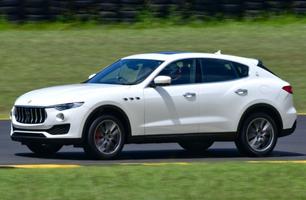
These are strange times, of course, and the Maserati Trofeo Levante is a suitably strange vehicle - stylish, classy, expensively appointed family hauler that also has the heart and soul of a race car.
Indeed, while performance SUVs are an increasingly commonplace vehicle, the Levante - which was actually getting along in the tooth as a model before this significant upgrade - has higher performance credibility than most.
That's because it has a big Ferrari V8 driving all four of its wheels and delivering a properly supercar-like 433kW and 730Nm.
It's not what you might call a typical Maserati buyer's car, but then only those who know what the Trofeo badge stands for - shouty insanity, basically - will be interested in this end of town. It is a lot of car, but is it worth the large load of money on the sticker ($330,000)?
The Captiva is very, very long in the tooth and is heading towards retirement some time in the next twelve months. Before then, it's a lot of car for the money, particularly the seven seat LS. It's not fast, flash or futuristic but it will do the job and with all of the early problems sorted, will probably do it for quite some time.
The Captiva's low scores are mostly to do with the car just being old and feeling it, with dodgier plastics, slightly undercooked ride and handling and a lack of engine and safety tech. It doesn't mean it's a terrible car, because it isn't and Holden papers up the cracks with a low starting price and good after-sales.
Maseratis are built for a fairly specific niche buyer; someone with a lot of money, someone slightly older and certainly someone who likes the finer things in life and appreciates Italian style, quality and heritage.
They are not, typically, the kind of buyers who want to tear around race tracks like fiends in big, shouty SUVs. But apparently there is a niche within the niche of Maserati fans who do, and they are willing to invest big dollars in vehicles wearing the Trofeo badge, like this Levante.
It might seem a slightly strange creation, a track-mad SUV with a screaming Ferrari engine, but surprisingly, it really does work.
Formerly known as the Captiva 7, the seven seat body has remained mostly the same for its 11 years on sale. The only real changes have been around the front end, with Holden several times fiddling with the grille, lights and bumpers. There's nothing flash about the Captiva, but you know exactly what it is coming at you, with the double grille and big Holden badge.
In profile there's a lot of the original BMW X5 if you squint, right down to the copyright lawyer-dodging shape of the rear quarter window. It also has that X5's big gaps between wheelarch and tyres and a good view of the wheelarch itself. If that's your thing.
Little has changed at the back apart from bumpers and the LED effect lights added in the last update in 2014. It's unlikely you're buying the Captiva as auto haute couture, though.
Inside is basic, and you can place the Captiva's genesis in the mid-2000s, there's a certain generic GM feel to it. The switchgear feels old and clacky, the plastics are hard but do fit well enough. An Audi interior it isn't. The update in 2014 to make the 7.0-inch screen fit in the dashboard is fairly obvious and it's a shame the whole dash couldn't have been replaced. The huge steering wheel surrounds a tightly packed instrument cluster with small dials and a very old-looking LCD panel for trip computer duties.
While the other two Maseratis to get the Trofeo treatment - the Ghibli and Quattroporte sedans - are undeniably lovely, the Levante is not quite as pretty.
Admittedly, for an SUV, it looks very good, and the Trofeo touches - that big, nostrilled bonnet, the red gills on the sides, the carbon, the badges - really do lift its game to another level.
Overall, though, the Levante has just never felt beautiful enough to me to be a Maserati. These guys really do style well, as you'd expect from a premium Italian brand, but making an SUV sexy is beyond even them.
I'll grant you, it does look good from front on, but at the rear they just seem to have run out of ideas.
Credit is due for feeling properly special inside, however.
The Captiva's interior dimensions are impressive. In seven seat versions, the boot space starts at 87 litres, expanding to a handy 465 litres with the 50/50 split fold rear row stowed. Flop the middle row forward and you're up at 930 litres, a good size cargo area that could swallow a flat-pack wardrobe. If you snaffle a five-seat version, you can remove the boot floor panels to reveal another couple of hundred litres of hidey holes.
There are cup holders up front (two), in the middle row (two) and in the boot (one, strangely) for a total of five. In the seven seater, two will go thirsty.
If you've got to move five people in a genuine hurry, the Levante is a pleasant way to go about it.
There's plenty of head and shoulder room, the seats, while firm in the front, are pleasant to the touch and supportive and there's a 580-litre boot with an electric tailgate and split-folding seats.
The boot feels properly spacious, too, with a 12-volt power outlet and four tie-down points. You won't, however, find a spare wheel out there, so serious off-roading is out (although it probably was already if you look at those expensive wheels).
There are huge door pockets with room for bottles and two big cup holders in the front. The centre-console bin looks lovely, it's all carbon fibre, but is quite small.
There are also three USB points, one in the front and two in the rear, and Apple CarPlay and Android Auto connectivity.
The Captiva's value is heavily dependent on the model you choose. Standard features across the range (starting with the LS) include a 7.0-inch touchscreen running MyLink, a six-speaker stereo with AM/FM radio, Bluetooth, cruise control, rear parking sensors, reversing camera, auto headlights, leather steering wheel, dual-zone climate control, three 12 volt power outlets, keyless entry and start and a tyre inflation kit in place of an (optional) spare tyre.
No Captiva comes standard with sat nav as they all feature Apple CarPlay or Android Auto, which both use your phone's GPS apps.
There are four models, three 'standard' specifications - LS, LT, and the top of the range LTZ, with a fourth version in the form of the five seat only Active 'special' edition, that isn't.
Pricing starts at $26,490 for the 2.4-litre LS (with five seats and five-speed manual gearbox), $28,690 for the auto, and the diesel comes in at $31,690. Seven-seat LS pricing ranges from $30,490 for the petrol and $33,490 for the diesel, both six-speed automatics.
The Active enters the price list at $31,990 drive away. Based on the five-seat petrol LS (to be discontinued in May 2017), the auto-only Active adds 18-inch alloys, textile leather seats and a cargo cover. There's also a similarly specified seven seat version at $33,490.
On to the LT, and the price rises to $37,490 for the petrol and $38,490 for the diesel, both of them seven seaters. Part of the big jump for the LT is explained by the petrol engine switching to Holden's 190kW 3.0-litre V6 and the addition of all-wheel drive (AWD). The LT picks up a sunroof, bigger alloys, side steps, cloth trim with "Sportec" bolsters on the front seats and powered heated mirrors.
The LTZ's pricing is a mixed bag. Ordinarily, the V6-powered version would attract an rrp (carmakers insist we call it MLP, manufacturer's list price) of $40,490, with the diesel adding a thousand dollars to weigh in at $41,490. However, Holden is running a long promotion offering the LTZ V6 at $35,990 drive away with three years of free servicing.
The LTZ has 19-inch wheels, leather-look trim, electric driver's seat and front parking sensors.
You can choose one of seven colours - black, white, red, silver, blue, brown and grey and all but white will cost you $550. Orange is no longer on the menu, no matter how much you want it to be 2007 again.
I'm sorry, but $330,000 for an SUV, of any kind? Personally I can't see the value, but then personally, as we'll discuss below in the Design section, I can't see the attraction.
This is one of the most expensive SUVs money can buy, well above things like Range Rover Sport SVR ($239,187) or even Porsche Cayenne Turbo Coupe ($254,000), although a pricier Ferrari one is surely on the way.
You'd want a lot for that, and the way it drives and sounds, thanks to that Ferrari engine, accounts for quite a few dollars.
There's also an undeniably high-quality feel to everything you touch on the car, inside and out, and a vast quantity of carbon fibre everywhere as well.
Other highlights include the 21-inch machine polished wheels, an 8.4-inch touchscreen with Navigation and DAB radio, full matrix LED headlights, and incredible Pieno Fiore natural leather, “the best the world has ever seen”, as Maserati says.
The lovely if firm front seats are heated and ventilated, sporty and 12-way adjustable, with Trofeo logos stitched into the headrests. The rooflining is lovely Alcantara, the steering wheel is sporty and features carbon-fibre shift paddles, ad the stereo system is Harman Kardon Premium and has 14 speakers.
And even the rear seats are heated. It feels expensive, and it should. But still, $330K?
If you like a choice of engine size, you've come to the right place. The Captiva has three engine specs in the range - two petrols and a diesel.
The smaller petrol, a 2.4-litre four-cylinder, produces 123kW at 5600rpm and 230Nm at 4600rpm. Driving the front wheels, this motor is available with choice of gearbox, either a six-speed manual or six-speed automatic. This 2.4 is only available on the LS and Active.
The 24-valve 3.0 SIDI V6 is available on LT and LTZ and produces 190kW at 6900rpm and 288Nm at 5800rpm.
The single diesel is a 2.2-litre iron block with common rail direct-injection and makes 135kW at 3800rpm and a stout 400Nm within a very usable range of 1750-2750rpm. You can have the oil burner in all three trim levels, driving the front wheels in the LS and four-wheel drive in the LT and LTZ.
Both the V6 and diesel are available only with the six-speed automatic transmission.
Unlike earlier Captiva models, none of these engines feature a timing belt. Those early engines suffered from issues related to the fabric belt while problems with the later timing chain driven engines are less common. Reliability of the V6 is well-proven in the Commodore while later four cylinders also perform well.
Zero to 100km/h performance varies between the engines. The 2.4 will reach 100km/h in around 10.5 seconds while the V6 is rather quicker at 8.6. The diesel falls right in the middle at 9.6 seconds.
We've not yet carried out a towing review, but according to Holden, towing capacity is rated at 750kg for unbraked trailers and 2000kg braked.
This will be the last time Maserati gets a proper Ferrari engine like this a 3.8-litre twin-turbo V8 shouty monster, which is good for 433kW and 730Nm.
The future, as is the case everywhere, is going to be more electric and less noisy. For now, anyone who can should enjoy this V8 masterpiece, which drives all four wheels through Maserati's Q4 on-demand all-wheel drive system via a limited-slip rear differential and uses an eight-speed automatic transmission.
Its claimed 0 to 100km/h time is 3.9 seconds, which puts it in what used to be super-car territory, and is still very quick indeed, while top speed is an unimaginable 304km/h.
If you're after good fuel economy, the Captiva probably isn't the car for you.
The 2.4-litre petrol is quoted at 9.7L/100km on the combined cycle but, as we recently discovered, is more likely to return closer to 12.5L/100km.
Diesel fuel consumption on the official combined cycle is listed at 8.5L/100km but our most recent test yielded a slightly startling figure of 12.9L/100km. The diesel's performance, particularly in the gears, is better than either petrol but it appears you'll pay for it.
The big banger V6's official fuel consumption figure is listed at 10.7L/100km, but past CarsGuide reviews suggest 14.0L/100km is a more likely real world figure. As far as fuel economy goes, diesel vs petrol usually falls to the diesel, but not in this case.
Fuel tank capacity is identical across the range at 65 litres.
The official claimed fuel economy for the Maserati Levante Trofeo is 13.5 litres per 100km, but good luck with that.
A more realistic number would probably sit somewhere above 17 litres per 100km, and we would have easily exceeded 20 litres while driving it like lunatics around a track.
But you just paid $330K for an SUV, what do you care about fuel economy?
You sit on the Captiva rather than in it, a feeling encouraged by the flat, shapeless seats. It doesn't matter which Captiva you choose, the front seats are not exactly huggy but they'll certainly take people of all shapes and sizes.
You twist a funny knob where the key barrel used to be to start the engine. The view out front and out the sides is commanding as there is a fair bit of glass all around, with just the view out the rear window restricted as it's quite small. If you've got passengers, forget it, but the reversing camera will save the day there.
The ride is, for the most part, reasonable, but will deteriorate along with the road surface. The suspension isn't very quiet and the overall firm feeling delivers passable handling, which you'd expect from a big heavy machine like this. It doesn't have anything like the finesse of much younger metal from Hyundai, Kia and Mazda.
The diesel specs suggest strong performance and that's exactly what you get. It's by far the torquiest of the three engines and shifts the Captiva's two tonnes with reasonable verve. It's a noisy, grumbly unit but works well with the six-speed auto.
The engine specs of the two petrols don't really tell the story. While the V6 is quicker in a straight line, its extra weight knocks the shine off the torque increase and the engine itself isn't a shining example of modern engine tech. Actually, neither of them are, missing out on stop-start and other goodies.
This isn't an off-road review, but moderately ambitious mud-plugging is doable in the AWD models, with a ground clearance of 200mm but no low range or off-road mode. We even checked the manual to make doubly sure there wasn't a diff lock button hidden somewhere.
As ever, the idea here is that when you're buying a Captiva you're buying a lot of space and a cheap ownership experience.
We got to drive all three Trofeo-fettled Maseratis on track at Sydney Motorsport Park, and before that on the road, where the Levante felt very pleasant, and pleasantly expensive at all times.
As you might expect, a vehicle with 433kW is difficult to fully appreciate on public roads, although there was the occasional and exciting change to give it a quick, loud blat between gears.
It only takes hearing that engine note, and feeling that torque surge, a few times to see why someone might fall in love with this car, or at least this engine.
Out on the track, the rear-driven Ghibli and Quattroporte, which share the Levante's engine, were surely the more fun and frenetic things to drive, but there were those who chose the Levante as their best of the three, even for circuit driving.
There's no doubt that its on-demand all-wheel-drive system, which is biased towards the rear but asks the front wheels for help when required, made it feel the most planted, and the safest, through fast and slow bends.
There's a definite sense that its engine is being asked to work the hardest, though, to push all that bulk through the air (although its brakes never seemed to fade, which is impressive with more than two tonnes of SUV to stop).
While the big, deafening V8 is willing and keen to rev all the way to 7000rpm (where it bangs on the redline waiting for your upshift, if you're driving in manual mode - I do like that), it started to make large sucking sounds towards the top of each gear, as if it was desperately trying to get more oxygen in.
It genuinely sounded different to the other two Trofeo cars, which is odd, but perhaps they just weren't as near their limits. That bulk also slowed it slightly in terms of top speed down the straight, but it still exceeded 220km/h with ease.
What should be said is that I was genuinely shocked at how good the Levante Trofeo was around a track. So much so I asked to have a second go, just to make sure I wasn't going mad.
Sure, it makes no sense to me personally, and I don't know why anyone needs an SUV that's good on a track, but if you do, I can recommend the Levante for sure.
That hugely enjoyable engine is just too much fun, although it's even better in a sedan like the Ghibli...
The Captiva carries six airbags, ABS, traction and stability controls, hill descent control, brake force distribution, active rollover protection, brake assist and three ISOFIX points, in addition to the reversing camera and rear parking sensors.
The Captiva's maximum five star ANCAP safety rating was awarded in November 2011.
Maserati's safety offering on the Levante includes six airbags, a reversing camera and 360-degree overhead camera, parking sensors front and rear, adaptive cruise control and Blind Spot Detection, Forward Collision Warning Plus, Pedestrian Detection, Lane Keep Assist, Active Driver Assist and Traffic Sign Recognition.
There is no ANCAP rating for the Levante as it's not been crash tested here.
As with all new Holdens, the Captiva owner benefits from a three year/100,00km warranty and lifetime capped price servicing. All prices are available on Holden's website.
Service costs for the diesel are significantly higher than the either of petrols, but do include oil changes.
The standard package also includes a year of roadside assist.
For common faults and complaints, check out our Holden Captiva problems page, which covers known automatic transmission problems, engine problems and diesel problems. There aren't any widespread diesel engine problems with the later version.
Resale value is often a consideration and we've looked at the last major update, released in 2014.
A seven seat Series II LS from 2014 - the second major update for the Captiva after the 2011 update addressed lingering problems - cost $30,490 when new and will trade at around $13000-$15000, below fifty per cent of the purchase price, with private sales a little higher.
An LTZ diesel from the same period sold for $41,490 and trades in the 45 to 50 per cent of purchase price and a little over 50 per cent in private sales.
Maserati offers a three-year, unlimited kilometre warranty, but you can choose to buy 12-month or two-year warranty extensions, and even a sixth or seventh-year drive-train warranty extension.
When much, much cheaper Japanese and Korean cars are offering seven and even 10-year warranties, this is so far off the pace that such a fast vehicle should be embarrassed. And if you're buying something Italian, a better, longer warranty would seem like a must. I'd be negotiating at sale for them to throw the longer warranty offer in.
Maserati says servicing for the Ghibli has a "ball park costing of $2700.00 for the first three years of ownership" with a service schedule of every 20,000km or 12 months (whichever occurs first)
Also, "please note that the above is indicative only of the manufacturers basic routine service maintenance schedule and does not include any consumable items such as tyres, brakes etc or additional dealership charges such as environmental levies etc."