What's the difference?
Hybrids are yesterday’s news.
If you’re looking for a combination powertrain in 2025 you want a ‘Super Hybrid’. This is the Chinese car industry’s term for what is more commonly known as a plug-in hybrid, but they are all the rage among car brands as they rush to simultaneously cut emissions and keep buyers.
The Geely Starray EM-i is the latest addition to a growing number of Super Hybrids available in Australia, joining the BYD Sealion 6, MG HS, Jaecoo J7, Omoda 9 and the Mitsubishi Outlander PHEV (which doesn’t have the fancy name but has the same tech).
This is Geely’s second entry into the Australian market, following the similar-sized but all-electric EX5 earlier this year. While it’s a new brand to Australia, Geely is an automotive giant, it’s so big in China it has been able to expand its global reach. Its parent company, also called Geely, has an ownership stake in Volvo, Polestar, Lotus, Zeekr, Proton, Smart, Lynk & Co. and Aston Martin.
But none of that really matters when you’re buying a car. So, how does the Starray stack up on its own merits? Is it a compelling new addition or just another forgettable offering in an increasingly crowded mid-size SUV market?
If you’re in the market for a city- and family-friendly compact SUV, you’re in luck.
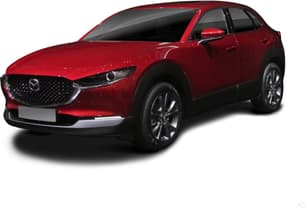
The small SUV segment is one of the most heavily populated and hotly contested in the Aussie new-car market and the Mazda CX-30 G25 GT SP FWD is pitched against a seething pack of at least 10 similarly sized, generously specified and highly-credentialed competitors.
So, stay with us on a mission to determine whether this high-end version of one of Mazda’s best sellers is worthy of a spot on your new-car short list.
While it has a few quirks and flaws, there is a lot to like about the Starray. For starters, the value it offers at its price point is excellent and will really put pressure on its competition. The design may lack flair, but it does have a roomy cabin with a good multimedia system, so it’s family friendly and easy to live with.
Yes, it could do with some refinement of its on-road manners and driver assistance features, but for the value it offers and the frugal powertrain, it will no doubt find plenty of buyers who enjoy its substance and not just its memorable name.
Note: CarsGuide attended this event as a guest of the manufacturer, with meals and accomodation provided.
About to enter its fifth year in market the Mazda CX-30 is holding up well and this GT SP FWD grade delivers solid value relative to its key competitors, of which there are many. It’s also space-efficient, practical and performs well with top-shelf safety, decent refinement and good dynamic ability.
Alternately, it’s crying out for a hybrid powertrain to improve fuel efficiency, the interior form and function is starting to date and while it meets the market the ownership promise could be sharper. But this little SUV is still worthy of a spot on your new-car short list.
Geely is very proud of the Starray, of course, and the company gave a very detailed presentation on the thought behind the design - involving aerodynamics, Chinese ceramics and a video that appeared to show a Geely spaceship releasing the Starray into a barren landscape.
But to be perfectly honest, I wouldn’t know how to describe it to you. The Starrary is a very generic looking car to my eyes, at least. Of course it’s subjective, and there is a clear visual connection between the Starray and the EX5, which is nice. But it just doesn’t have any real visual impact that makes it stand out.
It’s the automotive equivalent of a blank expression. Maybe it’s because the brand is so new, but if you removed the badges, there’s nothing about the Starray that screams ‘I’m a Geely’, and it could be a car from any number of brands.
By comparison, there is a distinctive visual style to Geely’s rivals, namely BYD, both externally and internally, to give it character. Obviously the same is very much true for bigger brands like Hyundai, Kia and even Toyota.
Perhaps with more time Geely will make more of a design impact on our market, but for now it’s hard to say it really has any standout design elements.
Mazda continues to follow a disciplined design path with everything from the MX-5 sports car to the BT-50 dual-cab ute sharing key attributes like the brand’s signature trapezoidal grille, simple flowing lines and sleek head- and tail-lights, all wrapped up with a subtle hint of chrome here and there.
Car-spotters with the GT SP on their checklist should look out for 18-inch black metallic rims as well as black exterior trim, including the mirror caps.
Inside, the CX-30 maintains Mazda’s restrained approach with smooth surfaces integrated across the multi-layer dash and primo leather-trimmed seats.
That said, this car is starting to show its age with the multimedia screen plonked on the top of the dash (in typical Mazda fashion) and a largely conventional instrument cluster.
Yes, the main dial is configurable courtesy of a central 7.0-inch TFT screen, but next to more recent arrivals boasting sleek, often twinned, flat screen displays the CX-30 looks and feels out of touch.
Functionally, there’s a sensible mix of digital controls and physical buttons (points for audio volume and ventilation dials!), but… the multimedia screen can only be accessed by a rotary controller in the centre console once the car is mobile (it works as a touchscreen when you’re stationary).
Some say touchscreens take your eyes off the road so the controller makes sense, but with a sequential app like Spotify it can take a lot of twirls to get to where you want to go, which upsets concentration and takes your eyes off the road, anyway. I’d prefer the relative ease of a quick press on a screen.
Aside from all that, the materials used are high quality with soft-touch surfaces across key contact points and hard plastics confined to high-wear areas.
The one area the designers do deserve a lot of credit for is the roomy cabin. Too often modern electric or hybrid SUVs compromise interior space in the name of aerodynamics, but the Starray has generous interior space.
The front seats are comfortable and roomy, but more impressive are the rear seats. They not only offer good kneeroom and head clearance, but the seats themselves are comfortable and supportive.
As for cargo space, the boot has 428 litre of space, which is on par with BYD Sealion 6, but smaller than the 507 litres offered by the MG HS. Space can expand to 2065 litres with the second row dropped to load larger items.
Despite the modest boot capacity, the Starray doesn’t come with a full-size spare wheel, or even a spacesaver, and instead you have to make do with a tyre repair kit.
In terms of the multimedia system, there’s a huge 15.4-inch display that takes up a lot of space, and does look like someone just glued a big iPad to the dashboard. Then there’s the increasingly common 10.2-inch rectangular digital instrument display ahead of the steering wheel.
While this setup is highly functional, it does add to the generic design mentioned earlier. It also lacks any meaningful physical buttons, with the key audio and air-con functions all housed in the giant centre screen.
Standard on both Starray grades is Geely’s Connected Services, which includes a voice assistant, 4G connectivity, live traffic updates for the in-built sat-nav, over-the-air updates, as well as online streaming, remote vehicle functions and access to Geely’s own app store.
The over-the-air updates are important, because it will allow the company to change the car over time. For example, at launch it includes wireless Apple CarPlay, but Android Auto won’t be wireless until an over-the-air update early in 2026.
The Inspire features a premium sound system from Geely’s own Flyme brand, and it’s impressive. The 16-speaker, 1000W system is powerful and offers good clarity, so it’s worth the extra spend on the higher grade on its own.
At just under 4.4m long, close to 1.8m wide and little over 1.5m tall (with a 2655mm wheelbase) the CX-30 is in the middle of the pack it competes with in terms of key dimensions.
And space up front is more than adequate, with an impressive feeling of roominess for a relatively small SUV.
For storage, there’s a large lidded box (which doubles as an armrest) between the front seats as well as a pair of cupholders in front of the gear-shifter with a bay for wireless device charging ahead of that.
The glove box is big, there are bins in the doors with room for decent size bottles and a drop-down tray for sunglasses sits overhead.
Move to the rear and the amount of space on offer is surprisingly generous. Sitting behind the driver’s seat, set for my 183cm position, I have plenty of head and legroom, although three full-size adults across the back seat will be an uncomfortable proposition for anything other than short trips. A trio of up to mid-teenage kids will be fine.
Adjustable air vents at the back of the front centre console are a welcome inclusion for back-seaters and storage runs to a map pocket (weirdly, on the back of the front seat only), a pair of cupholders in the fold-down centre armrest and bins in the doors with room for smaller bottles.
In-cabin power and connectivity includes two USB-C outlets and a 12-volt socket in the front centre storage box. No USBs specifically for those in the rear, which is a miss for road trips and no 12V in the boot which can be handy when camping or picnicking.
Speaking of the boot, cargo volume with the rear seat upright is okay for the class at 317 litres, which expands to a healthy 1479L with the 60/40 split-folding backrest lowered. For comparison the Kia Seltos coughs up 433L with the rear seat upright.
The space is illuminated, there are tie-down anchors to help secure loose loads and there’s a space-saver spare sitting under the floor.
And if you’re keen on towing a tinnie or similar you’re good to go for a 1200kg braked trailer (600kg unbraked).
As a mid-size SUV the Starray EM-i (which stands for E-Motive Intelligence) finds itself up against a wide variety of mid-size SUVs, including the popular Toyota RAV4, Kia Sportage and Hyundai Tucson hybrids, as well as the BYD Sealion 6, Chery Tiggo 7 and MG HS super hybrids.
To make sure the Starray stands out for more than just its name, Geely is hitting the market with a very sharp value proportion.
The Starray starts from just $37,490 (plus on-road costs), undercutting the BYD and MG, but not the Chery, which offers a drive-away price of $39,990. However, that’s for Geely's entry-level Complete variant, with the higher-grade Inspire starting at $39,990 plus on-road costs, to arguably make an even better value argument.
Standard equipment for the Complete includes 18-inch alloy wheels, LED headlights and tail-lights, keyless entry and ignition, power adjustable front seats with heating and an infotainment system run through a 15.4-inch display.
While the Inspire adds 19-inch alloys, a panoramic sunroof, power tailgate, ambient interior lighting and a 16-speaker, 1000-watt premium sound system to really ram home Geely’s value push.
The Mazda CX-30 G25 GT SP FWD weighs in at $43,140, before on-road costs and our test example features the optional ‘Vision Pack’, the details of which we’ll get to shortly, raising the price $1300 to $44,440.
Alternate options around that price point include the Hyundai Kona Premium N Line 2WD ($42,500), Kia Seltos GT-Line FWD ($41,850), Mitsubishi Eclipse Cross Exceed 2WD ($40,990), Honda HR-V e:HEV L 2WD ($42,900, drive-away), Nissan Qashqai ST-L FWD ($42,690), Peugeot 2008 GT FWD ($44,490), Renault Arkana Techno FWD ($41,000), Suzuki S-Cross Plus FWD ($41,490), Toyota C-HR 2WD GXL Hybrid ($42,990) and Volkswagen T-Roc Style FWD ($40,590).
That’s quite the automotive smorgasbord, the resulting price and specification cage fight meaning every included feature counts and the Mazda heads into battle with some significant weapons in hand.
Specifically, dual-zone climate control, a head-up display, a 10.25-inch ‘widescreen’ multimedia display, 7.0-inch driver’s multi-information display, 12-speaker Bose audio (with digital radio), wireless Android Auto and Apple CarPlay, ‘Burgundy’ leather seat trim, heated front seats, leather trim on the gearshift and heated steering wheel, wireless phone charging, power-adjustable driver’s seat (with memories), a glass power tilt and slide sunroof and a power tailgate.
There’s also adaptive auto LED headlights, 18-inch black metallic alloy wheels, radar cruise control (with stop/go), a reversing camera, auto-fold (and tilt) heated exterior mirrors and keyless entry and start.
It’s an impressive and competitive equipment list for a small SUV under $45K, even before we get to the performance and safety tech covered later in the review.
There is no mechanical difference between the Starray Complete and Inspire. Geely has developed a new naturally aspirated 1.5-litre four-cylinder petrol engine that pairs with an electric motor for a combined output of 193kW.
Power is sent to the front wheels only, with no all-wheel drive option.
There are three driving modes - Pure, Hybrid and Power - with the former able to lock the car into EV-only driving, while the latter is able to combine the electric and petrol engine for maximum performance.
Even so, Geely’s 0-100km/h claim is only a modest 8.0 seconds and has a limited top speed of 170km/h, which is fine for Australian conditions.
The CX-30 GT SP is powered by a 2.5-litre, naturally aspirated, four-cylinder petrol engine producing maximum power of 139kW at 6000rpm and peak torque of 252Nm at 4000rpm.
It’s a proven all-alloy unit featuring direct-injection as well as variable intake and exhaust valve timing with drive going to the front wheels via a six-speed auto transmission.
The AWD version of the GT SP adds an electromagnetic multi-plate clutch pack (managed by a multitude of sensors) to selectively engage the rear wheels, as well. But its engine and transmission combination is identical to this FWD model’s.
The electric motor is powered by an 18.4kWh lithium-iron phosphate battery, which provides a claimed EV-only range of 83km, which is good for a PHEV but no longer class-leading, with some now pushing into triple digits.
Thanks to the hybrid assistance, fuel consumption is rated at just 2.4L/100km, on the combined cycle. It’s worth noting that both of those figures are to the WLTP test cycle, not the more generous Chinese testing protocol.
With a 51-litre fuel tank and the 83km EV mileage, Geely claims a total combined driving range of 943km. However, as always, we must point out that it is not really possible to achieve that 2.4L claim once the battery is depleted.
One handy feature of these plug-in hybrids with the bigger batteries is the vehicle-to-load or V2L functionality, which allows you to draw power from the battery to power small electrical devices, such as laptops or camping equipment.
The CX-30 GT SP FWD’s official fuel consumption figure on the combined (urban/extra-urban) cycle is 6.6L/100km, the 2.5-litre atmo four-cylinder engine emitting 154g/km of C02 in the process.
It features fuel-saving stop-start and cylinder deactivation functions as standard and over a combination of city, suburban and some freeway running we saw an average of 8.4L/100km, which is average for an SUV in this class. A comparable hybrid package would easily better this result.
Based on the car’s 51-litre fuel tank theoretical range between refills is 772km, which drops to just over 600km using our real-world test consumption number. But the good news is this CX-30 runs happily on cheaper 91 RON ‘standard’ fuel.
The good news is Geely gave the Starray a different ride and handling tune to what it offers in the Chinese market. The bad news is it’s the European tune.
Australian and European roads couldn’t be more different, with ours offering more potholes, bumps, dips, cracks and other imperfections that require more compliance than what’s needed for Europe’s typically smoother, less wrinkled roadways.
It means the Starray feels too firm for our back roads, but equally lacks body control at times too, so it’s not the most enjoyable SUV to drive on a winding country road. Around town the ride can get busy at times, but overall it feels better at lower speeds.
Just as importantly, the powertrain does a nice job in both conditions. It offers reasonable performance for this type of SUV, feeling slightly off the mark and effortlessly swapping between the electric motor and petrol engine.
We drove in EV mode initially and noticed the battery drained significantly in a short period, raising doubts about its ability to go 83km. However, as we switched to hybrid mode, we’ll have to reserve judgement and give Geely the benefit of the doubt when it comes to EV range.
Long story short, if Geely is serious about winning over Australian buyers, investing in local ride and handling tuning would help elevate the Starrary from just another imported SUV to something more memorable.
It’s rare in 2024 to find a small SUV that doesn’t have at least one turbocharger attached to its engine, the CX-30’s 2.5-litre ‘atmo’ four being one of those increasingly scarce examples.
But Mazda’s been laser-focused on extracting maximum power and efficiency from its non-turbo petrol engines for yonks and this one stands up well.
It doesn’t have the low-down punch a turbo typically delivers but maximum pulling power arrives at a useable 4000rpm and it’s eager enough for easy city and suburban running as well as confident freeway cruising.
Although Mazda doesn’t quote an official number you can expect a sprint from 0-100km/h in around 8.5 seconds, which is quick for the class.
Worth noting engine noise and a raspy exhaust note make their presence felt under acceleration and the throttle isn’t as refined as it could be. Not a huge deal, but a slight jerkiness is evident on initial, especially moderate, acceleration.
The six-speed auto is smooth and fuss-free, the steering wheel paddle shifters on hand if you need to intervene and select a specific ratio. ‘Sport’ mode peps things up, causing the transmission to shift down earlier and up later. But it’s aggressive in that it often holds onto a gear for too long and you find yourself diving back to the default normal setting.
Tipping the scales at just under 1.5 tonnes, the CX-30 is underpinned by a MacPherson strut front, torsion beam rear suspension and ride comfort on typically pock-marked urban surfaces is average for the category. That is, a bit jittery over bumps and corrugations but there’s no bone-jarring going on here.
Steering feel and response is good and the grippy steering wheel helps with a connection to the front tyres. Speaking of which, the standard rubber is high-performance (215/55) Dunlop SP Sport Maxx 050 which is grippy and commendably quiet.
Push on into a corner and the CX-30 remains balanced and predictable with body roll well under control. Torque vectoring, by engine and physical braking, is also onboard to reel things in if you overstep the mark.
Braking is by discs all around, vented at the front and solid at the rear, and they wash off speed effectively with a satisfyingly progressive pedal action.
Vision is good, which combined with the CX-30’s compact dimensions and 10.6m turning circle, means parking is easy. Especially when you factor in the hi-res reversing camera and front and rear parking sensors.
Geely has tried to tick all the important boxes on the safety front. In terms of passive protection the Starray has seven airbags, crucially including a centre airbag between the front occupants, which is considered necessary to achieve a five-star ANCAP score in an SUV this size.
The Starray EM-i does not currently have an ANCAP rating, however the EX5, with which it shares a platform, carries a maximum five-star rating.
As for the increasingly important active safety, there’s a comprehensive list, including autonomous emergency braking (AEB), adaptive cruise control, rear cross-traffic alert, lane keeping assist and a host of other systems reduced to a series of complicated acronyms.
However, like so many new models, while it ticks the boxes, the real-world application of these technologies is still a work-in-progress.
In particular the 'Intelligent Cruise Control' is poorly calibrated and brakes heavily for any sort of bend in the road, which is awkward and bordering on dangerous. On the freeway the Starray repeatedly slowed dramatically on gentle curves, at times wiping off more than 20km/h, leaving us feeling exposed to a potential collision from behind.
The driver attention system is another that needs more work. It’s bordering on hyperactive, sometimes activating when all you do is glance across to the central screen for a second or two. That’s not only irritating but leads you to turn off the system, thereby rendering it redundant.
In its defence, Geely is hardly alone in this department safety authorities - for now - continue to ignore real-world usage, but it’s still something the brand must address.
The CX-30 carries a maximum five-star ANCAP assessment from early 2020 when the car was introduced locally.
It scored a stunning 99 per cent in the adult occupant protection category and an impressive 88 per cent for child occupant protection.
Active (crash-avoidance) tech includes AEB (operating from 4.0-160km/h) as well as lane keep assist, lane departure warning, traffic sign recognition, intelligent speed assistance, blind-spot monitoring, front and rear parking sensors, rear cross-traffic alert, a reversing camera and tyre pressure monitoring.
Mazda’s ‘Vision Pack’ is also standard which includes a 360-degree camera view, ‘Cruising & Traffic Support’, driver fatigue monitoring and front cross-traffic alert.
The airbag count runs to seven - dual front and front side, full-length side curtains and driver’s knee.
There are three top tether points for child seats across the second row with ISOFIX anchors on the two outer positions.
As Geely and many other new brands are learning, it’s easy to launch a new model into Australia, but it’s a whole different story to deal with the aftersales care - servicing, warranty, etc.
“We want to ensure every day with Geely is a good day,” said Li Lei, CEO of Geely Australia.
To that end, Geely has partnered with some of Australia’s biggest dealer groups to quickly expand to 47 dealers in less than 12 months. At the same time it has built two Parts Distribution Centres in Australia and has 135 service venues, to ensure if anything does go wrong with an owner’s car it can be fixed and returned as soon as possible.
Geely is offering a seven-year/unlimited kilometre warranty for the Starray EM-i, along with an eight-year warranty of the battery pack.
Servicing is annually or every 15,000km, whichever comes first, and with Geely’s Hybrid Assured Service Pricing you will pay $1932 over the first five years.
If you take up that offer and service with Geely, the company will also include seven years of roadside assistance too.
Mazda covers the CX-30 with a five-year/unlimited km warranty which is the norm in the mainstream market, and it’s worth noting a growing number of competitors are now at six, seven or even 10 years, although the latter are typically conditional on authorised dealer servicing. Roadside assistance is provided for the duration of the warranty.
Service is recommended every 12 months or 15,000km and Mazda’s ‘Service Select’ program sets maintenance pricing out to seven years, the lowest over that period being $352 and the highest $626, for an annual average of $459, which is reasonable but not exceptional for the category.
For comparison, a similarly specified Toyota C-HR averages $330 per workshop visit over the same period.