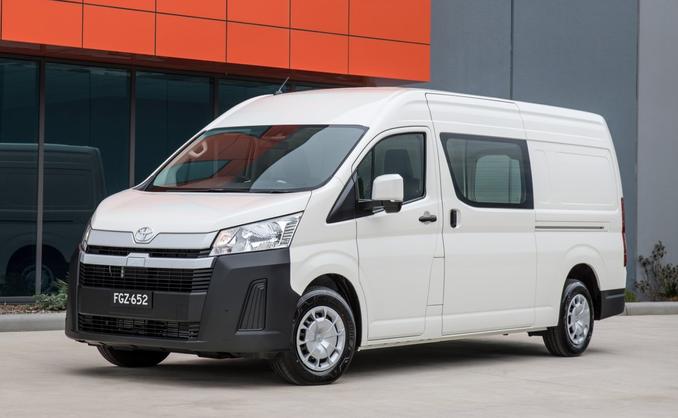
The 2024 Toyota HiAce range of configurations is currently priced from $47,999.
Our most recent review of the 2024 Toyota HiAce resulted in a score of 8 out of 10 for that particular example.
Carsguide Contributing Journalist Mark Oastler had this to say at the time: When you consider its competitive pricing (particularly for fleets), resolute resale value, robust construction, rock-solid reliability, excellent load-hauling ability, five-star safety and all-round practicality, it’s not hard to understand why the HiAce is such a popular workhorse. It’s not perfect, like any van, but when performing its intended role it’s very good.
You can read the full review here.
This is what Mark Oastler liked most about this particular version of the Toyota HiAce: Turning circle, GVM/GCM ratings , Robust and practical
The 2024 Toyota HiAce carries a braked towing capacity of up to 1500 Kg, but check to ensure this applies to the configuration you're considering.
All HiAce LWB and SLWB commercial vans come standard with 'Vanilla White' paint, 16-inch steel wheels with replaceable plastic covers, 215/70R16 tyres and a full-size spare, leather-accented steering wheel, one USB port and two 12-volt cabin sockets, infotainment system with 8.0-inch touchscreen and Apple CarPlay/Android Auto connectivity and more.
The cabin is spacious and the two-tone dash layout is neat and functional, with clear analogue instrumentation and dash controls (mostly physical dials and buttons) that are easy to reach and operate. And it sticks with a good old lever-type manual handbrake instead of an electric one.
The Toyota HiAce 2024 prices range from $42,790 for the basic trim level Van Lwb to $61,270 for the top of the range Van Slwb Barn Door.
Failed axle seals in Toyotas of this vintage are not unknown, but I’m not sure that they’re any more common than in any other make or model. And you’re right, replacing the seals in this model requires an awfully big hydraulic press and some pretty specific tolerances to be observed.
But the bigger question is why the seals keep failing and, more specifically, why two seals would fail simultaneously. Often, an axle seal will fail because of wear or play in the wheel bearing it helps protect. But to have two to fail together (one being a new-ish one) suggests a problem with the rear axle’s breather system. This is designed to allow pressure to escape as the axle unit heats up and internal pressures rise. If the breather isn’t allowing this to happen, the pressure can increase to the point where it will cause the seals to fail. So that’s where I’d start looking. A blocked breather fitting or crimped breather tube could easily be the cause.
Show more
It’s pretty unlikely that a 1987 Toyota van even has a limp-home mode. These were pretty simple engines and shouldn’t really tax a good mechanic too badly. Provided you have spark, fuel and compression, an old Toyota four-cylinder engine is more or less obliged to run.
If you’re happy that the carburettor and ignition are spot on, the next step is to perform a compression test to see if the engine is internally worn out. This is a possibility and would explain the sluggish performance. You should also make sure things like the air filter and fuel filter are clean and not restricting the flow of fuel.
Show more
There’s a very good chance that your problem concerns the cable or linkage that connects the gearstick in the cabin with the actual gearbox. It’s very common for one cable or linkage to operate half the gears, and a second linkage to operate the rest. If this linkage has fallen off or become detached somehow, there’s no longer a physical link between the gearstick and the transmission selectors for those gears. At which point, it’s impossible to select the affected gears.
A quick check under the gearbox will confirm whether this is the case, and fixing it should also be a simple case of reattaching the linkage or possibly replacing a broken cable.
Show more
All HiAce LWB and SLWB commercial vans except for the LWB Crew Van are two-seaters, with fabric-trimmed bucket seats for driver and passenger. The Crew Van has seating for up to five occupants with the addition of a fabric-trimmed bench seat.
The HiAce LWB offers 6.2 cubic metres of load volume, which expands to 9.3 cubic metres in the SLWB variant.
All HiAce vans use a 2.8-litre four-cylinder turbo-diesel engine which produces 130kW at 3400rpm and (in auto models) 450Nm of torque at 1600-2400rpm.
'French Vanilla' is the only colour offered.
The Toyota HiAce LWB can accelerate from 0-100km/h in approximately 10-11 seconds with a top speed exceeding 150km/h.
Toyota claims combined consumption of 7.4L/100km for the HiAce LWB manual, 7.9L/100km for automatic LWB models and 8.1L/100km for SLWB variants. So, driving range can vary from 860km to 950km depending on variant. All models have a 70-litre diesel fuel capacity.