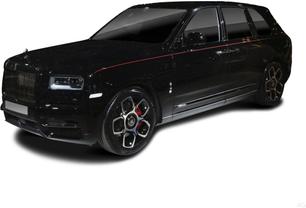
What's the difference?
The truly great thing about great wealth - I mean like, drop $1 million on a new Rolls-Royce with a casual yawn and a mouse click wealth - would be how great it is not having to do anything for yourself.
Personally, I would hire a chef, so I’d never have to cook again, and a pilot to fly my private jet, so I’d never have to catch pneumonia while flying 34 hours to Ibiza with strangers to do my weird job (oh, and if I was rich I wouldn’t have to work anyway), and in theory I might even hire a chauffeur for those odd times when I didn’t want to drive myself in one of my fleet of beautiful cars.
All right, so I can’t even imagine that last one, but the most interesting fact I gleaned while in Spain, tirelessly testing the new Rolls-Royce Cullinan Series II, is that even the ridiculously rich are falling out of love with not driving these days.
Perhaps, being tech-savvy types, they can see the end of driving and the rise of autonomy coming and they want to make the most of it while they still can. But according to Rolls, the percentage of its buyers who sit in the back rather than in the driver’s seat has flipped entirely over the past 15 years.
Back in the day, 80 per cent of Rolls owners were back-seat passengers, blowing cigar smoke at the back of a chauffeur’s head, while 20 per cent actually drove their expensive motors.
Today, the number who drive themselves has soared to 80 per cent, and apparently that’s not just because it would feel weird being chauffeured around in what is now the most popular Rolls-Royce by far - the Cullinan SUV.
The other big change, apparently, is that the average age of a Rolls-Royce buyer has also dropped, from 56 to the low 40s. And that means more buyers with kids, and gold-plated prams and other associated dross, which means they need bigger Rolls-Royces, family-sized SUV ones, which again helps to explain why the Cullinan now makes up as much as half of all the brand’s sales in some markets.
And why the arrival of this, the facelifted, tweaked and twirled Series II version of a car that was greeted cynically by many in the media when it arrived (“one group was not sceptical, and that was our clients,” as a Rolls spokeswoman delightedly pointed out) is such a big deal.
As part of recent updates to the line-up, the Ineos Grenadier’s steering has been tweaked for a more precise feel and a claimed slightly tighter turning circle and the driver-assist tech has been upgraded as has the air-con system.
This body-on-frame 4WD has live axles, a dual-range transfer case, front, centre and rear diff locks and a stack of other features intended to turn the driver into an off-road expert.
So how does the Grenadier station wagon perform off-road? Read on.
The Cullinan might not be the most beautiful or traditional Rolls-Royce, and it’s a shame modern success means providing an SUV option to everyone, but it’s still a remarkable machine, either to drive or just to sit in. It remains not just a marvel of engineering, but a marvellous of engineering. Hats doffed, old bean.
Note: CarsGuide attended this event as a guest of the manufacturer, with travel, accommodation and meals provided.
The Ineos Grenadier Station Wagon is an impressive four-wheel drive. This five-seat off-roader is stacked with features, is very capable off-road and it's actually not atrocious on-road. But its price will deter a lot of people and those who buy into the Grenadier lifestyle have to be prepared to endure some compromises and discomfort along the way… because this is not for everyone. And that’s kind of the point.
This is a new old-school 4WD – a niche within a niche – and while it’s bursting at the seams with an abundance of quirky features, those quirks may quickly lose their appeal and become annoyances. A lot of people will buy the Grenadier because they like the idea of it, but the reality of living with it day to day – or any old-school 4WD, for that matter – may be uncomfortable for them, similar to all of those people who bought a camper-trailer during COVID only to realise they hated camping.
When all is said and done, the Grenadier is a retro-cool 4WD with solid off-road capability.
It is something of an achievement when a team of designers manage to make a facelifted version of a vehicle less ugly, daunting and disappointing than the original.
I thought the first Cullinan, launched five years ago, looked like a London black cab that had been mounted and inseminated by a double-decker bus. Big? Sure? Impressive? Yes. Beautiful? Only if you think Boris Johnson is sexy.
There was a lot of chat at the launch about the changes made for Series II, but in summary they tried to make it look more… like a boat, according to Exterior Design Lead Henry Clarke.
“We don’t look for speedy, overcomplicated lines, we take our inspiration from the luxury world, and it’s often from yachts, it’s that same sense of scale and grandeur, that’s the key to the timelessness of a Rolls-Royce,” he explained.
“We’re not focused on the world of automotive design, and if you look at the Cullinan it has that ethos you think of with a yacht, that strong, vital bow and then everything rearwards, the back of a yacht, has an elegance and grace to it.”
Fair enough, but what I appreciated was that they’ve squared the front end off a bit more, by outlining the grille, adding some gills beneath it and putting in some natty DRLs, and then rounded off the rear a little as well, so that it looks less… awful.
Indeed, after a couple of days of staring at it (and particularly admiring how good it looks in your rear-view mirror when behind you), I did come around to its looks. Certainly a lot more than last time.
And strangers driving past seemed to really like it, because they keep smiling and clapping at me.
In terms of its design, you're either going to love the Grenadier or not. This is a big, tall, chunky four-wheel drive, with plenty of presence about it and if that’s your cup of tea you’re in luck.
This Grenadier is 4855mm long (with a 2922mm wheelbase), 1930mm wide, 2050mm high and a listed kerb weight starting from 2150kg, depending on how many accessories you have onboard.
In Trialmaster guise, this Grenadier has a raised air intake, sidesteps, big steel wheels and all of the sort of stuff that screams, "Hey, look at me. I'm an off-roader!”.
The interior is spare enough to retain the spirit of adventure the Grenadier so wants to conjure but with plenty of comfort and features on offer (more about those aspects in the next section).
But the Recaro seats, the profusion of buttons, knobs and dials, and this 4WD’s abundance of quirky design cues, all more than a bit of a novelty, combine to set this interior apart from the mainstream 4WD market.
It’s a military-style cockpit, but in a good way; this is a snug cabin replete with textured surfaces and durable materials, and again the dash and ceiling are seemingly peppered with controls.
So, in the design stakes, the Grenadier has it all over most rivals, except perhaps the Toyota LandCruiser 76 Series wagon, which also exudes old-school cool.
In terms of being a vehicle you might actually use - and keeping in mind that if you can afford one of these you’ve also got at least a half dozen other choices - every day, the Cullinan is the pick of the Rolls-Royce enclosure.
From the big boot space - 600 litres with the seats up, 1930 litres with them down - and its lovely little Viewing Suite, through the spacious rear relaxing zone to the absurdly comfortable and plush front seats, there’s a sense of grandeur about the whole Cullinan experience.
You can opt for a champagne fridge between those rear seats, if you like, or you can just lie back and stare at the blinking pins of light in your 'Starlight Headliner' and imagine that each one of them represents one of your millions, smiling down at you.
It’s a lovely place to be, in short, and with its super-thick double glazed glass, coated with an acoustic layer on top of that, and carpets thick enough to keep out road noise on their own, it’s also a very pleasantly quiet one.
There is a lot to like about the Grenadier cabin when considered through a lens focused on practicality and comfort.
I’ve revised my opinion on the Grenadier’s all-around practicality since I last tested the Quartermaster Trialmaster and, as a result, have uprated it from 7.0 to 8.0 – but it’s important to note here that our test vehicle is equipped with plenty of extra-cost add-ons which have helped bolster the cabin’s rating.
The interior is set up for the messiness of day-to-day life, with an abundance of hard plastic and other durable surfaces everywhere. Its big chunky rubber mats all cop a bit of a beating, but remember those come at an extra cost ($381, at time of writing).
The seats in the front and back – all Recaro – are comfortable, as you get plenty of room everywhere, and while the control panel is a bit of a confusion of dials and knobs and buttons, if you give yourself a time to get used to it you should be fine.
The Grenadier Station Wagon is a five-seater and with all five seats in use, there is a fair amount of space at the back for all of your gear. I had my vehicle-recovery gear in here, MaxTrax, two air compressors and there's plenty of space available.
The rear cargo space has a durable, hard plastic floor and that cargo area is equipped with movable tie-down points in the walls and fixed tie-down points on each wall and a 12-volt socket.
It's made for real life, it’s ready for dirt and mud and mess, so it's not too bad. For all-round robust practicality, the Grenadier bests its rivals.
Value? Price? What are these things you speak of, little plebeian person? Such is the disdain for such things at Rolls-Royce that they wouldn’t even tell us what the Series II is going to cost when it lands in Australia later this year.
The people who can afford one don’t much care, of course, but for the rest of us, who like to shake our heads and make low, whistling noises, you can bet the price will rise just a little from where it was with the original Cullinan - and that was $705,000 for the basic car, or closer to $795,000 for the sportier, and blacker, Black Badge variant.
In terms of value, it’s hard to grasp that any car could cost that much, but for a Rolls buyer the equation is very different. They don’t need a Rolls, no-one does, but it makes a nice change from buying art works, gold or small countries.
In terms of features, it has almost too many to mention, but let’s pause on the marvellous massage seats, the bespoke sound system, entirely unique to this case and built by Rolls itself, with incredible levels of detail, the Rolls umbrellas tucked into each door and the very lovely 'Viewing Suite'.
This consists of two pop-up seats in the rear, with a little champagne and canapés table in between, where “you can watch your children play football”.
Try that in Australia, at the rugby league, and you’ll be covered in half-time oranges and abuse spittle in no time. Stick to the polo, perhaps.
The Grenadier station wagon is available in three spec levels: the entry-grade Station Wagon, the Fieldmaster Edition and the Trialmaster Edition.
We’re testing a Trialmaster, which has a starting price of $120,000, before on-road costs, but our test vehicle has $26,322 worth of accessories onboard, which push its as-tested price up past the $145,000 mark.
Standard features include a 12.3-inch touchscreen multimedia system (with wireless Apple CarPlay and Android Auto), Recaro front seats and front, centre and rear diff locks.
On the exterior, our test vehicle has solid paint ($1155), contrast roof – Scottish White ($3450), exterior utility belt (mounting rail system), 18-inch steel wheels ($1580), safari windows ($2900), privacy glass ($770), differential locks front and rear, a raised air intake, Class III 1- 7/8-inch NAS tow hitch and electrics, winch electrical prep ($595), integrated 5.5-tonne front winch ($5395), spare wheel lockable storage box ($525) and an access ladder at the rear. It also has a 'roo bar' (bull bar - $2720), side runners ($1600) and a tailgate table ($636).
Exterior paint colours include standard Britannia Blue (solid) or you can choose from Scottish White (solid, $1155), Magic Mushroom (solid, $1155), Eldoret Blue (solid, $1155 – on our test vehicle), Sela Green (solid, $1155), Inky Black (solid, $1155), Devil Red (solid, $1315), Shale Blue (metallic, $1520), Queen's Red (metallic, $1520), Donny Grey (metallic, $1520) and Sterling Silver (metallic, $1520).
On the inside, our test vehicle has leather trim ($3900), heated seats ($715) Nappa leather driver’s pack, a lockable central stowage box, auxiliary battery, front seat-back storage nets, compass with altimeter, ambient door and puddle lighting, auxiliary charge points, interior utility rails, high load auxiliary switch panel and electrical preparation and rubber floor mats ($381).
The Grenadier more than matches rivals such as the Land Rover Defender 110, Mercedes-Benz G-Class and Toyota LandCruiser 76 Series wagon in terms of standard features for the price.
Rolls-Royce has committed to being a fully EV brand by 2030, so it’s a safe bet this Series II Cullinan will be the last one offered with its storming, staunch V12 engine.
Indeed, Rolls hinted the only reason it hung around in this version is that this is only a mid-life face-lift for the Cullinan, and the car that replaces it will arrive on an entirely new, all-electric platform.
As good as the EV Roller, the Spectre undeniably is, driving this old-school Cullinan with its 6.75-litre twin-turbocharged V12 making the kind of thumping, torque-thick, nothing-is-too-much-trouble acceleration is a hoot.
It’s not loud, but it’s just loud enough that you can enjoy its deep, brassy tones, and it’s got plenty of power in reserve to hurl even this 2.75-tonne machine past lesser vehicles with ease.
There are two Cullinans to choose from, of course, with the base model providing a very pleasant 420kW and 850Nm or the sportier Black Badge version (Rolls calls it the brand’s “alter ego”) with 441kW and 900Nm.
The Ineos Grenadier Station Wagon Trialmaster is available with either a BMW 3.0-litre six-cylinder turbo-petrol engine (producing 210kW at 4750rpm and 450Nm at 1750-4000rpm) or a BMW 3.0-litre six-cylinder turbo-diesel engine – producing 183kW at 3250-4200rpm and 550Nm at 1250rpm-3000rpm.
Our test vehicle has the diesel. This Grenadier has an eight-speed ZF automatic transmission and a dual transfer case (high- and low-range 4WD), as well as a front, centre and rear diff lock – those are Trialmaster-level features.
This is a nicely refined engine-and-auto combination that does, however, take some urging to keep this big blocky beast on the move but, all in all, it offers a decent punch of torque across a wide rev range when needed while 4WDing.
It may not be overly slick or smooth, but the Grenadier’s engine and auto at least put it on a par with the likes of the Toyota LandCruiser 76 Series.
Rolls-Royce claims the Cullinan will provide you with between 16 litres per 100km and 16.8L/100km, but I believe you’d have to drive it quite steadily to achieve even that quite appalling figure.
Twelve cylinders, 2.75 tonnes, you do the math, but it's interesting to note that with a nearly full tank - and we’re talking 100 litres of fuel - my distance to empty was looking like barely more than 500km - that’s an EV-like number.
Fuel consumption for the Ineos Grenadier Station Wagon with the diesel engine is listed as 10.5L/100km, and that's on a combined (urban/extra-urban) cycle.
On this test, which included a lot of high- and low-range 4WDing, I recorded 12.2L/100km.
This vehicle has a 90-litre fuel tank so, going by my on-test fuel consumption figures, from a full tank, you could reasonably expect a driving range of almost 740km.
The diesel Ineos Grenadier Station Wagon has a 17-litre AdBlue tank, which you’ll have to top-up as required.
None of its rivals are particularly impressive in terms of fuel efficiency, so the Grenadier holds it owns here.
The first word that comes to mind when describing the experience of driving a Rolls-Royce the size of a small housing estate is 'intimidating', because it's one of those cars where you take a few deep breaths before setting off (while muttering “please don’t crash it”) and then some sharp intakes of breath the first few times you find cars coming towards you on a narrow road, of which there are many on Ibiza where we were summoned to drive it.
I followed a panicked young man from India who had never driven a Rolls, nor a left-hand-drive car before, and boy, he sure looked intimidated, even if he didn’t ever get above 30km/h.
The incredible thing about the Cullinan, however, is how quickly it relaxes you and how astonishingly light and easy it is to drive. The steering feels almost absurdly light at first, you really can drive it with just one finger, two if you’re feeling cautious, but once you get used to it it just feels very Rolls-Royce.
The whole brand lives on the idea of effortlessness, wafting over the world, and the much-touted 'Magic Carpet Ride', and it really does deliver that sense of ease. You’re almost as relaxed at the wheel as you are in the rear seat (and the massage functions only make you feel more so).
Speed humps do upset the Cullinan, but only a very little, and you’re aware when the car finds broken surfaces, but only distantly so. It feels like someone is dealing with bumps and imperfections in a far-off-place, perhaps the car’s basement, and it shouldn’t worry you too much.
When traffic annoys you, you can just make it disappear by engaging your whumping V12 engine and making the world go briefly blurry.
Attempt to throw the Cullinan through sharp bends at speed, however, and it reacts in much the same way you’d expect the cruise ship it somewhat resembles to.
There’s a bit of body roll, but it’s all quite polite and a sense that if you need to drive like that, perhaps you should go and get one of your other cars.
The Black Badge version does feel just a trifle sportier than the base Cullinan but we’re splitting very grey and expensively coiffed hairs here.
The overall experience is one of grand relaxation, imperiousness and a certain touch of superior glee.
There’s a pleasant surprise in store for you if you haven’t been in an Ineos Grenadier Station Wagon before. It's not terrible on road, it’s actually quite nice to drive.
Keep your expectations in check, though. This is after all a tall, blocky four-wheel drive wagon, so there is wind noise around the mirrors and the straight up-and-down windscreen and there is some tyre noise, especially from the Trialmaster’s BFG all-terrain tyres. But overall, it's not too bad.
You have to constantly make minor corrections in the steering to keep this chunky mongrel in line, and it takes some urging to get moving, but otherwise it is quite reasonable on sealed surfaces.
However, this one of those vehicles that is, of course, best exercised off-road. And the news is mostly good.
An impressive over-arching aspect about this vehicle is the fact you can drive it straight out of the dealership into some challenging 4WD-only terrain and you shouldn't have a problem as long as you drive it with consideration. This Grenadier is pretty much fully kitted out for hardcore four-wheel driving – or as close as you can get to it in a standard (albeit very well-equipped) off-roader.
The six-cylinder, as mentioned, works well with the eight-speed automatic transmission. It’s a punchy combination, but not over the top.
It has impressive low-range gearing, plenty of torque on tap, quietly effective driver-assist tech (including hill descent control), and, in this Grenadier, you have front, centre and rear diff locks, so all of those factors help to make this a willing and able four-wheel drive.
As well, off-road angles (36.2-degree approach, 36.1 departure and 28.2 ramp-over) all check out for a vehicle of this size. Ground clearance is a listed 264mm, wading depth is 800mm and if you happen to touch earth with the undercarriage of this vehicle it has solid underbody protection for such occasions. There are, however, some trade-offs worth noting.
The tweaked steering still lacks the pinpoint precision that is handy, especially when you're four-wheel driving. It has a very floaty ride on road because it is a big vehicle and it's more at home in a four-wheel drive scenario.
You have to drive this vehicle with plenty of mechanical sympathy, it has to be used with reasonable use in mind. This is after all $150,000 worth of rolling machinery and if you want to keep it as new, then you'd better drive it with care.
And, while that underbody is well protected, it needs to be because it’s quite vulnerable to tree roots, rocks, rocky steps and any other kind of natural hazard you may encounter in the bush.
Also, like any decent old-school-style four-wheel drive that's worth its salt, engaging the diff locks requires some patience, because it’s a process that has to be done in a strict sequence. First, engage the centre diff, then the rear and then the front. The diff lock buttons are on the ceiling control panel so give yourself time to get your head around it and you’ll be fine. This vehicle demands your attention because it is a real driver-focused experience, which is great.
If you plan to use your Grenadier station wagon as a tow vehicle, it’s handy to know its capacities are 750kg (unbraked trailer) and 3500kg (braked).
The Grenadier matches or betters its rivals in terms of on- and off-road driving.
The Rolls-Royce Cullinan SUV has not been ANCAP tested, but it feels safe because it’s bigger than a tank. It has eight airbags - driver, front passenger, two curtains, driver side, front passenger side, two rear passenger side), and a full-suite of active-safety tech including Forward Collision Warning and Automatic Emergency Braking.
The Ineos Grenadier Station Wagon Trialmaster does not have an ANCAP safety rating because it has not been tested.
As standard, it has six airbags, electronic stability and traction control, tyre-pressure monitoring, and park assist front and rear. It does not have AEB (Auto Emergency Braking), adaptive cruise control or blind-spot monitoring. It does have a rear-view camera, but the screen is small.
As part of the most recent updates, its Advanced Driver Assistance Systems (ADAS) have been upgraded for the modern market to include one-touch deactivation of the audible Intelligent Speed Assist alert via the touchscreen.
Though it does not have an ANCAP rating, the Grenadier has a comprehensive list of safety gear.
Questions about service intervals and warranties seem to confuse the people at Rolls, as if none of their customers have ever bothered to ask.
Yes, you would think servicing would be free when you’re pushing a $1 million price tag, and that the warranty would be for life, particularly considering the low mileage on these things, but it is, in fact, just a four-year servicing and warranty offer for Australian customers of this vehicle. So that means an unlimited-mileage warranty, including all services, for the first four years (at which point you obviously buy a new one). "Rolls-Royce Motor Cars will offer a service inclusive package but no pricing available yet and this will not be required until the fifth year of ownership."
The Ineos Grenadier Trialmaster Station Wagon is covered by a five-year/unlimited km warranty.
No capped price servicing is available and service intervals are scheduled for every 12 months or 15,000km, whichever occurs soonest, and total cost for the five years is $5992 for the diesel and $5832 for the petrol.
At time of writing, there are 16 approved INEOS Automotive dealerships in Australia.
If you buy a big 4WD you should expect big 4WD ownership costs, right? The Grenadier remains competitive with its rivals in this space.