What's the difference?
The Nissan Juke was meant to herald a new era for Nissan in Australia.
It was the first in a slew of new-generation SUVs and has now been joined by the Qashqai, X-Trail, and Pathfinder as part of a new-look Nissan.
Unlike those others, though, the Juke hasn’t quite resonated with buyers. Since arriving to what Nissan probably expected to be fanfare back in 2020, the new Juke has since sunk to the bottom of its compact SUV segment, outselling only a handful of other models.
So, what went wrong? Is the quirky styling of the Juke too much? Are there too many appealing choices in the compact SUV space? Alternatively, could the Juke be an underrated gem worth checking out?
I find myself in an upper mid-spec ST-L to find out.
This is the new Tesla Model Y L, of course, but before we even start I need to ask you a very important question.
How often, honestly, do you use all seven seats in your seven-seater? Or if you only have five seats, how often is there a human in every single one?
Rarely, if ever?
Yep, me too. So stick around, because this is, by far, the best family SUV seating layout. And one where there’ll finally be no fighting over who gets stuck with the dodgy seat.
And as a result, the six-seat Tesla Model Y L might just be among the best all-electric SUV offerings around.
The Juke is a fun little car. It looks cool, it packs most of the important features and safety equipment, but while it can be fun to drive, it’s also a little clunky around town.
It’s so frustrating, because there is a great car in there somewhere, and it would take only small tweaks and enhancements to bring it out.
If you like the five-seat Model Y, then you'll like the six-seat L version even more. I think this the best example of Tesla's electric SUV to date, and the cabin layout just makes a lot of sense, and would suit plenty of families who don't need to squeeze someone into a compromised middle seat.
Note: The author, Andrew Chesterton, is a co-owner of Smart As Media, a content agency and media distribution service with a number of automotive brands among its clients. When producing content for CarsGuide, he does so in accordance with the CarsGuide Editorial Guidelines and Code of Ethics, and the views and opinions expressed in this article are solely those of the author.
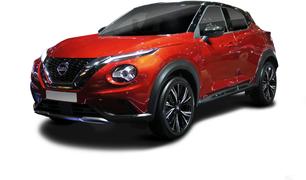
Urban style is clearly what the Juke is about. It’s always been about this, but the original incarnation, while unusual, was a bit bulbous and awkward. The current version is a razor-sharp re-interpretation of the original.
Ugly duckling no more, the Juke blends the elements of Nissan’s current design language with its own unique take, in a clever way.
The roofline and bulbous face of the original car, complete with its ‘eye’ headlights are all maintained, but this time they look more contemporary with a splash of chrome and gunmetal plastic in the face, offset by gloss blacks running down the doorline.
The new light fittings look great and the curviness is also gently off-set with some sharp angles. The massive 19-inch wheels finished in a two-tone gloss black and aluminium brush keep this car looking like a concept come to life. Just don’t crash them into the curb. It would be very easy to.
The cool elements continue inside, with rotary air vents, a blend of textures, including a gloss grey for the vent claddings, with white stitching for the wheel, seat, and into the door cards, too.
There are touches of chrome about the place, and an ambient red LED light surrounding the shifter, which sits on its own little pedestal thing.
It’s quirky and punches above its weight when it comes to soft trims in the doors. Like most higher-grade Nissans the seats are pretty comfy, too, clad in a hard-wearing synthetic leather material.
But it won’t be for everyone, and it’s not without its downsides. The abundance of grey plastic down the centre console is a bit cheap, and the tech offering doesn’t match the youthful style.
The centre screen is adequate, but compared to many rivals it’s a bit small and dull, and the Juke is still missing a digital overhaul for its instrument cluster.
The black headlining, usually reserved for sportier cars, makes the cabin feel smaller than it is.
Spoiler alert - it looks a lot like a five-seat Model Y, doesn’t it, albeit a slightly bigger one. And you’d have to be a bigger Tesla head than me to immediately spot the differences at a glance.
The wheelbase is longer, the rear doors are bigger as are the rear 3/4 panels and the roof line is higher, helping with headroom in the third row.
Still, safe to say if you like the look of the five-seat Model Y, you’ll like this one. And if you hate it, well, good luck.
The alloys are 19-inch and shaded by the aerodynamic caps and there are light bars front and rear which debuted on the updated five-seat Model Y when it arrived mid-last year.
The bigger changes are inside, of course. I promise we’ll get to the second and third rows in the Practicality section, but let’s talk about the look and feel first.
There’s a love/hate relationship with Tesla’s stripped-back aesthetics, and I’m probably somewhere in the middle. I like the airiness of the space in the cabin, and I think it feels nicely put together, and I really dig the contrasting fabric used on the doors and dash which add a little visual interest to the cabin.
But I hate using the central screen to select a gear and I hate not being able to see how fast I’m going without turning my head. A head-up display would work wonders in the Model Y L cabin.
The Juke is a small SUV in the true sense of the word, sitting below the Qashqai which is more like a mid-sizer these days in terms of dimensions.
However, it’s quite cleverly packaged on the inside and is more useful than it first appears.
The front seats, for example, offer heaps of headroom and a surprising amount of width, and while the seats are manual, they’re pretty adjustable. I was able to find a great seating position.
There are big pockets in the doors with an integrated bottle holder suitable for even the largest bottles, although the centre console area is a bit less versatile, choosing its funky design over additional storage.
It features two good bottle holders, but a tiny armrest box and a shallow tray with one 12V socket and a USB-A outlet, as well as an auxiliary audio input under the climate controls.
On the topic of climate controls, I love the fact the Juke maintains a dedicated ventilation panel complete with buttons and dials for all the core functions. No touchscreen nonsense here.
The media screen, as mentioned, is a tad small, and falls victim to glare easily.
The stock Nissan software is a massive upgrade on the brand’s previous-generation products, but while it’s functional it’s far from the prettiest or the fastest on the market.
The back seat offers more space than you might assume, but it’s not as well thought-out as the front of the cabin. At 182cm tall I fit behind my own driving position with just enough space for my knees and just enough headroom.
There are decent bottle holders in the doors, and a further two small ones in the drop-down armrest. The backs of the front seats are clad in that synthetic leather material, which is nice, and have soft pockets, too.
The back of the front centre console offers just a single USB-A outlet and a small cubby. There are no adjustable air vents for rear passengers. It also feels a little claustrophobic back there thanks to the black trim on everything and smaller windows.
Boot capacity for the Juke is impressive for an SUV in this class, with 422 litres on offer, which is close to the volume we’d expect from something a size-bracket up, and 1305L with the second row folded down. There is a space-saver spare under the boot floor.
Captain’s chairs are simply a more luxurious version of second-row seating. With that there is no argument and the heated and cooled chairs that occupy the second row of the Model Y L are pretty good examples of them.
Space, both knee and headroom, is ample, and you can adjust each seat individually if you want to grant a bit more space to any third row occupants. Armrests deploy at the push of a button — as do the two hidden cupholders — and it really is easy to settle in and get comfy.
The third row is a bit more hit and miss. I’m 175cm and found I had enough legroom and headroom, but the big plastic mouldings that emerge from each side of the Model Y (which house a cupholder) are a miss. They end up pushing you into the seat next to you, and I can foresee a lot of arm rubbing with anything like two adults back there.
Also confusing is how to actually get out of it. You can fold the seat in front of you flat, but then you have to climb over it. I found it easier to just walk out between the seats.
There are another two USB-C ports in the rear row and you get air vents but no temperature controls.
The Model Y L stretches 4969mm in length, 1668mm in height and 2129mm in width, which is roughly 18cm longer and 4.5cm taller than the five-seat model. The extra space doesn’t sound like that much, but start dropping rows and you find a heap of storage space.
Both the second and third row stow electronically from the boot, but with them in place you’ll find 420 litres of storage in the double-layer boot. Drop the third row, and that number grows to 1076 litres. With the third row folded there is a massive 2423 litres of space. The frunk serves up another 116 litres.
There’s also room (and the ISOFIX attachment points) for four child seats.
The Juke range kicks off from just $28,390 which gets you into a base ST and reaches to $36,890 for the top-spec Ti.
We’re driving the $34,440 (before on-road costs) ST-L which is the upper mid-grade car.
It scores concept-style 19-inch alloy wheels, synthetic leather interior trim, an 8.0-inch multimedia touchscreen with Apple CarPlay and Android Auto connectivity, a 7.0-inch digital screen between the analog dials, a surround camera system, single-zone climate, keyless entry and push-start ignition, and LED headlights.
The quite attractive ‘Magnetic Blue’ paint our car wears is a $700 option. For an additional $1133 you can also step up to the ST-L+ grade which adds alternate two-tone seat trim, chrome and black highlights and a 10-speaker Bose audio system.
While this ST-L grade gets the lion’s share of Juke equipment without the price-hike to the Ti (and is therefore the pick of the range) there are some notable items missing at this price.
For example, there’s no wireless phone charging, no head-up display, no fully digital instrument cluster, and no electrical adjustment for the seats. The 8.0-inch multimedia screen is starting to look a bit dated, too.
Still, it looks trendy and those massive wheels are well above the standard for a car at this size or price. So, if you’re going for style over equipment there is a choice to be made here.
Nissan also hasn’t cheaped out on safety equipment, with most active stuff coming standard, even on the base ST. More on this later.
Pricing is about line-ball with its most direct competitors. It’s a tad cheaper than some like the outgoing similarly-styled Toyota C-HR (Koba 2WD - $35,695), or slightly more expensive than others like the current equivalent Ford Puma (ST-Line - $33,190) or Mazda CX-3 (Touring SP - $34,300) although it is also ever so slightly larger than those last two by width, height, and wheelbase.
The Model Y L sits smack bang between the $68,900 Long Range AWD and the $89,400 Performance, setting you back $74,900, before your on-road costs. It’s also the only three-row option in the Tesla family.
Aside from people movers, we’re not swimming with options in the three-row electric space, either. The Kia EV9 will get it done from $97,000, the Hyundai IONIQ 9 starts from around $120K and the Volvo EX90 is more expensive again (from $124,990).
Anyway, in Tesla land, the Model Y L rides on 19-inch alloy wheels, has a glass roof, automatic wipers and Tesla’s smartphone access key, as well as the little credit-card swipe.
Inside, there’s a 16.0-inch central screen that handles everything. And I mean everything. It's your gear selector, your speedometer, and everything else, too. There’s no Apple CarPlay or Android Auto, but you can access things like Spotify and podcasts through the in-built apps and the on-board navigation system is a good one, too.
All of that pairs with a 19-speaker sound system, and there are dual wireless charge pads. All three rows of seats are heated, while the first and second row get ventilation, too.
A second 8.0-inch touchscreen in the middle row then handles things like the seat heating or cooling, music and games to amuse the kids. And the Model Y L also debuts V2L, or Vehicle to Load, for Tesla in Australia, using a connector in the external charger.
In the Juke’s messy engine bay lies a 1.0-litre, three-cylinder, turbo-petrol engine which sends 84kW/180Nm to the front wheels.
Nissan has its own 'HR10DET' engine code for this unit but it’s actually a Renault 'H5Dt' engine as evidenced by Renault logos all over the place.
Power is communicated by a seven-speed dual-clutch automatic which has been a source of strife for this car since it arrived. This very European engine and transmission combination is one which the Juke shares with its Renault Captur cousin.
I can’t believe I’m actually saying this, but I would prefer a continuously variable transmission (CVT) which Nissan uses elsewhere in its range. It would solve maybe the main issue with this car, which we’ll explore up next in the driving section of this review
The Model Y L gets Tesla’s dual-motor AWD powertrain, with two electric motors producing a total 378kW and 590Nm. That’s enough, Tesla says, to knock off the sprint to 100km/h in five seconds flat.
One of the reasons this car comes equipped with a dual-clutch automatic is to chase fuel efficiency as well as emissions output. On paper DCT autos don’t suffer the inherent losses of a traditional torque converter transmission.
The official combined cycle fuel consumption figure is 5.8L/100km. My week of driving, weighted slightly more towards freeway conditions, produced a marginally higher average of 6.8L/100km. It’s not the claim, but it’s pretty good.
This little engine requires mid-shelf 95RON unleaded fuel, and the Juke has a 46-litre fuel tank, suggesting a driving range of 793km using the official fuel consumption number.
Tesla is always a little vague when it comes to the size of its batteries, but reports point to the Model Y L carrying a 84Wh (useable) NMC battery.
Whatever the specifics, the range is strong, with Tesla promising a 681km driving range on the WLTP combined (urban/extra-urban) cycle.
It’s also set up for 250kW DC fast charging, which should see you take on 288km in 15 minutes, according to Tesla.
The Juke can be fun to drive, and I wanted to like it more, but the transmission its peppy little engine is paired with is frustrating.
Outputs of 84kW/180Nm doesn’t sound like a lot, but power isn’t the problem. The little engine has a fun turbo-surge which pairs with the Juke's light frame to make for a car which is quite athletic when you push it.
The issue is a mountain of turbo-lag conspires with the clunky dual-clutch automatic to make it far too sluggish off the line.
There’s a full second (or two, at times) to wait for any power to arrive, which simply isn’t good enough at T-junctions and roundabouts, the kind of situations a little urban SUV like this will constantly be encountering.
Nissan says the transmission software was even updated after the Juke’s launch, but it’s still not where it should be.
It has good traits, too. When you’re out on the open road, it has quick, snappy and well-defined shifts, and the engine is much better when it’s being properly pushed, too.
It has a gruff, entertaining tone, and the Juke’s light frame, firm ride, and comparatively heavy steering make it a joy to throw into some corners.
The long wheelbase for such a small SUV, paired with a decent set of tyres, also keeps it confident when its predecessor was a little clumsy.
Again, though, the reasonably hard ride, not helped by the very large wheels, isn't its best trait in an urban environment. The Juke is by no means uncomfortable, it just seems like the priorities for this little SUV aren’t in the right place.
I’ve said this before but there’s a great car in here somewhere. The Juke is fun to drive in the right environment, it’s just this environment is not where most prospective buyers will primarily be looking to use it.
What could fix this issue? A different transmission perhaps. Better yet, an e-Power hybrid powertrain.
Honestly, it feels like the Tesla Model Y has grown up. I didn’t love earlier iterations of this car and I found the Performance to be fast but lacking any emotional fizz.
This one, though, feels solid and composed, and the power on tap (of which there is ample) is more about effortless progress than it is attempting to offer sports car excitement.
The steering is now nicely weighted and feels direct enough without being too sharp, and the cabin is well insulated, with often the slightly off-putting sort of rubbing noise the steering wheel makes when you turn it the only intrusive sound.
One drawback is a ride that definitely errs on the side of firm. This Model Y L gets electronic damping designed to iron out some of the more jagged stuff, but it still feels brittle in places, and you can definitely feel some sharpness in the cabin. Now, to be fair, it’s not too firm for me, but it might be for you.
Another is a bizarre turning circle which constantly reminds you you’re driving a big bus, especially when you try to complete a tight three-point turn.
But despite its stretched dimensions, I found the Model Y L easy to drive and park in the city, and once you're up to speed with Tesla's operating system (there's no Apple CarPlay or Android Auto), then the screen is pretty easy to use, too.
The Juke's standard active safety features include freeway-speed auto emergency braking, lane departure warning with lane keep assist, blind-spot monitoring with rear cross-traffic alert, adaptive cruise control and traffic sign recognition.
Last time I reviewed this car I complained about the way it vibrates the steering wheel when the lane keep function decides you’re going out of your lane. But having since experienced so many more invasive lane keep systems, this one seems comparatively low-key.
Elsewhere, the Juke gets the standard array of six airbags (dual front, side, and curtain) and wears a maximum five-star ANCAP safety rating to the 2019 standards.
The Model Y L gets the same maximum five-star ACNAP safety rating as the rest of the Model Y range, with nine airbags (up from seven in the five-seat model), and things like AEB (Auto Emergency Braking), lane-keeping assist, 'Forward Collision Warning' and blind-spot monitoring all along for the ride.
Interestingly, the curtain airbags from the five-seat version haven't been replaced, with coverage still only extending to the second row. New airbags have instead been added for third-row occupants.
One more analogue quirk of the Tesla Model Y L is the thick B-pillar, which does a good job of almost completely obscuring driver-side blind-spot checks (for those of us who still like to do those manually).
Nissan offers the Juke with a five-year, unlimited km warranty, with five-years of roadside assist included.
It requires servicing every 12 months or 20,000km and the cost is subject to a capped price servicing program for the first six years.
This averages $651.33 annually, which is not cheap for a small SUV in this class.
However, there is also the option of a pre-paid five-year service plan which brings the annual cost over five years down to a more reasonable $429.60.
But, notably, it does not include the pricy $1521 sixth-year interval. It’s worth asking yourself how long you’ll own the car for before splurging on it.
Tesla warranty is a these-days-underwhelming five years and unlimited kilometres, while the high-voltage battery is covered for eight years or (a wildly specific) 192,000km.
There’s also five years' of roadside assistance, including puncture repair (a good thing, given the lack of a spare wheel). I also couldn’t find a puncture repair kit and later research suggests Tesla sells them, rather than provides them as standard.
Tesla servicing is condition-based, so there’s no fixed schedule, with a summary on the car’s touchscreen providing a record of when vehicle maintenance was last carried out and prompts for when they should be performed next.
In the absence of a combustion powertrain the emphasis is on things like wheel rotation, balancing and alignment, brake fluid testing, air-con servicing, camera precision, radiator cleaning and high-voltage battery maintenance.
Expecty a ‘Vehicle Health Check’ to come in under $300 with ‘General Diagnosis’ at around $270 per hour.