What's the difference?
The Nissan Juke was meant to herald a new era for Nissan in Australia.
It was the first in a slew of new-generation SUVs and has now been joined by the Qashqai, X-Trail, and Pathfinder as part of a new-look Nissan.
Unlike those others, though, the Juke hasn’t quite resonated with buyers. Since arriving to what Nissan probably expected to be fanfare back in 2020, the new Juke has since sunk to the bottom of its compact SUV segment, outselling only a handful of other models.
So, what went wrong? Is the quirky styling of the Juke too much? Are there too many appealing choices in the compact SUV space? Alternatively, could the Juke be an underrated gem worth checking out?
I find myself in an upper mid-spec ST-L to find out.
Audi’s latest Q5 Sportback brings mild-hybrid power, updated underpinnings, more technology and a genuinely impressive interior glow-up.
It’s clearly aimed at buyers drawn to a more athletic take on the mid-size SUV, where style plays a bigger role than outright practicality. We're testing the base petrol spec to see how it sits alongside the BMW X4 xDrive20i, Genesis GV70 2.5T and Mercedes-Benz GLC300 Coupe.
The Juke is a fun little car. It looks cool, it packs most of the important features and safety equipment, but while it can be fun to drive, it’s also a little clunky around town.
It’s so frustrating, because there is a great car in there somewhere, and it would take only small tweaks and enhancements to bring it out.
The updated Audi Q5 Sportback TFSI is a strong example of a luxury base-grade SUV, ticking most of the boxes in styling, comfort and features. It may not always outperform its rivals on paper, but it delivers where it counts, offering a refined, practical and engaging package that will satisfy.
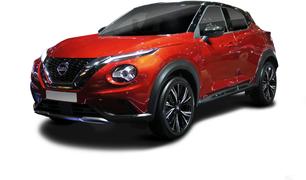
Urban style is clearly what the Juke is about. It’s always been about this, but the original incarnation, while unusual, was a bit bulbous and awkward. The current version is a razor-sharp re-interpretation of the original.
Ugly duckling no more, the Juke blends the elements of Nissan’s current design language with its own unique take, in a clever way.
The roofline and bulbous face of the original car, complete with its ‘eye’ headlights are all maintained, but this time they look more contemporary with a splash of chrome and gunmetal plastic in the face, offset by gloss blacks running down the doorline.
The new light fittings look great and the curviness is also gently off-set with some sharp angles. The massive 19-inch wheels finished in a two-tone gloss black and aluminium brush keep this car looking like a concept come to life. Just don’t crash them into the curb. It would be very easy to.
The cool elements continue inside, with rotary air vents, a blend of textures, including a gloss grey for the vent claddings, with white stitching for the wheel, seat, and into the door cards, too.
There are touches of chrome about the place, and an ambient red LED light surrounding the shifter, which sits on its own little pedestal thing.
It’s quirky and punches above its weight when it comes to soft trims in the doors. Like most higher-grade Nissans the seats are pretty comfy, too, clad in a hard-wearing synthetic leather material.
But it won’t be for everyone, and it’s not without its downsides. The abundance of grey plastic down the centre console is a bit cheap, and the tech offering doesn’t match the youthful style.
The centre screen is adequate, but compared to many rivals it’s a bit small and dull, and the Juke is still missing a digital overhaul for its instrument cluster.
The black headlining, usually reserved for sportier cars, makes the cabin feel smaller than it is.
The Q5 Sportback is the more attractive sibling when compared to the standard SUV, with a shape that feels more dynamic and sport-oriented. The updated design dials back the sharper creases of the previous model in favour of softer curves, paired with slim matrix LED headlights. The revised 'Singleframe' grille has strong presence and the full-width rear light treatment adds to the Sportback’s visual appeal. Overall, it’s a very handsome vehicle.
Inside, the interior glow-up is immediately noticeable. The large new display takes centre stage in a redesigned dashboard that looks clean and appropriately sophisticated.
There’s a good mix of materials throughout the cabin, including the beige leather upholstery, although the presence of hard plastics reminds you that this is still a base grade. Even so, the cabin largely hits the right notes for a luxury entry point.
There are a few details that don’t quite land for me. The door-mounted control panel on the driver's side feels busy and a little fiddly to use, and creates an oddly sized and positioned pull handle that just doesn’t feel nice to use. And this is very much a nitpick, but the black stitching on the beige seatbelts catches my eye all the time. None of these are deal-breakers, but they stand out in an otherwise well resolved interior.
The Juke is a small SUV in the true sense of the word, sitting below the Qashqai which is more like a mid-sizer these days in terms of dimensions.
However, it’s quite cleverly packaged on the inside and is more useful than it first appears.
The front seats, for example, offer heaps of headroom and a surprising amount of width, and while the seats are manual, they’re pretty adjustable. I was able to find a great seating position.
There are big pockets in the doors with an integrated bottle holder suitable for even the largest bottles, although the centre console area is a bit less versatile, choosing its funky design over additional storage.
It features two good bottle holders, but a tiny armrest box and a shallow tray with one 12V socket and a USB-A outlet, as well as an auxiliary audio input under the climate controls.
On the topic of climate controls, I love the fact the Juke maintains a dedicated ventilation panel complete with buttons and dials for all the core functions. No touchscreen nonsense here.
The media screen, as mentioned, is a tad small, and falls victim to glare easily.
The stock Nissan software is a massive upgrade on the brand’s previous-generation products, but while it’s functional it’s far from the prettiest or the fastest on the market.
The back seat offers more space than you might assume, but it’s not as well thought-out as the front of the cabin. At 182cm tall I fit behind my own driving position with just enough space for my knees and just enough headroom.
There are decent bottle holders in the doors, and a further two small ones in the drop-down armrest. The backs of the front seats are clad in that synthetic leather material, which is nice, and have soft pockets, too.
The back of the front centre console offers just a single USB-A outlet and a small cubby. There are no adjustable air vents for rear passengers. It also feels a little claustrophobic back there thanks to the black trim on everything and smaller windows.
Boot capacity for the Juke is impressive for an SUV in this class, with 422 litres on offer, which is close to the volume we’d expect from something a size-bracket up, and 1305L with the second row folded down. There is a space-saver spare under the boot floor.
Up front, the cabin feels spacious and comfortable, with plush (heated) electric seats, while the driver also benefits from a two-position memory function, which is a plus if the car is shared. My main gripe is the short seat bases, which become noticeable on longer drives.
In the rear, comfort largely holds up, though space is better suited to two adults due to the high transmission tunnel. The 40/20/40 split-folding rear seat is a practical inclusion and helps when juggling passengers and longer items.
Storage is mostly well considered. There’s a generously sized glove box and a couple of useful storage bins in each door, although the centre console is on the smaller side. The dedicated phone tray is a highlight, housing the wireless charging pad, two USB-C ports and a 12-volt socket. Both rows get cupholders and bottle storage, while rear passengers also benefit from USB-C ports, climate control, directional air vents and map pockets. Overall, there’s just enough space and amenity for adults or teens to remain comfortable.
Technology is handled by the updated media display, which features a responsive touchscreen and a menu system that’s easy enough to navigate. Wireless Apple CarPlay and Android Auto are quick to set up, and the built-in satellite navigation is clearly laid out. That said, the near-total absence of physical buttons may frustrate some, with functions like climate control buried within the touchscreen. The number of pop-up disclaimers on start-up also feels excessive.
Boot space is where the Sportback’s sloping roofline has the biggest impact. Load height is limited, and capacity tops out at 515L with all seats in place, making it the smallest in its segment, albeit only by around 10L. I like the deep underfloor storage, along with the cargo cover, net and hands-free powered tailgate. However, the lack of a spare tyre, replaced by a repair kit, is a deal-breaker for me as a country driver, though it may matter less to those with easier access to repair services.
The Juke range kicks off from just $28,390 which gets you into a base ST and reaches to $36,890 for the top-spec Ti.
We’re driving the $34,440 (before on-road costs) ST-L which is the upper mid-grade car.
It scores concept-style 19-inch alloy wheels, synthetic leather interior trim, an 8.0-inch multimedia touchscreen with Apple CarPlay and Android Auto connectivity, a 7.0-inch digital screen between the analog dials, a surround camera system, single-zone climate, keyless entry and push-start ignition, and LED headlights.
The quite attractive ‘Magnetic Blue’ paint our car wears is a $700 option. For an additional $1133 you can also step up to the ST-L+ grade which adds alternate two-tone seat trim, chrome and black highlights and a 10-speaker Bose audio system.
While this ST-L grade gets the lion’s share of Juke equipment without the price-hike to the Ti (and is therefore the pick of the range) there are some notable items missing at this price.
For example, there’s no wireless phone charging, no head-up display, no fully digital instrument cluster, and no electrical adjustment for the seats. The 8.0-inch multimedia screen is starting to look a bit dated, too.
Still, it looks trendy and those massive wheels are well above the standard for a car at this size or price. So, if you’re going for style over equipment there is a choice to be made here.
Nissan also hasn’t cheaped out on safety equipment, with most active stuff coming standard, even on the base ST. More on this later.
Pricing is about line-ball with its most direct competitors. It’s a tad cheaper than some like the outgoing similarly-styled Toyota C-HR (Koba 2WD - $35,695), or slightly more expensive than others like the current equivalent Ford Puma (ST-Line - $33,190) or Mazda CX-3 (Touring SP - $34,300) although it is also ever so slightly larger than those last two by width, height, and wheelbase.
The Audi Q5 Sportback is offered with a choice of petrol or diesel engines, across two grades before stepping up to the more powerful SQ5 variants. For this review, we’re testing the base petrol TFSI grade, which is also the only front-wheel drive option in the line-up.
It carries a before on-road costs price of $84,500 and comes well stocked with features that often sit on the options list with key rivals. Aside from the Genesis GV70 2.5T, which remains hard to beat for standard inclusions, the Q5 Sportback TFSI stands out as one of the better value propositions at this price point.
New for this update is a large panoramic display that combines an 11.9-inch digital instrument cluster with a 14.5-inch central media screen. The system includes built-in satellite navigation, wireless Apple CarPlay and Android Auto and access to the 'Audi Connect' app. The app allows access to remote services like locking/unlocking to car, checking fuel/charge levels, sending navigation routes, car finder and monitoring vehicle status (warnings, last parked location).
Our test car is fitted with optional 'Pearl Beige' leather upholstery, which is a no-cost option. New design elements include a full suite of LED exterior lights, including matrix LED headlights and side puddle lamps.
Comfort is clearly a priority in this grade, with electric and heated front seats featuring lumbar support and a two-position memory function for the driver. Three-zone climate control, a wireless charging pad, multiple USB-C ports and 12-volt sockets, along with a 360-degree camera system round out the major tech highlights.
Practical touches haven’t been overlooked either, with a hands-free powered tailgate, cargo cover and net plus a 40/20/40 split-fold rear seat set-up.
In the Juke’s messy engine bay lies a 1.0-litre, three-cylinder, turbo-petrol engine which sends 84kW/180Nm to the front wheels.
Nissan has its own 'HR10DET' engine code for this unit but it’s actually a Renault 'H5Dt' engine as evidenced by Renault logos all over the place.
Power is communicated by a seven-speed dual-clutch automatic which has been a source of strife for this car since it arrived. This very European engine and transmission combination is one which the Juke shares with its Renault Captur cousin.
I can’t believe I’m actually saying this, but I would prefer a continuously variable transmission (CVT) which Nissan uses elsewhere in its range. It would solve maybe the main issue with this car, which we’ll explore up next in the driving section of this review
The Q5 Sportback TFSI is front-wheel drive and powered by a 2.0L four-cylinder turbo-petrol engine paired with a mild-hybrid system. Combined outputs sit at 150kW and 340Nm, which places it toward the lower end of the segment when stacked against rivals such as the Genesis GV70 2.5T and Mercedes GLC300 Coupe offering 224kW/422Nm and 190kW/400Nm, respectively.
On the road, however, there’s still plenty on offer for everyday driving, with power delivery feeling smooth and accessible. The seven-speed transmission shifts effortlessly, helping the Q5 Sportback feel refined and easy to live with, even if outright performance isn’t its headline feature.
One of the reasons this car comes equipped with a dual-clutch automatic is to chase fuel efficiency as well as emissions output. On paper DCT autos don’t suffer the inherent losses of a traditional torque converter transmission.
The official combined cycle fuel consumption figure is 5.8L/100km. My week of driving, weighted slightly more towards freeway conditions, produced a marginally higher average of 6.8L/100km. It’s not the claim, but it’s pretty good.
This little engine requires mid-shelf 95RON unleaded fuel, and the Juke has a 46-litre fuel tank, suggesting a driving range of 793km using the official fuel consumption number.
The Q5 Sportback TFSI has a claimed combined (urban/extra-urban) cycle fuel consumption figure of 5.7L/100km and paired with its 65L fuel tank offers a theoretical driving range of up to 1140km. An impressive result on paper.
After a mix of long highway driving and my usual urban runaround, real-world consumption settled at 5.8L/100km, which is almost spot on.
It also highlights the Q5 Sportback TFSI’s performance/efficiency trade-off. While its outputs are modest relative to some rivals it rewards you with excellent economy in real-world use.
The Juke can be fun to drive, and I wanted to like it more, but the transmission its peppy little engine is paired with is frustrating.
Outputs of 84kW/180Nm doesn’t sound like a lot, but power isn’t the problem. The little engine has a fun turbo-surge which pairs with the Juke's light frame to make for a car which is quite athletic when you push it.
The issue is a mountain of turbo-lag conspires with the clunky dual-clutch automatic to make it far too sluggish off the line.
There’s a full second (or two, at times) to wait for any power to arrive, which simply isn’t good enough at T-junctions and roundabouts, the kind of situations a little urban SUV like this will constantly be encountering.
Nissan says the transmission software was even updated after the Juke’s launch, but it’s still not where it should be.
It has good traits, too. When you’re out on the open road, it has quick, snappy and well-defined shifts, and the engine is much better when it’s being properly pushed, too.
It has a gruff, entertaining tone, and the Juke’s light frame, firm ride, and comparatively heavy steering make it a joy to throw into some corners.
The long wheelbase for such a small SUV, paired with a decent set of tyres, also keeps it confident when its predecessor was a little clumsy.
Again, though, the reasonably hard ride, not helped by the very large wheels, isn't its best trait in an urban environment. The Juke is by no means uncomfortable, it just seems like the priorities for this little SUV aren’t in the right place.
I’ve said this before but there’s a great car in here somewhere. The Juke is fun to drive in the right environment, it’s just this environment is not where most prospective buyers will primarily be looking to use it.
What could fix this issue? A different transmission perhaps. Better yet, an e-Power hybrid powertrain.
There’s enough power in the base grade to keep things engaging on the open road, whether overtaking or maintaining pace, with a reassuring sense of reserves and smooth, punctual delivery.
Despite the firmer suspension, ride comfort remains high thanks to the newly tuned damping system, which absorbs bumps without sacrificing road feedback. The cabin is quiet at speed and at low speeds the car can switch to its hybrid system for extra refinement.
I’m not a huge fan of the adaptive steering assist, particularly on winding roads, as it can overcorrect at times. Overall, though, the Q5 Sportback delivers enjoyable, sporty dynamics.
Visibility is good from the front and sides, while the rear window is a little on the small side. It’s easy to get accustomed to the car’s dimensions and a clear 360-degree camera view comes standard across all grades, providing a clear view that automatically activates during low-speed manoeuvres. Parking this car is straightforward and stress-free.
The Juke's standard active safety features include freeway-speed auto emergency braking, lane departure warning with lane keep assist, blind-spot monitoring with rear cross-traffic alert, adaptive cruise control and traffic sign recognition.
Last time I reviewed this car I complained about the way it vibrates the steering wheel when the lane keep function decides you’re going out of your lane. But having since experienced so many more invasive lane keep systems, this one seems comparatively low-key.
Elsewhere, the Juke gets the standard array of six airbags (dual front, side, and curtain) and wears a maximum five-star ANCAP safety rating to the 2019 standards.
The Audi Q5 Sportback carries a fresh maximum five-star ANCAP safety rating from 2025 testing. It comes with nine airbags, including side-chest airbags for both rows which is a standout feature, as these are often limited to the front seats.
The safety equipment suite is strong, featuring lane departure warning, lane keeping assist, side exit warning, blind-spot monitoring, traffic sign recognition, dusk-sensing LED headlights and emergency call capability. There’s also front collision warning, rear cross-traffic alert with assist and rear turn-assist. Adaptive cruise control is generally well-calibrated, though it can occasionally slow for vehicles outside your lane.
Autonomous emergency braking covers cars, pedestrians, cyclists, motorcyclists, and backover assist which is operational between 5.0 and 250km/h. Child safety is supported with two ISOFIX mounts and three top-tether anchor points, although only two seats fit comfortably.
Nissan offers the Juke with a five-year, unlimited km warranty, with five-years of roadside assist included.
It requires servicing every 12 months or 20,000km and the cost is subject to a capped price servicing program for the first six years.
This averages $651.33 annually, which is not cheap for a small SUV in this class.
However, there is also the option of a pre-paid five-year service plan which brings the annual cost over five years down to a more reasonable $429.60.
But, notably, it does not include the pricy $1521 sixth-year interval. It’s worth asking yourself how long you’ll own the car for before splurging on it.
The Q5 Sportback comes with Audi’s five-year/unlimited km warranty, which also includes complimentary roadside assistance - all fairly standard at this end of the market. A five-year pre-paid servicing plan is available for $3520, which is cheaper than the pay-as-you-go option, though it’s not the most competitive compared with some rivals. For instance, BMW offers the same coverage for $2475, while the Genesis comes with complimentary servicing.
You can also extend the service period by two years with the 'Audi Advantage Package' for an additional cost. Services are spaced at sensible intervals, every 12 months or 15,000km, whichever comes first, making maintenance straightforward and predictable.