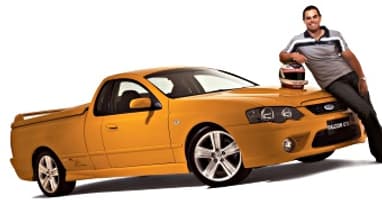
Ford Falcon 2008 Problems

Are you having problems with your 2008 Ford Falcon? Let our team of motoring experts keep you up to date with all of the latest 2008 Ford Falcon issues & faults. We have gathered all of the most frequently asked questions and problems relating to the 2008 Ford Falcon in one spot to help you decide if it's a smart buy.

Falcon auto transmission oil cooler
Answered by Graham Smith · 14 Jun 2013

It was thought that the problem with the automatic transmission oil cooler was fixed when the design was changed in the BFII model, but from the number of reports we are now beginning to receive of failures on the FG it appears the problem hasn't been fixed. You're right to seek a solution through the courts, and you're right, it isn't acceptable.

Ford Futura software issue
Answered by Graham Smith · 22 Feb 2013

It's possibly a software issue, so it would be worth talking to your dealer about possible software upgrades. Our auto transmission specialist suggested a possible course of action, which is to disconnect the battery for an hour or so, and then reconnect it. By doing that the transmission, which adapts to your driving style can relearn the way you drive. By doing that the problem might be fixed.

Falcon broken tailshaft
Answered by Graham Smith · 12 Apr 2013

A tailshaft shouldn't break at all, let alone at such low kays. I would have it examined by a mechanic to try and determine how and why it failed, and approach Ford about getting a replacement.

Ford Falcon 2008: Rattling sound
Answered by Graham Smith · 10 Jan 2014

If you're not sure whether it's coming from the diff or the auto trans you need to get some help to isolate it before you have any chance of finding the cause. Changing the diff oil would have been the first thing I would have suggested if it was the diff, the next would to suggest it could be a bearing, but that needs a specialist to sort it out. An auto transmission expert would say you should change the trans oil every 25,000 km or so, or every year, and there's good reason to do that if you do a lot of towing. They would also say you should do a full service every 100,000 km or so, and again it's more important to do that if you tow a lot.

Ford Falcon 2011: Wind noise
Answered by Graham Smith · 23 Nov 2012

With the window up and the door closed try running some duct tape over the seal on the outside of the door and that should tell you if it's the window or the door seal not sealing.

Ford Falcon 2009: Turbo tuning
Answered by Graham Smith · 20 Jun 2014

Dealers don't do that sort of work any more; they simply change oil, give it a bit of a grease, and hand it back to you. You obviously want more, and for that you have to go to a specialist mechanic who has the knowledge and experience, and equipment to do what you want.

2008 Ford G6 manual gearbox noises
Answered by Graham Smith · 11 Oct 2013

Take it back to your dealer and ask him to reset the computer to soften the gear selection.  He should have a recalibration available to do it for you.

Used Ford Falcon review: 1998-2012
By Ewan Kennedy · 05 Jul 2013
Ford's Falcon has slipped from the minds of many new-car buyers in recent years, resulting in the sad news that production will cease late in 2016. However, the iconic Falcon has long been a favourite with used-car buyers and there’s no sign of that changing anytime soon.To some extent we blame the demise of the Falcon on over adventurous styling. The radical shape of the AU was years ahead of its time when it was introduced in September 1998 and many conservative buyers didn’t like it.Facelifts to create the AU Falcon Series II in April 2000 and to the AU III in November 2001 lifted sales slightly. In September 2002 a major facelift to produce the BA Falcon started to put the Falcon back on track in new sales. The BA Falcon was upgraded to the BF Falcon in October 2005.The introduction of the rather conservative FG-series Falcon saw sales slip again, and history shows that Ford Australia never did recover after that.Falcons have seating for five adults, though four makes more sense because rear-wheel drive means the transmission tunnel takes up a lot of footroom in the centre-rear position. Legroom and headroom are ample for all but the largest adults. Some find the relatively steep slope of the roof in the AU to BF Falcons make it awkward to get in and out; naturally the back seat of the wagon doesn’t have this hassle.Comfort is very good and passengers can step out of a Falcon after a trip of hundreds of kilometres still feeling fresh and relaxed.The boot in the sedan is rather shallow in the older models and the slope of the bootlid on the AU reduces its practicality. It’s easy to load thanks to a good-sized opening. The BA Falcon is better, though still on the shallow side.Falcon station wagons are great load carriers as they are built on a longer wheelbase than the sedan so they have a long, wide, practical cargo area. The rear end of the BA is virtually identical to that of the older AU. Ford chose not to do an FG variant of the wagon. Instead, it created a Series III BF model to sell alongside the FG sedans. It wasn’t a success and was discontinued in 2010.Handling is surprisingly good for a car of this size and mass. You wouldn’t call it agile, but Falcons hold on when cornering at speeds far above those likely to be attempted by most drivers.Ford's six-cylinder engines all have a capacity of 4.0 litres but come in several formats, including one with a turbocharger. An interesting variant on the six-cylinder is a dedicated LPG engine. Very common in taxis, but less so in private cars (except in Victoria) this engine is all but indistinguishable from a petrol unit to drive. It’s quite a bit thirstier than the petrol so fuel range suffers.The standard AU six-cylinder unit is good enough, but the BA’s six-cylinder is noticeably smoother and offers even better performance.Ford fitted a 5.0-litre V8 to the AU, but it didn’t have a lot more performance than the six-cylinder units and was on the thirsty side. Much better were the BA bent eights: there was a choice of two, both with a capacity of 5.4 litres, one with a single-cam cylinder head, the other with a twin-cam setup.A powerful four-cylinder engine, tagged the EcoBoost gave us arguably the best Falcon ever, thanks to excellent performance and nimble handling, the latter due to the lighter weight of the smaller engine. Buyers in this market segment can be on the conservative side and they stayed away from the EcoBoost in droves.Automatics were all four-speed units until the launch of the BF, when a sophisticated six-speed ZF unit was installed. The ZF was originally only fitted in the topline variants, with the introduction of the FG Falcon all received the six-speed auto, with the exception of the LPG power models, which stuck with the old four-speed unit until the launch of the new-design LPG unit in July 2011.Manual gearboxes are rare and probably best avoided in all but the sporting XR6 and XR8 as they can affect resale value. The manual was a five-speed until the BF series, when a six-speed was installed.Prices for spare parts, servicing and repairs are very reasonable and there are Ford dealers just about everywhere in Australia. Most spare parts for the Falcons covered here are readily available, although a few bits on some older cars may have to come from a wrecker.These are very simple cars to work on, with plenty of underbonnet and undercar space. We recommend having a workshop manual at your elbow before starting the work.Insurance prices are generally very reasonable and premiums for the everyday models are invariably at the lower end of the scale. It will generally cost more to cover a V8 Falcon than a straight-six, and more expensive for a turbo six.WHAT TO LOOK FORRust is far less of a problem in these newer Falcons than old ones. To be on the safe side, check the door lower corners, door sill panels, mudguards and bootlid. If you do find serious rust the car may have been badly repaired after a crash.Many thousands of used Falcons will have been taxis at some time in their life. Be wary of one running on dedicated LPG; while these are quite common in Victoria, they are rare anywhere else in Australia. Signs of an ex-taxi are vinyl, rather than cloth, upholstery, severe wear both inside and out, holes where signs and a taximeter have been removed, and possibly a paint respray.Engine wear is indicated by a reluctance to start and by smoke from the exhaust and/or oil filler cap when the engine is revved.Four-speed automatics can cause problems on hard-driven cars, especially the older models. Check they change gears cleanly and don't hunt up and down through the ratios. Be suspicious of any automatic that’s slow at going into gear from Neutral or Park.Listen for a whining differential when driving at around 60 to 90km/h.Check the cabin for damage caused by wild kids. In station wagons have a good look at the load area for signs of commercial useCAR BUYING TIPBeware ex-taxis: they are run hard and often not driven in a sympathetic manner. 
Read the article
Used Ford Falcon review: 2008-2010
By Graham Smith · 02 Nov 2012
In the 20 years since its introduction the Falcon XR6 has become the quintessential Australian performance car, blending the robust and reliable Falcon driveline with the refinement and sophistication once only available in an imported European GT. There were plenty of doubters when it was originally launched, lots didn't believe a six-cylinder car could win over a market that worshipped at the altar of the V8.But it has and the XR6 and its sizzling sibling, the XR6T, have become firm favourites with Australian buyers. As the latest in the line, the FG is perhaps the best of the bunch. Based on the FG Falcon released in 2008 the FG XR6 and XR6T use the basic Falcon four-door architecture, but build on it with a range of mechanical and cosmetic upgrades that transform the family Falcon into an impressive driver's carThey can be identified externally by specific grilles, bumpers, fog lamps and alloy wheels, while inside they feature sports seats, instruments, alloy pedal covers and gear shifter on manual models. At the XR6's heart is the Falcon six-cylinder engine that puts out 195 kW and 391 Nm, which is linked to a five-speed auto, six-speed auto or six-speed manual.Underneath the suspension was retuned for a more taut, sportier drive. The XR6T, with a whopping 270 kW and 533 Nm on tap from its turbocharged version of the 4.0-litre six-cylinder engine, was a blistering drive.It was much more overt in its intent than was the mo re reserved XR6. In addition to the turbocharged engine the XR6T also had a limited- slip differential, upgraded brakes, larger alloy wheels, and the option of a ZF 6-speed auto to handle the engine's output. On the road both models were sure-footed and smooth, with a comfortable ride.Build quality has long been an issue with the Falcon, but the FG seems to be better than most of its predecessors and doesn't appear to attract the same level of owner complaint. Still, it's worth doing a thorough inspection all over the car looking for signs of possible build quality issues, and have them fixed before you take delivery.Mechanically the XR6, with its fundamentally stock drivetrain is sound and little goes wrong with it on a regular basis. The issues that affected earlier models have mostly been resolved and don't appear to affect the FG. Thoroughly test the auto transmission when on a test run and make sure it shifts smoothly, without reluctance and that there's no thumping of shuddering through the driveline. Repairing the 6-speed auto is a very expensive business, something to be avoided. Consider having the auto transmission serviced on cars with high mileage.Also take note of any brake shuddering, which could indicate new pads and rotors are needed. Rotor and pad replacement are a fact of life with the Falcon, and should be factored into the running costs. Checking the XR6T needs an even more thorough inspection, as enthusiast owners would have driven them hard.Listen for knocks and clunks in the suspension, check the clutch for signs of wear, like a low take-up, slipping, shuddering etc. Like the XR6 thoroughly test the automatic transmission, which is likely to have come under extreme pressure from enthusiast drivers. Anyone looking to buy a potential classic should consider an XR6T.Safe, sound sports sedan with all the performance you could want, and more in the turbo model, which is a potential future classic in waiting.
Read the article
Used Ford Falcon review: 1997-2014
By Ewan Kennedy · 25 Nov 2014
Not a lot of new Ford Falcons are sold these days, so there's a shortage of late models on the used-car scene, but certainly no lack of offering built prior to 2010. For many years Falcon was a huge seller in Australia as the car suits the needs of many local buyers, particularly those in country areas. Built tough for Australia may sound a bit corny, but Falcon certainly answers to that description.Falcons have seating for five occupants, though four works better if they are all adults because the transmission tunnel takes up a lot of footroom in the centre-rear position. Legroom and headroom are ample for all but the largest adults in the remaining four seats. Comfort is very good and passengers can step out of a Falcon after a trip of hundreds of kilometres still feeling fresh and relaxed.The boot in the sedan is relatively shallow, but it's easy to load thanks to a good-sized opening. From the BA Falcon model onwards things are better, though the boot's still on the shallow side.Falcon station wagons are great load carriers as they are built on a longer wheelbase than the sedan so they have a long, wide, practical cargo area. The rear end of the BA is virtually identical to that of the older AU. Ford chose not to do an FG variant of the wagon. Instead, it created a Series III BF model to sell alongside the FG sedans. It wasn't a success, as SUVs were starting to make inroad in the wagon market, so it was discontinued in 2010.Handling is surprisingly good for a car of this size and mass. You wouldn't call it agile, but Falcons hold on when cornering at speeds far above those likely to be attempted by most drivers.Ford's six-cylinder engines all have a capacity of 4.0 litres but come in several formats, including one with a turbocharger. An interesting variant on the six-cylinder is a dedicated LPG engine. Very common in taxis, but less so in private cars (except in Victoria) this engine is all but indistinguishable from a petrol unit to drive. The LPG engine is thirstier than the petrol so fuel range suffers.The BA Falcon's six-cylinder engine is noticeably smoother and offers even better performance than the units it superseded. Ford fitted a 5.0-litre V8 to the AU, but it didn't have a lot more performance than the six-cylinder units and was on the thirsty side. Much better were the BA bent eights. There was a choice of two - both with a capacity of 5.4 litres. One has a single-cam cylinder head, the other a twin-cam setup.The EcoBoost Falcon has what many say is the best non-V8 engine of them all. It provides excellent performance and nimble handling, due to the lighter weight of the smaller engine. Buyers in this market segment can be on the conservative side and they stayed away from the EcoBoost in droves, so you can pick up a real bargain as a used-car.Automatics were all four-speed units until the launch of the BF, when a sophisticated six-speed ZF unit was installed. The ZF was originally only fitted in the topline variants. With the introduction of the FG range all received the six-speed auto, with the exception of the LPG powered models, which held onto the four-speed auto until the launch of the new-design LPG model in July 2011, when it received the six-speed.These are very simple cars to work on, with plenty of underbonnet and undercar spaceManual gearboxes are rare and probably best avoided in all but the sporting XR6 and XR8 because they can affect resale value. The manual was a five-speed until the BF series, when a six-speed was installed.Prices for spare parts, servicing and repairs are very reasonable and there are Ford dealers just about everywhere in Australia. Most spare parts for the Falcons covered here are readily available, although a few bits on some older cars may have to come from a wrecker.These are very simple cars to work on, with plenty of underbonnet and undercar space. We recommend having a workshop manual at your elbow before starting the work. Insurance prices are generally very reasonable and premiums for the everyday models are invariably at the lower end of the scale. It will generally cost more to cover a V8 Falcon than a straight-six, and more expensive for a turbo six.WHAT TO LOOK FORMany thousands of used Falcons will have been taxis at some time in their life. Be wary of one running on dedicated LPG; while these are quite common in Victoria, they are rare anywhere else in Australia. Signs of an ex-taxi are vinyl, rather than cloth, upholstery, severe wear both inside and out, holes where signs and a taximeter have been removed, and possibly a paint respray.Engine wear is indicated by a reluctance to start and smoke from the exhaust and/or the oil filler cap when the engine is revved after it has been idling for more than about a minute. Four-speed automatics can cause problems on hard-driven cars, especially if they have done a lot of work. Check they change gears cleanly and don't hunt up and down through the ratios.Be suspicious of any automatic that's slow at going into gear from Neutral or Park. Listen for a whining differential when driving at around 60 to 90km/h. Check the cabin for damage caused by bored kids. In station wagons have a good look at the load area for signs of commercial use.Rust is more unusual in these newer Falcons than old ones. If you do find rust the Falcon may have been poorly repaired after a crash.CAR BUYING TIPBig old used cars that have been looked after properly and driven correctly can be picked up for pretty low prices these days. Don't forget to have a professional inspection, though.
Read the article
Disclaimer: You acknowledge and agree that all answers are provided as a general guide only and should not be relied upon as bespoke advice. Carsguide is not liable for the accuracy of any information provided in the answers.
Have a new question for the CarsGuide team?
More than 9,000 questions asked and answered.
Complete guide to Ford Falcon 2008
Complete guide to Ford Falcon 2008 CarsGuide Logo
Reviews, price, specs and more