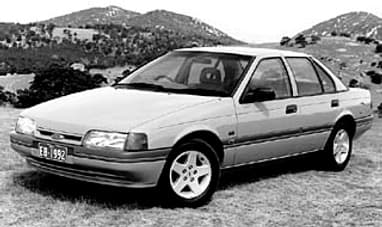
Ford Falcon 1992 Problems

Are you having problems with your 1992 Ford Falcon? Let our team of motoring experts keep you up to date with all of the latest 1992 Ford Falcon issues & faults. We have gathered all of the most frequently asked questions and problems relating to the 1992 Ford Falcon in one spot to help you decide if it's a smart buy.

Used Ford Falcon review: 1992-2000
By Graham Smith · 21 Oct 2003
Before the hot XR6 was unleashed in 1992, fast Fords were V8-powered. So the six-cylinder sports sedan came as a surprise to everyone. The XR6 was a bent-eight beater, but it was much more than that.  It was not only fast, it also handled beautifully and was comfortable.Had we known then what we later found out about Tickford, now called Ford Performance Vehicles, it wouldn't have been such a surprise.  The EBII XR6 was the first glimpse of Tickford's ability to produce a refined sporting sedan that did everything well.  It had often been the case with Aussie-built muscle cars that power was everything.That relentless pursuit often came at the cost of handling, ride and comfort, but Tickford brought a European approach which balanced power and road manners.  Another surprise came in the styling, which was neat and attractive, without being look-at-me in the way of most other muscle cars.  But if the XR6 was rather reserved in appearance terms, there was nothing reserved about it when it hit the road.THE XR6 was based on the EBII Falcon S, a sportier version of the family four-door sedan.  The engine was the Falcon 4.0-litre single-overhead cam unit, an effective but rather harsh and lumbering lump. But it had come under the spell of the engineers at Tickford Vehicle Engineering, Ford's performance partners who started working with the men from Broadmeadows in 1991.By the time Tickford was finished tinkering with the Falcon's head, cam, valves, valve springs, exhaust system and electronics, the fuel-injected six was slamming out a massive 161kW at 4600 revs and 366Nm at 3650 revs. And all of that while running on regular unleaded.It was enough to have the 1529kg sedan sprinting to 100km/h in 7.5sec. The standing 400m sprint was covered in 15.5sec and it had a top speed of 223km/h.They were numbers that had the V8 brigade looking back in horror, but they didn't tell the whole story, which was that the XR6 had plenty of low-end and mid-range punch which made it very driveable.Gearbox choices were a five-speed manual and a four-speed auto which delivered the power to the live axle LSD rear end running a low 3.45-ratio axle which helped it jump out of corners.Back in 1992 Ford was committed to a live rear axle, but Tickford's engineers managed to tame it quite effectively. The XR6 rode lower and had a package of gas shocks, stiffer springs, larger anti-roll bars front and rear which, coupled with revised front-end settings, made the steering precise and responsive and brought an assured balance to the handling.Despite still having 3.1 turns lock-to-lock, the Falcon could be pointed at corners with confidence it would hold its line right through to the exit. There was still some evidence of the roll oversteer associated with the Ford rear end, but it would quickly settle under power.To match the go power, the XR6 was equipped with decent disc brakes, which worked in tandem with ABS. The XR6's rolling stock consisted of 15-inch five-spoke alloy wheels and 205/65R15 Michelin tyres. It stood out from the Falcon crowd with body-coloured bumpers and mirrors, red rub strip inserts and a small rear wing.Inside there were reshaped sports front seats which were more supportive and comfortable than the regular Falcon ones. They had velour facings, were highlighted with red piping, and there was also a leather-trimmed Momo sports steering wheel and gear shift knob.ALL alloy-headed Falcon sixes have a problem with head gaskets. It's not unusual to blow them at any time, but they seem to be more prone to it from about 80,000km onwards.Cylinder head reco experts say there is a problem with coolant circulation, which leads to a steam pocket at the rear of the head which can then lead to gasket failure and cracking of the head.Some even relieve the problem by tapping into the head and allowing the coolant to flow from the problem area through an external pipe.  Suspension bushes can be a problem at higher mileage, and require replacement to restore the XR6's renowned handling.Falcon electrics can also be troublesome. Body control modules are a headache and replacements are expensive, so check the system's operation as thoroughly as you can.  Engine oil leaks are also a common problem. Look at the front cover and power steering pump.MARK Harris bought his white XR6 new in 1993 and has driven it sparingly. It has just 51,000km on the odometer and is driven only on weekends, when he enjoys it very much.  Dion Coughlan bought his three years ago when it had done 175,000km. He has added another 80,000km, and says he drives it hard.It has had a near-death experience when it was hit by a bus. Despite a few rattles, Dion says it still performs well. Apart from minor things such as a fan belt, the only things Dion has had to replace are the front suspension bushes.
Read the article
Used Ford Falcon review: 1991-1993
By Graham Smith · 22 Jan 2009
The EB Falcon was a rather minor facelift in the big scheme of things automotive, but it played a key role in keeping Ford at the head of the pack in the early 1990s. Ford was the clear market leader through much of the 1980s and into the 1990s as Holden went about rebuilding its fortunes following a lean patch dating back to the end of the ’70s.But while Ford was in the lead the EB had to regain some of the ground the company lost when the EA, the massive model change that preceded it suffered a series of embarrassing problems.MODEL WATCHThe EB was little changed visually over the EA. About the most significant thing Ford did was to move the blue oval badge from the bonnet to the grille, but the EA was an attractive sedan at the time. Its proportions were balanced and it had clean lines that were both sleek and aerodynamic.There was lots of speculation about Ford’s plans for the EB in the lead-up to the 1991 launch, much of which proved to be way off the mark.There was no independent rear suspension as was predicted, Ford instead stuck with the tried and true live rear axle with Watts linkage while tinkering with the suspension in detail to sharpen the handling.Uprated springs, gas shock absorbers, along with negative camber and increased castor at the front, made a measurable improvement to the handling.It seems Ford was awakening from the performance slumber it had slipped into in the 1980s and there was a significant change in the company’s approach to the Falcon in the EB.Most notably it saw the return of the V8 for the first time since 1983. Unlike Holden Ford dropped the V8 engine as sales of the big engine slumped, but the Falcon’s image had suffered as a result, which hastened its return.This time it was a 5.0-litre Windsor small block engine fully imported from the USA. With fuel injection the pushrod engine managed to pump out 165 kW at 4500 revs and 388 Nm at 3000 revs.While the V8 was an image engine the main engine choice was the 3.9-litre single overhead camshaft six-cylinder engine introduced with the EA model.There were two versions available, the entry level had throttle body injection (TBI), but was rather confusingly called EFI, the other had multipoint fuel injection and was tagged MPFI.The TBI engine put out 120 kW at 4250 revs and 311 Nm at 3250 revs, while the MPFI engine made 139 kW at 4250 revs and 338 Nm at 3500 revs.A mid-model EBII upgrade in 1992 saw the MPFI engine become standard across the range and the power climb to 148 kW at 4500 revs and 348 Nm at 3750 revs.Falcon buyers could choose between a five-speed manual gearbox and a locally developed four-speed electronic auto, which had come into play during the life of the EA.Underneath the suspension was the familiar Falcon package of independent front suspension with unequal wishbones and coil springs and a live axle rear end with coil springs and location by a Watts Linkage.The GL provided the stepping off point in the Falcon range; the S was a sporty newcomer while the Fairmont provided the luxury touches. When the EBII arrived the GL became a GLi.IN THE SHOPAll alloy-headed Falcon sixes have a problem with head gaskets. It’s not unusual to blow head gaskets at any time, but they seem to be more prone to it from about 80,000 kays up.Cylinder head reco experts say there’s a problem with coolant circulation through the head, which leads to a steam pocket at the rear of the head that can then lead to a number of problems, including failure of the cylinder head gasket and cracking of the cylinder head itself. Some even relieve the problem by tapping into the head an allowing the coolant to flow from the problem area through an external pipe.There is also a belief that the Falcon’s water pump suffers from cavitation, which diminishes the coolant flow through the engine.Engine oil leaks are also a common problem. Look for leaks from the front cover, power steering pump etc.The Falcon’s auto is a problem. Auto trans experts say the problems are due to insufficient oil capacity in the transmission causing the oil to overheat. Another problem they can suffer from is one caused by small flakes of brass coming adrift in the oil cooler in the radiator; these then block the filters in the transmission, which again causes the oil to overheat.It’s not such a problem in light driving conditions, the trans could last as much as 200,000 km before a rebuild is needed, but add a trailer or some hilly terrain and you could cut the trans life by half. The best solution is to fit an external oil cooler.Suspension bushes can be a problem at higher mileage, and require replacement to restore the Falcon’s handling.Falcon electrics can also be troublesome. Body control modules are a headache and replacements are expensive to replace so check the operation of the car’s system as thoroughly as you can to check that all is well.IN A CRASHAirbags were yet to be deployed on the Falcon so safety is a matter of the basics of body structure, handling, steering and braking.Check the seat belts for wear and tear, and don’t hesitate to replace them if there is any sign of damage. It’s even worth doing that as a precaution.Don’t forget to carefully check the tyres. Worn tyres render other safety systems useless when there’s no grip on the road.LOOK FOR• Clean pleasant lines• Return of the V8• SOHC sixes deliver plenty of zip• Auto trans troublesome• Sixes tend to overheat• Dodgy electrics
Read the article
Used Ford Falcon review: 1992-1993
By Graham Smith · 23 Jan 2009
Before the hot XR6 was unleashed in 1992 fast Fords were V8-powered, so the six-cylinder ‘family’ sports sedan was a surprise to everyone, particularly to those who owned a hot V8. The XR6 was a V8 beater, no doubt about it, but it was much more than that. It was not only fast, it also handled beautifully and was comfortable to boot. Had we known then what we now know about Tickford, now called Ford Performance Vehicles, it wouldn’t have been such a surprise.The EBII XR6 was the first real glimpse of Tickford’s capability to produce a well-balanced and refined sporting sedan that did everything well. It had often been the case with Aussie-built muscle cars that power was everything. The relentless pursuit of power often came at the cost of handling, ride and comfort, but Tickford brought a European approach which balanced power and road manners to produce a truly fast road car that was still comfortable on a long, fast cross country trip.Given Ford’s reliance on V8 power for past performance models, perhaps it was surprising that Tickford relied on Ford’s rather harsh six-cylinder as the XR6’s power source, but then the XR6 was marking out new sports sedan territory and the men behind it were well accustomed to hot sixes from their British background.Another surprise came in the styling, which was neat and attractive, without ever being “look-at-me” in the way of most other Aussie-built muscle cars. But if the XR6 was rather reserved in appearance terms, there was nothing reserved about it when it hit the road where it was a revelation.MODEL WATCHThe XR6 was based on the EBII Falcon S, a sportier version of the family four-door, but was further upgraded with an array of sporty features.The engine was the Falcon 4.0-litre single overhead cam unit, an effective but rather harsh and lumbering lump that was anything but impressive in its normal guise in its everyday Falcon cousins.But this engine had come under the spell of the engineers at Tickford Vehicle Engineering, Ford’s performance partners who’d started working with the men from Broadmeadows in 1991, and was anything but mundane.By the time Tickford was finished tinkering with the Falcon’s head, cam, valves, valve springs, exhaust system, and electronics the fuel-injected six was slamming out a massive 161 kW at 4600 rpm and 366 Nm at 3650 rpm. And all of that while running on regular unleaded.It was enough to have the 1529 kg sedan sprinting to 100 km/h in 7.5 seconds. The standing 400-metre sprint was covered in 15.5 seconds and it had a top speed of 223 km/h. They were numbers that had the V8 road ragers looking back in horror, but they didn’t tell the whole story, which was that the XR6 had plenty of low end and mid-range punch, which made it very drivable.Gearbox choices were a five-speed manual and a four-speed auto, which delivered the power to the live axle LSD rear end running a low 3.45 ratio axle that helped it jump out of corners.Back in 1992 Ford was committed to a live rear axle, but Tickford’s engineers managed to tame it quite effectively with some smart retuning of both ends.The XR6 rode lower and had a package of gas shocks, stiffer springs, a larger anti-roll bar, front and rear, which coupled with revised front-end settings made the steering precise and responsive and brought an assured balance to the handling.Despite still having 3.1 turns lock-to-lock the Falcon could be pointed at corners with confidence it would precisely hold its line right through to the exit. There was still some evidence of the roll oversteer associated with the Ford rear end but it would quickly settle under power and hold a steady line through corners.To match the go power the XR6 was equipped with decent disc brakes at both ends, which worked in tandem with ABS.The XR6’s rolling stock consisted of 15-inch five-spoke alloy wheels and 205/65R15 Michelin tyres.Externally the XR6 stood out from the Falcon crowd with body coloured bumpers and mirrors, red rub strip inserts, and a small rear wing.Inside there were reshaped sports front seats that were more supportive and comfortable than the regular Falcon seats. They had velour facings, and were highlighted with red piping, and there was also a leather-trimmed Momo sports steering wheel and gearshift knob.IN THE SHOPAll alloy-headed Falcon sixes have a problem with head gaskets. It’s not unusual to blow head gaskets at any time, but they seem to be more prone to it from about 80,000 kays up.Cylinder head reco experts say there’s a problem with coolant circulation through the head that leads to a steam pocket at the rear of the head, which can then lead to a number of problems, including failure of the cylinder head gasket and cracking of the cylinder head. Some even relieve the problem by tapping into the head an allowing the coolant to flow from the problem area through an external pipe.There is also a belief that the Falcon’s water pump suffers from cavitation, which diminishes the coolant flow through the engine.Suspension bushes can be a problem at higher mileage, and require replacement to restore the XR6’s renowned handling.Fitting wide tyres can lead to tramlining with the Falcon’s front-end set-up, which can be hard work and annoying so be careful about fitting any tyres other than those originally fitted to the car.Falcon electrics can also be troublesome. Body control modules are a headache and replacements are expensive to replace so check the operation of the car’s system as thoroughly as you can to check that all is well.Engine oil leaks are also a common problem. Look for leaks from the front cover, power steering pump etc.OWNERS’ VIEWSMark Harris bought his white XR6 new in 1993 and has driven it rather sparingly since. It has just 51,000 kays on the odometer and is driven only on weekends when he enjoys it very much.Dion Coughlan bought his XR6 three years ago when it had done 175,000 km. He has added another 80,000 km to it since, and says he drives it “hard”, the way it was meant to be driven. It has had a near-death experience when it was hit by a bus, but despite a few rattles Dion says it still performs better than any Commodore of the same era. Apart from minor things like a fan belt, the only things Dion has had to replace are the front suspension bushes.LOOK FOR:• great performance from Tickford tuned six• precise responsive steering• balanced predictable handling• neat “who me” styling• well equipped sports package• cylinder head problems• dodgy electrics 
Read the article
Which car - Falcon EB or ED?
Answered by Graham Smith · 02 Apr 2010

When it comes to buying old cars I tend to go with the car that is in the best condition and usually the one with the lower odo reading regardless of age. In your case that's the older car, but because it has done a lot less kays it is likely to give you a better run in the long term. Of course the dual-fuel ED will be cheaper to run, but it will take you a year or so to cover the extra $1000 you have to pay for it. The ED was little changed from the EB it replaced; it had better side impact protection and used environmentally friendly gas in the air-conditioning system.

Dashboard fright
Answered by CarsGuide team · 13 Feb 2004

Sounds as if you have an intermittent electrical problem. They're difficult to track down. I assume the brakes were working properly despite the brake fail warning light. It might be worthwhile having an auto electrician check it out.

Go for the xr6
Answered by Carsguide.com.au · 15 Apr 2004

SOUNDS as if you have a nice Fairlane there, Steve, and it seems a shame to sell it when it has such low mileage and is giving you good service. Instead of buying the V8 I'd consider an EB Falcon XR6 because I reckon you'd prefer the performance of that over the Ghia. Sure, the leather and the sports suspension sound great, but the XR6 will eat it for breakfast. Returning to the V8, the Windsor is a good, solid engine that gives little trouble and is good when converted to LPG. As you say, it is all steel, with cast-iron block and heads.

Ford Falcon: Broken air-conditioning
Answered by Carsguide.com.au · 16 Mar 2012

A/C compressors mostly fail because of a lack of lubricant through a loss of refrigerant gas in the system. The gas carries the   lubricant that keeps the compressor and other system components alive. I can't recommend an alternative system that you could turn to for your car, instead I would have the system checked for leaks that might be causing a loss of refrigerant, make sure the system is fully gassed, and check it at least annually.

Falcon's big brake
Answered by Carsguide.com.au · 09 Sep 2004

THE BA's brakes were significantly upgraded form the AUIII. The pads are larger, the disc rotors are larger -- 11 mm at the front and 16 mm at the rear -- and the calipers are 40 per cent stiffer, so many factors are affecting what you feel. That should result, as Ford claims, in better braking performance, increased pad life, reduced fade and more solid pedal feel.

Radiator blockage
Answered by Carsguide.com.au · 31 Mar 2005

I WOULDN'T agree with rodding out the radiator every six months or so, I would rather try to eliminate the problem. If it is casting sand then I would have thought it would have been flushed out by now. Talk to a cooling system/radiator specialist and try to have the sand flushed out. There shouldn't be any affect on the lubrication system.

Ford Falcon and Holden Commodore: Sale figures
Answered by Graham Smith · 15 Feb 2019

The best source of that sort of information is the Federal Chamber of Automotive Industries (FCAI). You could also ask Ford and Holden.

Disclaimer: You acknowledge and agree that all answers are provided as a general guide only and should not be relied upon as bespoke advice. Carsguide is not liable for the accuracy of any information provided in the answers.
Have a new question for the CarsGuide team?
More than 9,000 questions asked and answered.
Complete guide to Ford Falcon 1992
Complete guide to Ford Falcon 1992 CarsGuide Logo
Reviews, price, specs and more