What's the difference?
Without a whole lot of fanfare BMW has slipped yet another model into its Australian line-up.
Sitting alongside existing coupe and convertible variants, the new 4 Series Gran Coupe follows the template established by the previous gen version.
A sports luxury four-door with a sleek, fastback twist, it provides a more adventurous alternative to its close 3 Series cousin.
Offered in three grades, this is the M440i xDrive, the 3.0-litre, six-cylinder, all-wheel drive 4 Series Gran Coupe flagship.
It competes with premium all-wheel drive four-doors like Audi’s S5 Sportback, the Jaguar XF P300 R-Dynamic HSE, and the Mercedes-AMG C 43.
Half a decade on, the current-generation Mazda 3 has weathered a world of change.
Cheap cars have vanished. Electric vehicles are commonplace and the small car class it belongs to has been decimated by SUVs. Big names like the Ford Focus, Holden Astra and Mitsubishi Lancer are history.
But while it looks identical to the car unveiled at the 2018 LA Auto Show, today’s Mazda 3 has also evolved, albeit gently.
Let’s see how competitive the latest and improved (as well as more expensive) version is.
The BMW M440i xDrive Gran Coupe manages to combine sleek design with a fun-to-drive personality and surprising practicality. It’s a rapid premium, four-door, five-seater offering extra flair, and in this part of the market, good value. But more than anything else it’s got a cracking in-line six under the bonnet.
Given how effortlessly it traverses the mainstream and premium small car classes, the Mazda 3 might be the best value small car on the planet.
With racy styling, sports car handling, classy interior presentation and impressive, intelligent efficiency, there’s plenty to sink your teeth into here.
Poor rear vision, a dark back-seat area and smallish boot aside, it doesn’t have any glaring faults.
In a world overrun with SUVs, props to Mazda for evolving the small car so brilliantly to mask a half-decade of existence. Continuous improvements have made the 2024 G25 Evolve SP Vision an essential small car shortlist proposition, regardless of price.
So, how does this four-door 4 Series differ from a four-door 3 Series? The answer is as plain as the nose on this car’s face.
BMW’s head of design, Adrian van Hooydonk, has been expanding the brand’s signature ‘kidney grille’ in every conceivable direction, and this is the much talked about interpretation adorning all 4 Series models (petrol, hybrid and electric) as well as the M3 sedan.
The new Gran Coupe is longer, wider, and taller than the outgoing model, and the track is broader, front and rear. The wheelbase has also been extended, now a whole 5.0mm longer than the 3 Series.
The DRLs and headlight main beams are LED with laser high beams, immense gills square up the edges of the front clip, while a vent and the strake attached to it stand the car apart. Plus, of course, the doors are frameless.
One niggle, though. I’m not in love with the slender door handles. It’s hard to get a good grip on them, especially in the wet.
Standard 19-inch alloy rims are shod with Pirelli P Zero rubber 245/40 fr / 255/40 rr), the roofline slopes distinctly towards the rear, a lip spoiler on the trailing edge of the tailgate is classic BMW, darkened LED tail-lights wrap around the rear corner, and a diffuser-type panel is flanked by large exhaust apertures.
Our car’s ‘Aventurine Red’ finish is a $3850 option, but to my eyes anyway it looks superb.
Exterior trim including the grille frame, front air intake inserts, mirror upper housing, model designation badges, and tailpipe are finished in ‘Cerium Grey’, which I reckon 99.9 per cent of people will see as black.
The interior will be familiar territory for any current BMW owner, the 12.3-inch digital instrument screen sitting in a compact, hooded binnacle, and partnering with a 10.25-inch multimedia display standing proud of the dash above the broad centre stack.
The seats are trimmed in top-shelf leather with blue contrast stitching, plus the grippy sports wheel is also wrapped in genuine hide.
BMW calls the finish on the main buttons and controls ‘Galvanic’ which translates to a slick silver metallic look and feel. Configurable ambient interior lighting is a nice touch, and the broad console enhances the driver-focused feel, with a sprinkling of carbon-fibre around the centre console and dash lifting the sense of occasion.
Overall, the interior feels clean and classy with an obvious attention to detail.
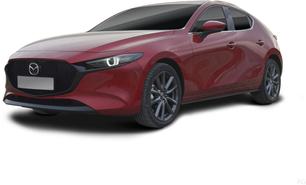
How is it that the current Mazda 3 is already five years old? This hatchback is still stunning, the sort of car you look back at when walking away.
The shape is sleek and almost coupe-like, with a shark-like nose, cab-backward-style long bonnet, upswept shoulder line and a fastback silhouette.
More importantly, it’s the way the light dances across the sculptured sides that draw the eyes in. Bereft of clutter, it makes you wish all mainstream manufacturers had the courage to be so daring.
We’ve said it before – the 'BP'-generation Mazda 3 (Axela in Japan) is the brand’s boldest C-segment hatch since the 1993 'BA' 323 (Astina/Lantis/323F).
But there’s a price to pay for such timeless beauty…
At close to 4.8m long the 4 Series Gran Coupe is a sizeable machine. Up front, the feeling is airy and comfortable, and the rear is surprisingly spacious, especially in light of the car's sloping roofline.
At 183cm I have to fold myself tightly to fit under the low roof, but once inside I have enough room to sit behind the driver’s seat set for my position with more than enough legroom and adequate headroom. Put three full-size adults across the back row, though, and there will be breathing difficulties.
Kids will be fine, however, and individual vents with adjustable temp in the rear was a big plus during a particularly hot test week.
For storage there are generous door bins in the front with room for large bottles, a decent glove box, dual cupholders in the centre console, a reasonable lidded bin (which doubles as a centre armrest), and the wireless device charging bay (forward of the gearshift) makes a handy oddments space when not in use.
In the rear, again the doors feature pockets with room for (medium-size) bottles, there’s a fold down centre armrest with two cupholders, but thanks to the one-piece shells on our test car’s optional M Sport front seats there are no map pockets.
Power and connectivity runs to a USB-A socket and a 12V outlet in the front centre console, as well a USB-C port in the front storage bin, a pair of USB-Cs in the rear, and a 12V outlet in the boot.
Speaking of which, lift the tailgate and with the rear seat upright we were able to fit all three of our suitcases or the beefy CarsGuide pram into the healthy 470-litre (VDA) boot space.
Lower the 40/20/40 split-folding rear seat down and 1290 litres of volume is at your disposal. Plus there are handy bag hooks and tie-down anchors to help secure loose loads.
You can also tow a braked trailer up to 1.8 tonnes (750kg unbraked), but don’t bother looking for a spare of any description, a repair/inflator kit is your only option.
There is a price to pay for all this quasi-coupe styling flair, and that’s a comparatively snug-feeling interior, though you’d never call it cramped.
Actually, the Mazda 3 is no less spacious than most of its competition in all but one area, with enough room even for 200cm drivers, along with sufficient shoulder width and ceiling height to match.
If you’re really tall, maybe that missing sunroof isn’t such a bad thing, after all.
Sat so low-down on cushy, enveloping front seats that offer plenty of comfort and support, this is the anti-SUV. Maybe Mazda should have called this the MX-3.
Sporty and spot-on, the driving position is a laid-back affair, with an emphasis on better ergonomics, as emphasised by the thoughtful placement of switchgear that’s all within easy reach, ahead of a beautifully flowing and layered dash. Proudly Japanese in flavour, it brings to mind functional minimalism.
Drilling into some of the 3’s finer interior details, the analogue-look digital instrumentation is super-legible, ultra-classy and gorgeously lit at night. As previously mentioned, the dials and surrounding air vents are reminiscent of the later Porsche 944 and 968.
It’s not just all for the sake of aesthetics, either.
Yes, it’s lovely, but the thinned-rim three-spoke steering wheel feels great to grip, with nifty little paddle shifters that are a delight to prod.
Same goes for the physical volume knob and climate-control buttons, sidestepping the need to get distracted and frustrated by virtual sub-menus.
And having a conventional gear lever with old-school Tiptronic-style shifts suits the 3’s athletic vibe.
Plus, forward vision is A-OK, ventilation is faultless, storage is better than you might expect, and the fit and finish is as good if not better than any of this 3’s German premium opponents.
Out back, the split-fold rear backrest is set at a comfortable angle, the cushion is well padded, and you’re provided with USB ports, air vents, and an armrest with two cupholders. More thoughtfulness.
But while knee room is fair, rear headroom isn’t great if you’re tall or wear a beehive, as the falling ceiling line reveals.
Vision out is limited by that rising window line and fat pillars. Getting in and out of the back requires some contortionist moves. And the small windows mean it can be gloomier in the back than a Smiths album.
Finally, at just 295 litres, the 3’s cargo capacity is disappointing. Sure, it eclipses the Corolla hatch’s 217L cubby, but other rivals are far larger back there.
At least the floor is wide and flat and there are 60/40-split backrests for cabin access for longer items.
Note that a space-saver spare wheel lurks underneath. Mazda argues there’s always the closely-related CX-30 if you need (slightly) more space (317L).
Meanwhile, at the other end of the 3…
We’re in a zone some way North of $100K here with cost-of-entry running to $115,900, before on-road costs. So, as well as the included powertrain, suspension, and safety tech you should rightfully be expecting a lengthy standard features list.
And the M440i Gran Coupe goes toe-to-toe with its heavyweight Euro competition, featuring three-zone climate control air, adaptive cruise control, ‘Laserlight’ headlights, that 12.3-inch ‘BMW Live cockpit Professional’ instrument display and 10.25-inch ‘Control Display’ multimedia touchscreen managing navigation, the 16-speaker/464W harmon/kardon Surround Sound audio system (with Apple CarPlay and Android Auto integration) and a host of other on-board functions.
There’s also the ‘Vernasca’ Black leather trim, an electric glass sunroof, the leather-trimmed sports steering wheel, the electric sports front seats are heated and there’s wireless charging for compatible devices.
Mazda has rationalised the MY24 3 range, with fewer grades and no more manuals, sadly.
The pretty little piece of automotive industrial design you see here is the mid-range Evolve SP Vision, which sounds less like a car and more like a posh hairdryer from Vidal Sassoon.
Priced from $36,520 before on-road costs (or about $41K drive-away before you start haggling), this Mazda 3 is a sporty and well-equipped alternative to the likes of the speedy Hyundai i30 N-Line Premium, spacious Kia Cerato GT Turbo, new Subaru Impreza AWD 2.0R and evergreen Toyota Corolla ZR. All cost roughly the same money.
The thing is, do Mazda’s upmarket aspirations mean the 3 possesses the ride quality and chic to embarrass at times substantially more expensive hatchbacks with premium pretensions? We’re talking rivals like the BMW 1 Series, Mercedes-Benz A-Class, Peugeot 308 and VW Golf, here.
Stay with us, because we reckon you might be surprised by how far the 3 has come since its humble 323 predecessors.
Anyway, this version comes with most of the good gear, including a full suite of driver-assist safety tech like front and rear Autonomous Emergency Braking (AEB), blind-spot alert, lane-keep assist and adaptive cruise control, as well as keyless start and walk-away lock, powered driver’s seat with memory, 360-degree camera views, a head-up display, digital radio, sat-nav, auto tilt/folding exterior mirrors, dual-zone climate control, Bluetooth phone/audio connectivity and 18-inch alloys.
Oh, and for 2023, an upgraded version introduces a smartphone charger and wireless for the Apple CarPlay/Android Auto function, along with USB-C port access front and rear.
What’s missing at the Evolve SP Vision’s price point? Some mainstream rivals offer leather and a sunroof, available respectively in the more-expensive GT Vision, from $40,000, and flagship Astina grades, from nearly $42,500.
Still, that’s quite a lot of small car for the money, given the quality of the presentation and design. Speaking of which…
Under the bonnet is BMW’s (B58) all-alloy 3.0-litre twin-scroll turbo intercooled, in-line six-cylinder engine, driving all four wheels via an eight-speed automatic transmission and electronically controlled clutch pack, as well as an electronic limited-slip differential at the rear.
It features high-pressure direct-injection and BMW’s ‘Valvetronic’ system managing air flow to the intake side, to produce 285kW at a relatively high 5800-6500rpm. But the big punch is 500Nm of peak torque from just 1900rpm all the way to 5000rpm.
The M440i is also a mild-hybrid with a 48-volt starter motor-generator and supplementary battery able to give an 8.0kW kick at low engine speeds.
When you think about it, shoehorning a big torquey engine in a light and agile small car is a recipe for fun. Ford did just that with the Escort RS2000 in the 1970s… and Mazda’s now an expert at it, too.
The engine in question is the G25, a 2.5-litre four-cylinder naturally aspirated twin-cam petrol engine, delivering 139kW of power at 6000rpm and 252Nm of torque at 4000rpm.
As this Evolve SP Vision hatch tips the scales at 1415kg, it makes for a healthy, and consequently very lively, power-to-weight ratio of over 98kW/tonne.
That’s if you decide to use all the available revs, which the six-speed torque-converter auto makes great use of.
Driving the front wheels, it offers a 'Sport' mode to extend the revs even more, which is keeping in line with this Mazda’s sporty character.
Less so is the company’s decision to ditch the old multi-link independent rear suspension system a few years back for a more prosaic torsion beam arrangement. We’ll get to how that affects ride and handling in a moment.
BMW’s official fuel economy figure for the M440i xDrive Gran Coupe, on the ADR 81/02 - urban, extra-urban cycle, is 8.2L/100km, the 3.0-litre turbo six-cylinder emitting 187g/km of C02 in the process.
Stop/start is standard, and we saw an average of 11.1L/100km over city, B-road and freeway running during a week with the car.
With the 59-litre tank brimmed (with minimum 95RON premium unleaded) that real-world test number translates to a range of around 530km.
Mazda claims the G25 averages 6.6L/100km on the combined cycle… for a carbon-dioxide emissions rating of 154g/km. On a 51L tank, that gives a potential distance of over 940km!
Driven good and hard in our hands, we managed 7.5L/100km, which isn’t bad given the speed and conditions it was subjected to.
Plus, the Mazda’s happy on 91 RON 'standard' unleaded petrol.
BMW says the M440i xDrive Gran Coupe will accelerate from 0-100km/h in 4.7sec, and I reckon the threshold for a properly quick car is sub-five seconds.
The 3.0-litre turbo six develops its peak power of 285kW between a relatively lofty 5800-6500rpm, but the big number is a solid 500Nm punch of pulling power delivered between 1900-5000rpm.
Squeeze the throttle pedal pretty much anywhere in the rev range and the response is glorious. Rapid acceleration accompanied by raucous engine noise and rorty exhaust note (albeit with some synthetic support). Various pops and bangs in the Sport settings add extra entertainment..
The eight-speed auto gets some electric support from the mild-hybrid system to fill the torque gap on up shifts, and the result is a conventional torque-converter transmission that behaves like a dual-clutch.
Shifts are seamless in general driving, and satisfyingly quick in a more aggressive mode, the wheel-mounted paddles dialing up the fun in manual changes.
Suspension is double wishbone front and multi-link rear with the standard ‘Adaptive M Suspension’ built around an adaptive damper set-up.
The change between the ‘Comfort’ setting to the ‘Sport’ or ‘Sport+’ calibration is close to instant and makes a discernible difference, especially in terms of ride comfort.
I found the best ‘Individual Sport’ arrangement to be damping in Comfort, with the steering engine and transmission in Sport. The car flows so beautifully through corners with urgent response from the powertrain.
By all means dial up the suspension if you’re having a real crack, but the car feels superbly balanced, stable and predictable in Comfort (front to rear weight distribution is 50:50).
The electrically-assisted variable-ratio steering is nicely weighted with good road feel, and the grippy sports steering wheel is a nice point of contact.
The xDrive AWD system’s default setting is rear-biased, although it will push most of the drive forward when required. But the RWD feel is unmistakable.
The M440i weighs in at around 1.9 tonnes but feels lighter and more nimble than that figure would typically indicate.
A standard electronically-controlled M Sport limited-slip differential puts the power down confidently. I have a favourite LSD test corner on my regular evaluation drive, a sharply twisting and rising left-hander.
Rolling into it in a low gear before planting the throttle mid-corner, the car simply hunkers down without a hint of fuss (or traction loss) as it rockets out the other side.
Optional M Sport front seats ($2000) provide comfort and firm location in equal measure and in terms of ergonomics BMW knows how to focus on the driver and set-up an efficient environment. Key controls are perfectly positioned and simple to operate.
I have an issue with the ‘Lane Departure Warning’ function, however, which is too quick to intervene and overly intrusive when it does so. I turned the ‘Steering Intervention’ function off. You can dial down steering wheel vibration warnings, too.
The standard M Sport brakes feature big vented rotors front and rear, with fixed four-piston front calipers doing the bulk of the work. They’re strong but don’t bite or release too aggressively. It’s easy to grease in a smooth application.
Ask yourself. What do you want from a new small car?
Since the first Familia of the early 1960s, Mazda’s been at it constantly, through the 1300 and 323 eras and into the modern age of the 3.
The Hiroshima brand knows its stuff. Space, practicality, comfort, ease, reliability and affordability. But a small car has to offer more, specifically in the way it makes the owner feel.
That’s why, while the Focuses, Lancers, Astras and Pulsars are gone, the 3’s still here. And it isn’t just the lush visuals inside and out that are, well, sensory-rich.
As older Alfa Romeo owners know, there’s something special about an engine that sounds alive, and the moment you push the 3’s starter, it purrs into life. That’s the first clue.
Slot the refreshingly old-school lever into Drive, and the G25 leaps into action, and, if you need it to, will keep pulling forward strongly, engine buzzing, like it’s on a mission.
That describes the torquey urge of this big 2.5L four, paired perfectly with the sensibly-geared auto.
We miss Mazda’s magnificent manual immensely, but the 3’s instant response reflects its favourable circa-100kW/tonne power-to-weight ratio.
And, as we’ve harped on in the past, the twin-cam unit’s extra oomph beyond 4000rpm delivers muscular high-speed responses akin to a good turbo – or a great old-school Alfa. You can keep your laggy dual-clutch transmissions, Europe.
Now, sweet, smooth and speedy performance is one thing, but having the chassis tuned with precise and fluid steering for tactile handling, and confident roadholding, backed by nuanced driver-assist and traction controls, are another.
There is a consistent and unifying control to the 3’s linear and forgiving dynamics, reminiscent of past masters like the Focus (and today’s brilliant Peugeot 308) that makes it a joy to drive enthusiastically through fast corners, with the knowledge that it won’t suddenly snap-oversteer and bite an unalert driver back.
For a Mazda, the ride is quiet enough, but there is still some droning transmitted through the cabin, via the Bridgestone Turanza (215/45) tyres, on coarse-chip bitumen surfaces.
And while suspension comfort is pretty impressive for the most part, larger bumps reveal the torsion beam’s limitations, as the car can occasionally thud over them in a way that we remember the multi-link rear end wouldn’t.
Anyway, what we’re saying is that, overall, the 3 Evolve SP Vision is an immersive and interactive driving experience that is right up there with the best of them.
Brawny performance, exquisite agility and a refinement that, collectively, have eluded every small Mazda in living memory until this generation’s 2019 debut. This 3’s right on the money. Still.
Active crash-avoidance tech in the M440i xDrive Grand Coupe is impressive with AEB standard, as well as lots of assistants and warnings, namely: ‘Steering and Lane Control Assistant’, ‘Cross Traffic Warning’ (front and rear), ‘Lane Keeping Assistant’ (with ‘Lane Departure Warning’ and ‘Lane Change Warning’), ‘Crossroads Warning’, ‘Evasion Assistant’, and ‘Parking Assistant Plus’ (including ‘3D Surround View and Reversing Assistant’).
If an impact is unavoidable there are six airbags on-board (driver and front passenger front and side, plus side curtains) as well three top tethers and two ISOFIX positions for child seats in the second row.
Plus an ‘Intelligent Emergency Call’ function automatically dials back-to-base if the car has been involved in a crash, and a comprehensive first aid kit is on-board.
The BMW scored a maximum five-star ANCAP assessment in 2019.
Tested way back when this generation was new in early 2019, the Mazda 3 scored a maximum five-star ANCAP crash-test rating.
On the driver-assist front you’ll find front and rear AEB (with a working range of 40km/h to 200km/h) with pedestrian and cycle detection available between 10-80km/h, while the 'Forward Collision Warning' operates from 40-200km/h.
Blind-spot monitoring, lane departure warning, lane-keep assist, 'Forward Obstruction Warning', rear and front 'Cross-Traffic Alert', 'Secondary Collision', auto high beams, breakaway pedals, adaptive cruise control (with full stop/go functionality and cruising/traffic support), parking sensors front/rear, 360-degree round-view monitor, reverse camera, traffic sign recognition, driver monitor and tyre-pressure monitors are also included.
The lane-keep support systems work between 55-200km/h.
Seven airbags – front, side, curtain and a driver’s knee bag – are fitted, along with anti-lock brakes with 'Electronic Brake-force Distribution', 'Emergency Brake Assist', stability control, traction control, hill-start assist are also fitted, seat-belt pretensioners, and two rear-seat ISOFIX points as well as three top tethers for child seat straps.
The M440i Gran Coupe is covered by BMW’s three-year/unlimited km warranty (including paintwork), as well as 12-year/unlimited km anti-corrosion (perforation) cover.
That’s off the premium market pace now with Genesis, Jaguar, and Mercedes-Benz at five years/unlimited km and Lexus set to join them from January 1st, 2022.
That said, roadside assistance is provided for the duration of the main warranty, but it’s worth noting “rattles and squeaks” are only covered for one year.
Service is condition-based, the car telling you when maintenance is required, and a range of service packages are available. The basic plan covering a 4 Series for five years/80,000km comes in at $1750.
Mazda offers a five-year/unlimited kilometre warranty, with five-years roadside assistance… and that’s nothing special nowadays.
Service intervals are at 12 months or every 15,000km.
A fixed-price service scheme is available, averaging out to $434 annually over the first five years. Mazda shows pricing right up to 16 years and 240,000km on its website.