What's the difference?
Without a whole lot of fanfare BMW has slipped yet another model into its Australian line-up.
Sitting alongside existing coupe and convertible variants, the new 4 Series Gran Coupe follows the template established by the previous gen version.
A sports luxury four-door with a sleek, fastback twist, it provides a more adventurous alternative to its close 3 Series cousin.
Offered in three grades, this is the M440i xDrive, the 3.0-litre, six-cylinder, all-wheel drive 4 Series Gran Coupe flagship.
It competes with premium all-wheel drive four-doors like Audi’s S5 Sportback, the Jaguar XF P300 R-Dynamic HSE, and the Mercedes-AMG C 43.
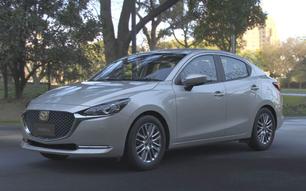
The entry-point into one of Australia's most popular brands has been around for almost 10 years in its current generation, but the Mazda2 has had a refresh.
Possibly for the last time in its current lifespan, the small hatchback gets a facelift to remain appealing, Mazda hopes, to first-car-buyers.
Mazda's up against not only direct rivals, like the Suzuki Swift and Toyota Yaris, but also the shifting market.
Mazda has sold just over 3500 Mazda2s so far this year, but almost 11,000 CX-3 small SUVs, the latter based on our friend here's platform.
It's a name with a little over two decades behind it, but can it be a first-car-favourite in an increasingly difficult small car market?
The BMW M440i xDrive Gran Coupe manages to combine sleek design with a fun-to-drive personality and surprising practicality. It’s a rapid premium, four-door, five-seater offering extra flair, and in this part of the market, good value. But more than anything else it’s got a cracking in-line six under the bonnet.
While Mazda's insistence that the Mazda2 is a 'first-car' could be very limited by the incomes of most teenagers or early-20s city-dwellers, the starting price being close enough to $20,000 for a dynamically enjoyable and convenient small car isn't to be scoffed at.
The new styling of the Mazda2 is well executed, and as an alternative to small SUVs (which continue to become more popular) it's a sensible option, especially considering its efficiency and ease of use.
The lower specifications in the range are probably the best in terms of value, as even the features on the higher grades aren't groundbreaking, and the Pure SP definitely exudes the most style cred.
So, how does this four-door 4 Series differ from a four-door 3 Series? The answer is as plain as the nose on this car’s face.
BMW’s head of design, Adrian van Hooydonk, has been expanding the brand’s signature ‘kidney grille’ in every conceivable direction, and this is the much talked about interpretation adorning all 4 Series models (petrol, hybrid and electric) as well as the M3 sedan.
The new Gran Coupe is longer, wider, and taller than the outgoing model, and the track is broader, front and rear. The wheelbase has also been extended, now a whole 5.0mm longer than the 3 Series.
The DRLs and headlight main beams are LED with laser high beams, immense gills square up the edges of the front clip, while a vent and the strake attached to it stand the car apart. Plus, of course, the doors are frameless.
One niggle, though. I’m not in love with the slender door handles. It’s hard to get a good grip on them, especially in the wet.
Standard 19-inch alloy rims are shod with Pirelli P Zero rubber 245/40 fr / 255/40 rr), the roofline slopes distinctly towards the rear, a lip spoiler on the trailing edge of the tailgate is classic BMW, darkened LED tail-lights wrap around the rear corner, and a diffuser-type panel is flanked by large exhaust apertures.
Our car’s ‘Aventurine Red’ finish is a $3850 option, but to my eyes anyway it looks superb.
Exterior trim including the grille frame, front air intake inserts, mirror upper housing, model designation badges, and tailpipe are finished in ‘Cerium Grey’, which I reckon 99.9 per cent of people will see as black.
The interior will be familiar territory for any current BMW owner, the 12.3-inch digital instrument screen sitting in a compact, hooded binnacle, and partnering with a 10.25-inch multimedia display standing proud of the dash above the broad centre stack.
The seats are trimmed in top-shelf leather with blue contrast stitching, plus the grippy sports wheel is also wrapped in genuine hide.
BMW calls the finish on the main buttons and controls ‘Galvanic’ which translates to a slick silver metallic look and feel. Configurable ambient interior lighting is a nice touch, and the broad console enhances the driver-focused feel, with a sprinkling of carbon-fibre around the centre console and dash lifting the sense of occasion.
Overall, the interior feels clean and classy with an obvious attention to detail.
Aside from the Pure SP, the Mazda2's styling changes are subtle. Mazda's design team aimed to move the model's looks slightly away from the previous ‘premium' chrome-adorned look to a sportier and more ‘aggressive' style.
A redesigned front bumper and mesh grille, with the rear's nip and tuck being more subtle, don't need to do much to keep the hatchback looking fresh. Despite being almost a decade old, the Mazda2 looks, to some extent, like it could be a new generation.
The Pure SP in particular is a highlight, with the blocked grille evoking some ‘electrification' vibes, while the coloured-accent treatment at the front and rear of most variants is a welcome addition for something different.
The range of differing wheels is also a plus point for the Mazda2 range, with each model having its own distinct characteristics.
Inside, the Pure SP also gets a stand-out panel across the dash in a lighter colour like mint, while others get different seat trims and colour accents in places like the vent surrounds.
New colours for the range are 'Aero Grey Metallic' and 'Air Stream Blue Metallic'.
At close to 4.8m long the 4 Series Gran Coupe is a sizeable machine. Up front, the feeling is airy and comfortable, and the rear is surprisingly spacious, especially in light of the car's sloping roofline.
At 183cm I have to fold myself tightly to fit under the low roof, but once inside I have enough room to sit behind the driver’s seat set for my position with more than enough legroom and adequate headroom. Put three full-size adults across the back row, though, and there will be breathing difficulties.
Kids will be fine, however, and individual vents with adjustable temp in the rear was a big plus during a particularly hot test week.
For storage there are generous door bins in the front with room for large bottles, a decent glove box, dual cupholders in the centre console, a reasonable lidded bin (which doubles as a centre armrest), and the wireless device charging bay (forward of the gearshift) makes a handy oddments space when not in use.
In the rear, again the doors feature pockets with room for (medium-size) bottles, there’s a fold down centre armrest with two cupholders, but thanks to the one-piece shells on our test car’s optional M Sport front seats there are no map pockets.
Power and connectivity runs to a USB-A socket and a 12V outlet in the front centre console, as well a USB-C port in the front storage bin, a pair of USB-Cs in the rear, and a 12V outlet in the boot.
Speaking of which, lift the tailgate and with the rear seat upright we were able to fit all three of our suitcases or the beefy CarsGuide pram into the healthy 470-litre (VDA) boot space.
Lower the 40/20/40 split-folding rear seat down and 1290 litres of volume is at your disposal. Plus there are handy bag hooks and tie-down anchors to help secure loose loads.
You can also tow a braked trailer up to 1.8 tonnes (750kg unbraked), but don’t bother looking for a spare of any description, a repair/inflator kit is your only option.
The Mazda2's interior is mostly unchanged through the facelift, with the car's overall dimensions unchanged and not affecting space for its occupants.
Up front, the two seats are comfortable for adults and arm, shoulder, and head room is ample.
Storage space for drinks, phones, or small bags and wallets is sufficient, though not quite road-trip-worthy.
In the rear seats, adults will find enough space to be comfortable for short trips but might get a little restless after a while.
Headroom when sitting upright is tight for anyone around 182cm (six-feet) tall, and a lack of armrest and little storage save for the doors means loose items will be joining occupants on the seat or sitting on the floor.
The Mazda2 has a claimed 250 litres of luggage space in the boot, which is fine for a small hatchback, but short of rivals like the Toyota Yaris' 270L.
We’re in a zone some way North of $100K here with cost-of-entry running to $115,900, before on-road costs. So, as well as the included powertrain, suspension, and safety tech you should rightfully be expecting a lengthy standard features list.
And the M440i Gran Coupe goes toe-to-toe with its heavyweight Euro competition, featuring three-zone climate control air, adaptive cruise control, ‘Laserlight’ headlights, that 12.3-inch ‘BMW Live cockpit Professional’ instrument display and 10.25-inch ‘Control Display’ multimedia touchscreen managing navigation, the 16-speaker/464W harmon/kardon Surround Sound audio system (with Apple CarPlay and Android Auto integration) and a host of other on-board functions.
There’s also the ‘Vernasca’ Black leather trim, an electric glass sunroof, the leather-trimmed sports steering wheel, the electric sports front seats are heated and there’s wireless charging for compatible devices.
Mazda has managed to keep pricing for its entry model relatively low for the segment. In fact, the base Pure in manual form starts from $22,410, before on-roads, and the auto is only $2000 more.
That means at a time when the Toyota Yaris is starting to look more expensive than its historic ‘cheap and cheerful' image allows, Mazda is pushing the Mazda2 to be slightly more premium while keeping its price competitive.
Standard features for the range, which start in the Pure variant, include a 7.0-inch touchscreen with Apple CarPlay and Android Auto capability, plus auto headlights and windscreen wipers.
The Pure SP, which starts at $25,210, gains a different styling kit that adds a body-coloured front panel to the grille, plus a carbon-look roof in vinyl. It also gains the ‘shark-fin' roof aerial.
The Evolve, which starts from $25,910, gains LED DRLs, with the mesh grille replacing the SP's block colour panel.
Its upholstery gets red stitching, plus it's also got a couple more tech additions with Mazda's active head-up driver display, traffic sign recognition and satellite navigation.
Finally, there's the top-spec GT, from $27,610, which gains unique aero-inspired 16-inch alloy wheels, and a set of black leather-upholstered seats with synthetic suede and red trim.
A sedan is available in Pure or GT specification at the same prices and with the same features as the hatch, though you can't get a Pure sedan in manual - that's available in the hatch only.
Under the bonnet is BMW’s (B58) all-alloy 3.0-litre twin-scroll turbo intercooled, in-line six-cylinder engine, driving all four wheels via an eight-speed automatic transmission and electronically controlled clutch pack, as well as an electronic limited-slip differential at the rear.
It features high-pressure direct-injection and BMW’s ‘Valvetronic’ system managing air flow to the intake side, to produce 285kW at a relatively high 5800-6500rpm. But the big punch is 500Nm of peak torque from just 1900rpm all the way to 5000rpm.
The M440i is also a mild-hybrid with a 48-volt starter motor-generator and supplementary battery able to give an 8.0kW kick at low engine speeds.
Mazda's ‘SkyActiv-G' 1.5 litre four-cylinder petrol engine is the unit used for six-speed manual and automatic models, but outputs vary slightly.
Manual cars produce 82kW and 144Nm, while autos deliver a slightly lower 81kW and 142Nm, both driving the front wheels only.
It's pretty much the same engine you used to find in an entry-grade MX-5, just with less power.
BMW’s official fuel economy figure for the M440i xDrive Gran Coupe, on the ADR 81/02 - urban, extra-urban cycle, is 8.2L/100km, the 3.0-litre turbo six-cylinder emitting 187g/km of C02 in the process.
Stop/start is standard, and we saw an average of 11.1L/100km over city, B-road and freeway running during a week with the car.
With the 59-litre tank brimmed (with minimum 95RON premium unleaded) that real-world test number translates to a range of around 530km.
Improved fuel efficiency and lower CO2 emissions come thanks to the automatic's slight drop in power and torque.
Mazda claims a 5.0L/100 km rating for the automatic Mazda2, which is down by 0.3L/100km over the previous version, but the manual's unchanged engine tune burns through the petrol at 5.4L/100km.
Filling the 44-litre tank with at least 91RON or even E10 is fine, and with its auto variant's efficiency rating means the Mazda2 technically has a theoretical range of 880km.
Comparatively the Mazda2 scores well here, the more expensive Toyota Yaris comes with a 4.8L/100km consumption claim with its CVT auto. A Suzuki Swift, with a smaller 1.2-litre engine, also has a 4.8L/100km rating.
BMW says the M440i xDrive Gran Coupe will accelerate from 0-100km/h in 4.7sec, and I reckon the threshold for a properly quick car is sub-five seconds.
The 3.0-litre turbo six develops its peak power of 285kW between a relatively lofty 5800-6500rpm, but the big number is a solid 500Nm punch of pulling power delivered between 1900-5000rpm.
Squeeze the throttle pedal pretty much anywhere in the rev range and the response is glorious. Rapid acceleration accompanied by raucous engine noise and rorty exhaust note (albeit with some synthetic support). Various pops and bangs in the Sport settings add extra entertainment..
The eight-speed auto gets some electric support from the mild-hybrid system to fill the torque gap on up shifts, and the result is a conventional torque-converter transmission that behaves like a dual-clutch.
Shifts are seamless in general driving, and satisfyingly quick in a more aggressive mode, the wheel-mounted paddles dialing up the fun in manual changes.
Suspension is double wishbone front and multi-link rear with the standard ‘Adaptive M Suspension’ built around an adaptive damper set-up.
The change between the ‘Comfort’ setting to the ‘Sport’ or ‘Sport+’ calibration is close to instant and makes a discernible difference, especially in terms of ride comfort.
I found the best ‘Individual Sport’ arrangement to be damping in Comfort, with the steering engine and transmission in Sport. The car flows so beautifully through corners with urgent response from the powertrain.
By all means dial up the suspension if you’re having a real crack, but the car feels superbly balanced, stable and predictable in Comfort (front to rear weight distribution is 50:50).
The electrically-assisted variable-ratio steering is nicely weighted with good road feel, and the grippy sports steering wheel is a nice point of contact.
The xDrive AWD system’s default setting is rear-biased, although it will push most of the drive forward when required. But the RWD feel is unmistakable.
The M440i weighs in at around 1.9 tonnes but feels lighter and more nimble than that figure would typically indicate.
A standard electronically-controlled M Sport limited-slip differential puts the power down confidently. I have a favourite LSD test corner on my regular evaluation drive, a sharply twisting and rising left-hander.
Rolling into it in a low gear before planting the throttle mid-corner, the car simply hunkers down without a hint of fuss (or traction loss) as it rockets out the other side.
Optional M Sport front seats ($2000) provide comfort and firm location in equal measure and in terms of ergonomics BMW knows how to focus on the driver and set-up an efficient environment. Key controls are perfectly positioned and simple to operate.
I have an issue with the ‘Lane Departure Warning’ function, however, which is too quick to intervene and overly intrusive when it does so. I turned the ‘Steering Intervention’ function off. You can dial down steering wheel vibration warnings, too.
The standard M Sport brakes feature big vented rotors front and rear, with fixed four-piston front calipers doing the bulk of the work. They’re strong but don’t bite or release too aggressively. It’s easy to grease in a smooth application.
Our drive loop for the Mazda2's launch included a mix of urban, highway, and rural driving, with varying road quality and conditions.
Fortunately for the little hatchback, it handled everything well or at least at a passing mark, with only a couple of small shortcomings that are common in the segment.
The Mazda2 is a joy to drive in most circumstances, with a lively but confidence-inspiring chassis and controls that give a connected feel to the road.
At low speeds, the Mazda2's relatively low power isn't noticeable, with the gearbox getting things moving at a reasonable pace and the engine is responsive enough with the traditional gearbox helping it along.
It's worth noting that for ultimate control over the drivetrain, Mazda still offers a six-speed manual transmission in the entry-grade Pure, and it's a gem.
Smooth, sporty shifts and well thought out gear ratios mean the manual is easy to handle even in traffic, and the clutch has a forgiving bite point. The 'i-Stop' stop/start system works with the three-pedal car, too, as does cruise control.
In terms of handling and comfort, the Mazda2 is a little shaken by large bumps, though some of the rough surfaces on our test loop were particularly brutal.
Similarly, when pushed hard to conquer steep hills the 1.5-litre engine becomes a little harsh.
On twisty sections the Mazda2 (especially in manual form) provides ample fun while remaining predictable in its steering and chassis feedback, rather than feeling loose.
Active crash-avoidance tech in the M440i xDrive Grand Coupe is impressive with AEB standard, as well as lots of assistants and warnings, namely: ‘Steering and Lane Control Assistant’, ‘Cross Traffic Warning’ (front and rear), ‘Lane Keeping Assistant’ (with ‘Lane Departure Warning’ and ‘Lane Change Warning’), ‘Crossroads Warning’, ‘Evasion Assistant’, and ‘Parking Assistant Plus’ (including ‘3D Surround View and Reversing Assistant’).
If an impact is unavoidable there are six airbags on-board (driver and front passenger front and side, plus side curtains) as well three top tethers and two ISOFIX positions for child seats in the second row.
Plus an ‘Intelligent Emergency Call’ function automatically dials back-to-base if the car has been involved in a crash, and a comprehensive first aid kit is on-board.
The BMW scored a maximum five-star ANCAP assessment in 2019.
The updated Mazda2 is equipped with the brand's suite of 'i-Activsense' safety tech, which includes 'Smart City Brake Support' for operating forward and reverse, blind-spot monitoring and rear cross-traffic alert.
The Evolve and GT model grades are fitted with traffic sign recognition.
The GT model grade comes fitted with front parking sensors and a set of surround-view parking cameras.
The Mazda2 also features six SRS airbags to cover the driver and front passenger, side airbags, and curtain airbags front and rear. It also has ISOFIX anchor points and top tethers for child seats in the rear.
Mazda isn't going to put the Mazda2 up for a new crash test rating by ANCAP, with the brand telling us the new safety additions bring the car's safety up to date, though its original rating from 2015 was a maximum five stars.
The M440i Gran Coupe is covered by BMW’s three-year/unlimited km warranty (including paintwork), as well as 12-year/unlimited km anti-corrosion (perforation) cover.
That’s off the premium market pace now with Genesis, Jaguar, and Mercedes-Benz at five years/unlimited km and Lexus set to join them from January 1st, 2022.
That said, roadside assistance is provided for the duration of the main warranty, but it’s worth noting “rattles and squeaks” are only covered for one year.
Service is condition-based, the car telling you when maintenance is required, and a range of service packages are available. The basic plan covering a 4 Series for five years/80,000km comes in at $1750.
Mazda offers a five-year/unlimited-kilometre warranty across the range, under which the Mazda2 will be covered. That's on par for the market, although some rivals, like the MG3, come with a seven-year term.
Scheduled servicing costs for the first seven workshop visits range from $334 to $587, and are undertaken every 12 months or 15,000km (whichever comes first).