What's the difference?
That the 2020 Mini Clubman John Cooper Works is the most powerful Mini to have landed in Australia isn’t all that surprising. After all, parent company BMW has squeezed the thumping four-cylinder engine from the M135i under its bonnet, and that thing creates a snarling beast of any vehicle it finds a home in.
What is a surprise, though, is that having now driven this angry, crackling, snarling hot hatch, what with its burbling exhaust and properly rapid acceleration, is that it took Mini this long to get around to doing it.
So does the engine upgrade now put the Clubman JCW on the same pedestal as the best European hot hatches? There's only one way to find out.
Few cars have had the sheer staying power of the Suzuki Swift.
Except for a four-year hiatus as the original Ignis from 2001, the Japanese supermini has been a segment mainstay since 1983, winning over consumers worldwide as an inexpensive, economical and reliable yet fun option in the Toyota Yaris class.
In Australia, its impact has been even more profound, providing Holden with its famous “beep-beep” Barina for two early iterations from 1985, while also introducing us to the pocket rocket decades before the Volkswagen Polo GTI, with the Swift GTi of 1986.
Now there’s this – the sixth-gen model in 41 years if you exclude that Ignis – doing what the little Suzuki has always done: offering buyers a great budget alternative. But this time, in this new-electrification era, where precious few attainable choices remain.
Is it any good? Let’s dive straight in.
The Mini Clubman JCW is quirky in a lot of the right ways, and now has a hard-charging engine to up the adrenalin factor. If you were already sold on the idea of joining the Clubman club, this one will steal your heart more than any other.
So, there you have it. A brief look at the new, sixth-gen Swift.
Better where it needs to be, the supermini survivor still remains competitively priced, with loads of new efficiency and safety tech that buyers will appreciate.
But, most of all, the Suzuki still feels, drives and rewards like the old model used to. It just does so with more sophistication.
As inexpensive city cars continue to fade, the new Swift continues 41 years of providing a fun, affordable and dependable solution, in a vibrant and desirable package.
It's no real secret that earlier iterations of the Clubman were, well, a little challenging on the eye (Mini itself says “It was cool - if you were built that way…").
But this face-lifted version is much easier on the eye, if not as a cute a package as the three-door hatch variants. It's dimensions - long, smooth sides, a squared-off rump and bulging grille - somehow work as one to create car that is undoubtedly unique, but also rather fetching.
Inside, it’s all pretty familiar Mini, what with the circle screens and jet-style switches. And it is a stylish space in the cabin, with a good material mix and the addition of wireless Apple CarPlay and Android Auto making the centre screen far more functional.
The only downside is that, for mine, it favours that style over substance. It’s not the most user-friendly space I’ve ever sat in, though I imagine you’d get a little more used to it the more time you spent in there.
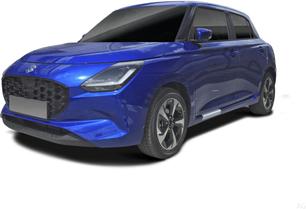
At first glance, the new one looks a lot like the old one. Short overhangs, long wheelbase, upright A-pillars, that signature 'floating' roof. This could be nothing else but a Swift.
Obviously, though, every single panel has changed, resulting in a stronger, quieter and more aerodynamic body.
Helping communicate this is a new and very definite crease line added to create a more-pronounced shoulder. The bonnet seems to be more clamshell-like and the nose is squarer, too. Indeed, everything about the overall styling seems to be more upright.
Debate is already raging in some circles. Is the new Swift too fussy? Too conservative? Has it lost the playful boldness of the proceeding version's gently-sculptured sides and hidden rear-door handles? Are the proportions slightly out now? Has the previous design integrity and oneness of vision been diluted? Does the 2017 predecessor look better?
Underneath, the platform is essentially the same, while overall dimensions are largely identical except for a 20mm stretch and 25mm roof lift. Length, width, height and wheelbase numbers 3860mm, 1735mm, 1520mm and 2450mm, respectively.
Happily, the aesthetic changes inside are likely to please rather than perplex, and even delight rather than divide opinion.
The Clubman is super practical - for a Mini... This is not a Bunnings bandit, and nor will you be piling endless Ikea flatpacks into the boot.
It measures just over 4.2m in the length, 1.4m in height and 1.8m in width, and while they're not massive numbers, you might find yourself surprised by the room in the backset.
I'm around 175cm, and I could sit behind my own driving position with ease - thanks in no small part to the clever scalloped seas that give you extra leg room - and the headroom isn't half bad, either.
Yep, you can definitely fit two adults in the backseat (but never three), and those travelling back there will find air vents to help keep the temp down, as well as USB points and a pair of child seat anchors.
Up front, the cabin somehow manages to feel more cramped, with the steering wheel, centre console and controls on the driver's door all feeling like they're encroaching on your personal space a bit, but it's a comfortable place to sit all the same.
Step around to the barn-door style boot and you'll find what looks a little bit like a station wagon, only without all the space. Yes, it looks like a positive load-lugger next to the three-door hatch, but you still don't get that much space for luggage, with the official number at 360 - 1250 litres.
From a packaging perspective, the latest Swift carries on from before, and that’s no bad thing. It remains exceptionally roomy as well as practical.
To that end, entry and egress are easy, there’s a sense of spaciousness thanks to deep windows, a high ceiling and lofty seating, while the latter also helps provide an agreeable driving position. Storage and ventilation are provided in abundance.
For many people, the dash redesign reflects a big change in attitude, having finally grown up and away from the previous cheap and cheerful look. Highlights include pleasing seat fabrics, interesting textures and a sense of quality craftspersonship, within a stylish and sweeping design. After 41 years, the Swift has matured gracefully.
It’s also worth pointing out the super-clear analogue instrumentation dials, supported by a digital speedo and configurable trip computer data; actual buttons for the heating and air-conditioning system and – joy of joys – a handbrake lever.
Plus, if you want to turn off the various beeps from the driver-assist systems, physical buttons are but a simple press away. No distracting sub-menu searches within fiddly touchscreens here, thanks.
Except if you want to change the volume because you’ll need to prod the screen after all. The knob is always the better option, Suzuki.
What else? The rear bench area is a little plain but surprisingly roomy for this class of light car. Probably more so than a Corolla provided back in the early 2000s, with a decent level of cushy support for two people or three at a squeeze.
Given the extra specification, even the cheapest grade is all the Swift you’ll need. A sign of a democratic car.
But keep in mind the base variant no longer comes with a driver’s seat adjuster, passenger vanity mirror and multiple USB ports found in the Plus and GLX versions, while it is alone with a clammy plastic rather than leather-sheathed steering wheel rim.
At least cargo capacity edges up, by 23 litres to 265L (VDA), and that’s just under the luggage cover, thanks to some clever repackaging of a now-lower boot floor and internal tailgate panels. Drop the rear backrests and that expands to 569L.
Note, however, that for the Swift to achieve its sensationally low kerb weight that starts from just 919kg (up around 50kg), it now uses a fiddly and frankly-inadequate tyre repair kit. Thankfully, Suzuki offers that space-saver spare, at extra cost (and mass) of course.
Still, keeping those kilos low pays high dividends when it comes to performance and economy.
Mini is rolling the dice on a new specification strategy designed to take the endless questions and options out of buying a new car.
And so the Clubman JCW is the first Mini to be offered in the Pure trim ($57,900), which seriously limits the personalisation options to get you out of the dealership and behind the wheel as quickly as possible. You can choose from two wheel choices, four exterior paint choices, a back roof or a sunroof, and, well, that's about it.
Outside, your money buys you 18-inch alloys wrapped in Michelin rubber, adaptive suspension, roof rails and LED head and taillights. Inside, expect cloth sports seats, an 8.8-inch screen that's both (wireless) Apple CarPlay and Android Auto equipped, standard navigation, climate control with rear vents and push-button start.
If the Pure doesn't give you enough options, then the regular Clubman JCW ($62,900) will add 19-inch alloys, leather seats, a 12-speaker Harman Kardon stereo, a head-up display and heated front seats. Oh, and all the personalisation options you shake your credit card at.
So. Why are there so few affordable city-sized superminis like the Swift?
Just 10 years ago, the Swift had at least 25 rivals under $25,000. Today that’s phonetically as well as literally down "t(w)o" "three" – namely, the ageing but still-surprisingly-spry Mazda2 and intriguing all-new MG 3, as well as Australia’s sole sub-$20K new car, Kia's darling Picanto.
Many of the Class of 2014 have since morphed into pint-sized crossover hatchbacks like Suzuki’s soon-to-be-discontinued Ignis, the Hyundai Venue and Kia Stonic. And if you must, there are also the cheerless MG ZS and ancient Mitsubishi ASX biggish-small SUVs – but they’re cheapo for a reason.
Unlike the latest Swift... which, from $24,490 drive-away, is more than reasonably cheap, since it introduces some electrification tech across the whole range, while still being around the same price as the old base GL.
This now makes the new Swift Australia’s cheapest 'hybrid'.
Granted, despite wearing the Hybrid badge on every grade, it’s just a mild hybrid system, but one that provides extra electrification to usefully boost performance and economy for the all-new powertrain and revised transmissions. More on all that later.
What else? The base Swift at last gains LED lights, telescopic as well as tilt steering adjustment and important driver-assist safety like Autonomous Emergency Braking (AEB), along with lane-support systems, adaptive cruise control and rear parking sensors.
Also included now are keyless entry/start, a 9.0-inch touchscreen as part of a new multimedia set-up, wireless for Apple CarPlay (but not for the Android Auto), a digital radio, heated mirrors, traffic sign recognition, auto high beams and an alarm.
And there's more. The entry-level Swift Hybrid is also class unique in offering a manual gearbox. Good on you, Suzuki.
Not for you? Don't worry, because the Hybrid auto that is expected to be the bestseller starts from $26,990, drive-away. For the record, that’s only about $1000 more than the equivalent old version but with all that extra gear to boot.
But, beware, the base-model Hybrid alone lacks a few items that may or may not have been standard in the outgoing Swift, such as a driver’s seat-height adjuster, leather-wrapped steering wheel, privacy glass, alloy wheels, front passenger vanity mirror, front-seat map pockets, multiple USB charging outlets and a spare wheel (though you can pay extra for one as the wheel-well remains).
All of the above, except the missing spare, are included in the new Hybrid Plus auto grade, from $28,490 drive-away, along with heated front seats and additional driver-assist tech like a blind-spot monitor. We’ll get into more detail in the Safety section below.
Finally, there’s the Hybrid GLX auto, with its wireless phone charger, folding exterior mirrors, steering wheel paddle shifters, climate control, glossy alloys and more from $29,490, drive-away.
Sadly, the terrific old GLX 'BoosterJet' three-cylinder turbo is no more, and there might not even be a new Swift Sport to continue the GTi hot-hatch legacy.
Still, Suzuki’s managed to keep the entire range under $30K drive-away, despite big changes inside and out. Let’s check those out.
This is a cracking engine; a twin-charge, 2.0-litre, four-cylinder weapon that sends 225kW and 450Nm thundering to all four tyres.
That power is funnelled through an eight-speed automatic transmission, and will see the Clubman JCW clip 100km/h in 4.9 seconds before pushing on to a 250km/h.
If there’s one area where Suzuki shines, that’s in making sweet little engines, and the new, chain-driven, 1197cc 1.2-litre mild hybrid three-cylinder petrol unit is no exception.
Now, on paper, 61kW at 5700rpm and 112Nm at 4500rpm may seem slightly lacking. A Mazda2 manages to make nearly 35 and 30 per cent more power and torque, respectively.
But the Swift's new 'ISG' integrated starter/generator/electric motor unit delivers an additional 2.3kW and 60Nm.
Combined with the hatchback's comparative lightness, it makes for a sufficient power-to-weight ratio of between 63 and 66kW per tonne.
Or, in other words, it provides some welcome extra low-down muscle.
Drive is naturally sent to the front wheels, via either a light-yet-positive shifting five-speed manual gearbox, or new CVT auto. Both have been heavily revised in their new roles serving the mild-hybrid powertrain.
Mini says its Clubman JCW will sip 7.7L/100km on the combined cycle, and emit some 175g/km of C02.
The latest Swift’s maturity does not end with its suave cabin presentation.
Prioritising high economy and subsequently low pollution, this Euro 6d-rated three-pot hybrid powertrain promises an astonishing combined fuel-consumption average of just 3.8 litres per 100km for the manual, and slightly more for the CVT at 4.0L/100km.
The results are 78 and 80 grams per kilometre of carbon dioxide emissions, respectively, along with around 970km between refills of the meagre 37L fuel tank.
These facts somewhat ease the pain of the need for more-expensive 95 RON premium unleaded petrol instead of the regular brew. High-tech solutions do require superior fuel, after all.
With just 70km on our ultra-tight test car’s odometer, the trip computer’s 6.7L readout is likely no indicator of the frugality we’re expecting to come.
So, how are such low consumption figures attainable? Along with better aerodynamics and a low kerb weight, the latest Swift Hybrid’s ISG hybrid unit generates supplementary electricity under acceleration, to ease the engine’s reliance on petrol.
It also recharges the 12-volt lithium-ion battery that lives beneath the front passenger-seat floor off-throttle via regenerative braking.
Note that the Suzuki never drives purely on electricity.
Yes, this is the most powerful Mini to have landed in Australia. And even better, it’ll remain so, or at least equal first, when the Mini GP arrives next year. That car gets this same thumping engine, and the outputs are the same, though the smaller, lighter hatch will no doubt be faster.
It means Clubman JCW shoppers aren't about to lose their street credit, with this engine likely to remain the king of the castle for some time yet.
The Clubman It might tip the scales at 1550kg, but the kilos don’t hurt its straight line speed much. Whack it in sport mode, which also adds this deep bass to the exhaust, plant your right foot and the Clubman positively pounces forward.
Better still, it feels - and sounds - quick, too, There’s this angry snap and crackle on the overrun, and the exhaust genuinely booms in the cabin when you really bury your foot.
You’ve heard the cliches before, of course, about Minis feeling like they’re on rails, and we won’t waste your time with those here. Suffice to say we have pushed Clubman around some pretty tight corners at some pretty decent speeds, and while it doesn’t feel like a featherweight, it also picks and sticks to a line with absolutely no nonsense from the tyres and very little in the way of body roll.
That’s the good, now the not so good. The impressive handling feels like it’s been achieved by hardening up the suspension as much as possible, and the downside of that is that it can feel plenty sharp and bouncy over big bumps. On the right road, it kind of adds to the experience, but I'd imagine the daily commute would start to fray your patience fairly quickly.
There’s also a kind of skittishness to the way it drives fast too, which I actually don’t mind, but others might say isn’t as natural and flowing as others in the segment.
But this is the hardest, fastest clubman you can buy, and so you’re going into it knowing there’s going to be some comfort compromises. And if you’re looking a loud and rorty hot-hatch experience, this thing delivers in spades.
And on the right stretch of road, it’s an absolute hoot.
No Swift since 2004’s new-millennium redesign has been anything less than fun to punt around. A focus on driving pleasure and superior dynamics has helped make each version a cut-above most rivals.
Losing the smooth old 1.2-litre four-cylinder engine in the name of low consumption and emissions is a noble move. But how does this translate out in the real world, especially with a Swift fan behind the wheel?
It's mostly great, actually.
Losing a cylinder results in a slightly less creamy power delivery, especially as it’s accompanied by a distinctive three-cylinder exhaust-note thrum. But that’s still in keeping with the Swift’s endearingly sporty character.
Better still, even with all the examples we tested showing barely more than delivery mileage on the odometer, there seems to be more than enough grunt to please driving enthusiasts.
While not wanting to tax engines that weren’t even run-in yet, the charming revvy eagerness and instant throttle response remains, along with a discernible extra kick when accelerating away from standstill.
Even being so new, our Swifts proved to be lively, lusty and surprisingly rapid performers. We can’t wait to test run-in examples!
The five-speed manual is deliciously well-oiled and precise, immersing the driver into the Swift experience on another level compared to the CVT auto, which still manages to impress by responding quickly and effortlessly, without feeling laggy or droney. A lot like the old version.
Suzuki is making a lot of noise over how agile yet comfortable the newcomer’s handling and ride qualities are, as a result of improved rigidity and noise-dampening measures.
The Swift’s MacPherson-style front struts and torsion beam rear suspension systems have been revised with stronger and quieter mounts for better performance, while the electric steering has been retuned for greater feel and linearity.
The result? Even our limited time behind the wheel revealed tactile and precise steering, composed handling and extraordinary isolation from the road below for a car barely weighing 950kg (at most).
Combined with the nuanced driver-assist safety tech that rarely interrupted the fun, the latest Swift is a cheerfully animated, nimble and rewarding experience... and one that stands out all the more for evolving while so many other like-minded rivals like the Ford Fiesta have sadly fallen away.
Bravo, Suzuki. Generation Number Six remains the enthusiast driver’s choice, and a hybrid bargain to boot.
The Clubman JCW arrives with six airbags, a reversing camera, AEB, active cruise, forward collision warning and front and rear parking sensors and what Mini calls Performance Control, which it promises will reduce understeer and increase traction in corners.
The Mini Clubman was awarded the full five-star ANCAP safety rating when tested in 2017.
The latest, sixth-generation Swift has yet to be crash-tested by ANCAP.
Even the base Hybrid now includes driver-assist safety like AEB that includes night and day pedestrian and cyclist detection as standard, along with lane-departure warning, lane-keep assist, 'Weaving Alert' (a driver-drowsiness warning prompt), rear parking sensors, traffic-sign recognition, a reverse camera, automatic high beams and adaptive cruise control.
You’ll need to go Hybrid Plus for rear-cross traffic alert and blind-spot warning tech, though.
Note that Suzuki does not supply information about the AEB and other driver-assist tech’s operating parameters.
Also fitted are six airbags (dual front, dual front side and curtain), electronic stability control, anti-lock brakes with electronic brake-force distribution and brake-assist.
The rear seats also contain a trio of child-seat tether anchorages, as well as an outboard pair of ISOFIX attachments.
The Mini Clubman JCW is covered by a three-year warranty, and falls under the BMW group's condition-based servicing program, in that it will tell you when it's time for a service.
Suzuki offers an industry-average five-year/unlimited kilometre warranty and roadside assistance.
Service intervals are every 12 months or 15,000km, while basic capped-price servicing is available, with the website showing pricing for the first five years and 100,000km averaging $391 per workshop visit.