What's the difference?
That the 2020 Mini Clubman John Cooper Works is the most powerful Mini to have landed in Australia isn’t all that surprising. After all, parent company BMW has squeezed the thumping four-cylinder engine from the M135i under its bonnet, and that thing creates a snarling beast of any vehicle it finds a home in.
What is a surprise, though, is that having now driven this angry, crackling, snarling hot hatch, what with its burbling exhaust and properly rapid acceleration, is that it took Mini this long to get around to doing it.
So does the engine upgrade now put the Clubman JCW on the same pedestal as the best European hot hatches? There's only one way to find out.
The smallest car in Skoda’s local line-up is also its most affordable, but only just.
When the current generation Fabia launched with the halo Monte Carlo variant at almost $40,000, it was a bit of a surprise for a small hatch from what’s seen as an affordable brand.
Now, there’s a new entry-level version of Skoda’s bub and, while it’s not nearly as cheap as it once was, it offers a choice that’s more within reach for anyone keen on a premium small car.
Can the Fabia Select convince customers looking at the likes of the Mazda 2 or Suzuki Swift to go Euro and cross the $30,000 threshold?
The Mini Clubman JCW is quirky in a lot of the right ways, and now has a hard-charging engine to up the adrenalin factor. If you were already sold on the idea of joining the Clubman club, this one will steal your heart more than any other.
Once you get past the shock of the Fabia no longer being a sub-$25K car (because let’s face it, what is anymore?), the fact that it remains refreshingly simple to live with and engaging on the road should be celebrated.
It has its downsides if you need space, and you can buy a light (or even small) SUV for the same price, but you’ll be compromising in other areas.
The Skoda Fabia can’t do everything, but what it can, it does well. Plus, it’s certainly less common than the similarly priced Toyota Yaris.
It's no real secret that earlier iterations of the Clubman were, well, a little challenging on the eye (Mini itself says “It was cool - if you were built that way…").
But this face-lifted version is much easier on the eye, if not as a cute a package as the three-door hatch variants. It's dimensions - long, smooth sides, a squared-off rump and bulging grille - somehow work as one to create car that is undoubtedly unique, but also rather fetching.
Inside, it’s all pretty familiar Mini, what with the circle screens and jet-style switches. And it is a stylish space in the cabin, with a good material mix and the addition of wireless Apple CarPlay and Android Auto making the centre screen far more functional.
The only downside is that, for mine, it favours that style over substance. It’s not the most user-friendly space I’ve ever sat in, though I imagine you’d get a little more used to it the more time you spent in there.
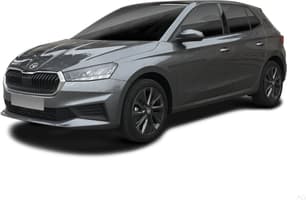
The Fabia’s design hasn’t departed dramatically from its predecessor, but the evolution into the current generation has the little Skoda looking more mature and smoother than before.
Some elements like its grille and headlights are a little sleeker and the car looks less boxy, but still has a unique Skoda design language that’s instantly recognizable.
Its chrome grille trim and its set of unusual 16-inch alloy wheels are the clues that this is the entry Select, plus the lack of much badging.
Inside, the change in generation is most obvious in the step-up in materials and some of the aforementioned tech (screens in particular), though the steering wheel is a carry-over even if it doesn’t look dated.
The new instrument display cowl which features the model name on its side, the round air vents, and the fabric across the dash bring the interior into the current decade, though the centre stack’s modernity is betrayed by climate controls that could have existed in 1998.
There are a fair few hard plastic surfaces, though none of them are in poorly thought-out places and don’t let the cabin down too much.
The Clubman is super practical - for a Mini... This is not a Bunnings bandit, and nor will you be piling endless Ikea flatpacks into the boot.
It measures just over 4.2m in the length, 1.4m in height and 1.8m in width, and while they're not massive numbers, you might find yourself surprised by the room in the backset.
I'm around 175cm, and I could sit behind my own driving position with ease - thanks in no small part to the clever scalloped seas that give you extra leg room - and the headroom isn't half bad, either.
Yep, you can definitely fit two adults in the backseat (but never three), and those travelling back there will find air vents to help keep the temp down, as well as USB points and a pair of child seat anchors.
Up front, the cabin somehow manages to feel more cramped, with the steering wheel, centre console and controls on the driver's door all feeling like they're encroaching on your personal space a bit, but it's a comfortable place to sit all the same.
Step around to the barn-door style boot and you'll find what looks a little bit like a station wagon, only without all the space. Yes, it looks like a positive load-lugger next to the three-door hatch, but you still don't get that much space for luggage, with the official number at 360 - 1250 litres.
There are cars in the market that, for around or not much more than $30,000, seem like a bargain given the perceived value of features like big touchscreens and (synthetic) leather.
The Fabia Select doesn’t have those things, but everything in it makes sense and, more importantly, everything works well.
For example, as much as I point out the dated-looking air conditioning controls, the reality is they're much easier to use than an in-screen menu requiring the same amount of attention as replying to a text while driving - something that is rightfully illegal.
Simple controls on the steering wheel, a touchscreen that doesn’t require much attention, a clear driver display and a few shortcut buttons around the gear selector mean you can focus more of your attention on driving, without lacking any of the convenience or features you’d expect in a new car.
Wireless phone mirroring for Apple CarPlay and Android Auto add to this, as you can bypass Skoda’s (fine, but basic) multimedia software easily.
The lack of wireless phone charging is a shame, but not a deal-breaker, as the space under the centre stack is conveniently sized. The same can’t be said for the tiny storage bin under the centre armrest, though.
However, the glove box and door card storage is generous and there’s the Skoda-standard umbrella in the door that’s accessible when open.
The seats in the Fabia have decent bolstering and are ergonomically sound, manual adjustment is easy enough and there’s a turning wheel rather than a lever with increments to adjust the backrest.
Given the Fabia’s diminutive stature relative to most vehicles on the road, it shouldn’t be a surprise that the back seat isn’t the most spacious. But as an average-sized adult it feels like the kind of space I’d be comfortable in for a short trip, with adequate headroom, knee room and even a vent.
There’s no centre armrest, though, and the seats aren’t as comfortable as the fronts.
Behind the 60/40 split-fold there’s a generous (for a hatch this size) 380-litre boot with bag hooks, though the floor has some mildly intrusive angled plastic elements.
Impressively, the Fabia has a spare tyre rather than a repair kit, so kudos to Skoda for not taking the cheap (and less safe) option.
Mini is rolling the dice on a new specification strategy designed to take the endless questions and options out of buying a new car.
And so the Clubman JCW is the first Mini to be offered in the Pure trim ($57,900), which seriously limits the personalisation options to get you out of the dealership and behind the wheel as quickly as possible. You can choose from two wheel choices, four exterior paint choices, a back roof or a sunroof, and, well, that's about it.
Outside, your money buys you 18-inch alloys wrapped in Michelin rubber, adaptive suspension, roof rails and LED head and taillights. Inside, expect cloth sports seats, an 8.8-inch screen that's both (wireless) Apple CarPlay and Android Auto equipped, standard navigation, climate control with rear vents and push-button start.
If the Pure doesn't give you enough options, then the regular Clubman JCW ($62,900) will add 19-inch alloys, leather seats, a 12-speaker Harman Kardon stereo, a head-up display and heated front seats. Oh, and all the personalisation options you shake your credit card at.
The Skoda Fabia has fallen prey to the same upward-creeping prices as many other light cars have, quite hard.
What was a sub-$25,000 car in its previous generation’s entry grade is now a $32,390 offering, plus on-road costs.
For an entry-level light hatch, the Fabia Select has a decent list of features, though is decidedly more basic than the already-launched Monte Carlo ($39,690 MSRP).
The headline tech features in the base Fabia include an 8.25-inch touchscreen covering multimedia functions, with wireless Apple CarPlay and Android Auto, an 8.0-inch driver display, two USB-C ports, plus drive mode selection and a host of safety features (covered later in this review).
For reference, the Monte Carlo gets a larger 10.25-inch digital instrument cluster and a 9.2-inch multimedia touchscreen.
The Select makes do with manual-adjust cloth seats, but does have keyless entry and start, a leather ‘sports’ steering wheel, automatic windscreen wipers, an auto-dimming rear view mirror and auto LED headlights and LED tail-lights.
Skoda says the Select’s features list aims to line up as “similar to rivals’ mid-specification models” and it’s about bang on. But its price might still be a turn-off for some seeking a budget-friendly light car.
This is a cracking engine; a twin-charge, 2.0-litre, four-cylinder weapon that sends 225kW and 450Nm thundering to all four tyres.
That power is funnelled through an eight-speed automatic transmission, and will see the Clubman JCW clip 100km/h in 4.9 seconds before pushing on to a 250km/h.
The Fabia’s turbocharged 1.0-litre, three-cylinder, petrol engine makes 85kW and 200Nm in this guise, mated to a seven-speed dual-clutch transmission driving the front wheels only.
Given the Fabia weighs 1265kg, getting to 100km/h in under 10 seconds - which it should be able to do, just - might depend on how many passengers you have.
While it’s not very fast or powerful, the Fabia’s outputs sit about average for its class and price.
Mini says its Clubman JCW will sip 7.7L/100km on the combined cycle, and emit some 175g/km of C02.
The Fabia has a 5.0L/100km combined cycle (urban/extra-urban) fuel consumption figure under WLTP testing, with a minimum 95RON premium fuel grade required.
With its 42-litre fuel tank, that means you could hypothetically expect to cover a touch more than 800km before running out of fuel, though that seems unlikely in the real world.
Despite a particularly lively drive undertaken purely for testing purposes, the highest fuel consumption the trip computer displayed was 7.7L/100km, which isn’t so bad when you consider the Fabia’s not likely to be driven hard most of the time.
Yes, this is the most powerful Mini to have landed in Australia. And even better, it’ll remain so, or at least equal first, when the Mini GP arrives next year. That car gets this same thumping engine, and the outputs are the same, though the smaller, lighter hatch will no doubt be faster.
It means Clubman JCW shoppers aren't about to lose their street credit, with this engine likely to remain the king of the castle for some time yet.
The Clubman It might tip the scales at 1550kg, but the kilos don’t hurt its straight line speed much. Whack it in sport mode, which also adds this deep bass to the exhaust, plant your right foot and the Clubman positively pounces forward.
Better still, it feels - and sounds - quick, too, There’s this angry snap and crackle on the overrun, and the exhaust genuinely booms in the cabin when you really bury your foot.
You’ve heard the cliches before, of course, about Minis feeling like they’re on rails, and we won’t waste your time with those here. Suffice to say we have pushed Clubman around some pretty tight corners at some pretty decent speeds, and while it doesn’t feel like a featherweight, it also picks and sticks to a line with absolutely no nonsense from the tyres and very little in the way of body roll.
That’s the good, now the not so good. The impressive handling feels like it’s been achieved by hardening up the suspension as much as possible, and the downside of that is that it can feel plenty sharp and bouncy over big bumps. On the right road, it kind of adds to the experience, but I'd imagine the daily commute would start to fray your patience fairly quickly.
There’s also a kind of skittishness to the way it drives fast too, which I actually don’t mind, but others might say isn’t as natural and flowing as others in the segment.
But this is the hardest, fastest clubman you can buy, and so you’re going into it knowing there’s going to be some comfort compromises. And if you’re looking a loud and rorty hot-hatch experience, this thing delivers in spades.
And on the right stretch of road, it’s an absolute hoot.
If you’re someone who doesn’t need a big car and likes an engaging drive, the Fabia ticks those boxes.
In fact, it feels like it punches above its weight. Well, not literally, because while it actually weighs in at over 1.2 tonnes, it feels lighter than even that.
Tight corners don’t faze the Fabia, and its steering and suspension both feel more dialled-in than a car with 85kW has any right to.
Yep, even though its engine is only slightly more powerful than some budget sports cars from the 1980s it feels peppier than it should.
It has some low-speed hesitancy thanks to its transmission - taking off from a stop sign if you’re not in Sport mode can be annoying - but with shift paddles (or a manual gearbox… ) the Fabia could be a hidden gem for enthusiasts.
Its suspension is firm, but not sharp enough that it allows bumps and rough roads to make their way into the cabin as shocks or rattles, and even holds its own on unsealed surfaces at sensible rural speeds.
The Fabia feels playful even on a commute, and the follow-through from the rear-end on a spirited bit of cornering speaks volumes about its chassis, even in urban driving.
The Clubman JCW arrives with six airbags, a reversing camera, AEB, active cruise, forward collision warning and front and rear parking sensors and what Mini calls Performance Control, which it promises will reduce understeer and increase traction in corners.
The Mini Clubman was awarded the full five-star ANCAP safety rating when tested in 2017.
The Fabia wears a maximum five-star ANCAP safety rating from assessment in 2021, under recent but now-surpassed criteria.
That’s not to say its safety kit is outdated, as occupant protection scored well (58 per cent for adults, 81 per cent for children) while pedestrian and active safety were also adequate (70 ad 71 per cent, respectively).
The Fabia Select comes with autonomous emergency braking (AEB), pedestrian and cyclist detection, multi-collision braking, driver monitoring, lane assist, rear cross-traffic alert and six airbags - though no front-centre airbag.
It also features cruise control, though it’s not adaptive and requires a little more attention than most new cars - not necessarily a bad thing, mind you.
On the road, its safety tech is unobtrusive, leaving you to focus on driving while knowing there are features there to keep you safe should the unexpected happen.
The Mini Clubman JCW is covered by a three-year warranty, and falls under the BMW group's condition-based servicing program, in that it will tell you when it's time for a service.
Skoda offers a seven-year/unlimited kilometre warranty on all its cars, which is becoming more common in the industry but is quite competitive for a European brand.
The Fabia is also able to be covered by a seven-year servicing pack for $3650, that being the total price you’d need to pay for the first seven years of servicing (occurring every 12 months or 15,000 kilometres, whichever comes first). In other words $521 per workshop visit.
Skoda also offers 12 months of roadside assistance from the new vehicle warranty start date, and another 12 months is topped up every time you service with Skoda.