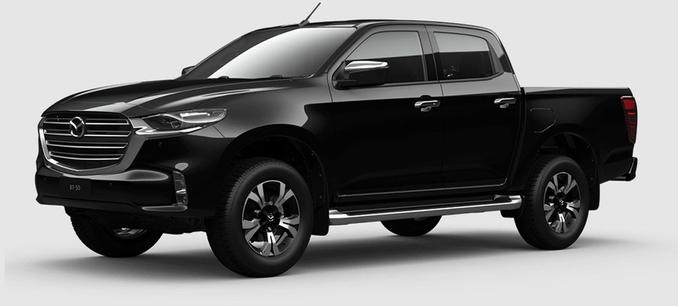
The 2025 Mazda BT-50 range of configurations is currently priced from $36,895.
Our most recent review of the 2025 Mazda BT-50 resulted in a score of 8.6 out of 10 for that particular example.
Carsguide Contributing Journalist Mark Oastler had this to say at the time: The MY25 Mazda BT-50 benefits from its robust Isuzu underpinnings to excel in this dual cab-chassis configuration, particularly with Mazda’s premium heavy-duty aluminium tray as fitted to our test vehicle. Fact is, apart from the big drop in payload required to tow 3500kg (but it’s not alone there) it’s hard to find any major flaws. Overall, it’s an excellent workhorse that would be well suited to a multitude of tradie tasks.Â
You can read the full review here.
This is what Mark Oastler liked most about this particular version of the Mazda BT-50: Five-star ANCAP (2022), Design/build quality, Load-hauling ability
The 2025 Mazda BT-50 carries a braked towing capacity of up to 3500 Kg, but check to ensure this applies to the configuration you're considering.
Mazda offers 15 variants in its BT-50 range. There are five model grades - XS, XT, XTR, GT and SP - which stretch from mid-$30K to past $70K.
The overall level of equipment is high, for example, the entry-level XS is the only one with steel wheels, the rest have either 17- or 18-inch alloy wheels.
The XTR is the sweet spot in the range, with 18-inch alloys, LED front fog lights, daytime running lights (DRLs), side steps, keyless entry, dual-zone climate control, navigation and the pick-up gets a tub liner and tow bar with receiver, tongue and wiring harness.
You might be looking at two distinct issues here. The high idle could be caused by any number of things including a dirty intake system, or something electronic. It could simply be that the idle was set too high the last time the vehicle was serviced.
This may be contributing to the feeling of the engine shuddering when you switch it off, but in reality, a lot of diesel engines exhibit this. It’s all to do with the heavy-duty nature of the diesel engine design. Because of the high combustion chamber pressures inherent in the diesel’s design, the whole thing needs to be more physically robust than a petrol engine of the same size and capacity. That means everything from the crankshaft to the con-rods, pistons and even the cylinder head and crankcase need to be made stronger. And that means more material and that means more mass.
This is why diesels generally don’t rev as high as petrol engines (there’s much more reciprocating mass) and why they can feel a bit lumpy when you load them up and even at idle. So, when you switch one off, it can feel like it’s trying to jump out of the engine bay. However, if this sensation has become more pronounced over the years, it might be wise to check the engine and transmission mounts for wear. Any wear or looseness here can contribute massively to vibrations from the driveline being passed through to the cabin.
Show more
I’d start by talking to a transmission specialist. There’s a fair chance they will have seen these exact symptoms before in this make and model and will know what’s wrong without wasting any time or money on guesswork. It’s probably also worth going back to basics and checking the transmission fluid level, as low fluid can cause all sorts of drive problems. If, on the other hand, the gearbox is worn out internally, you’ll either need to rebuild or replace it, but don’t rule out something less expensive like an internal selector fault or even a torque converter problem.
Show more
This sounds more like a gearbox that isn’t selecting fifth gear properly, rather than one where it’s leaping out of fifth. For it to pop out of gear when cruising along suggests it’s not getting into gear fully in the first place. You might be able to adjust the shifter’s position and alignment and therefore get fifth gear to engage more fully.
There’s also a chance that this refusal to select fifth gear is the result of bent or worn selector forks within the transmission itself, and that’s a gearbox-out job unfortunately. So the first step is to get underneath with a torch while somebody inside attempts to select fifth gear. If the selector linkage runs out of range of motion, you might just have an adjustment problem which can be pretty easily sorted.
Show more
The Mazda BT-50 2025 prices range from $32,560 for the basic trim level Single Cab Xs (4X2) to $76,450 for the top of the range Dual Cab Thunder (4X4).
The Mazda BT-50 is available in seven colours - 'Ice White', 'Geode White', 'Ingot Silver', 'Concrete Grey', 'True Black', 'Sailing Blue' and the new 'Red Earth'. The latter was developed specifically for the new BT-50.
For 2025 the cabin of the Mazda BT-50 was redesigned for a more premium look. There’s a new multimedia system as well as a new digital instrument display on the XTR model and above, with a new 7.0-inch digital display integrated into the dashboard.
The majority of the Mazda BT-50 range is powered by a 140kW/450Nm 3.0-litre four-cylinder turbo-diesel engine, paired with a six-speed automatic transmission with the choice of 4x4 or 4x2.
The entry-grade XS has a 1.9-litre four-cylinder turbo-diesel, which makes 110kW/350Nm, and is also paired with a six-speed auto but only offered with 4x2 drive.
The Mazda BT-50s fitted with the 3.0-litre diesel a 4x4 have a claimed combined fuel economy figure of of 8.0 litres per 100km, while the 4x2 option with the same engine uses 7.7L/100km on selected variants. The entry-grade model with the 1.9-litre engine has a claimed rating of 7.0L/100km.
All BT-50 have a 76-litre fuel tank so the theoretical driving range for the 4x4 models is up to 950km and more than 1000km for the 1.9-litre model.
The 2025 Mazda BT-50 is available as a two-seat single cab and Freestyle cab, or a five-seat dual cab ute.
Mazda doesn't publish a 0-100km/h time for the BT-50, because it's not a performance vehicle.
With the 3.0-litre turbo diesel engine, we'd estimate it should run 0-100km/h in approimately 10 seconds.
The Mazda BT-50 pick-up tray measures 1571mm long, 1120mm wide between the wheel arches, 1530mm wide at the top and 490mm deep.
Payload varies from 1379kg for the XS single-cab down to 924kg for the XTR dual-cab