What's the difference?
The first two things any new starter who arrives in the design department of Jeep’s headquarters in Ohio is told are, 1) The bathrooms are here and, 2) Don’t change the Wrangler.
Okay, I made that up, but it’s probably not far from the truth, because the Wrangler isn’t just iconic for Jeep, but iconic for the entire car world in a similar way to the Porsche 911 and the Ford Mustang.
The Jeep Wrangler is the equivalent of a Hollywood superstar - the Clint Eastwood of the car world - with its design that stretches all the way back to the iconic little off-roader purpose-built for the US Army in World War II.
So, how do you make changes without changing the recipe? Well, the Wrangler has been updated and we went to the Aussie launch to see what’s changed.
The lonely Cadillac Lyriq finally has some company, with the iconic US brand tripling its range down under with the launch of the much bigger Vistiq (which we've already tested) and this entry-level Optiq, which Cadillac describes as the gateway to its electric family.
It's a medium all-electric SUV with plenty of equipment and – depending on whether you see it as an established premium player or another newcomer brand – pretty sharp pricing.
Cadillac says it has the German big three in its sights with the Optiq, so how does it stack up?
The changes to this updated Jeep Wrangler are small but meaningful. The inclusion of airbags, the updated media screen, and a feisty engine which suits the plucky nature of this off-roader make it a better Wrangler than ever.
Note: CarsGuide attended this event as a guest of the manufacturer, with travel, accommodation and meals provided.
A taste test, but so far so good for the Cadillac Optiq, which is already my favourite model in the Caddy range. More space than you think meets a lovely cabin experience and a punchy powertrain.
Note: CarsGuide attended this event as a guest of the manufacturer, with accommodation and meals provided.
Note: The author, Andrew Chesterton, is a co-owner of Smart As Media, a content agency and media distribution service with a number of automotive brands among its clients. When producing content for CarsGuide, he does so in accordance with the CarsGuide Editorial Guidelines and Code of Ethics, and the views and opinions expressed in this article are solely those of the author.
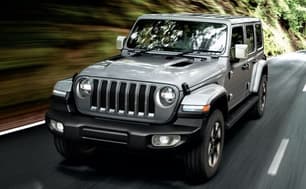
The Jeep Wrangler looks like a cartoon of a four-wheel drive, that’s how familiar and well-known the design is. It’s almost generic, like the word Jeep.
You could say the design is iconic, given that the roots of this SUV stretch back to the little Willys off-roader built for the US army in World War II. And to this day the slotted grille, pronounced wheel guards, short and upright windscreen, even the removable doors are still with us in this latest incarnation.
That’s why each generation of the Wrangler only sees very subtle tweaks to famous shape and look, in much the same way a Porsche 911’s design changes at the rate of dripping water reshaping a rock.
Changing the styling completely would destroy the look which connects the Wrangler to its past and the nostalgic appeal would be over.
So, this update sees more than subtle styling changes in the form of a tweak to the grille with the addition of a metallic-look trim around each of the slots while the mesh insert now has larger openings.
Along with this there’s a new front bumper. The Wranglers we tested had the optional heavy duty steel front bumpers.
There’s also some interior changes in the form of a new dashboard trim, horizontal air vents and then there’s the 12.3-inch media display which goes a long way to making the cabin look more modern.
Still, the interior is busy with buttons and switches in a design that seems to mix the look of heavy machinery controls with a prestige car. The Nappa leather of the Rubicon grade lifts the quality feel higher.
All Wrangler interiors also have an internal roll-over cage which covers the entire cabin, for the fixed metal roof and removable roof body style which are standard on the Overland and Rubicon.
Only the Rubicon is offered in a two-door and a four-door, while the Overland and Sport S are four-door only.
The Rubicon two-door looks cute and fun to my eyes, while the four-door versions look a bit more serious and beefy, but both definitely still give off tough and adventurous vibes.
The wheelbase difference between the two is as giant as it looks. The Rubicon two-door’s wheelbase is 2459mm while the four-door Rubicon’s, along with the Sport S and Overland, is 3008mm.
The Wrangler ranges in length from 4334mm for the Rubicon two-door to 4882mm for the four-door Wranglers. Width is the same for all Wranglers at 1894mm and the height ranges from 1879mm in the Rubicon two-door to 1901mm in the four-door versions.
I really like the exterior of this Optiq, and especially the front-on view, with its vertical DRLs and that bold Cadillac grille delivering real medium SUV street presence.
You could argue the side profile is a little more vanilla (discounting the big wheels, of course), but it looks swept-back and sporty, and not as though it has been designed exclusively for aerodynamics above all else. That's a compliment, not an insult. Cadillac's engineers say every line and crease has been developed to help it slip through the air, but it does it without looking like a science experiment.
The material choices inside are lovely, too. The brand says it has focused on sustainable and recycled materials (the centre console is made from tulip wood and recycled newspaper, for example), but the highlight in my test car was the fabric derived from recycled polyester fabric that lined the door panels and much of the dash. It's a refreshing (and comfy) departure from the norm.
Less positive is the level of Mar-a-Lago bling dotted elsewhere in the cabin, like the chrome ringed centre console and silver-tipped vent controllers. They jar with the otherwise dark, calming and modern-feeling space.
There are physical buttons galore, controlling all your climate settings along with steering-wheel controls as shortcuts for key functions, but there is also still a bit of on-screen action for things like quick access to your driving modes.
The tech looks fab, though, with the curve through the screen looking intentional and elegant and way nicer than the tablets plonked in a lot of EVs these days.
When we review most SUVs practicality is scored on things like legroom, storage space and boot size. But in the case of a vehicle with removable doors and roof, and a cabin that has one-way drainage valves so you can hose the interior out, practicality takes on a different meaning.
The Wrangler’s practicality seems focussed on serving adventurous folks in search of a muddy off-road expedition and, so, while there is storage it’s mainly nets for door pockets, moulded wells on top of the dash, and smaller hidey holes to makes sure loose items don’t get flung around the cabin.
Given the roof can be removed there’s also a lockable glove box and centre console storage box.
When it comes to cabin space the Wrangler’s interior feels a bit cramped. The footwells up front don’t offer much space and headroom throughout is restricted by the roll cage which stretches from the front to the boot.
The four-door Wrangler has five seats and good legroom in the second row, even for me at 189cm tall. As mentioned above, headroom is limited in places because of the safety structure. Boot space behind those rear seats is 898 litres.
The two-door Rubicon has four seats. The back ones aren’t the most spacious and the boot behind them is almost too small to mention at 365L, Two pieces of carry-on luggage wouldn’t fit back there and we had to put our bags on the rear seats.
The rear tailgate for all Wranglers is side-hinged (opening left to right) and splits to allow just the window section or lower part to open separately.
For charging and powering devices all Wranglers have two USB ports up front (one -A and one -C) and four USB ports in the second row (two -A and two -C). There are also two 12V outlets on board (front and rear).
There are two cupholders, seatback map nets and directional air vents for the second row.
The Wrangler sits high and climbing into the rear seats might be a challenge for smaller kids or even fully-grown humans, but there are chunky handholds at the pillars for extra help.
So, the Wrangler has excellent practicality, but this is geared more to its intended purpose of adventuring off-road rather than the city commute and school pick-up.
The Cadillac Optiq is around 4.8m long, 1.9m wide and 1.6m high, which is slightly longer than your average mid-size SUV. And I would argue most of that extra space is located in the back seat, where – at 175cm – I had no problem stretching out behind my own driving position. There was plenty of knee room and, thanks to a virtually flat floor, no bulky tunnel getting in the way for the middle-back rider, either.
Headroom could be a touch more challenging. It was no issue for me, but there wasn't a ton of clear air between the top of my head and the raked roofline, so six-foot-plus passengers might be stooping. Still, if your kids are six-foot-plus, get them into the NBA and have them buy you a car instead.
Elsewhere in the back there are cupholders in the pull-down seat dividers, ISOFIX attachment points in each window seat and twin USB-C ports. There are air vents but no temp controls for backseaters.
The boot is sizable, too, with Cadillac promising 744 litres of cargo space with the rear seats in place and 1603 litres with the rear seats stowed flat. And kudos for not just providing a neat charging cable space under the boot floor, but also giving you a little zip-up suitcase to store it in.
The Jeep Wrangler range comes in three grades. There’s the entry-grade Sport S which can only be had with four doors, the Overland which is also a four-door and the top-of-the-range Rubicon comes as a shorter wheelbase two-door and the four-door.
The Sport S replaces the Night Eagle as the entry-point into the Wrangler range and with a list price of $75,950 it’s $5500 cheaper, too.
Above this is the Overland for $84,950 and at the top of the line-up is the hardcore Rubicon which is $83,950 for the two-door and $90,450 for the four-door.
This update sees all Wranglers now coming with a (damage and scratch-resistant) 'Gorilla Glass' windscreen and a 12.3-inch media screen. But each grade also comes with its own new features.
The Sport S has been given heated front seats, a heated steering wheel and ambient cabin lighting. Meanwhile, the Overland now has power front premium 'McKinley' seats and soft spare tyre cover.
And finally the range-topping Rubicon receives Nappa leather seats and a forward-facing 'Trailcam'.
There are mechanical upgrades across the range, too, especially for the Rubicon and we’ll get to those in the engine and driving sections of this review.
As for the rest of the features, coming standard on the Sport S are LED headlights, 17-inch alloy wheels, proximity key and push button start, sat nav, Apple CarPlay and Android Auto, a nine-speaker Alpine sound system and dark tint windows.
Along with its new features the Overland also comes standard with all of the Sport S’s equipment plus a three-piece removable hardtop, 18-inch wheels and a leather-wrapped shifting knob and hand brake handle.
Then there’s the Rubicon which has all the Sport S features, but 17-inch wheels instead of the 18s and an enormous amount of engineering hardware that makes this grade the off-road king of the Wranglers, which we’ll get to.
The Cadillac range has undergone a pretty epic price repositioning recently. The Lyriq launched in Australia at around $117,000, before on-road costs, but it has been chopped back to $90,000, making room for the flagship Vistiq, which is $116,00, BOC. The Optiq then slots in beneath both, starting at $80K.
Depending on where you see the Cadillac, that can be pretty good value. The BMW iX3 will start at $89,900, the Genesis GV60 is $88,300 and the Lexus RZ – itself the recent recipient of a significant price adjustment – is $84,500.
So, cheaper than those. But the big dog in the fight is still the Tesla Model Y, and you can have an all-wheel drive version of that for less than $70K. Is the Tesla a bona fide premium car? Is the Cadillac? These are questions best left to the buyers of each.
Anyway, the Optiq ditches any single-motor powertrains to launch exclusively in dual-motor, all-wheel drive guise, called the Sport, and you want for little on the equipment list.
That starts outside with cool-looking LED lighting and DRLs, what the brand calls its '3D etched crystal shield' grille, significant 21-inch alloys and a sizeable glass roof with a powered sun shade.
Inside, there's a lovely mix of premium-feeling cabin materials, with seats that offer heating, cooling and a massage function up front, and heating for backseat riders.
There's also dual-zone climate control, ambient interior lighting, a heated steering wheel and wireless device charging.
Tech is a strong point here, with the Optiq's cabin dominated by a massive and curved 33-inch display that stretches from the centre of the cabin to the driver's door and does double duties as your multimedia and driving info screens.
There's wireless Apple CarPlay and Android Auto, too, but the brand is making the biggest deal of the Optiq's stereo, which Cadillac says is unrivalled, and is the result of a five-year partnership with Dolby.
The Optiq gets 19 AKG speakers with Dolby Atmos, effectively the same surround sound developed for theatres, and the brand says listening to Atmos-mastered music (which is most tracks on paid streaming services, apparently) gives you music studio-level audio. So much so, Cadillac says, that producers for Mariah Carey and Fleetwood Mac have purchased models in the Cadillac electric family.
One of the biggest changes Jeep could make to the Wrangler without causing complete mayhem for fans is to the engine and even then there will be folks who don’t like what they’re about to read.
Deep breaths, okay? Right, so, in this update the V6 petrol engine has been replaced by a 2.0-litre turbo-petrol four-cylinder.
At 200kW the new four-cylinder makes a smidge less power than the V6 but more torque at 400Nm. An eight-speed automatic transmission shifts gears and sends the drive to all four wheels.
If you’re a Wrangler fan you’ll most likely know about this engine swap, but you’re wondering how this four-cylinder feels.
The answer is, really good. Jeep has got it right. It’s a torquey, responsive engine that feels energetic and suits the Wrangler's personality well.
In the short time I’ve spent on and off the road I’m convinced this turbo-four will be a good companion wherever you decide to go.
And go pretty much anywhere you can, with all Wranglers being ridiculously capable off-road thanks to their ladder frame chassis, high- and low-range gears, outstanding ground clearance (233mm-257mm, depending on variant ), excellent approach angle (41.4 to 44 degrees, depending on variant) and a departure angle to match (37 degrees for the both Rubicons; 36.1 for the Sport S and Overland).
The Rubicon comes standard with Jeep’s 'Rock-Trac' on-demand four-wheel drive system and this update adds a full float rear axle. Sport S and Overland grades have Jeep’s 'Selec-Trac Active' on-demand 4WD set-up.
There is only one trim level and powertrain on offer in the Optiq, called the Sport AWD, and with it comes dual electric motors – one on each axle – delivering a total 224kW and 480Nm.
That's enough, says Cadillac, to push the Optiq to 100km/h in a hot-hatch-feeling 6.3 seconds and on to a top speed of 210km/h.
The new turbo-petrol, four-cylinder means better fuel economy than the V6 it replaces. We have yet to test Jeep’s claims that after a combination of open and urban roads the four cylinder uses 9.2L/100km in the sport S and Overland grades and 9.9L/100km in the Rubicon.
In comparison, Jeep says the previous V6 uses 10.1L/100km in the Rubicon and 9.9L/100km in the Overland. Our own testing saw consumption closer to 13L/100km.
We’ll have the new Wrangler in our garage soon and we’ll be able to put the fuel consumption claims to a real world test.
In terms of range, the two-door Rubicon has a 61-litre fuel tank and in theory a range of up to 680km. The Sport S and Overland have an 81-litre tank and can get up to 880km, while the four-door Rubicon’s 81-litre tank should manage 830km.
Of course if you’re off-roading you’ll use more fuel and the range will drop accordingly.
The downside of the Cadillac EV experience arrives here, with surprisingly slow charging speeds for a vehicle in this class. Remember, Australia's fastest DC chargers are rated to 400kW, and a vehicle like the BMW iX3 will accept it, taking you from 10 to 80 per cent charged in 21 minutes.
The Optiq, though, is rated to just 110kW, which feels a bit odd. The brand doesn't quote a 10 to 80 per cent time and instead says you'll accrue "up to 94 kilometres of range in 10 minutes".
Still, most people charge at home, and there the Optiq can be plugged into anything from a regular wall socket to a super-fast 22.1kW three-phase AC wallbox.
The brand is promising a total 425km WLTP driving range with a fully charged battery.
Every one of the Jeep launches I’ve attended over the past 15 years has involved a pretty decent off-road component and it’s clear the company has a lot of faith in its product.
This Wrangler launch’s off-road test had been scaled back due to days of flooding rain beforehand, but the section that was passable was enough to remind us of what we already know and that is the Wrangler is formidable.
A Queensland bush off-road course full of steep, muddy hills, ruts, rocks, dirt and slippery descents was still all there for us to test the Wrangler Rubicon four-door.
Fun and comfortable are the first words that pop into my head when recalling how the Rubicon fares. This is a super-capable beastie that feels planted, secure and adept at all times.
We tested low- and high-range four-wheel drive, locked the rear differential and let the hill descent mode do its thing and get us down the sides of hills that felt so close to vertical all we could see through the windscreen was the ground.
What's also clear is the new turbo-petrol, four-cylinder feels well suited to the job, with plenty of torque along with a feisty and responsive nature that fits the Wrangler better than the old V6.
There was also plenty of time spent on the road in the four-door Rubicon and its smaller two-door sibling. And was here it was also super clear the Wrangler felt like we’d taken it out of its natural habitat.
At 110km/h on the motorway the two door Rubicon feels light and floaty in its suspension, with steering adjustments having to be made constantly, like actors pretending to drive cars in movies, as the Wrangler wanders around in its lane. The Wrangler wander is a known trait and isn’t specific to this updated car.
And even though our launch drive took us on some great winding country roads which would have been perfect for a Mazda MX-5, the Wranglers found the fast tight turns difficult to handle.
I’m sure I heard a sigh of relief from our Rubicon as we pulled off the road and selected low-range four-wheel drive before bouncing up what looked to be a sheer cliff, with ease.
Of course, our Adventure Expert Marcus 'Crafty' Craft will put the Wrangler though its paces once we have one in the CarsGuide garage.
First things first, this was a limited test of the Optiq, mostly stop-start Sydney traffic, so you’ll have to wait 'til we get the Caddy through the CarsGuide garage for a full and thorough test for a detailed driving review. But on first impressions, the signs are good for the Optiq.
The power delivery is rich and plentiful, and while it’s not aggressively fast, there’s more than enough punch from the line to get you up and moving in traffic.
It rides well, only feeling a bit brittle over properly rubbish road surfaces, and it offers a refreshing sense of connection to what’s going on beneath the tyres.
The steering can feel a little vague on-centre, however beyond that it feels direct but not darty, with a nice weight to the movement.
The active noise cancellation and sound deadening appear to be doing their roles well, too. I drove past a roadworks site, and most of the drilling occurring outside was banished from entering the cabin. Impressive stuff.
Again, I want to spend more time with the Optiq before passing full judgement, but so far so good – it's my favourite of the Cadillac products to date.
The Jeep Wrangler has a three-out-of-five star ANCAP rating from testing in 2019. This isn’t an adequate safety score for a modern vehicle and the relatively modest advanced safety tech compared to other new SUVs and its structural integrity in crash tests caused ANCAP enough concern to award it lower scores.
Surprisingly the ANCAP report scored its child occupant protection at 80 per cent which is excellent.
This update to the Wrangler now adds curtain airbags which cover the front and second rows. Along with these there are dual front airbags plus safety tech which includes AEB (city and inter-urban) and blind spot warning. There’s also adaptive cruise control and front and rear parking sensors.
For child seats you’ll find two ISOFIX and three top tether mounts across the second row of the four-door variants.
The standard full-sized spare wheel is mounted on the tailgate.
The Cadillac Optiq wears a maximum five-star Euro NCAP safety rating, which will likely translate to an Australian ANCAP five-star score.
The standard inclusions list is long, and probably too laborious to go into in detail here, but things like seven airbags, autonomous emergency braking (forward and reverse), lane centering and pedestrian and cyclist detection are all present and accounted for. The Optiq also has rumblers in the driver’s seat pad, rather than an annoying chime or alarm, which is a far more peaceful way of delivering a safety message.
The Wrangler is covered by Jeep's five-year/100,000km warranty, which is off the mainstream market standard of five years/unlimited km.
Service intervals are recommended every 12 months and 12,000km and service prices are capped at $399. Jeep also offers lifetime roadside assistance if you service your Wrangler though Jeep.
The Cadillac Optiq is covered by the brand's five-year, unlimited-kilometre warranty, which lags the similarly sized and priced Hyundai Ioniq 9 and Kia EV9, but is on par with the Germans. There's also five years of roadside assistance, while the battery is co vered for eight years or 160,000km.
Service intervals are 12,000km or 12 months, and the brand says it is still finalising service pricing, so that’s something to ask about before you commit.
Rather than conventional dealers, Cadillacs are typically sold online with hands-on inspection at 'Experience Centres' - currently one in Sydney and one Melbourne. Service and test drive sites are also in place in Brisbane, Canberra, Adelaide, Perth and Hobart.