What's the difference?
What sets the most iconic Jaguars apart?
Here’s a theory. Consider history’s greatest: the 1948 XK, its 1961 E-Type replacement and the first XJ of 1968. We’re talking about a grand tourer, sports car and luxury sedan respectively that broke ground in each of their segments.
Despite being a sales disappointment, let’s add the 2018 I-Pace to this elite group.
Like the others, it was a pioneer, this time in the luxury electric vehicle (EV) SUV field, beating most competitors and seemingly influencing newer ones ever since, from the excellent Kia EV6 to the coming Mercedes-Benz EQE SUV.
Now, five years and a comprehensive update later, we revisit the 2023 I-Pace to see if it’s still a standout.
MG has been one of the fastest growing brands in the Australian market in the past five years, carving a spot for itself amongst the best-selling names.
But now it’s about to take on arguably its toughest challenge yet - selling a performance car.
MG’s success until now has been built largely on value, with its affordable MG3 and ZS SUV leading the way. The arrival of the all-new, all-electric MG4 XPower means the brand will try its luck at selling cars based on performance, dynamics and an emotional connection.
It’s not the first electric hot hatch in Australia, that distinction arguably belongs to the Cupra Born. But, MG has achieved much higher sales locally than Cupra, making it the first electric hot hatch from a mainstream brand, and that’s why it has the potential to be a game changer for the market.
If the XPower succeeds it will likely reshape the hot hatch market, which until now has been dominated by long-time players and big-name brands, including the Honda Civic Type R, Hyundai i30 N, Toyota GR Corolla and Volkswagen Golf R.
In the 1960s Jaguar used to promote its range as providing “grace, space and pace”. Nowadays, the I-Pace may as well also be known as the I-Grace and I-Space, because all three terms still ring true.
Jaguars were never cheap but the greatest hits felt like exceptional value because they were special. The same applies here. Five years might seem like an eternity, but age has not yet wearied the British luxury EV SUV nearly as much as you might imagine. Especially when optioned up as per our test vehicle.
Bereft of any post-modern brand baggage, the I-Pace remains a modern great. If only more buyers would catch on to that.
The MG4 was a game changing electric car, resetting the price benchmark while also being a very good small car in its own right. But as we discovered when we tested the rest of the range, the MG4 is a car that gets more compelling the cheaper it is. The $38,990 MG4 Excite 51 is arguably the pick of the range given its value equation.
But that’s not to say the MG4 XPower isn’t a good car. It’s a very quick car that will play the role of daily driver and weekend fun machine well. Just not quite as well as its petrol-powered rivals.
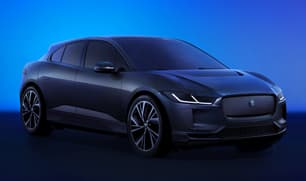
Five years on, from the bold cab-forward silhouette to the high-riding crossover proportions, the I-Pace is a distinctive and handsome machine, offering progressive, flowing aerodynamics that have as much to do with function as they do with form. This is an out and proud EV.
But there’s the rub. Perhaps the disappointing sales reception is down to it being too removed from what many consumers might expect a Jaguar to look like.
Grille-aside, there isn’t enough connection with stablemates like the woefully-underrated XE or F-Pace, while traditionalists – many of them Americans – wanting classic XJ or XK retro schtick are also plum out of luck. Cover the badge and the styling could be from any (forward-thinking) carmaker.
Or maybe it’s because the I-Pace, whose body is 94 per cent aluminium to help offset the weight of the batteries, looks compact in photos, like a crossover hatchback, when in reality it is surprisingly large, belying its sleek styling by packing in plenty of space inside.
Speaking of which, let’s take a closer look.
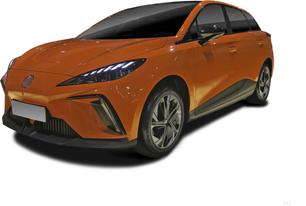
What really stands out about the design is… that not much stands out about the design. At least in differentiating the XPower from the rest of the MG4 line-up.
There are no pumped out wheel arches or a bigger, sportier spoiler that makes it look different in the same way a GR Corolla won’t be mistaken for a regular Corolla hatch.
Instead, the XPower has the same 'Energetic Agile' silhouette and includes the same ‘Active Intake spoiler’ at the front and the ‘Twin-Aero’ rear spoiler that’s the same as the Essence models.
There are some differences though, including more pronounced styling on the sides of the doors. It doesn’t add any performance benefit but creates a slight visual difference between the models in the range.
Surprisingly, there is very little to signify that this is the sportiest XPower model, with a distinct lack of badging - inside and out. In fact, the only visual clue that this is the XPower is on the bright orange brake calipers. Or, to be more accurate, brake caliper covers.
These are just lightweight metal covers that make the MG4 braking hardware look bigger than it really is, so it’s a bit of visual trickery from the MG designers.
Yes, compared to the vast mega screens invading most new models of today, the I-Pace’s dashboard layout is looking, well, off the pace. On first glance at least, this is definitely a product of the previous decade.
But as far as design elegance and functionality are concerned, Jaguar seems to have created a timeless piece of crafted automotive interior architecture that – consequently – holds up very well.
Or, in other words, the I-Pace provides a welcome sanctuary away from the infuriating folly of today’s faddish, fiddly and infuriatingly distracting touchscreen interiors. Maybe some old-school XJ smarts live on in this EV after all.
Look past the dated dashboard design, and the cabin’s overriding impression is of solidity and quality. No cheap plastics or rough surfaces here, just restrained luxury.
While electronic displays with very-analogue-style dial options amid digital driving data take care of the instrumentation ahead of the driver, a modestly-sized touchscreen is set at a lower plain so as to not dazzle and distract the job of vehicle controlling with data-overload, while under that is smaller display for climate control. More on that later.
Part of the Pivo Pro multimedia system, that central touchscreen is switched on and ready for use before the ignition button is even pressed, for immediate action.
No delaying-tactic welcome fanfare as the system boots up as per almost every other carmaker’s set-up, either. Just instant gratification, ironically. This dash is starting to feel like a resto-mod, with all the latest tech behind that Boris-era façade.
Plus, besides being fast, it is logically laid out and avoids confusing sub-menus. Nice swipey action, too. Some familiarisation is required at first, but the system makes sense. And if you need volume adjustability, you turn a physical knob. As the ergonomics lords intended. Easy.
Speaking of which, let’s get the sensible stuff out the way. Because it sits at near-SUV height, the I-Pace is easy to get in and out of as long as you’re aware of the swooping roofline out back. And you sit up high, affording excellent forward vision ahead.
Sinking yourself into the front seats, the Jaguar lives up to its old luxo-barge reputation in that they’re sumptuous yet firm in back-location and support, providing hours of comfort if required.
The driving position is superb, with ample adjustment and those thoughtfully-placed switchgear and controls coming into play.
Storage is ample, with deep door pockets, a sizeable centre console bin and even a secret cubby underneath the rear seat.
The Jaguar provides five USB outlets and two 12V sockets. And ventilation is as effective as you need it to be.
Problems? Pleasingly, our Graz-built Jaguar suffered from no breakages or squeaks. It is as well-screwed together as you’d expect from a luxury SUV, so there are no issues there to moan about.
However, rear vision is poor due to the tapering rear windows and shallow tailgate glass. In turn, the back-seat area can seem a bit dark and hemmed-in without the (optional) fixed glass roof.
The glove box is disappointingly shallow. And, though simple in execution, the climate control can be fiddly to figure out at first.
Of greater concern is the counter-intuitive transmission selection, since the ‘DNRP’ buttons are placed in descending order, putting ‘Drive’ up top and ‘Park’ down at the bottom.
On several occasions, ‘D’ was selected instead of ‘P’ or ‘R’, nearly leading to unintended forward acceleration into parked cars or walls directly ahead.
As mentioned earlier, our test HSE features the optional suede dash and pillar covers; along with the beautiful woven grey flannel-like trim on Alcantara-like seats, they add a distinctive classy ambience – and that’s something that translates out back, too.
While you wouldn’t call it a large wagon, it is more than sufficiently spacious for two adults, while middle-seat space is A-OK for smaller folk only as the ceiling tapers a bit too much for taller passengers. Legroom is exceptional, thanks in part to a stretchy near-3.0-metre wheelbase.
The bench seat itself does not slide or recline, but the 40/20/40-split backrest seems sufficiently angled for comfort and support, while the cushion is sprung enough not to lead to achy thighs, even for longer-legged occupants.
Amenities include rear-facing air vents, a centre armrest with two cupholders, two USB and a single 12V port, overhead grab-handles and reading lights, (quite shallow) door pockets, four coat hooks and some under-seat storage.
Further back, the Jaguar’s boot area is set up high, so requires some lifting to get heavier objects in, but the floor is long and flat, and the overall volume is quite practical. Capacity varies from 656 litres to 1453L with the backrests dropped. You can fit a 1797mm by 1244mm object in two-seater only mode.
There’s storage underneath for charging cables, as well as straps and hooks to secure loose items. And, as mentioned earlier, buyers can order a space-saver spare if the tyre-repair kit is undesirable. Note, too, that a sizeable ‘frunk’ front trunk is good for a couple of soft overnight bags.
Overall, then, equipped as our $180K HSE was, the I-Pace’s interior is likely to impress.
As with the exterior, there’s not a lot to differentiate the XPower from the rest of the line-up. No bright red Civic Type R style interior treatment here. MG has opted to carry over the minimalist design that no doubt contributes to the sharp pricing.
Probably the only notable difference is the seat trim, with the XPower model getting a combination of synthetic leather and suede for a sportier look and feel. But the rest is largely the same, which detracts slightly from its hot hatch credentials.
On the plus side, the MG4 cabin is generally a well-designed interior space, which is a positive for the XPower’s hot hatch argument, as the idea behind the ‘hot hatch’ is that it can be a practical car during the week and fun on the weekends.
There’s good room for passengers and luggage, in large part thanks to the relatively slim battery design that frees up more cabin space. Front seat occupants will enjoy the space and good visibility on offer.
Small item storage is very good in the MG4, with a pair of cupholders, a large, flat lidded tray (with one USB-C and one USB-A outlet just above) and the centre console box all fitting between the front seats.
There’s also a wireless smartphone charging pad that sits halfway up the centre fascia, next to the rotary gear selector, but it’s a shallow space so your phone will almost certainly fly out as soon as you begin cornering vigorously.
However, once again highlighting the ways MG has saved money to keep costs down, the back seat accommodation isn’t anywhere near as well appointed.
While the space is adequate for a small hatch, there are no cupholders, no air-conditioning vents and no fold down armrest for those in the back. All they have access to are some pockets on the back of the front seats, including a pair of small ones high on the seat, seemingly designed to accommodate your smartphone.
In another positive for its hot hatch practicality, there are ISOFIX points on the outer rear seats, neatly covered by leather pieces for a cleaner look when you don’t have kids.
As for the boot, the XPower measures the same 363 litres with the seats up which is unchanged from the rest of the MG4 line-up.
Disappointingly, there’s no obvious place to stow the charging cable, even though it comes in a small, neat bag. This is a worryingly common trend with these early generation EVs that shows a lack of practical thinking from the designers.
The MG4 has no under-bonnet storage either, so it feels like a few wasted opportunities for what is a bespoke EV design.
Unveiled for the 2021 model year elsewhere but finally released just this year in Australia, the updated I-Pace EV400 (denoting the maximum power output in braked horsepower) brings minor visual changes, but more important ones underneath, too.
Most noteworthy are a larger onboard charger (from 7.0kW to 11kW) to substantially increase charging times, an advanced new-from-the-ground-up multimedia system, improved climate control, better surround-view camera options including integration with the rear-view mirror (dubbed 'ClearSight') and wireless charging updates.
They help smother some of the Austrian-built Jaguar EV’s wrinkles against a growing army of fresher alternatives, including the EV6, Audi e-tron (soon to gain the Q8 prefix), BMW iX, Lexus RZ and Mercedes-Benz EQC.
Kicking off from $148,800 (all prices are before on-road costs), the ‘24MY’ (2024 model year) EV400 SE is the latest I-Pace’s opening gambit, though we’re testing the HSE flagship version from $165,600.
Both grades feature an electric motor on each axle for all-wheel drive, a 90kWh battery pack and Jaguar's R-Dynamic pack.
Standard features include LED automatic headlights, electric/heated door mirrors, flush exterior door handles, an acoustic and heat-deflecting windscreen, rain-sensing wipers, keyless entry/start, a rear-view camera, part-leather upholstery, front sports seats with electric adjustment and driver’s side memory plus adaptive cruise control with lane-assist.
There's also dual-zone climate control with remote cabin pre-conditioning, configurable ambient cabin lighting, electronic instrumentation, Bluetooth connectivity, Apple CarPlay/Android Auto compatibility, digital radio, wireless charging, over-the-air updates for the 'Pivo Pro' multimedia system, voice control, a public charging cable, perimeter alarm and three-year subscription to Secure Tracker car finder, a powered tailgate, a bicycle-carrier preparation kit, 20-inch alloy wheels and a tyre-repair kit.
There is no spare wheel fitted but a space-saver is available at extra cost.
Stumping up another $16,800 for the HSE nets you upgrades like leather trim, heated/cooled front seats, heated rear seats, suede headlining, fixed panoramic roof, animated indicators, approach lights in the exterior mirrors, a head-up display (HUD) and different wheels.
On the safety front, both grades feature six airbags and a decent level of driver-assist technologies including autonomous emergency braking (AEB) as expected at this price point. More on those in the Safety section below.
Now, the I-Pace EV400 HSE R-Dynamic we tested was a 23MY model, which differs from the above in that it started from over $5000 less at $160,217, but isn’t as well equipped as the 24MY.
It also included a number of options that bumped the price up to a tad under $180,000, starting with the $5008 'Premium Black Pack', ushering in air suspension, a rear spoiler, black exterior trim highlights and 22-inch glossy black alloys.
Other goodies included a fixed panoramic roof ($3580), adaptive dampers ($2405), four-zone climate control ($1820), carbon-fibre trim finish ($1521), that ClearSight rear-view mirror ($1131), full-colour HUD ($1040), Privacy Glass ($845) and no-cost 'premium textile' (non-animal derived) upholstery.
The point is, to specify your I-Pace to what you see in our images, you’ll need to add nearly $20K to an already hefty starting price.
This is par-for-the-course for most premium brands, though paying extra for cupholders, a HUD and rear-seat climate control when some carmakers include them seems mean at these prices.
While we’ll dive into performance and the headline figures of the XPower soon, there’s another number that’s arguably more impressive - the price.
The MG4 XPower is priced from $59,990 (plus on-road costs), making it only $4000 more expensive than the range-topping MG4 Essence 77.
More importantly, when compared to the likes of the $72,600 Honda Civic Type R, $68,990 Volkswagen Golf R, $64,190 Toyota GR Corolla and $57,990 Subaru WRX tS Sport the XPower is arguably one of the first EVs to achieve true price parity with its internal combustion engine rivals (although the Cupra Born starts at $59,990 so it can argue the same).
Beyond the performance upgrades we’ll detail below, that price brings a well-equipped car.
The XPower comes with 18-inch alloy wheels, LED headlights and tail-lights as well as vehicle-to-load (V2L) functionality.
It also comes with a six-speaker sound system, Bluetooth, navigation, Apple CarPlay and Android Auto, a wireless smartphone charging pad and synthetic leather and Alcantara trim.
There’s the 'MG Pilot' safety package included as standard as well, but we’ll detail that below.
The 'Hunter Green' hero paint colour is exclusive to the XPower in the MG4 range, and is reportedly inspired by an MG land speed record car the legendary Sir Stirling Moss drove in the 1950s.
Built around a standalone architecture with no internal combustion engine versions, the I-Pace EV400 is fitted with two permanent magnet synchronous electric motors – one above the front axle and one located on the rear axle. Each produces 150kW of power and 348Nm of torque, for a system output total of 294kW and 696Nm.
Tipping the scales at 2226kg, this means the EV400 has a power-to-weight ratio of a very healthy 132kW/tonne, helping this electric crossover cross the 100km/h marker in 4.8 seconds, on the way to a top speed of 200km/h.
With a single-speed transmission sending torque to a motor on each axle, the I-Pace has permanent all-wheel drive.
The I-Pace’s standard suspension is double wishbones and coils up front and an integral link independent set-up out back.
Nowadays, the standard wheel size in the SE is 245/50R20, though ours was fitted with 255/40R22 – along with air suspension and adaptive dampers. These profoundly alter ride comfort. Towing capacity is 750kg braked or unbraked.
Ground clearance is usually 174mm, but with the air suspension, that increases to a handy 241mm in its maximum height setting. At speeds over 105km/h I-Paces with air suspension drop a further 10mm to aid efficiency. Which brings us to…
This is arguably the biggest single difference between the XPower and the rest of the MG4 line-up. Unlike the others that have a single, rear-mounted electric motor, the XPower adds a second motor on the front axle.
This has an obvious impact on the performance, boosting it from the previous best of 180kW to an impressive 320kW/600Nm.
Having motors on each axle also means the XPower is all-wheel drive, so it has little trouble transferring all that grunt to the road.
So much so that the MG4 XPower is the equal quickest hot hatch on the market (at the time of publication), taking just 3.8 seconds to run 0-100km/h; matching the Audi RS3, with its turbocharged five-cylinder engine.
With a 400V architecture, the I-Pace EV400 has the charging capability of most EVs, but not the Hyundai Ioniq 5 and 6, Kia EV5, EV6 and EV9, Genesis GV60 and Porsche Taycan/Audi e-tron GT fraternal twins, which have an 800V capability.
Under the floor is a 90kWh lithium-ion battery, with a useable capacity of 84.7kWh.
For AC charging, it uses a Type2 connector with 11kW capacity, or for DC fast charging, it has a maximum 104kW capacity via a CCS port. Both are located in the left-hand-side mudguard.
Jaguar says the official combined average consumption is 23kWh/100km. Our car’s trip computer showed we averaged 24.2kWh/100km.
The WLTP range is 408km, or 446km under the more-lenient NEDC regime. Fully charged, our vehicle indicated 407km of range in normal mode and 415km in 'Eco' mode.
After 345km, our distance-to-empty read 14km, meaning we averaged a very reasonable 359km under absolutely normal urban conditions, with some freeway driving thrown in.
Using a 150kW DC fast charger, we added 200km of range in exactly 30 minutes. It cost us around $31.
For the record, AC charging from empty to full using a regular household socket will take nearly 44 hours, or 13.5hr and just 9.25hr if you have access to a 7kW or 11kW Wallbox, respectively.
Meanwhile, a 50kW DC fast charger needs 75 minutes to go from 10-80 per cent full, or 45 minutes with anything above a 105kW charger, as that’s the Jaguar’s maximum capacity.
Interestingly, the XPower is not fitted with the biggest battery in the MG4 range, forgoing the 77kWh version in favour of the 64kWh option.
In the ‘standard’ rear-wheel drive MG4 Excite 64 model this battery can provide up to 450km of range (on the WLTP cycle) but in the XPower that figure is reduced to 400km.
While that’s well short of the 530km offered by the long-range Essence 77 model, it’s still a respectable amount of driving range and should suit your typical hot hatch buyer, who knows performance typically comes at the expense of efficiency.
Our test drive was limited to just two days, so we didn't have the chance to live with the XPower for an extended period, but it managed to make it this reviewer’s preferred hot hatch playground on the edge of the city and back again to home with more than 50 per cent of the battery charge remaining.
This was a trip that included a lot of urban driving, some highway and then some ‘spirited’ running on the twisty road, so there’s enough range from the XPower to meet most buyers' needs.
Across almost seven hours of driving, the MG’s trip computer was claiming an average energy use of 18.6kWh/100km. To replenish the batteries, a 140kW DC charger will take just 30 minutes to take them from 10 to 80 per cent.
The V2L is another nice addition, which allows you to draw power from the battery, if needed, to run small electrical appliances.
The XPower is hardly a car for camping but, for example, if you decided to take it to a track day and want to plug in a kettle to make a hot drink, you can literally plug it into the car. Handy!
One of the great EV questions is just how premium brands like Jaguar, BMW and Mercedes-Benz can justify their higher prices, when comparatively inexpensive alternatives from BYD, Hyundai and Kia rely on similar electric motor tech.
Indeed, a Tesla Model Y Performance offers the same acceleration and a higher top speed at nearly $100K under our EV400 HSE as tested.
But then you snuggle into that opulent cabin, buckle up, and realise that – just as the original XJ changed big luxury sedans forever back in ’68 with its sophistication and lush ride – the I-Pace still sets the tone for luxury EV SUVs.
Push the D button and – even in 'Comfort' mode – the Jaguar steps off the line briskly. A long-travel accelerator pedal tune disguises the fact that the EV400 is actually sensationally fast, as it swiftly yet silently streaks towards triple digits in no time at all, accompanied by a dull turbine-like drone.
Select 'Dynamic' mode, and the I-Pace’s performance lives up to both the make and model names, offering instant, pinned-back-in-your-seat thrust as well as ample muscle as it glides along.
Flex your right foot and you're already tailgating Mercedes AMG and BMW M-Sport SUVs in no time. Immediate, addictive speed.
A low centre of gravity; that double wishbone and multi-link suspension layout; near 50/50 weight distribution – we’re expecting something special here, and happily, the I-Pace as optioned up with air suspension, adaptive dampers and 22-inch wheels refuses to disappoint.
The sheer urgency from the twin electric motors is matched by reassuring grip and control, even over the rain-soaked hills we belted along.
Beautifully weighted steering, offering lots of road connection, adds to the sense of confidence and calm, as the Jaguar handles corners with a flat, contained composure.
It’s only when you’re really fanging it through tight and twisty turns that this EV SUV starts to feel its considerable mass.
Keep in mind that our HSE included the optional air suspension and adaptive dampers, because together they provide impressive suppleness and sweet isolation (in Comfort mode, obviously) to go with the I-Pace’s unassuming agility.
They allow for those oversized alloys to swell out the arches without resulting in a ruinous ride – something you’d get a taste of if you switch to Dynamic mode, where everything stiffens up noticeably.
Thus specified, we’d imagine the softness would be well off the scale on the standard 20-inch rubber.
As tested, our HSE is one of the most enjoyable luxury SUVs to drive and travel in at speed, regardless of what sort of fuel you’re using.
Downsides? Around town, the limited side and rear vision mixed with the Jaguar’s two-metre width makes manoeuvring a little daunting at times.
The turning circle is on the larger side. And the traffic sign recognition tech is far from reliable and doesn’t work in concert with the adaptive cruise control so can’t automatically alter speed to what’s signposted.
Yet our biggest gripe is the lack of greater single-pedal braking when lifting off the throttle.
A set of paddles to alter the regeneration braking force as per Hyundai’s set-up would be appreciated.
This is one of the single biggest giveaways to the Jaguar’s advancing years.
Still, as a hushed, refined, comfortable and forcefully quick luxury EV SUV experience, the I-Pace, with the choice options as fitted, remains a fierce opponent against newer alternatives. Especially from behind the wheel.
The real question about the XPower is not if it’s quick, because all EVs and especially those with dual motors tend to be very rapid in a straight line, but how it handles itself on a twisty road.
That’s what separates a good hot hatch from a great one, but it’s also an area EVs have struggled in, because the combination of silence, weight and just the fact they’re new and different tends to mean they lack the driving engagement of more established competition.
Hot hatches also need to play a dual role, as daily transport and weekend fun machine, so that’s another factor to consider.
So, how does the MG4 XPower stack up? Well, the unsurprising news is it’s very, very quick. The acceleration is ferocious and really shoves you back in your seat, leaving you in no doubt that it will leave most of its hot hatch rivals (with the exception of the Audi RS3) in its dust.
When the going gets twisty though the XPower feels like it lets its rivals catch back up. There are different driving modes and switching to ‘Sport’ and reducing the regenerative braking makes a notable difference to the way the XPower handles.
The steering gets heavier and it will roll and coast into corners more like a petrol-powered hatch. It makes for a very competent car, with direct steering and good road holding… but not a great hot hatch.
It lacks the engagement and excitement that the best hot hatches offer. For example, the steering gets heavier in Sport mode, but doesn’t provide any more feedback to the driver. The Bridgestone Turanza tyres do a fine job but they lack the grip of a Michelin Pilot Sport.
The lasting impression on the driver is a car that feels quick but doesn’t leave you wanting more. The best hot hatches make you want to keep on driving and driving, that’s not the case in the XPower.
As a daily driver it’s arguably better than its rivals, though, with quiet, effortless commuting potential thanks to its electric powertrain.
Tested in 2018, the I-Pace scored a maximum five-star ANCAP crash-test rating.
It managed to do well in all four of the independent body's disciplines, especially so for occupant protection at 91 and 81 per cent for adults and children, respectively, while vulnerable road users (cyclists and pedestrians) fared worst with a still-adequate 73 per cent rating.
Six airbags are fitted (dual front, head/side front and head/side rear outboard occupants), along with a raft of driver-assist systems, including AEB, lane-alert, lane-assist, blind-spot monitoring, rear-collision monitor, rear-traffic monitor, adaptive cruise control with steering assist, driver fatigue monitor, tyre pressure monitors, emergency call out and traffic sign recognition with adaptive speed limiter tech.
Note the AEB operates from 5.0km/h to 85km/h, and functions in day and night conditions in all cases including cyclists and pedestrians. The lane support systems operate from 50km/h to 180km/h.
Additionally, you’ll find anti-lock brakes with electronic brake-force distribution and brake-assist, as well as stability and traction controls.
Two outboard rear-seat ISOFIX latches are fitted, along with a trio of top-tether anchorage points for child seats.
No front occupant knee or centre-front airbags are fitted.
There’s the usual passive safety features, including six airbags as well as the required stability controls, anti-lock brakes and the like, however the XPower also comes equipped with the MG Pilot suite of active safety features as standard.
MG Pilot includes autonomous emergency braking, lane keeping assist, lane departure warning, adaptive cruise control, blind-spot monitoring and rear cross-traffic alert.
Thanks to all of this safety gear, the MG4 range was awarded a maximum five-star ANCAP assessment, when it was tested in 2022.
The I-Pace is covered by an industry-average five-year/unlimited kilometre warranty, along with five years of roadside assistance.
Additionally, owners will enjoy five years/130,000km of free scheduled servicing. These are at 12 months or 26,000km.
Jaguar says the EV traction battery is covered by an eight-year/160,000km warranty, with a minimum of 70 per cent state of health.
Like every MG sold in Australia, the MG4 XPower is covered by the brand’s seven-year, unlimited kilometre warranty, which is industry standard for high-volume brands these days.
As for servicing, the intervals are also the same as the rest of the MG4 range, which means a lengthy two years or 40,000km, whichever comes first, between visits to the dealership.
That’s much longer than your typical petrol-powered hot hatch, which has more moving parts that need servicing.
In terms of costs, the XPower is ever-so-slightly more expensive compared to the rest of the MG4 line-up.
A minor service is the same $296 but a major service (which comes every second service) will cost you $962.
But even so, for the first six years you’ll only be up for $1554 in servicing costs, which is comparatively cheap amongst its hot hatch rivals, and only $76 more than you’ll pay for any other MG4.